Kaytlyn Miller has been in National Little Britches Rodeo Association “NLBRA” since she was 7, when she won her first world title in the goat tail pull. That record held as the world record until last year. “I have been roping since I could remember,” said the 15-year-old freshman from Dammeron Valley, Utah. “When I was young, I’d ride anything – strap me on and I’d go for it – sheep, calves, roping steers.” Her ranch upbringing and her love of horses gained her the All Around Title at the National High School Finals Rodeo, as well as the Rookie All Around Title. She is the 2015 NHSFR Breakaway Champion and she just captured the World All Around Champion as well as Goat Tying World Champion at the 2015 NLBFR.
A tomboy at heart, Kaytlyn, known as Kayt, grew up on a ranch on the Arizona strip in Utah. “We pushed cows all the time and I wanted to rodeo competitively. We set barrels up in our back yard like we were going to the NFR,” she said. Roping is her favorite, doesn’t matter what event. “I love having a rope in my hand and to be able to compete with one is awesome.”
She has three younger brothers, 8-year-old Mitchell, and 4-year-old twin brothers Wyatt and Weston, and an older brother, CJ, 19, who is on a mission trip in Boston. Kayt has always been competitive with CJ. “We would bet on everything from roping the dummy to who could be the fastest at taking their boots off or even eating dinner. Whoever lost had to do ten pushups.” As they began winning, they included who could win the most buckles to the list. CJ is the first Miller to serve a mission.
The family is making a major move to a ranch in central Nevada, and Kat will be homeschooled beginning this fall. “It’s right in the middle of nowhere and ten minutes further,” said Heath, her dad, who has been commuting from the ranch to Utah each week for the past three years. The ranch is 86 miles long and 15 miles wide; 600,000 acres, running 1,400 mother cows. They also have roping steers they raise to sell to producers.
The nearest school is 40 miles away and Kayt does not want to take time away from practice to make the daily trip to school. “I wouldn’t get the things done I need to get done,” said the high honor roll student, who enjoys studying government and geography. “I like to learn about other places and the troubles they have.” Her help will be needed at the ranch as well, as the ranch is run by her family and her grandpa. “There are five of us that ride.” She will still travel to Utah to rodeo. “They rodeo on Sunday in Nevada, and we don’t do that. And I want to compete with the people that I’ve started with.”
Heath tries to keep her grounded. “She has to put the time in,” he said. “There’s only one thing that matters and that’s the next one. That’s helped her along the way. She doesn’t get hung up on a bad run. She’s in seven events and that’s the best thing I could have taught her.”
Full story available in our August 15, 2015 issue.
Kaytlyn uses a bra as a blinder for her horse during the NHSFR – JenningsRodeoPhotography.com
Competing in Trail Course at NLBFR – JenningsRodeoPhotography.com
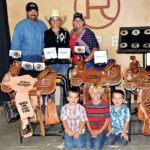
Kaytlyn with dad, mom, and siblings with her awards from NLBFR – JenningsRodeoPhotography.com
courtesy of “Ridin’, Ropin’ & Recipes” by Nancy Sheppard recipes submitted by Linda Griffin Brost: Mollie Griffin’s granddaughter
INGREDIENTS:
1 hen
1 onion
2-3 stalks celery
Salt to taste
(2) 14oz containers frozen red chili puree, such as Baca, thawed
2-3 cups Yellow corn meal
2 cans whole kernel corn
1 can whole black olives
2 sm. cans button mushrooms
Flour
Canola or olive oil
DIRECTIONS:
Boil hen with chopped onion and celery, with salt to taste. Remove chicken, cool, debone and chop.
Reserve broth.
Prepare roux to thicken chili puree into gravy consistency:
4 TBSP canola or olive oil
4 tsp flour
Brown flour in oil and add water to make roux (approx. 1 chili container)
Add 2 containers of defrosted chili to roux and stir
Stir in chopped chicken and simmer
Polenta
2 cans whole kernel corn
2-3 cups yellow corn meal, depending on amount of chicken broth reserved
Add enough cold water to cornmeal to make it pour from bowl. Bring chicken broth to a boil and pour corn meal into broth, stirring constantly until thickened and smooth. Add whole kernel corn and mix.
Pour enough polenta into 9×13” baking dish to cover a depth of approximately 1/3 of the dish.
Reserve approx.. 1 cup to use on top of casserole
Pour chili/chicken layer over polenta layer
Dot the top of the casserole with dollops of the polenta mixture, whole black olives, and button mushrooms,
Bake at 350 degrees for 30 minutes to set.
In 2008, Dustin Hulme and his wife, Alexie, were at a rodeo in West Jordan, Utah. Dustin was roping with his brother trying to help him fill his permit. They won the rodeo, filling his brother’s permit at his first pro rodeo. It was there Dustin saw a PRCA merchandise trailer set up and told his wife, “That looks like a fun job.” Now, less than ten years later, Dustin is the Director of Merchandising for the PRCA.
Dustin grew up in Montpelier, Idaho. One of four boys, Dustin grew up with a rope in his hand. He roped in Junior High and High School rodeo and qualified for the state finals all four years of high school. Dustin also played basketball and football in high school, where he was all state as a defensive tackle the last two years of high school.
Dustin then attended Utah State University where he joined the college rodeo team. He competed in the Rocky Mountain Region in Team Roping and Tie-down Roping for three years. After college Dustin continued to rope at amateur rodeos for a couple of years. Then, in 2006 he bought his PRCA permit and went to pro rodeos in the Wilderness Circuit.
Dustin started his career in western retail in 2003 when he managed a feed and tack store in Layton, Utah. After several years he went to work for Inter-Mountain Farmers Association (IFA) as a Territory Manager over the store managers. Dustin credits that position for propelling him into sales.
After several years at IFA, Dustin decided he wanted to be able to rope and enter jackpots while earning money by selling tack. He started his own business, Travelin’ Tack and had a custom trailer built. He and his wife hit the road and worked at their business for a couple of years.
Through his business, Dustin received an opportunity to work for the PBR as Director of Merchandise, selling merchandise at their events. After a couple of years of being on the road 300 days a year, Dustin accepted the position he now holds with the PRCA.
As Director of Merchandising for the PRCA, Dustin spends most of his time on merchandise for the NFR. He approves and contributes to the design of the clothing sold by the PRCA. He also manages all inventories, in addition to three full-time trailers that set up at PRCA rodeos.
Dustin and Alexie have a 21-month-old daughter, Adri. They live in a small town, Driggs, Idaho, 25 minutes from Jackson Hole. They have nine head of horses and keep a small herd of roping steers.
The Hulmes also operate Teton Valley Rodeo Company and produce rodeos every weekend during the summer months.
COWbOY Q&A
How much do you practice?
Five days a week.
Do you make your own horses?
Absolutely.
Growing up, who were your roping (rodeo) heroes?
Denny Watkins and Dee Pickett.
Who do you respect most in the world?
My wife.
Who has been the biggest influence in your life?
My brother.
If you had a day off what would you like to do?
Spend time with my family and my horses.
Favorite movie?
Lonesome Dove.
What’s the last thing you read?
AQHA Journal.
How would you describe yourself in three words?
Honest, Reliable, Fun.
What makes you happy?
Succeeding at my roping.
What makes you angry?
Whining.
If you were given 1 million dollars, how would you spend it?
Invest every penny into a business that could grow.
What is your worst quality – your best?
Worst quality is being too detail oriented at times. Best quality is I don’t quit until the job is done.
Where do you see yourself in ten years?
With a couple more kids, and continuing to succeed at my current job.
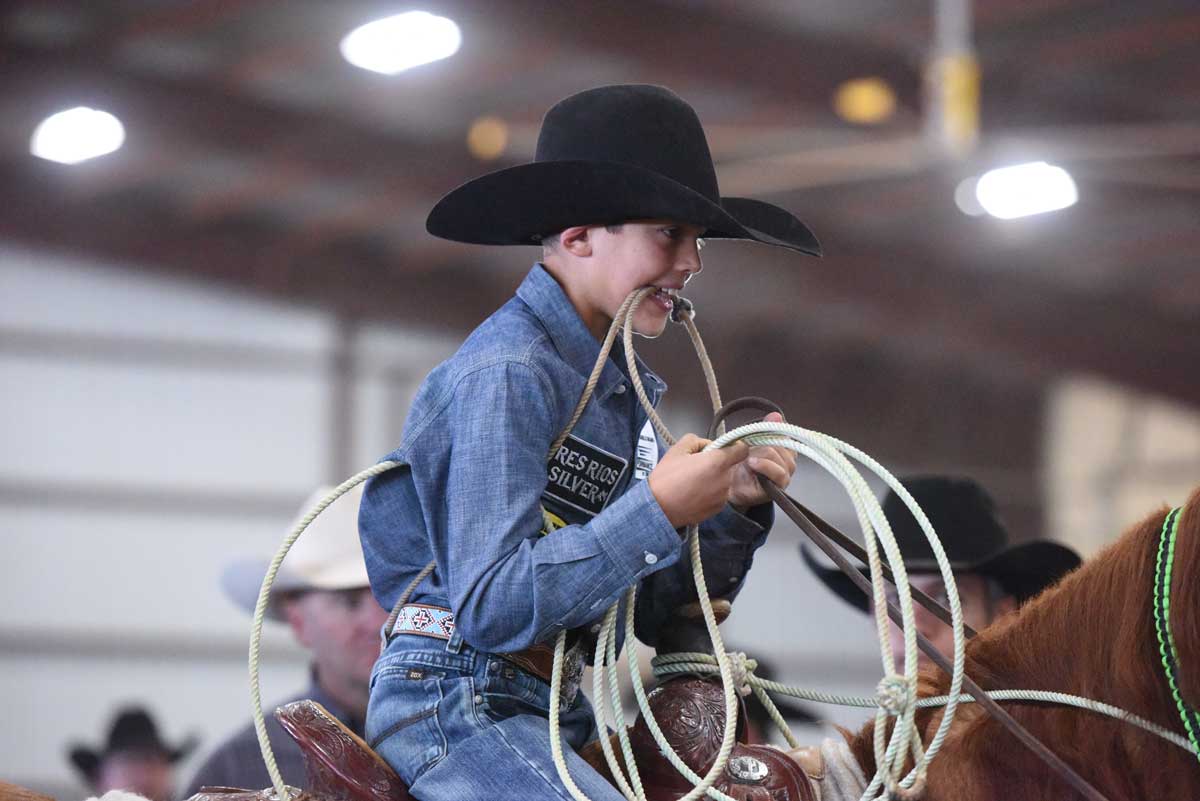
Rodeo is really fun,” states nine-year-old Pecos Tatum. “The harder you practice and the more you do, the more it pays off!” The young cowboy from Llano, Texas, competes in the NLBRA and AJRA. He made the short round in three events in 2013 at the NLBFR. He won three world championships in the AJRA in 2014 in the 8 & Under calf riding, breakaway roping, and all-around cowboy, with a reserve championship in goat tying. Pecos also competes in ribbon roping, double mugging, tie-down roping, and steer riding now that he is older, but roping is where his true devotion lies. He will be back competing at the NLBRA next year in the junior boys. “This boy lives and breathes roping calves,” said Brett. “That’s what he works at every day. We’ve been up at 6 every morning to saddle and rope calves.”
Though an only child, Pecos enjoys the friendship of countless other rodeo kids, several of which live with the Tatums in the summer. “We were always going to have more kids, but as Pecos got older, it seemed like God was always placing at least one other kid in our lives,” says Brett. “We have a bunkhouse and RV hookups, and this summer we have a girl staying with us from Durango (Colo.). Her brother also stayed and rodeoed with us in the past.” The family is going to head back to Durango this summer to Durango Fiesta Days, and Pecos is entered in two junior rodeos that Keylie grew up with. It will be the first year in 8 years that they have been back to her roots.
Pecos never lacks for someone to rope with, whether it’s one of his family’s summer guests, or his parents. Pecos and his dad, Brett, rope in Ultimate Calf Roping Championships together, while mom, Keylie Tatum, was the WPRA World Champion Header in 2008. Up until he was four, Pecos and his parents travelled the U.S. doing equine dentistry while Brett rode bulls and worked as a rodeo judge. Brett lived on a ranch in Oregon until he was ten, and when the family moved to Arizona, he started riding steers in the Arizona Junior Rodeo Association. He continued roping and riding bulls, focusing on riding bulls for 13 years. He met Keylie at the NFR, and two years later they met again and started dating and married in May of 2003. They became partners in 2008 of Tres Rios and took over management three years ago. He and Keylie design and draw buckles all day, take orders, and manage the day -to-day operations.
Full story available in our August 15, 2015 issue. Available online!
Pecos at the Rising Stars Calf Roping – photo by Fletch
Imagine trying to escape oppression in Russia during the late 1880’s! After long miserable months on slow, overcrowded vessels your feet touch solid ground only to be herded through Ellis Island, where you discover the only word you can speak that anyone understands is “Oberdauer”. . . something someone in the Old Country told you to remember from a land promoter’s letter. You’d have no way to know speaking that name would get you shuttled to a place named Fredonia, in an Indian reservation along the rocky unforgiving North /South Dakota borderlands. Neither would you know that if you’d said “Schwartzkopff” you’d have been trundled off to Nebraska’s Sandhills country!
Difficult to imagine – yet that’s the history of Harlan Schott’s paternal ancestors. When the Northbound rails disappeared into the prairie grass the Schott family continued their great adventure by loading wagons with provisions and whatever meager belongings survived the voyage. The ferry at Kennell got them across the Missouri River, but they could not ascend the wet gumbo bluffs along the river bottom. For three days and nights the rain continued, swamping the chilled family who waited, huddled together beneath their wagons.
At last they reached Fredonia, where they persevered. Eventually, another generation sprang up. By the time Harlan was big enough to ride, his father owned several hundred horses and was becoming a master horse trader. Only broke horses commanded premium prices, so Harlan had ample opportunity to study for a Ph. D – even go on for his Master’s – in “wild broncmanship.”
It started with riding or driving three and a half miles to school and home again each day. The Maple Leaf School provided a barn for student’s horses. For the cold winter days the elder Schott built what he called a “Whippet” for the girls. Made from the wheels and axle of a Whippet automobile, the cart sported shaves so a single horse could draw it. The girls may even have enjoyed the luxury of a lap robe when weather turned really bitter.
As for the boys, “One of us would ride a gentle horse, one a bronc, and Dad would ride alongside for a quarter mile or so to get us started,” Harlan recalls. He remembers a pretty Palomino mare that took the snaffle in her teeth and flat ran off with his brother . . . but he eventually got her under control without anybody getting hurt, except they overshot the schoolhouse by a mile and a half and were tardy by the time they got back.
He also vividly remembers the blizzard that trapped him (at eight years old) and his horse overnight at an abandoned house about a mile from the school. “The teacher was reluctant to let us go because we could see the storm coming. By the time I made it across the wooden bridge on Oak Creek the storm was a lot worse. I saw the turn to that house, so I headed for it. The doors and windows were gone, but my horse and I found a corner mostly out of the wind. I stood up by his side all night long, moving around and stamping my feet and pounding my hands. He kind’a kept me warm. Dad had told us to never lie down or sit still in a case like that or you might go to sleep and freeze to death. Finally daylight came, and we were still alive. Pretty soon here came old Dash, our English Shepherd. I was sure glad to see him! Then he left, and pretty soon here came Dad, through the storm to get us.”
Along with riding and farming with their many horses, the Schott’s roped off them, to get the branding done and doctor whatever had to be doctored. Harlan admired and wanted to emulate his brothers-in-law Marvin Dietrich and Johnnie Keller, who rodeoed when they came back from the war.
Full story available in our August 15, 2015 issue!
Harlan calf roping Deadwood College National Finals rodeo
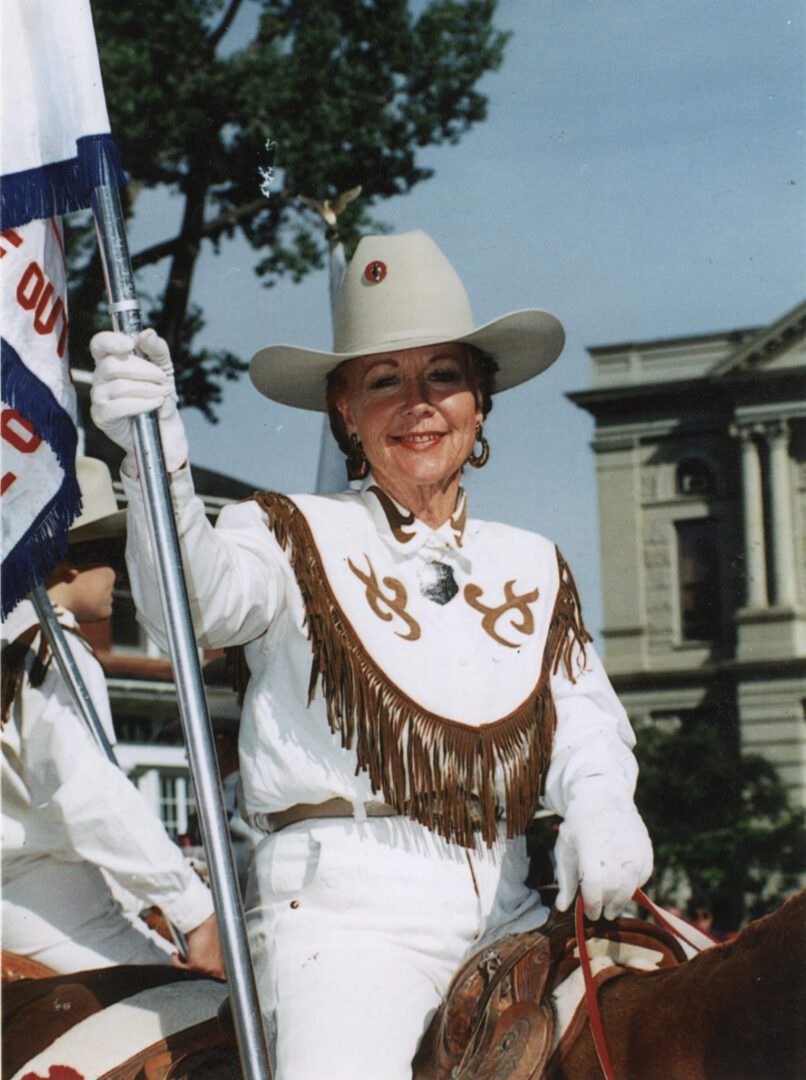
Arlene Kensinger came to Cheyenne, Wyo., in the early 1950s to go to beauty school. “I wanted to be in the circus, but my dad said I needed to go to school,” she said. She made the trip to Cheyenne from her home in Hawk Springs, where she grew up. Her father, S Paul Brown, was a school superintendent in Hawk Springs for 11 years. She learned to trick ride and rodeo through babysitting. “She was a trick rider and he was a roper,” she said of the parents.
She met her husband, Don, who owned the only trailer park in Cheyenne, where Arlene lived when she came to town. “He found out I was a trick rider and liked to do rodeo, and he had started the Cheyenne Riding Club. He talked me into joining the PRCA and getting a secretary card and so I was the secretary out there at the riding club.” She obtained her cosmetology license and worked in the industry 30 years. She started buying and selling wigs in the 1950s and still does. “I started wearing them when I was in my 30s –it’s so much easier,” she said, of her collection of more than 30. “I like change, and with wigs I can have different colors and different length.”
She split her time between working at the Plains Beauty Shop and secretarying rodeos for Don. “I wore a uniform and the Greyhound bus depot was there so I’d change and go work a rodeo – either secretary or carry a flag.” She and Don married in 1960. “I told him, ‘you’ve been my boss for ten years and it’s time I changed that.’”
Arlene is credited for starting the Cheyenne Frontier Day Dandies in 1970. “I started the first barrel racing club in Wyoming,” said Arlene. “Don was working for Vern Elliot at the Wild West Show in Brussels, Belgian and he hired me to work that and that’s where I learned how to quadrille. I started the Quadrillette with my barrel racing club.” Arlene taught her barrel racing club how to do it. “The Frontier committee asked us if we would set the pivots for the Serpentine and we did that for ten years. That’s when it would rain and snow and the arena would be so deep. My station was down by the roping chutes and the cowboys loved to splash me with the water.” Don came up with the idea to put sand in the arena, something they did in Brussels.
After ten years, the Frontier committee wanted to do something different and asked if Arlene could come up with something. “That’s when I started the Dandies.” The Dandies of the Daddy of “em All began in 1970, and Arlene was the director until 1998. “We had a competition and I picked 12.” She came up with the idea of carrying all the American flags that had ever flown over Frontier Days, along with the Canadian flag. “After that first year, we got invited a lot of places and had an auction to raise money to buy different flags.” Her position as director of the Dandies was a perfect blend with her husband’s role with Cheyenne Frontier Days. Don was the livestock superintendent and chute boss at Cheyenne for 65 years. “He was here longer than anybody,” she said. Don had come to Cheyenne as a jockey from Nebraska, where his dad raised race horses. He rode horses for CB Irwin when he came to town. “He still thought he was a jockey,” Arlene laughed. “Vern convinced him he was a cowboy.”
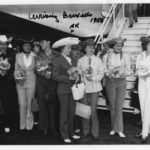
Arlene and Don provided trailers, food, and drinks to all of the bands and performers that crossed the stage of Cheyenne for at least 30 years. “Don would pull trailers in to be their dressing room,” she said. Arlene also added coordinating Miss Frontier for 14 years. “Queens didn’t used to travel much and I was their coordinator for 14 years, so I traveled with them,” she said. That connection led her to be involved in Miss Rodeo America. She often hosted the various state queens at her home, something she has done every year since 1984. She was the first woman elected on the board for Miss Rodeo America and implemented the scholarship program into the contest. “I convinced the PRCA to use the Miss Rodeo America as the spokesperson.” She was the schedule coordinator and chaperon for Miss Rodeo America at the pageant for 25 years. She was also the president of Miss Rodeo Wyoming for ten years.
Arlene and Don spent their winters in Acapulco where they performed as trick water skiers. An accident in 1994 altered that, but not for long. They had bought a place in Lake Havasu, and were heading out to do a little trick ski practicing and as the boat circled around to pick her up, the rope became tangled in the propeller. The result was a mangled arm, and as she was getting ready to maneuver her way into the boat, she looked down and her leg was gone. “I said one prayer, keep me calm – I’m in Your arms. It was 110 that day and my leg was gone from the knee down is all I thought.” Due to the rope tangled in the propeller, the boat had to be towed back to shore, which took more than an hour. “I remember feeling like there was a scratchy blanket on my leg, so I found enough strength to rare up and take it off. My leg filleted open – what I thought was the blanket was actually little bone chips. I never looked again.”
Arlene remained calm and awake during the entire trip from the accident to the hospital. “When they loaded me up on the ramp, I heard somebody say ‘Sis keep your eyes shut.’ I heard someone say, ‘Your skin stretches a mile.’ My foot was in the boat, and they got it out and laid it on my stomach. I almost fainted then. But I remember when we got to the hospital the doctor asking me my mother’s maiden name.” That was the last she remembers until eight days later. “They kept me unconscious for eight days as I fought for my life. I was given 24 pints of blood in the first 24 hours.” Two months to the day after her accident, Arlene got on an airplane, rented a car, and resumed her duties chauffeuring Miss Rodeo America around. “I wear prosthesis and still dance,” she said.
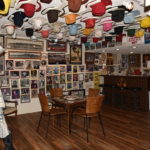
Last year, Arlene stepped down from her duties as the chauffeur for Miss Rodeo America. She still invites people into her home in Cheyenne, a museum of photos, cowboy hats, and mementos from a lifetime of service to Cheyenne Frontier Days and the western industry.
“My dad’s motto was discipline, love what you’re doing, and have fun,” she said, adding the most important part. “In that order or none of that works.”
Arlene Kensinger has been involved with Cheyenne Frontier Days for 54 years. – Courtesy of Alrene
Zane Thompson has grown up in the arena. From junior high rodeos to the WHSRA, the 17 year old from Cheyenne, Wyo., believes that home is in the saddle, including working Cheyenne Frontier Days with his dad, Frank Thompson, who is the arena director for the Daddy of ‘em All. Not only do Zane and Frank work the arena during performances, but Zane’s 12-year-old sister, Madison, does her share of work during slack, while their mom, Dawn Thompson is the Malt Beverage Manager and volunteer coordinator for Cheyenne Frontier Days.
“I come back to help at Frontier Days every year because of how much a person can learn,” says Zane, who competes in the WHSRA in steer wrestling, team roping, reined cowhorse, and his favorite, tie-down roping. “If I’m going to be in that arena for ten days, I try to learn something from every run. Not a lot of kids have that opportunity, and I figure I’d better take advantage of it!” Zane qualified for the 2014 NHSFR in team roping and qualified again for 2015, this time in reined cowhorse. “I’ve always had some interest in showing horses, and Brent Lewis, the guy I set as my idol, has shown quite a few horses and always says it made him a better roper. You learn how to ride your horse better and read a cow.”
Zane’s goal was to qualify for Nationals in his roping events, but missing his steer and breaking the barrier in the team roping at state finals decided otherwise. “Not making it in my other events this year is a wakeup call for me, and I’ll stay more focused,” says Zane, who plans to buy his PRCA permit when he turns 18. He did, however, compete at the IFYR with his roping partner, Riley Curuchet, before returning home to help with Cheyenne Frontier Days.
Zane, has been helping in the arena since he was seven, and is now in charge of hooking and picking up flank straps, as well as helping with the wild horse race. He and his dad spend more time in the saddle than on their feet. “It gets kind of grueling, but it does for everyone,” says Frank, who has been the arena director for Cheyenne Frontier Days since 2012. The PRCA World Champion Steer Wrestler in 2000, Frank grew up rodeoing in South Dakota and later, the NIRA Central Rocky Mountain Region, which he won in the steer wrestling in 1988. He met Dawn several years later at the National Western Stock Show and they were married soon after. Frank started volunteering at Cheyenne Frontier Days in the mid ‘90s, while Dawn had been working for the rodeo since 1988. “I was rodeoing all the time, but after I quit rodeoing for a living in 2005, I became more and more involved in Frontier Days,” says Frank. “I was ready to be home with my family. Zane was almost ten and I’d had my time rodeoing. I was ready to be home. I was scared to death of regretting my decision – when rodeo is such a huge part of your life, it’s scary to quit all of a sudden, but working for Cheyenne has helped. When you’re involved in the Daddy of ‘em All, you get your rodeo fix in different ways.”
Full story available in our July 15, 2015 issue. Available online!
Stray gathering in New Castle, Wyo. – Marcy Cunningham
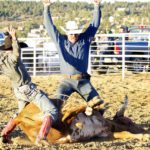
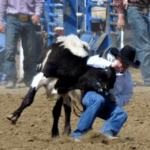
Zane bulldogging in New Castle, Wyo.
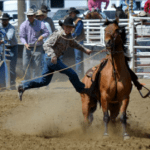
Zane tie down roping in New Castle, Wyo.
– Marcy Cunningham
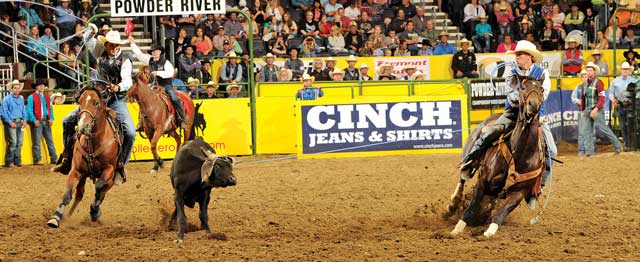
Sawyer Barham has been roping with Kolton Schmidt for two years. “He’s four hours away,” said Sawyer, the 2015 CNFR Team Roping Champion Heeler. Four hours from colleges, but a whole lot further from Kolton’s home town in Alberta Canada. “When we first started roping, we entered a lot of amateur rodeos and we just kind of know each other’s game plan,” explained Sawyer. “He always says he’s going to be safe but aggressive and not back off and that’s what he does.” The team was second going into the finals and since Kolton had to miss some rodeos to pro rodeo, he was a little further behind. “We got to go because of a tie for heelers in his region, I was going, but I wasn’t going to get to rope with him.”
Kolton Schmidt grew up in Canada and came here for ‘no snow and nice weather.’ His parents own a place in Arizona and he’s wintered there since 2004. “It all started in 2004 in Arizona, so it’s still pretty new for all of us. It’s unbelievable – it is a roper’s paradise. Our definition of cold in Canada is -40 and three feet of snow.” He is a few hours shy of a degree in communications from Durant, Okla., and when he graduates, all he wants to do is rope. “I don’t have a back-up plan,” said the 21-year-old, who is entered up through the summer with Dustin Searcy. “We were in the same region, and we’re hauling down the road in a mini freightliner and Platinum with two horses each.” He started roping when he was 12, but was involved in other sports in Canada. “I did baseball, hockey, basketball, and football and rode motorcycles cross country. I just kept weeding out sports until I dropped them all and roped and this is pretty addicting. I’m sure glad I did.” The only thing he misses about organized sports is the discipline to be in shape. “In rodeo, it’s your own personal choice to be in shape. But I sure like the western lifestyle.”
He admits that rodeo in the US is different than Canada. “I’ve never rodeoed this much south of the line and this is awesome. Everybody is out here cheering for each other and everybody is happy to be alive. We are making a living doing what we love and it’s hard to complain.” Kolton is still soaking in the win in Casper. “It’s a really big win for me and Sawyer. To have our names on that forever – everybody goes to school for an education and to win at the national level, that’s awesome,” he said. Sawyer has another chance, but for Kolton the 6.2 short round run will forever be a memory. “We had to have 7.5 to win and we were 6.2 in short round. As soon as we heard our time, we knew we won it,” he said. Kolton relies on his training to make that kind of time. “I just try not to think about it,” he said. “One step at a time. If you plan your run – there’s lots of stuff that can go wrong. Handle it each step at a time.” Kolton grew up a third generation roper, and his family recently gave up the cold for a place in Arizona.
He would love to rope with Sawyer all summer, but that isn’t going to work. Sawyer is going to school for Ag Business and is working for his grandfather in the concrete business in Oshalade Oklahoma. “I really enjoy it,” he said. “This year work has really picked up and I’ve only been to a couple of rodeos.” My horse is back to sound and I’m about to start rodeoing again.” Sawyer is heading to Northwestern OSU in Alva and will rope with Hunter Muncell next year; Hunter was third high call coming back to the finals.
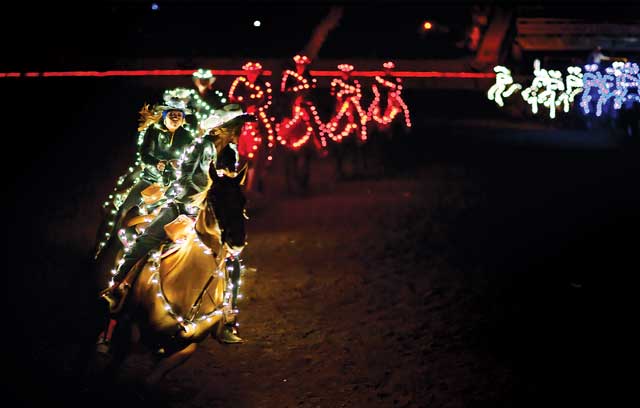
The velvet darkness of the Thomas & Mack arena in Las Vegas, Nev., has been lit up five times by the Snake River Stampeders, a precision drill team of 16 riders galloping in the cover of darkness, each one glowing in the outline of nearly 200 lights. The only drill team invited to perform at the WNFR, the Snake River Stampeders also performed at the 2002 Winter Olympics in Salt Lake City, Utah, and the 2002 Copenhagen Cup Finale held in Texas, and were even approached by America’s Got Talent, who is considering adding outdoor related talent to the show. But the Stampeders’ trademark is their hometown rodeo in Nampa, Idaho.
The Snake River Stampede moved from its well loved outdoor rodeo grounds to the indoor arena of the Ford Idaho Center in 1997, but Stampede fans were loathe to give up the old arena. “I wanted to think of something we could do to dress up the rodeo in the new place – something we couldn’t have done in the outdoor arena,” says Jimmie Hurley, the Stampede’s executive secretary. Brainstorming with her longtime friend Shawn Davis, the general manager of the WNFR, Jimmie’s solution didn’t come until Shawn’s wife recalled the opening of a rodeo she had seen with pretty girls on fast horses. It seemed the perfect complement to the Stampede’s claim as the wildest, fastest show on earth, but Jimmie wanted to add one more element – the pretty girls and their fast horses would perform in the dark.
Jimmie set to work appointing a drill instructor and holding tryouts, which were well attended by horsewomen curious to ride in a drill team unlike any other. The riders wore all black clothing and hats, with yellow Christmas lights safety-pinned on to their clothes and tack. It was wryly observed by one of the volunteers that even D-Day hadn’t required so much planning. The hours of practice and planning were an instantaneous hit, however, and the cheers of the 1997 rodeo audience confirmed what Jimmie hoped was true – the Snake River Stampeders were ready for Las Vegas. They performed that very December at the WNFR and returned again in 2001, riding in red, white, and blue lights, to “Proud to Be an American”, sending out a lone Stampeder with a flag made of lights to start the drill, an especially moving performance just months after 9/11.
Horsewomen all, the team is largely made up of wives, mothers, rodeo queens, and drill instructors, all hailing from the Treasure Valley in Idaho. Coached by Paula Vanhoozer, a seasoned drill team judge and rider, the Stampeders practice once a week over the course of three months, members chosen each year after a challenging night of tryouts in the spring. Of the 30 – 40 women who audition, only 19 are chosen – 16 regular team members and three alternates.
“I enjoy practice!” says Brandi Krajnik, a seven year member of the team. “Paula writes such good drills, and adding that mixed element of danger turning the lights off is a challenge.” Another member, Heather Miner, adds, “You have to have a horse and rider that are willing to push the boundaries of what common sense says is okay, and have a little fun with some adrenaline.” Heather has ridden with the Stampeders the last four years and coaches another drill team, the EhCapa Bareback Riders, with Brandi. “Stampeders is challenging horsemanship wise. It takes a rider who can push through fear, and a horse that has some go but that also stays under control, which is kind of a rare combination.”
Since its creation 18 years ago, the Snake River Stampeders have changed very little beyond team members and drill instructors coming and going. The team switched to L.E.D lights in 2010, which was brought about by Randi Wood, the assistant drill instructor, light coordinator, and rodeo board liaison. The new, brighter lights snake over the riders’ sleeves and up to their glowing hats with the help of extension cords. “Once your lights are fastened on, you’re pretty well staying put in the saddle,” says Randi.
By the time the Snake River Stampede week arrives in July, the Stampeders’ drill – written anew each year by Paula – is second nature. Once the arena is set up, they have just three practices in the dark before launching into their six performances during the Stampede. Though seldom, when the lights do fail, charged by 45 pound battery packs on the saddles, the Stampeders never fail to care for one another, especially during the accidents that inevitably occur. Even performing to music so loud they can feel it in their horses’ hooves, the team manages to communicate with one another during what one Stampeder described as a four minute barrel race in the dark with 16 horses.
“I think proof of how good we are is that we have the fastest riding, in the dark, with some of the best riders practicing in the least amount of time,” Heather Miner describes, “and there’s no way you can do that without amazing horses and riders.”
The Snake River Stampede was inducted in to the ProRodeo Hall of Fame in 2014
– Courtesy of the Hall of Fame
The Snake River Stampeders performing at the 2014 Snake River Stampede
– Shauna Rae’s Photography, Nampa, ID
The Snake River Stampeders performing at the 2014 Snake River Stampede
– Shauna Rae’s Photography, Nampa, ID
Snake river stampede
Celebrates 100 years
Potatoes immediately spring to mind when the state of Idaho is mentioned. But among PRCA cowboys and cowgirls, the pistol shaped state hosts one of the West’s top rodeos to compete in during July. And while Idaho produces more than 13 billion pounds of spuds every year, the Snake River Stampede boasts a $400,000 payout, placing it in the top ten of the PRCA’s regular season rodeos.
The Snake River Stampede, which lands in the middle of Cowboy Christmas, celebrates 100 years this month, a historic milestone coming just after the rodeo was inducted into the ProRodeo Hall of Fame in 2014. The legendary barrel man and rodeo clown, Leon Coffee, is coming out of retirement to be the man in the can during the rodeo, while the rodeo’s trademark drill team, the Snake River Stampeders, are performing their dark defying routine with a surprise twist at the opening. They’ll ride in green and yellow lights – the colors of the original Stampede arena.
Originally an offshoot of the Nampa Harvest Festival, which began in 1911, the Snake River Stampede started as a bucking contest in a roped-off block in town. The event became official in 1915, the first year admission was charged, and soon took place in a ball field. Other events were added, and the buck show, still nameless, grew in popularity.
The year of 1937 proved pivotal when the buck show was christened the Snake River Stampede by rodeo director Ike Corlett, and joined the Rodeo Cowboys Association. The bucking stock, which was originally herded to Nampa from a ranch near Horseshoe Bend, some 50 miles away, was later provided by Leo Cramer, a Montana stock contractor who brought the stock by train. The rodeo was changed to a nighttime show when lights were installed, and President Franklin Roosevelt opened the new rodeo from his home in Hyde Park, New York, where he pressed a golden telegraph key that turned on the lights of the rodeo grounds 2,000 miles away. In 1950, a new arena was built, seating 10,000 in its horseshoe shaped stadium. Gene Autry was the Snake River Stampede’s first star, followed by entertainers including Roy Rogers and Dale Evans, and later, Reba McEntire, and Glen Campbell. The Snake River Stampede moved indoors in 1997 to what is now the Ford Idaho Center, pulling spectators in from the heat and closer to the thrills and spills of the wildest, fastest show on earth.
“I’ve been working here since 1977, and the rodeo is part of my family,” says the Snake River Stampede’s executive secretary, Jimmie Hurley. “I love the rodeo’s heritage, and the fact that the committees have toughed it out through the good and bad years and didn’t let the rodeo go. We strive to have the best announcers, stock, bullfighters, clowns, and specialty acts – and to pay out a lot of money – which of course attracts the best cowboys and barrel racers. It’s an honor for us to be one of the top ten (PRCA) rodeos!”
The Peterson family is the embodiment of the motto “One for all, all for one.” From the school auditorium to the sports bleachers and rodeo sidelines, the Petersons stand together and cheer in tandem. The bond of the family was forged largely in rodeo, the sport that Ross and Chrissy both competed in through high school and college, and wished to pass down to their children. “Ross and I feel that kids don’t come with manuals when they’re born,” says Chrissy with a laugh. “We decided the best way to raise our kids was to keep them super busy and keep them with each other. Every weekend, they’re with us! We know their buddies, and we have expectations for them.”
Raised on these expectations, the girls have grown up training horses and selling them to pay their entry fees. Kaitlin and Karlee also competed in several rodeo royalty contests before they were ten, holding titles with local rodeo organizations. “The girls had to learn to speak eloquently in front of adults and crowds, introduce themselves, and learn horsemanship skills,” says Chrissy. “Today, when they have a high school or college presentation and have to speak in front of others, it’s not even an issue.”
Rodeo practice at the Petersons is serious fun. Their arena, referred to as the Peterson Playpen, is almost more of a home to them than their log house, which pins down a portion of the swelling Black Hills. Karlee and Sidney practice together daily, and their parents join them after work. Ross is the shift supervisor at a saw mill in Spearfish, S.D., and Chrissy is the Special Education Director for the Meade School District. “Practice is kind of mass chaos,” says Ross. “Chrissy is the chute helper, I’ll be riding some young horses, and then we’ll have someone lining calves and holding goats, loping horses, and saddling and unsaddling.” Karlee adds, “Grandpa will help us, and some kids come over too, but you won’t get to come and watch. When friends come over to the Peterson house, Mom puts them to work – and they love it!”
Kaitlin, a junior this fall at University of Wyoming (UW) in Laramie, Wyo., is competing in breakaway roping and goat tying. An NJHFR, NHSFR, IFYR, and NLBFR qualifier, she finished the college rodeo season sitting high in the breakaway roping for the Central Plains Region, which she competed in for Oklahoma Panhandle State University (OPSU) in Goodwell, Okla. She is also majoring in secondary math education, with plans to graduate in the next two years with a 3.5 or higher GPA. Her other passion is riding colts and turning them into barrel or roping horses, and she’s doing just that this summer as she rodeos with her family and does ranch work for the Haugen family. Last winter, she bought two broodmares, one of which foaled in early June. Kaitlin is smitten with her new bay filly.
Karlee graduated from Sturgis Brown High School on May 17. With 12 college credits already under her belt from dual enrollment, her flair for time management has also allowed her to be this year’s student body president for her school, work 20 hours a week at The Buckle, volunteer in the South Dakota Teen Court System, and compete in the SDHSRA, SDRA, NLBRA, and 4-H rodeo. “Time management is something I learned from a young age, and its shown me how much I care about rodeo,” says Karlee. Family is her other secret to success. “It absolutely wouldn’t be possible to rodeo if not for such a team effort. Since I have so many horses to get in shape, Sidney helps me with exercising them every single day.”
Full story available in our July 1, 2015
Karlee on Socks at the IFYR Finals, 2014
Sidney and S’mores, the pony she has been training on to pay for entry fees. – courtesy of the family
Kaitlin with Socks. Socks was first Kaitlin’s main mount and then was handed down to Karlee. Just recently, Sidney took Socks to the NLRB in Colorado. Socks was trained by Ross and Chrissy.
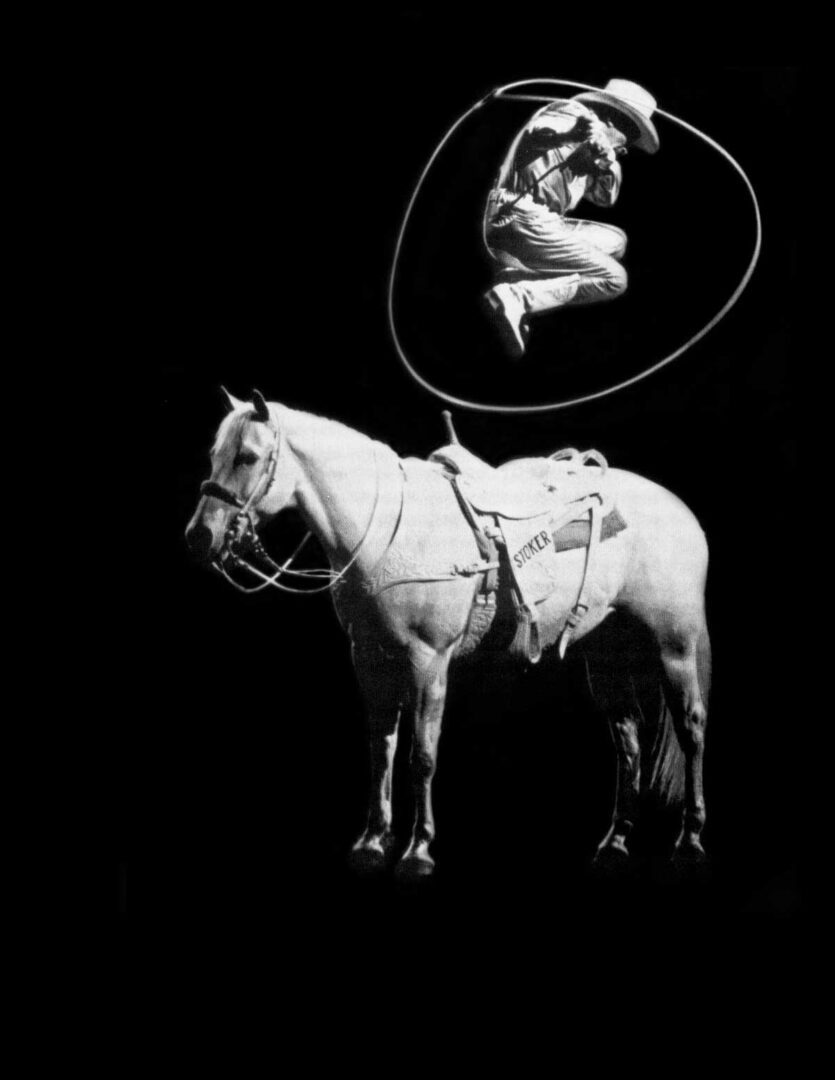
For seven of his eight decades, J.W. Stoker has entertained rodeo and western fans.
The Weatherford, Texas cowboy has criss-crossed the nation and the globe, trick riding and trick roping for hundreds of thousands of people.
Born in 1927, it began for J.W. when his parents moved from Colorado Springs to Kansas City when he was eight. J.W. attended the Santa Fe Trail Riding Club in Kansas City, and one week, a cowboy by the name of Pinky Barnes came to town. Barnes, a trick rider and trick roper, gave lessons to the club kids. “I liked it real well, and he was a good teacher, too,” J.W. remembers. Even though he didn’t know it yet, his career path was born.
J.W. took to the roping, spending his lunch times and recess at home practicing.
The next spring, Pinky brought a guest to town. Clyde Miller, who put on rodeos and Wild West shows, had heard how good J.W. was. “I was practicing, and they asked me if I’d take them down to the house. They’d like to see my parents.” Clyde wanted to hire J.W., who was the tender age of ten years old. “Of course my folks weren’t going to send me down the road at ten.” So Clyde had a different proposal for them. It was the Depression days, and money was scarce. He offered the whole family a job: J.W.’s dad could haul the bucking chutes, his mother would care for kids, and J.W. and his sisters Frankie and Bessie would trick rope. His parents decided to do it. It brought him notoriety and fame. In 1939, he was billed as the “Juvenile World Champion Trick Rider,” with his picture featured on a box of Wheaties. To his knowledge, he is the only western lifestyle person to be put on the iconic cereal box.
J.W.’s work with Miller continued till Miller suspended his rodeos during World War II due to gasoline and tire rations. Stoker had begun booking his own shows as a brother/sister act with his sisters. One of his first rodeos was Burwell, Neb., in 1940, which he worked for 25 years.
He continued to trick rope and ride till he was drafted for the Korean Conflict. Basic training was at Ft. Benning, Georgia then he was sent overseas, where he was put in the Special Services, the entertainment division of the Army. “I was wanting to trick rope, the same thing I’d been doing in the States,” he remembers. “They auditioned me, and said we’ve never had a trick roper before, but we’ll try it and see what happens. I trick roped and got along real good.” Stoker spent his entire time overseas entertaining the troops, with artillery fire occasionally going on overhead during shows.
He was discharged in 1952, when he came home and his career continued.
In addition to rodeos, Stoker worked Wild West Shows and served as a stuntman in movies. He went to Europe with Rodeo Far West in 1970 for Buster Ivory, and in 1973, worked with Casey Tibbs at a Wild West show in Japan. When the show didn’t go well, Casey got him a job promoting Las Vegas and Nevada outside a log cabin, similar to the one from the Bonanza TV show.
He worked in the movie “Bus Stop” with Marilyn Monroe in 1956 (“she was late every day,” he says, and much shorter than he expected), in “The Kansan” in the late 1940s, where he trick rode and roped, and in “Bronco Billy,” where he doubled for Sam Bottoms, who played Lariat Leonard James in the movie. Stoker taught Bottoms basic spins and for the more difficult spins, trick roped and was filmed from behind him.
Stoker trick roped in Harry Truman’s inaugural parade in 1948. That was back when news reels were shown prior to movies, and Stoker’s trick roping showed up in those reels. He entertained President Ronald Regan and future president George H.W. Bush at the 1984 Republican convention in Dallas. He’s also entertained in nine countries: Venezuela, Germany, England, France, Switzerland, the Dominican Republic, Finland, Japan, and Cuba. He served as entertainer at the Calgary Winter Olympics in 1988, and worked on Michael Martin Murphy’s West Fest for a decade.
Stoker served as a stunt double for Roy Rogers, and Roy even rode one of J.W’s horses. It was while Stoker was working the Houston Rodeo in 1969. Rogers was there, and he’d been told by his doctor he shouldn’t ride because of heart problems. On the second performance, he said to J.W., “I don’t feel right walking out (in the arena to do the Sons of the Pioneers). Can I use your horse to enter and leave on?” J.W. was honored to share his horse.
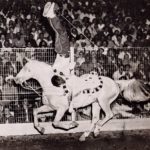
He made his own trick riding horses, and two of them stick out as favorites. One of them was Pumpkin, the same horse that Roy Rogers rode. He was a palomino with stocking legs and a wide blaze, and “he really ran,” Stoker says. Pumpkin was purchased from the famous woman trick rider and bronc rider Tad Lucas.
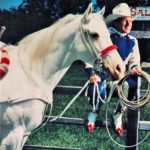
Another favorite horse was Hot Diggity. Hot Diggity was purchased from Rex Rossi, another famous trick rider who worked a lot of shows with Stoker. Stoker’s trademark was white horses and Hot Diggity fit the bill. His current horse, Romeo, a paint stallion, is exceptionally intelligent and has a big personality. “I wish I’d had that horse decades ago,” Stoker says.
Living 50 miles from Dallas, he had the opportunity to work conventions as well.
About six years ago, he was forced to slow down and eventually retire. He was diagnosed with spinal stenosis, which pinches nerves and causes leg pain. He can walk to the barn, but once he’s there, he has to sit down for a bit before he can continue. “You can’t trick rope sitting down,” he says.
But Stoker hasn’t quit for good. He has been willing to help anybody who asks. “People would call up and say, ‘I need help with the roping.’ I’d say, come over. I didn’t charge them. I figure it’s been good to me.” He currently works with the Cowgirl Chicks, an entertainment and trick riding group. He and the Cowgirl Chicks are on RFD-TV weekly.
The 87-year old cowboy has had numerous honors and awards. He’s been a two-time Pro Rodeo Cowboys Association Entertainer of the Year. He’s inducted into the National Cowboy Hall of Fame in Oklahoma City, the Texas Cowboy Hall of Fame, the Texas Rodeo Cowboy Hall of Fame, and the ProRodeo Hall of Fame.
And life’s been good for the entertainer. “I’ve done so many things, there’s no end to it,” he recalls. “I just lived life, and lived it good.”
Story also available in the July 1, 2015 issue.
Stoker doing a shoulder standJ.W. Stoker, age 12J.W. and Hot DiggityRomeo, the paint with JW: JW loves his current horse, a paint stallion he wishes he had had years ago.
Stefan Ramone is the youngest of five children, growing up in Lehi, Utah, roping and riding from the time they could walk. Stefan’s mom, Patricia, says Stefan actually started swinging a rope before he could walk.
“As young kids we used to rope at the National Dummy Roping in Las Vegas each December,” says Stefan. “We would practice all year for it. My sister, Tashina, won it when she was about eight.”
Stefan and older brother, Brady, roped as a team as youngsters. They practiced every day using both a donkey and a lead steer for practice. Stefan credits his parents for pushing him to achieve his goals. Stefan’s father, Benson, is a horse trainer and farrier. His mom, Patricia, is a behavioral specialist at a children’s hospital.
“Stefan just doesn’t give up and has always had a lot of determination,” says Patricia. “He’s very easy going and doesn’t let things get to him. He’s able to shake it off and go to the next one. That has helped him in both roping and baseball.”
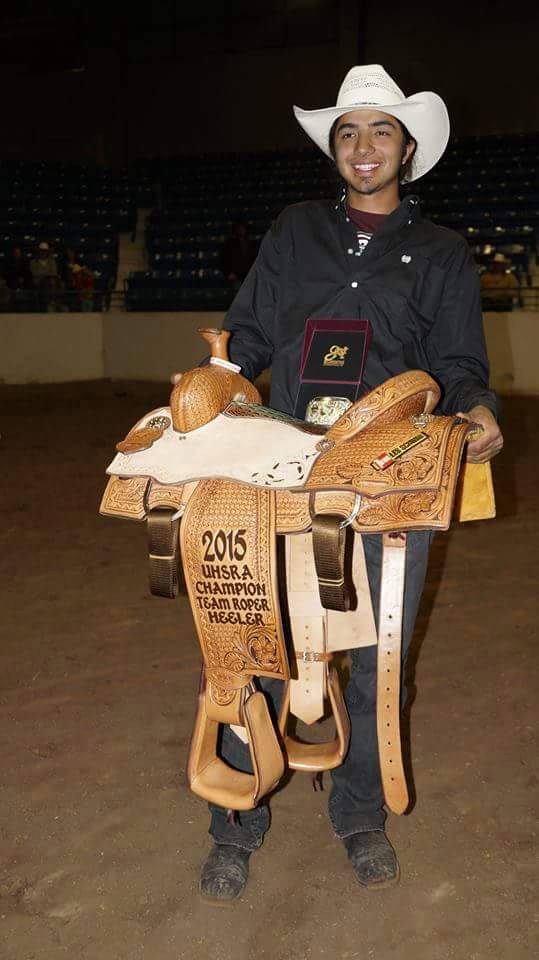
Stefan, a junior in high school, was recently crowned the Utah High School Rodeo Association Champion Heeler. He and his partner, Louie Ivie, plan to attend college in Texas after graduation.
In addition to roping, Stefan is an avid baseball player and has played varsity baseball since he was a freshman. He pitches and plays shortstop. Half Native American, Stefan is proud of his heritage and wears his hair in a long braid.
“I’m very thankful to have such a close family,” says Stefan. “My parents are always there to support us and help us achieve our goals.”
COWBOY Q&A
How much do you practice?
Every day.
Do you make your own horses?
Yes.
Who were your roping (rodeo) heroes?
Speed Williams, Rich Skelton
Who do you respect most in the world?
My mom and dad.
Who has been the biggest influence in your life?
My dad.
If you had a day off what would you like to do?
Go fishing.
Favorite movie?
Driven
What’s the last thing you read?
American Sniper
How would you describe yourself in three words?
Hard working, dedicated, motivated.
What makes you happy?
Roping, playing baseball and being with my family.
What makes you angry?
When my family gets beat roping.
If you were given 1 million dollars, how would you spend it?
I’d pay our place off.
What is your worst quality
– your best?
My worst is I get distracted easily. Best quality is being easy going.
Where do you see yourself in ten years?
On a ranch in New Mexico.