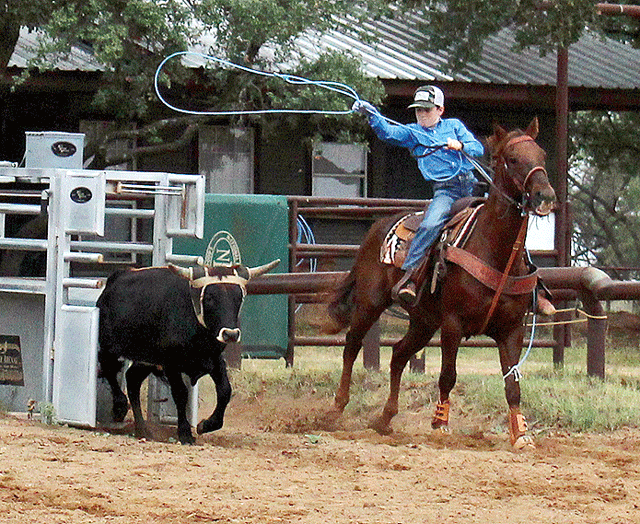
The other day while at a Junior Rodeo, I was asked my thoughts about roping dummies like the Quick Fire, Super Goat, Hot Heels, and goats. Some parents think this creates bad habits and won’t let their kids rope them. When I was growing up there were a few heelers who didn’t rope goats or toy dummies and were successful. Now days I haven’t talked to many young successful ropers who have not.
As for myself, when I was young, I roped anything that moved. Including my dad’s cow dogs until it got me in trouble. One day he had a bull in the woods and when he picked up his rope to rope the bull, his dogs scattered like quail. He came home and lined all the kids up and we received a serious scolding about roping his cow dogs. He bought me some goats and turned them loose. When I got home from school, that’s what we roped. There was no more roping the dogs.
Yes, bad habits can be created roping the Quick Fire, Hot Heels, Super Goat, Fast Lane, or even goats. But many good habits can also be created using these tools. Your kids can rope so much more without wearing a horse out. It will improve their rope handling ability while they learn correct angles they will need to rope steers.
These are great tools that provide opportunities for kids to simulate situations they will face in the arena. When you’re roping goats or dummies with them – instead of making runs just for fun, make it worth something to them. If they catch so many in a row, or catch in under so many seconds, then let them win something of their choosing. Maybe going to a movie, what to eat for dinner, etc. Set a goal they can achieve by accomplishing a feat with their roping.
We have been booking a lot of schools for kids at the indoor arena in Santo. We cut 25’ off the back of the arena and built a small arena for my son to rope goats. When I was young I roped goats anytime I wasn’t doing something else. Gabe has put in many of hours roping goats. It’s helped him with his rope handling ability and he is learning where to place his rope.
They can also learn a lot about competition. It provides a lot of necessary repetition. That’s the name of the game, making repetition runs. Your horses can only handle so much. This provides a place they are able to move their feet, swing their rope, and create the angles they need to rope. Currently, it’s 9 p.m. and after we’ve had a school all day, I’m working the chute right now for Gabe to rope goats. He loves it and we have a USTRC roping coming up.
No matter what you rope, the hours spent learning to handle a rope and being able to control it are valuable. So much of roping is math and learning to create the angles. That’s why I’m a huge fan of kids getting a lot of opportunities to rope anything.
We just had a ten-day road trip to South Dakota and Nebraska teaching schools and private lessons. I was very impressed with how much my kids improved in their own roping by doing all of the drills. My daughter sat and listened to me teaching schools and telling stories about my father and when I was young. I think she enjoyed that more than anything.
I’m thankful they can both help out at schools heading and heeling. I will be uploading some videos soon at speedroping.com of Gabe preparing for USTRC and Hali getting ready for Junior High Texas State finals.
Author: Speed Williams
-
Should Your Kids be Roping Toy Dummies and Goats?
-
Overcoming Weaknesses
My daughter does not like to miss. She’s very cautious, will take extra swings to make sure she catches, and follows instructions to a tee. I have to challenge her to rope fast. Since she doesn’t like to miss, she has trouble taking a risky throw. I really have to push to get her out of her comfort zone.
My son, on the other hand, is the complete opposite. When Kaleb and Junior came and roped with us before the NFR, Junior quickly became Gabe’s hero. I decided to practice a little reverse psychology on him. To head for Junior, I put him on one of my horses and told him he could come over the top of the chute and rope as fast as he wanted. I truly thought he wouldn’t want to miss for Junior and it actually had the opposite effect. He probably missed the first 10 or 15 steers and I kept thinking any minute he was going to just go catch one. I bet he ran 100 steers in three days and caught less than 30% because every run was two swing and then fire.
Now in the practice pen he has to catch three “high teamers” and once he does that, he can come over the chute and throw fast. If he doesn’t catch three in a row, he doesn’t get to throw fast. It’s completely different scenario with Hali. If she catches three, then I make her rope fast once. Missing makes her want to catch the next one, where it doesn’t affect Gabriel at all. They are complete opposites with completely different mindsets.
The both have their weaknesses and I’m always encouraging and pushing them to overcome. Don’t get me wrong… I don’t really get onto my kids in the practice pen. I think it’s important to praise them when they do well. Some parents really get mad and onto their kids when they miss in the practice pen. I find it ironic that they then expect so much of them in competition. As someone who has roped their entire life, and for a living, I understand how complicated it is and how many things can go wrong.
However, I’m huge on preparation for competition. I expect my kids to watch the roping and pay attention to the steers to give themselves a chance to win. That comes from how I was raised. The only thing my dad ever got mad at me for was when I floated my heel loop… or when I was playing football during the roping. I got in trouble for that a lot. I loved football and there was always kids playing football at the ropings. Other than those two things, I don’t remember getting in trouble for failing. One the way home, my dad would ask what I learned, and what do we need to do next week to better prepare ourselves. Understanding why you failed at competition, and how to prepare yourself or your kids for it not to happen again is key.
As a young man, in my late teens or early 20’s, I would be gone every weekend and make as many rodeos as possible. One weekend I hauled my back up heel horse and my calf horse, and left my good horse home. When I got back my dad asked me why Medicine Man was standing in the stall. I answered that he was missing the corner and I couldn’t see my shot. My dad’s response was, “Really?” We saddled horses and my dad got on Medicine Man, laid the reins on his neck, and held onto the saddle horn without roping. He did this behind three steers and the horse worked perfectly. He rode up to me and said, “Now do you think it was the horse, or pilot error?” I have never forgotten it and had he not shown me that it was pilot error, I may have quit riding the best horse in the barn.
My point is you need to have access to someone who understands the sport and horsemanship to recognize the weaknesses, and show you how to work on it and progress.
Feel free to visit speedroping.com and browse our video library. There are quite a few videos of my kids practicing and competing. -
Are Your Kids Having Fun in the Arena?
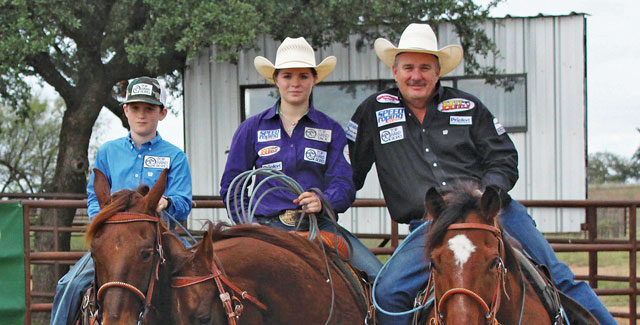
A couple of weeks ago I asked my son, Gabe, to ride some head horses for me. My wife has a horse, Deputy, that she hasn’t been riding, and Hali has one she hasn’t been able to ride. I promised Gabe if he would ride these horses I would take him to some ropings. After watching videos of Gabe roping on my website, Lloyd South called and asked if Gabe would head for him in the #9 and #8 at Robertson Hill on Tuesday night. The ropings were limited to thirty teams, so it would be a short roping on a weeknight.
Gabe turned all ten of his steers. He and Lloyd caught all four steers in both the #8 and #9, winning 2nd in the #8, and 3rd in the #9. My little man was some kind of pumped up on the way home after winning money.
It was like that with Hali also. I really didn’t want either of them to rope much until they were 11, 12, or 13 years old. At that age they are big enough and strong enough to ride, control their horse, and handle a rope.
When Hali caught the roping bug she was playing travel softball and going to a lot of tournaments. She went to a roping, won some money, and the very next weekend we went to a softball tournament. The temperature was in the high 20’s and the wind was blowing about 20 mph. They played all day long, placed second, and won a trophy.
I will never forget the look on her face. She looked at me and said, “Daddy, I don’t have a muscle in my body that’s not sore from playing ball for the last two days. Can I buy a hamburger with this trophy?” I told her, “No, you can’t.” Her answer was, “I won money last weekend and my horse did all the running. We might need to rethink this softball.” I assured her it was her decision. It wasn’t long after that she was a full time team roper. Now after winning some money, I think Gabe will do the same. Only time will tell, but we are planning for him to rope at the Big Break roping in the #10, #9, and if he has the energy, maybe the #7 too.
If you want your kids to rope, it’s important they have fun and enjoy it. That means they need to be on horses that give them a chance. The worst thing for them is to be on a horse they can’t control. When they pull on the bridle reins, their horse needs to respond.
Accidents can always happen, as with any sport. I teach them safety by practicing fundamentals at a slow pace on the Hot Heels, using a short rope to prevent ducking, and having them mounted on a horse they can control and feel confident on.
Most parents that rope also want their kids to rope. They have to want to, you can’t make them or they will quit. I have seen clients break the spirit of their kids when they sell their horses out from under them. If their child doesn’t show the interest they think they should, they sell their horse, devastating their kid, and that’s the last thing I want to do.
My father trained and sold a lot horses. He used to sell horses all the time that Mom and I wanted to keep. Now as a parent, in our family everyone has the prerogative to put their name on one horse that can’t be sold. If someone offers to buy one, we have a board/family meeting and discuss it. Sometimes the outcome doesn’t turn out the way I want, but I don’t want to do my kids like my dad did us. I want my kids involved and out there helping. I want them to make decisions and understand the consequences of those decisions.
I’m beyond happy that my kids want to rope. They have always had the option to play other sports or have other activities and we have supported them in those activities. But I have also worked at making roping fun for them.
Please feel free to visit speedroping.com to watch videos of Gabe or Hali roping. Sign up for a free membership and browse any unlocked video. You can use search function using names or to find videos on a variety of topics. -
Creating Pressure
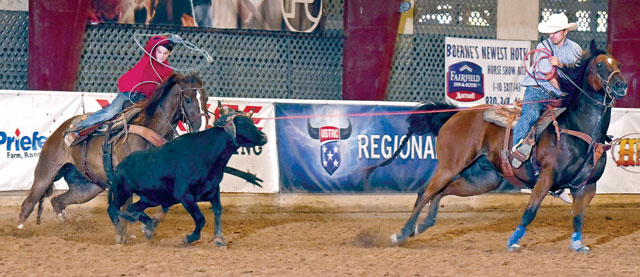
Both Hali and Gabe were recently given the opportunity to rope in the Wildfire Sponsor roping for Precision HydroVac. Instead of heading against his sister, we decided Gabe would heel for me. He’s been heading very well and he’s been working at his heeling and dallying roping the Hot Heels and goats.
Last week he was heeling very well. Then the day before the roping, as so many ropers can relate to, the wheels fell off. He couldn’t get a cow to jump in his loop. He was trying so hard not to miss, and suffered the things that happen to our roping when we do that.
When we went got to Hamilton, before the Sponsor roping, we were able to run a few. After Gabe missed five or six in a row, I rode up to him in the box, in front of everyone in the arena. I said, “Buddy if you miss this one, it costs you five pushups.” Everyone was whooping and hollering and he missed. I told him he could go double or nothing on the next one. He missed again.
We got to the stripping chute and he hopped off and did his pushups. He asked why I embarrassed him and made him do push ups in front of all these people. I said, “Son did you get nervous?” and he replied, “Yes, I got real nervous.”
He has a bad habit where he takes his hand from behind head and pushes his rope forward and the bottom loop never gets to the ground. He did this on both steers. We visit a bit and I said, “Son, I’m trying to give you the pressure you’ll be feeling tonight, so tonight when you get nervous – are you going to be more nervous about roping or doing push ups in front on every one?”
My philosophy is it does you no good to rope cow after cow in the practice pen if you can’t get the excitement, nervous, or sticky fingers you will feel during competition. You have get your heart rate up and simulate the feeling you have at a roping. On our very first steer at the roping, we drew well and he roped two feet and got to do the Junior layback – he’s a huge Junior fan. I broke the barrier on our second steer, and he thought he had to go fast and hit a front leg. I was super proud of our first steer and the way he’s been roping overall.
Parents, occasionally in the practice pen I suggest you create a situation for your child to win something, or maybe think of something they don’t want to lose. Whether it’s their favorite place to eat, a movie they want to see, or an extra hour before bedtime. Create some kind of pressure in the practice pen where they want to win or don’t want to lose.
When my kids were young, if they caught ten times in a row, we went to the movies. I’ve never made my kids rope, but if there was something they wanted I gave them a way to win it. I’ve been blessed my daughter has always been a cowgirl and wanted to ride horses since she could walk. Just this year Gabe has really caught the roping bug. You can see some of our practice runs in preparation for the Sponsor roping at speedroping.com. -
Safety First
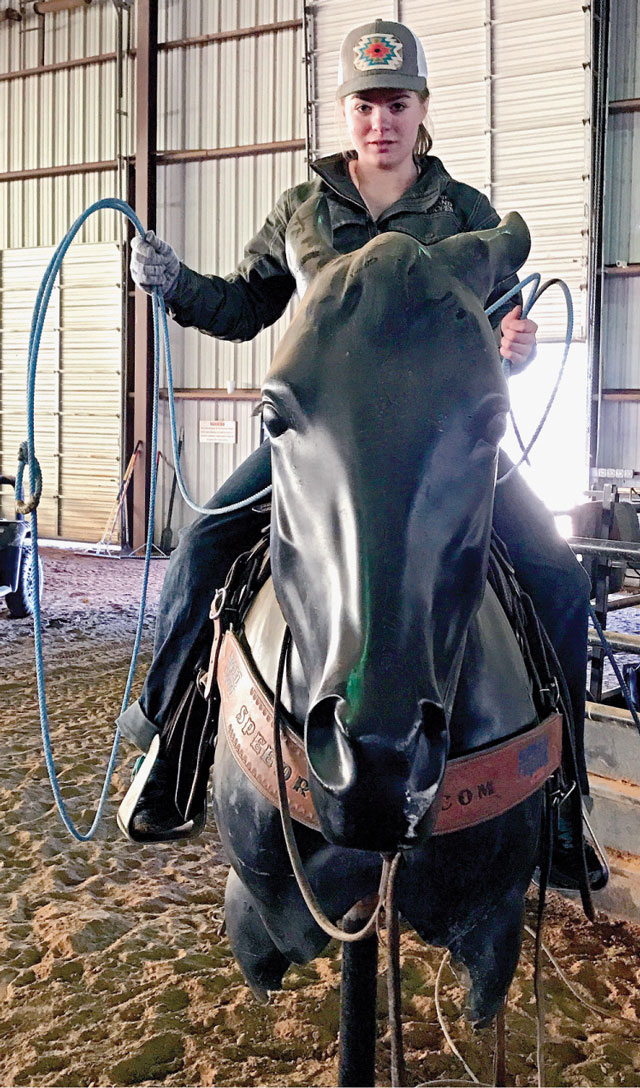
One of the most important things I learned watching my father teach people to rope was to help keep them safe. He would let headers start out with just one coil in their hands and the tail of their rope hanging down by their stirrup. There’s no option, when you throw your rope, you have to kick and keep riding your horse – or lose your rope.
Hali, my daughter, roped until June or July of this year with just one coil in her hand. She was a 4+ header, winning money and saddles, still using one coil. My theory is her hands are more valuable than any roping she could ever win. If the steers stops or drags, there are so many things than can happen to your kids, or any beginner, that can get them in trouble.
I highly recommend this for anyone who is learning, whether it’s kids or beginners. Let them build the loop the size they want, with the amount between their hands, then cut their rope off where the tail is hanging down by their stirrup.
I advise starting on a Hot Heels or mechanical dummy with their horse sitting still. They need to be able to sit on their horse, rope, pull their slack and then dally without the horse moving at all. They need to master these fundamentals at a stand still before attempting to rope a moving dummy.
The next step is to cover the same fundamentals at a slow walk. Rope, pull slack, and dally without letting the horse turn. By mastering basic fundamentals at this pace, the odds of staying in control at a faster pace are much greater. It’s very easy to get excited once things start moving.
I once had a school in Oklahoma where the head guy was notorious for ducking. Everyone at the school was related to him somehow. I told him before we started I could fix it, but I wanted to see how bad it was first. I let him run two steers, and it was pretty wild. The first steer wasn’t too bad, but the second was out of control. I rode up to him, grabbed his rope and cut it off where he only had a coil and no tail hanging.
Everyone was amazed when he wasn’t ducking anymore. He would rope, ride up and handle the steer. At lunch he said, “I had to ride, because I didn’t have any rope.”
It’s amazing how much better your mind works to engage your legs if you know you don’t have the luxury of going left and getting a dally. I have a simple rule at my schools – you get to lose your rope once. After that, I will make sure you don’t have enough rope to duck.
I recommend starting all youngsters and beginners out this way. It’s no more than a learning tool to help teach someone to ride their horse. I can’t begin to tell you how many young kids I’ve seen who are missing fingers and thumbs. It scares me to see kids rope with a long rope. It’s so important for them to learn to ride after they throw and stay in control.
Currently I’m working with Hali to help her learn how to reach. As a 5+ she will have to learn this to be competitive. I am working on a series of videos of drills including ground work. These are available to view at speedroping.com. -
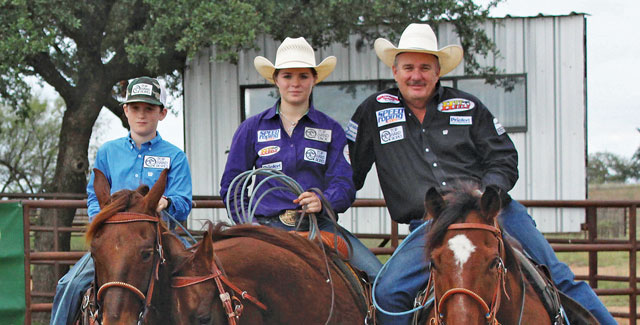
Effective and Fun Practice
Teaching people to rope, and improve their roping, is what I do for a living. I enjoy teaching riding and roping and seeing the improvements people make. I think it’s important to be ready to rope when you get to your cow, especially with the popularity of the World Series ropings and their barrier.
One of the big conversations I have with parents is about the practice pen. I absolutely believe kids need to make their horses work correctly. They need to prepare their horses for competition by mastering the fundamentals of scoring, running across the line, rating, pulling, and facing…. But it also needs to be fun.
If at all possible, kids need a practice horse in addition to the horse they compete on. Because, when getting your horse ready for competition and working at the fundamentals described above, it’s not necessarily helping your roping. The focus is on the horse and what he needs to do. I think kids need to have a horse to ride so they can work on their roping. A horse they can practice on and test their ability without worrying about how their horse is working.
In the practice pen when someone tells me he can catch 15 in a row without missing, I think that’s a guy who’s not challenging himself. To truly improve and be prepared, it’s important to work at different scenarios… not just make the same runs over and over. Having a good practice horse, that you don’t have to train, makes this enjoyable. I believe you have to ride your competition horse differently than your practice horse. The reason a practice horse is so valuable is it allows you to work on what you need to do to be faster.
A great practice horse is one that scores just a little and leaves flat across the line. He may not be the fastest, but you can practice riding, swinging, and roping. The same goes for heel horses. They don’t need to be fast, but they do need to stop correctly. Practice horses need to be good enough that kids can work and focus on their roping.
Some parents have a tendency to make their kids do everything correctly in the practice pen and the kids don’t really have a chance to enjoy it. I don’t disagree that they need to work at their roping, but the fact is, if they don’t enjoy it they will find something else to do.
There are many beneficial videos on speedroping.com for kids and adults. If you want to watch some of my daughter’s runs with my tips, visit the site and do a search with her name, Hali. Most are free to watch. -
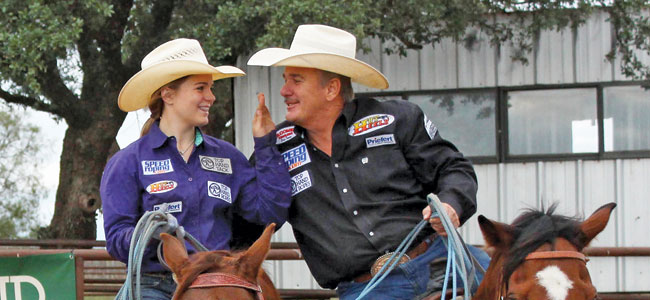
Raising Kids in the Arena
My daughter, Hali, is in her second year of Junior Rodeo and I’ve had some interesting conversations with parents at these events. One question I’m often asked is how to deal with when your child has a bad day, or when things don’t go according to plan. I’ve caught a few people off guard with my response.
When I was competing for a living and going to rodeos every day, one of my most valuable tools was video. It’s difficult, if not impossible, to dissect or pin point mistakes that need to be corrected if you can’t review what happened.
We video every run, win or lose, good or bad, and afterwards we sit down and watch the video. This way Hali can see what I see and we talk about it. I’m not a parent that yells at my kids or talks to them while they’re competing. I’ve never once gotten mad at my child when she didn’t do well. We talk about what happened and why. There’s a bigger picture at play and life is way more important than any run she may make. I don’t want to alienate her or have her dread going to the arena.
I have been teaching for a living for some time now. One thing I know for sure is giving too much advice to your child can limit their learning ability. But making sure they get the right advice is crucial. Often times less is more with the right information.
My goal is to train her to be able to function if I’m not there. That means she needs to be able to see what she’s drawn and make a battle plan. Believe it or not, I don’t tell her what the start is. I have her go look. She used to ask if I agreed with her decision and now she’s pretty confident of her judgment.
I give credit to my father for my philosophy. He did not give me an abundance of advice. He let me make mistakes and we talked about what went wrong afterwards. You learn a lot from failure – far more than from success. None of us want to experience failure again, so it will cause you to put in the effort and do a better job.
Last year, Hali’s first year, I helped her a bit with finding out what she’d drawn and taught her to check with whoever had run the calf, steer, or goat before so she would know what to expect. This year she does it herself.
Here’s the funny part. I will saddle, unsaddle, groom and do all the stuff that I usually hire someone to do for me. But, if she’s taking care of business in all six of her events, and she works at rodeo, she needs some help. I’ve heard many parents say they would not saddle their kids’ horse. My answer to that is, if they are preparing and trying to do a good job, I have no problem helping. The important things to me are: knowing the start, what cow they’ve drawn and then making a battle plan.
Hali is now 13 and played softball until she was 12. Last year when we went to the USTRC Finals she was a #3. This week they just moved her to a #5E. She did a great job this year and won $44,000, but ultimately it comes down to the fundamentals of knowing how to score, riding your horse, and being ready to rope when you get there. Hali has always been my helper when I teach private lessons. Now, she can spin steers or heel for my clients.
When things don’t go well she knows when she sees me she won’t be in trouble. I will joke with her to pick her spirits up. There are much more important things in life than one run. When it doesn’t go well, that’s when your kid needs you to encourage them, more than any other time. I don’t understand parents who yell, scream, and threaten to whip their kids when they don’t do well. My goal in life is for my kids to stay close to me as adults, when they have the choice to be around me or not. That, to me, is far more important than any single victory.
There are many beneficial videos on speedroping.com for kids and adults. If you want to watch some of Hali’s runs with my tips, visit the site and do a search with her name. Most are free to watch. Next month I’ll talk about fundamentals and how crucial they are in competition.