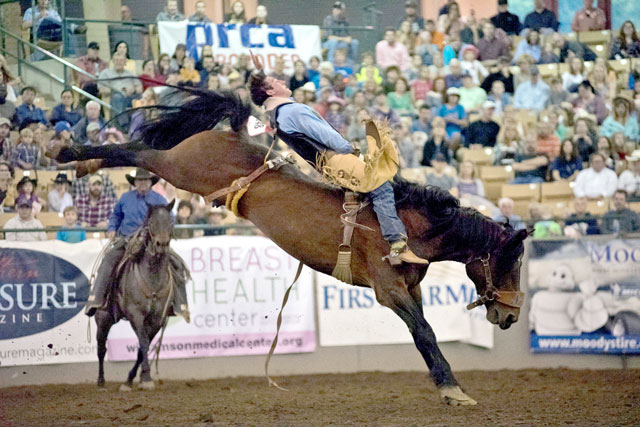
Nebraska man to step in as second bullfighter at hometown rodeo
North Platte, Neb. – May 2018 – The Buffalo Bill Rodeo will have a new face in the arena this year.
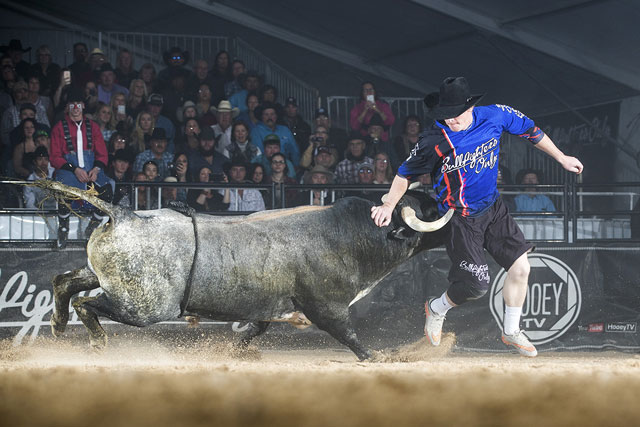
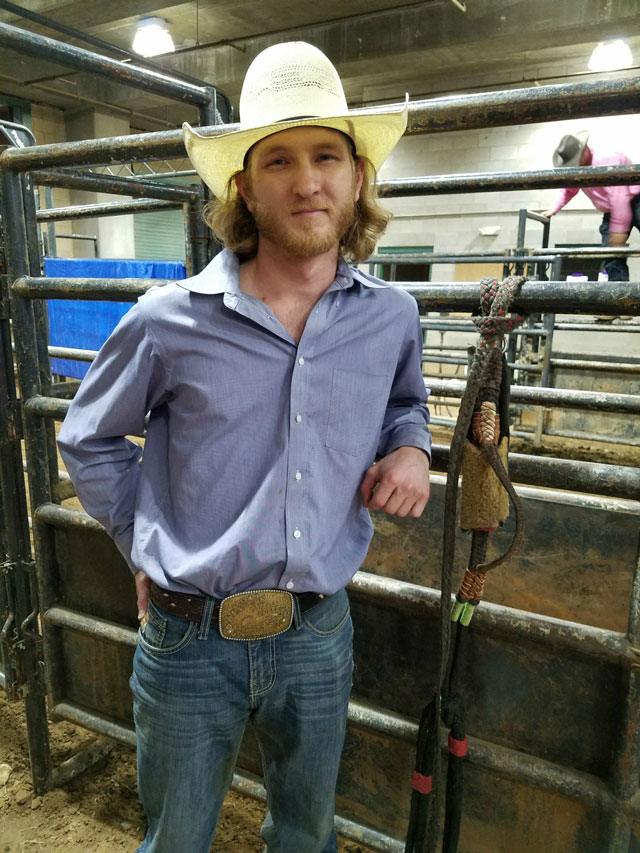
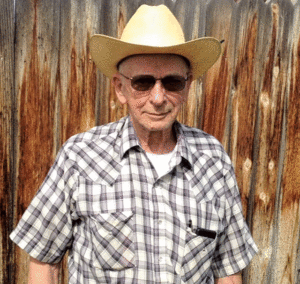
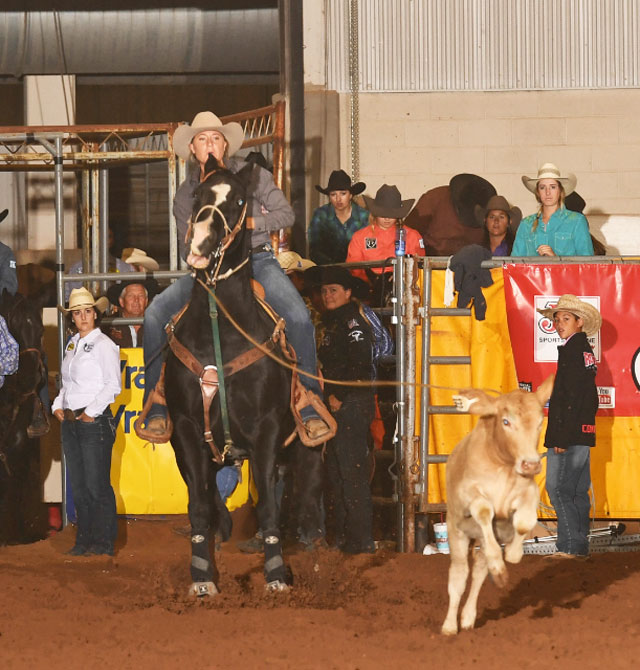
Zach Call, Thedford, Nebraska, will work as a bullfighter at the rodeo.
It’s the 25 year old’s first time to work the North Platte event.
The Mullen-born and raised cowboy will work the rodeo alongside a family friend. Quirt Hunt, from Gordon, was working high school rodeos as a bullfighter when Call’s older brothers were riding bulls. Call “grew up watching Quirt when I was really young,” he said. The two worked a Professional Bull Riders event in Kearney last winter.
Call started his rodeo career as a bull rider, competing in the Nebraska High School Rodeo Association and qualifying for the high school state finals twice. He competed collegiately at Dodge City (Kan.) Community College for two years, then continued at Panhandle State University in Goodwell, Okla.
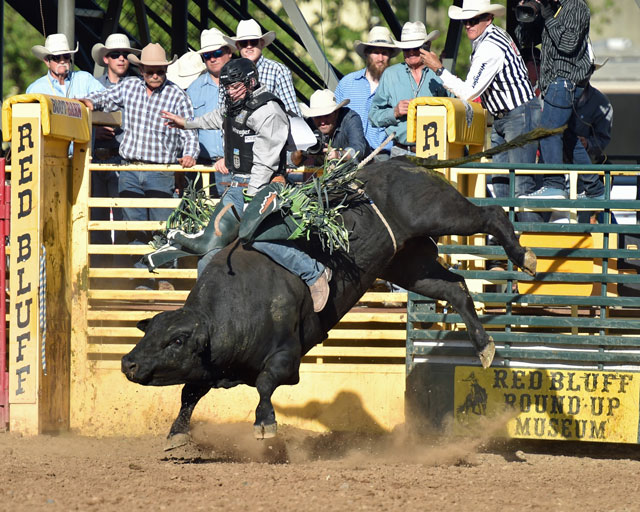
His sophomore year of college, he was fighting injuries and things weren’t going smoothly with bull riding. So he tried the bullfighting, and found it to be to his liking. “I enjoyed it a lot more,” he said and slowly, the bullfighting: protecting the bull riders after their ride, overtook the bull riding.
He went to a bullfighting school put on by world champion bullfighters Rob Smets and Miles Hare. Hare, who grew up in Gordon, took a liking to the young Nebraskan and gave him pointers and tips.
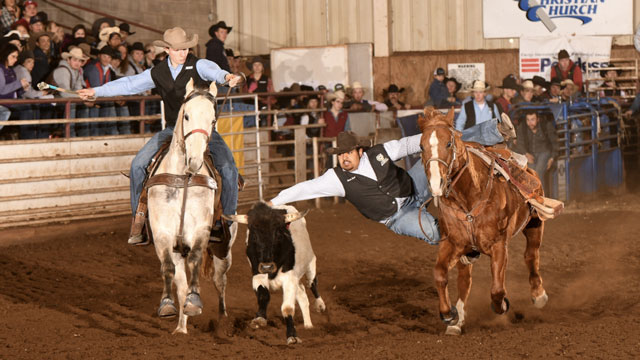
It was at the school that he began freestyle bullfighting. In freestyle, there is no bull rider to protect: it’s a competition among bullfighters with points awarded for how well they maneuver around the bull, how close the fighter gets to the bull, and how well they stay in control.
Call shows a particular affinity to it and has competed in the Bullfighters Only (BFO) events for two and a half years. He finished the 2016 year in sixth place in the BFO world standings, and the next year in ninth place.
In North Platte, Call will be doing cowboy protection bullfighting only. He likes a mix of both types: “you get to change it up every once in a while.”
Cowboy makes winner’s circle even with life’s detours; Tennessee cowboy wins first in the bull riding
Franklin, Tenn. (May 19, 2018) – For the second year in a row, the saddle bronc riding title at the Franklin (Tenn.) Rodeo went to a Louisiana man.
Joey Sonnier III, New Iberia, La., made an 86 point ride on the J Bar J Rodeo horse Sweatin’ Bullets.
It was a horse he was looking forward to getting on. As he worked in his saddle shop last Monday, and found out what horse he’d drawn, he gave out a shout, causing the people in the western store next door to come running.
Sonnier is in his second career as a saddle bronc rider, after having faced down a drug addiction.
He started his pro rodeo career in 1998, but after becoming addicted to pain pills after a shoulder surgery, he quit riding in 2002.
In 2014, he faced down his demons, lost fifty pounds, and came back to rodeo.
He’s done well with his second chance at life.
“Everybody calls it my second career,” Sonnier said. “It’s awesome.” He won nearly $14,000 at the RAM National Circuit Finals Rodeo in Florida last month, and is ranked tenth in the PRCA world standings.
The difference between the second Joey and the first Joey? In one word, he said, “God. Everything goes better with God’s plan than with my plan. His plan is always better than mine. That’s what my life’s been, detours. A lot of them were my own choices, and even when I make a bad choice, God gives me another opportunity.”
In addition to rodeo, Sonnier has another business, making bronc saddles, saddles specifically designed for saddle bronc riding. He started his business a year ago, with four saddles being ridden by cowboys. Now there are 31 cowboys using his saddles.
But his saddle business will have to be sidelined for a while, as he pursues a chance at a qualification for the Wrangler National Finals Rodeo. The top fifteen in the standings vie for a chance at a world championship at the WNFR each December in Las Vegas, and Sonnier hopes to be among them.
His goal: “to keep preparing myself for the opportunities God gives me, and at the end of the year, if I get to go to the (Wrangler) National Finals, then that’s what it’s meant to be.”
Sonnier is married to Michelle; they have three children, Kade (18), Kenley, eight, and Kylie, two.
The bull riding title went to a Tennessee cowboy.
Gray Essary III, Somerville, Tenn., scored 87 points on the J Bar J bull Cold Dice.
He has been riding since he was ten years old, having won the Tennessee High School Finals Rodeo bull riding title in 2012 and the National Inter-Collegiate Rodeo Association title three years later, while a student at Ranger (Texas) College.
Essary was looking forward to his ride. “I drew a really good bull,” he said. “I knew I had the bull to win it on. I just had to do my part.” Cold Dice carried Chase Dougherty to a round win at the Ft. Worth, Texas rodeo earlier this year.
Other winners from the 69th annual Franklin Rodeo are bareback riders Daylon Swearingen, Rochelle, Ga., Tim O’Connell, Zwingle, Iowa, and Blade Elliott, Centreville, Ala. (all three with 81 points each); steer wrestler Denell Henderson, Dmascus, Ark. (3.7 seconds); team ropers Cyle Denison, Stephenville, Texas and Lane Siggins, Coolidge Ariz. (4.1 seconds); tie-down roper John Douch, Huntsville, Texas (7.9); and barrel racer Ericka Nelson, Century, Fla. (17.59 seconds).
Next year’s rodeo will be held May 16-18, 2019. The rodeo is the annual fundraiser for the Franklin Noon Rotary Club.
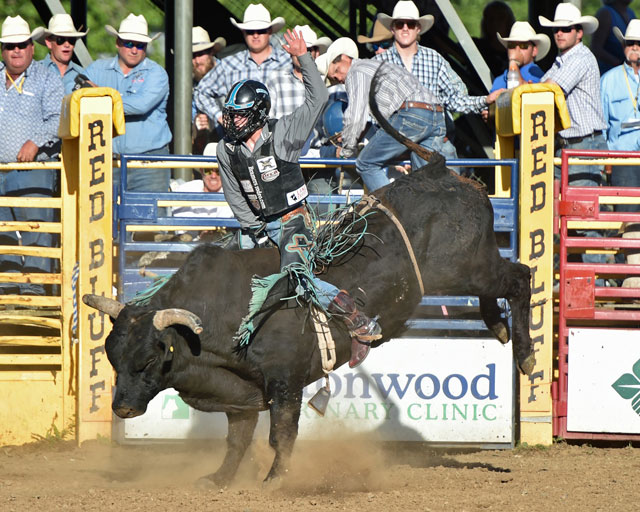
Cutline: Gray Essary III, Somerville, Tenn., won the bull riding title at the 2018 Franklin Rodeo. The 23 year old competed in high school and college rodeo. Photo by Ruth Nicolaus.
Results, Franklin Rodeo, May 17-19, 2018
Bareback riding
(tie) Daylon Swearingen, Rochelle, Ga., 81 points on J Bar J Rodeo’s Dairy Day, Blade Elliot, Centreville, Ala., 81 points on J Bar J Rodeo’s Dairy Day, and Tim O’Connell, Zwingle, Iowa, 81 points on J Bar J Rodeo’s on Two Lounges; 4. Taylor Broussard, Estherwood, La. 79; 5. Steven Dent, Mullen, Neb. 78.5; 6. Scotty NeSmith, Morristown, Tenn. 77.5
Steer wrestling
Denell Henderson, Damascus, Ark. 3.7 seconds; 2. (tie) Juan Alcazar, Jr. Okeechobee, Fla. and Drew Slade, Brooklyn, Miss. 4.1 each; 4. (tie) Quinn Campbell, Robertsdale, Ala. and Lane Bateman, Sorrento, Fla. 4.2 each; 6. Mike Cliver II, Westfield, Penn. 4.3; 7. Tooter Silver, Quitman, Ark. 4.4; 8. Olin Ellsworth, Warrensburg, 4.5.
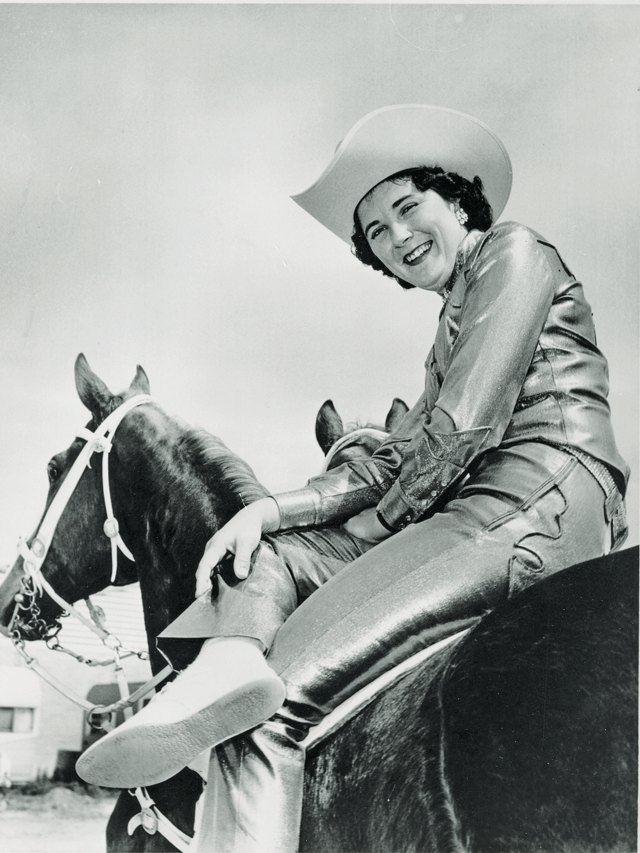
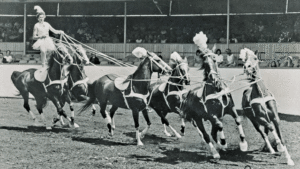
It all started at the Metro Theater in Prairie du Chien, Wisconsin. That’s where Elaine Kramer saw the horses and maneuvers that would make her famous, to which she would dedicate the next twenty years of her life. The Wisconsin woman was born in 1935 and grew up the middle child of Irvin and Helen Kramer. She and her brothers roamed their farm and the woods, playing cowboys and bank robbers and riding horses. Elaine’s first horse was a pony named Little Beauty, then an American saddle bred, and the farm’s draft horses, which she was able to mount by throwing an ear of corn on the ground. When the horse put his head down to eat it, she’d jump on its neck, then as the horse raised his head, she’d slide down on its back. But it was a chance encounter at the movie theater that determined the course of her life.
On the big screen, Elaine watched the movie Ride a White Horse and was fascinated. When the credits rolled, she stayed in her seat, reading them, and discovered that the movie was filmed at the White Horse Ranch in Naper, Nebraska.
Elaine sent a letter to the ranch, asking about it. An invitation came back to come and visit, so she did. It was the summer after her high school graduation, in 1954, and there she learned to roman ride.
The White Horse Troupe, a group of riders from the White Horse Ranch, performed their act at various events. The Troupe was invited to perform at the American Royal Horse Show in 1954, and when a girl was injured during an act, Elaine was asked to take her place. She was “surprised, excited and scared, and determined to do my very best,” she said. And she did. Her goal became clear: she wanted a horse act of her own.
She trained her own horses and learned how to roman ride, sometimes with five and even six horses abreast, and often with two jumps. After Sports Illustrated used a photo of her jumping six horses abreast, the Flying Valkyries, a horse act based out of Palm Springs, Calif., saw the picture and asked her to ride with them.
Elaine performed with them, and also with a troop of performers from Franklin, Indiana, called the Jinks Hogland All Girl Review. The girls jumped horses, roman rode, and had a garland entry. They performed at circuses, wild west shows and horse shows.
She also worked for two years in Pontiac, Michigan, at John F. Ivory’s ranch, instructing girls on jumping horses and ponies and roman riding. At that time, she jumped and rode a nine horse tandem. Each weekend, Ivory had a horse show and polo games, with hundreds of fans showing up to watch.
Mr. Ivory helped her start her own roman riding team, and Elaine’s first show was the Dairy Cattle Congress in Waterloo, Iowa. She fell off her horse, but only her pride was hurt. Red Foley, who was performing, came to see if she was OK and gave her a hug.
Elaine got her Rodeo Cowboys Association membership in 1955, and her career blossomed. She worked for all the major stock contractors of the era: Harry Vold, Bob Barnes, Lynn Beutler, Mike Cervi, Lynn Knight, Rodeos, Inc., and others.
Louisville, KY, Elaine at a rodeo in the 1960’s. Her brother Keith Kramer is helping in the arena – Courtesy of the family
Elaine Roman rides at a rodeo in Santa Barbara, California in the 1960’s. – Courtesy of the family
In 1969, she went to California and worked for Cotton Rosser, spending two years on the West Coast.
Throughout her career, Elaine had a wonderful time, meeting wonderful people and making memories. One of her more memorable moments, in part because it was a near-accident, came in 1964. She was entertaining at the Toronto Royal Winter Fair, the opening of all winter fairs in Canada, with the queen in attendance. The queen’s rifle battalion was marching out of the arena when someone hollered that she was up. The gate was opened before the soldiers were out of the arena, and as Elaine and her six horses galloped in, she nearly ran over one of the soldiers. He never moved, she remembered, as she maneuvered around him. The next day’s newspapers said that she had made a splash at the Fair, and she was invited to sit with dignitaries in the press box.
She never had any major accidents, but she recalled a wreck one time in El Paso. She was roman riding a six horse hitch when the right lead horse fell between jumps. The rest of the team landed on each other, and Elaine fell between the wheel horses, the horses she was standing on. She got up, put bridles back on, sorted out the reins, did her act, and got a big ovation.
Elaine remembers meeting celebrities from all walks of life and doing extraordinary things. She drove the Budweiser hitch, and when Tanya Tucker was in her teens and not yet a big country music star, she sat on Elaine’s lap and told her, “I’m going to buy all your horses.” Elaine had a reply for her: “You don’t have enough money.”
She usually did her roman riding with a two, four or six horse hitch, going over two jumps, with her trademark act being with the six horse hitch. She trained her own horses, sewed her own costumes, and did a lot of her own driving. Her horses: Flash, Frosty, Flicka, Frisky, Fleet, Fury, Fantasy and Fascination were all sorrels with white faces and four white socks, and if they didn’t have the white socks, she made boots so they looked alike. The horses wore white plumes, white harness, and had white glitter on their hooves.
Occasionally, her younger brother Keith would help her. Their parents would pull him out of school and send him to the bigger shows and rodeos. He knew how to set the jumps: nine paces between the jumps, and as he got older, he drove truck for her. She taught him how to haul horses, “yelling at me if I took off too fast or hit the brakes,” Keith remembered. Her long-time companion Dan Quinn traveled with her for the majority of the time; they spent 41 years together.
Throughout her career, she worked the Dallas-Fort Worth Stock Show (where she had a complete wardrobe change for each of the ten performances), Madison Square Gardens, the National Western in Denver, the Cow Palace in San Francisco, was invited to tour Europe, and more. (She didn’t go to Europe; the quarantine for her horses would have taken too long).
In 1974, she decided to call it quits. One of her horses had passed, and the two wheel horses were getting old. Her knees were bad, and it was time to stay home. Her last performance was in Omaha at Ak-Sar-Ben, where one of her horses came up lame. The veterinarian gave him a shot of cortisone to get him through the show, and the horses were “flawless,” Elaine said. As she styled around the arena for one last round, she got a standing ovation. “My horses pranced out of the arena, as though they knew it was their last performance.” Later, the veterinarian told her if he’d known how dangerous her act was, he wouldn’t have let her ride. She told him, with his help, she had made another safe ride, her last ride.
“After twenty years of training, feeding, washing and hauling horses and driving many miles, fixing harnesses, sewing sequins on costumes, I concluded I would definitely do it all again,” Elaine said.
Her career came full circle when, in 1974 at the Metro Theater in Prairie du Chien where it all started, Elaine watched the movie The Great American Cowboy starring Larry Mahan, where a cameo appearance of her act was included.
After her two decades, she came back to Prairie du Chien to help with her parents’ beef farm. She started a trailer park which she still oversees. Her parents have passed, and now her great-nephew David Kramer runs the farm. The circle may be coming back around; a few months ago, when Elaine was visiting David and his family, she witnessed his two-year-old daughter standing on her rocking horse, just like her great-aunt did years ago.
Elaine is a 2005 Cowgirl Honoree in the National Cowgirl Hall of Fame and Museum. Her brothers: Keith and Russell, live in Wisconsin, and she has two nieces and two nephews.
She doesn’t regret a minute of her career. “I never expected what a satisfying fulfillment it would be.”
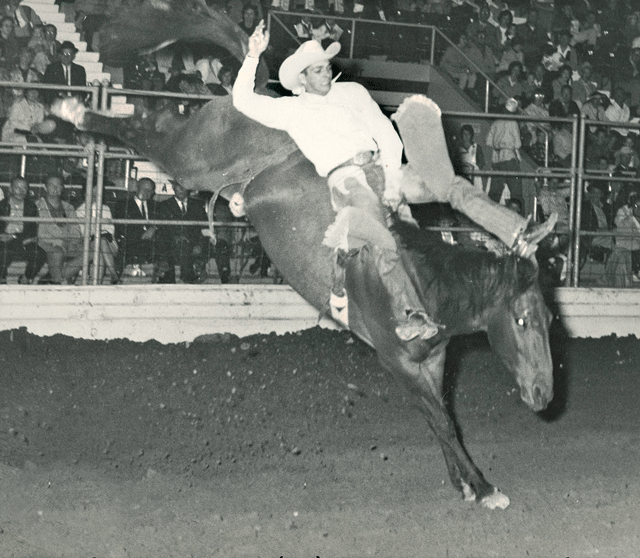
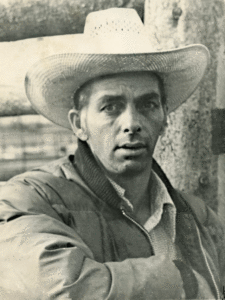
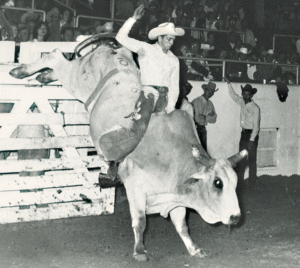
It was while riding his dad’s milk cows that Ken Stanton got the inspiration to be a rodeo cowboy. The Weiser, Idaho man spent over two decades in pro rodeo, competing in both the bareback riding and the bull riding, and qualifying nine consecutive years for the National Finals Rodeo, six of those years in both of his events.
He was born in 1941, the youngest of four children of Roy W. and Lillian (Pattee) Stanton in The Dalles, Ore. The family moved to Cloverdale, Oregon, five miles from Sisters, and the kids attended Redmond High School. Ken was an outstanding wrestler, winning the state championship two years and finishing one year as runner-up. As a freshman, he wrestled at 98 lbs. and four years later, at 115 lbs.
Even though he had wrestling scholarships from Oregon and Oregon State, he chose to go to work, cowboying on a cattle ranch in eastern Oregon. It was winter time and one of the coldest winters, when he was on the wagon, throwing bales, while another worker was driving the tractor. One day, Ken told him, “it’s your turn to throw bales,” and the guy said no. Ken replied, “You are today, because I’m leaving.”
He took off for Odessa, Texas. He and his older brother Bill had competed in a half-dozen amateur rodeos (there was no high school rodeo then), and together, they headed south. He didn’t win money in Odessa, but a week later, in San Antonio, won $1800, more money than he’d ever seen before. He wasn’t greedy: “I sent most of it home to the folks because I didn’t need it.”
Ken stayed in the south, rodeoing at Rodeo Cowboys Association rodeos. He got his RCA card in 1960 and was a full time cowboy for the next decade. Bull riding was his favorite, but he was pretty even in his talent at both.
Mural of Ken on #18 Steiner, Fort Worth, Texas; photo by Ferrell; Mural is made up of 1 inch tile that is 31 feet tall and 9 feet wide. It is located on the Will Rogers Memorial Arena parking garage in Fort Worth, Texas – Matt Brockman, Forth Worth Stock Show & Rodeo
“Old Man” Stanton, Stanton School – Wright Photo
Ken on #10, he scored a 63 point ride in Albuquerque, 1965 – Allen Photo
He was a natural at bareback and bull riding. He was small: only 5’4” and 145 lbs., but wiry and strong. In high school, he had jumped on the school’s trampoline, strengthening his core and improving his balance while entertaining fans during basketball halftimes. And he’d worked hard on his family’s ranch, throwing bales that weighed as much as he did.
From 1960 to1970, he rodeoed in the south during the winter and headed to the Northwest for the summer. He competed at about fifty rodeos a year, when other cowboys were going to 100 or more.
And he did well, financially. He estimates he averaged $22,000 a year as income over the ten year period, with his best year earning $28,500. “That was a good income for us,” he said. “It was a lot of money then.”
He competed at the National Finals Rodeo every year from 1962 through 1970, in the bareback riding eight times and the bull riding seven times. His highest finish was fourth place in the bull riding in 1964. In 1970, he was ahead of Gary Leffew in the bull riding, both having covered eight bulls, till Ken got bucked off his ninth bull and Gary beat him by only 35 points on nine head. “If I’d have rode (the ninth bull), nobody could have touched me.” He finished that year second in the average.
When he was on the road, his family went with him. He married Ginger Tarter in 1965 and they had three children: daughter Tracy and sons Scott and James. The kids loved being on the road. “They were like rodeo orphans,” Ken said. “The kids loved (being at rodeos) and people loved them.” Some of Ken’s fondest memories were at the Pendleton Round-Up. His parents and Ginger’s parents attended the Round-Up, and they’d take a big box of tomatoes grown by friends of his parents’. The cowboys loved it. “They couldn’t wait for us to get there, and they’d sit there and eat tomatoes,” Ken recalled. “It was like a family reunion.”
The year 1970 was his last year of full time competition. He spent the next three years working as a general contractor in Colorado Springs, building homes. Then he became a deputy sheriff for Washington County, Idaho, his home county. He worked that job for ten years, handling the civil lawsuit work and some of the jailer duties. He competed in a few rodeos, but not many.
After ten years of deputy sheriff duties, Ken went to work for a gold mine in Battle Mountain, Nevada, driving a 350 ton haul truck and working there till 2000.
It was an injury that started on the eastern Oregon ranch and culminated while he was a deputy sheriff that bothered him the rest of his life. On the ranch, he had gotten frostbitten feet while feeding cattle. A few years later, while traveling on slick roads on a cold snowy day with his wife and daughter, the car went into the ditch. Ken ran for help, running eleven miles in two and a half hours and getting frostbite again. The final straw was as deputy sheriff. He was working an accident that started with one car in the ditch on icy roads, and seven hours later, was a seventeen-car pileup. His feet were frozen, and gangrene set in. Doctors amputated two toes in 1974, then a few years later, his feet at mid-arch. In 2004, his left leg was amputated four inches above the knee. His leg’s veins had collapsed.
Ken Stanton – Courtesy of the family
Ken on “Sorrel Top,” Houston, 1965 – Allen Photo
The toughest bull Ken saw while rodeoing was Snowman, owned by the Christensen Brothers. The bull had been unridden for five or six years when Ken drew him at Pendleton. He got bucked off at the whistle and remembers seeing Jim Shoulders and Harry Tompkins kneeling in the arena, watching the ride. He also remembers their comment: “that bull can’t be that bad, that kid almost rode him.” It was several more years before someone made a qualified ride on Snowman.
Ken was part of a unique brotherhood. At the 1967 and 1968 National Finals Rodeos, five contestants: Ken, his brother Bill, Jim Ivory, his brother John Ivory, and Larry Mahan were all graduates of Redmond High School and all members of the wrestling team.
After his leg was amputated, Ken moved back to Weiser, where he lives with his brother Bill, who also competed at the National Finals Rodeo. Ken and Ginger divorced in 1981. His daughter Tracy, who has five children, lives a few miles away. His sons, Scott and James, live in Boise. Ken has three great-grandchildren.
He served as bareback riding director for two years, but it wasn’t for him. And he was asked to judge rodeos, but by then, his feet were bothering him and it was difficult to stand for long periods of time.
His brother Bill, who was a year and a half older than him, had a plane and a pilot’s license and they would sometimes fly to rodeos. Ken remembers one time when they left St. Paul, Oregon, headed south of San Francisco. As soon as Bill got the plane off the ground, he asked Ken to take the wheel for a minute. “Then Bill jumped into the back and said, ‘wake me when we get to Bakersfield,’” Ken laughed. They were cruising at 12,000 feet, and Ken knew Mt. Shasta was 13,000 feet, so he pulled the plane up to 14,000, following the freeway to their destination.
His dad always knew when his boys had been riding the milk cows. “One of us would get on, and the other would turn her loose,” Ken remembered. “The hard part was ducking under the door.” The next day, those cows wouldn’t give milk, and it would be a dead give-away for the boys’ antics. His dad would ask, “have you boys been riding them cows?”
Ken is an inductee into the Ellensburg (Wash.) Rodeo and Pendleton Round-Up Halls of Fame. At Ellensburg, he won the bareback riding, bull riding, and the all-around several times. Lewiston, Idaho was also a rodeo he won multiple times.
Ken loved having his family with him as he rodeoed, and he loved rodeoing. “I wouldn’t trade it for nothing now,” he said. He never won a world title but he stayed in the top fifteen, competing at half as many rodeos as the others. “It’s in your blood or you just don’t do it,” he said. “It’s not easy but it’s a good way to make a living.”
Ft. Hays rodeo students benefit from Kansas’ Biggest Rodeo
PHILLIPSBURG, KAN. (April 9, 2018) – Two Ft. Hays (Kan.) State University (FHSU) students have been awarded scholarships courtesy of the Phillipsburg Rodeo Association.
Shae Biedenbender, Westmoreland, Kansas, and Travis Booth, Castle Rock, Colo., have both been awarded $500 scholarships.
Biedenbener, who is a freshman at Ft. Hays State, competes in the breakaway roping, goat tying, team roping (as a heeler), and will add barrel racing to her repertoire this spring.
She is studying to become an interior designer, having dabbled in it since childhood. After college, she plans on designing the interior of living quarter horse trailers. “Since I’m on the road, I know what people would like in a trailer. I’ve always had a creative mind.”
She is a 2017 graduate of Rock Creek High School in St. George, Kansas and was on the honor roll all four years of high school. Her parents expected her to study. “My dad made it known,” she said, “that he struggled in high school and he made sure his kids knew to take it seriously.” Studies still come first for her in college. “That’s what our (college rodeo) coaches say, too, and I don’t disagree with them at all.”
The scholarship will go towards cost of tuition and books, and she’s grateful for it. “I’m all about helping my family not have to pay expenses,” she said.
She is the daughter of Dan and Meloni Biedenbender.
Travis Booth is a sophomore at FHSU and is majoring in animal science.
He competes in the steer wrestling and team roping, having begun his collegiate rodeo career at Otero Community College in La Junta, Colo. and transferring to FHSU last fall.
He is appreciative of the scholarship money; “it really helped me,” he said.
Booth plans on graduating in May of 2020 and may choose to go back to Colorado and grow the cattle operation he and his dad have started.
Since 1997, the Phillipsburg Rodeo Association has awarded scholarships to FHSU students who compete in rodeo. The Phillipsburg Rodeo Association is the organization behind Kansas’ Biggest Rodeo, which will be held August 2-4, 2018. For more information on the rodeo, visit www.KansasBiggestRodeo.com.
World champions, contenders leave northern California with gold buckles
Red Bluff, Calif. (April 22, 2018) – Two world champions won their events at the 97th annual Red Bluff (Calif.) Round-Up this weekend.
Tyler Pearson, the reigning steer wrestling champion, and Zeke Thurston, the 2016 saddle bronc riding champion, both collected gold buckles for their efforts in Red Bluff.
Pearson, Louisville, Miss., had a combined time of 21.0 seconds on four runs to win the steer wrestling. He had seen another cowboy make a 5.2 second run on his steer earlier this week, and “I knew I had a chance. I trusted in the horse and the hazer, and all went well.”
Pearson’s first world championship, won last December at the Wrangler National Finals Rodeo (WNFR), has been a big confidence booster. It was a “dream come true,” he said. “It was one of those story book endings, and it’s rolled over to this year. It’s been fun.” Pearson is currently ranked in the top ten in the PRCA world standings.
The horse Pearson rode has his own special resume. Outlaw, a twenty-year-old palomino, has been ridden by the last four Red Bluff champions: Pearson this year, Chance Howard in 2017, Ty Erickson in 2016, and Tyler Waguespack in 2015.
Owned by Waguespack, the horse does well with long scores and larger arenas, and at this year’s Round-Up, was ridden by five cowboys: Pearson, Erickson, Waguespack, Timmy Sparing and Rowdy Parrott.
Outlaw is a former barrel horse who was purchased by Waguespack five years ago. “My dad and I got to playing around with him one day, and we wound up training him (for steer wrestling) one summer. We found out what he was good at, and we took him into rodeo kind of slow.”
Outlaw is well loved by his riders and his owner. “I’m really proud of him and how he performed today, and really proud of all the guys who rode him,” Waguespack said.
The saddle bronc riding title went to Zeke Thurston.
The world champion from Big Valley, Alb., scored 86.5 points on the Calgary Stampede horse Urgent Delivery. It wasn’t the first time the two had met.
Five years ago, when he was eighteen, he rode the horse at the Canadian Finals Rodeo during the novice saddle bronc riding, winning the round. “I rode that horse when he was just a baby and I was pretty young myself,” he said. “We were both pretty green. He’s a big strong bucker but I made a good ride on him and got a little money for it.”
Thurston is the son of Skeeter Thurston, a six-time WNFR qualifier. The world title the younger Thurston won two years ago was “awesome. That’s the pinnacle of our sport, what everybody works their way towards. Every year I rodeo, I rodeo for a world title.”
He and his wife are expecting their first child in August.
The tie-down roping title went to an Oklahoma man.
Tyler Milligan, Pawhuska, Okla., had a time of 38.2 seconds on four runs to win the Round-Up buckle.
Milligan is the 2017 Resistol Rookie Tie-Down Roping of the Year, a title that goes to the contestant in each event who has won the most money during their rookie year.
He was aboard a fifteen-year-old sorrel named Big Time, who has enabled him to do well. “He’s the best horse I’ve ever had,” Milligan said. “I wouldn’t have won near what I won last year without him. He’s phenomenal. He’s the same trip every time.”
Milligan is all business in the rodeo arena, not letting wins or misses affect him. “I just keep doing the same thing, just take one calf at a time. Every time you win, it’s a confidence booster. But I always try to stay the same, not get too high or too low.”
Other Red Bluff champions include bareback riders Jamie Howlett, Weatherford, Texas (87.5 points); team ropers Cody Snow, Los Olivos, Calif. and Wesley Thorp, Throckmorton, Texas (29.1 seconds on four runs); barrel racer Jessi Fish, Franklin, Tenn. (34.53 seconds on four runs) and bull riders Jordan Hansen, Ponoka, Alb. and Garrett Tribble, Bristow, Okla. (88.5 points each).
During the rodeo, which was the annual Tough Enough to Wear Pink event, a VIP rodeo package was auctioned off. Rose Crain and Dan Davidson, owners of Haleakala Ranch, purchased it for $26,000. The “Run for the Roses” package includes a trip to the Kentucky Derby, a behind-the scenes tour from an official veterinarian, hotel stay, and round-trip airfare. Monies raised during the Round-Up’s “pink” campaign go to breast cancer treatment at the St. Elizabeth Imaging Center.
Next year’s Red Bluff Round-Up will be held April 19-21, 2019. For more information on the rodeo, visit RedBluffRoundup.com.
Results, Red Bluff Round-Up, April 20-22, 2018
All-around winner: Rhen Richard, Roosevelt, Utah (tie-down roping and team roping)
Jamie Howlett, Weatherford, Texas 87.5 points on C5 Rodeo’s Virgil; 2. Zack Brown, Red Bluff, Calif. 87; 3. (tie) Bill Tutor, Huntsville, Texas and Jake Brown, Cleveland, Texas 85 each; 5. (tie) Seth Lee Hardwick, Ranchester, Wyo., Mason Clements, Springville, Utah, and Kaycee Feild, Spanish Fork, Utah 84.5 each; 8. Steven Dent, Mullen, Neb. 83.5
Steer Wrestling 2018 Red Bluff Champion – Tyler Pearson, Louisville, Miss.
First round:
(tie) Jesse Brown, Baker City, Ore. and John Henry Franzen, Riverton, Wyo. 4.8 seconds each; 3. Nick Guy, Sparta, Wisc. 5.1; 4. Curtis Cassidy, Donalda, Alberta 5.2; 5. (tie) Rowdy Parrott, Mamou, La. and Ty Talsma, Avon, S.D. 5.3 each.
Second round:
(tie) Stan Branco, Chowchilla, Calif. and Aaron Vosler, Cheyenne, Wyo. 4.2 seconds each; 3. (tie) Bridger Chambers, Stevensville, Mont. and Brad McGilchrist, Marysville, Calif. 4.4 each; 5. Jesse Brown, Baker City, Ore. 4.6; 6. (tie) Rhett Kennedy, Chowchilla, Calif. and Sterling Lambert, Fallon, Nev. 4.7 each.
Third round:
Bridger Chambers, Stevensville, Mont. 3.8; 2. Ty Erickson, Helena, Mont. 4.8; 3. (tie) Dirk Tavenner, Rigby, Idaho and Tyler Pearson, Louisville, Miss. 5.1 each; 5. Harley Cole, Okotoks, Alb. 5.3; 6. (tie) Taylor Gregg, Walla Walla, Wash. and Cody Cabral, Hilo, Hawaii 5.4.
Finals:
Ty Erickson, Helena, Mont. 4.5 seconds; 2. Tyler Pearson, Louisville, Miss. 4.9; 3. Tucker Michael Allen, Oak View, Calif. 5.0; 4. Jesse Brown, Baker City, Ore. 5.1.
Average:
Tyler Pearson, Louisville, Miss. 21.0 on 4 head; 2. Bridger Chambers, Stevensville, Mont. 21.8; 3. Ty Erickson, Helena, Mont. 22.6; 4. Aaron Vosler, Cheyenne, Wyo. 23.8; 5. Will Lummus, West Point, Miss. 24.1; 6. Jesse Brown, Baker City, Ore. 24.4.
Saddle bronc riding 2018 Red Bluff Champion – Zeke Thurston, Big Valley, Alb.
Zeke Thurston, Big Valley, Alb. 86.5 points on Calgary Stampede’s Urgent Delivery; 2. (tie) Rusty Wright, Milford, Utah, and Taos Muncy, Corona, N.M. 85 each; 4. Jesse Wright, Milford, Utah 82.5; 5. Chuck Schmidt, Keldron, S.D 82; 6. (tie) Ryder Wright, Milford, Utah, Wade Sundell, Boxholm, Iowa and Louie Brunson, New Underwood, S.D. 81 each.
Tie Down Roping 2018 Red Bluff Champion – Tyler Milligan, Pawhuska, Okla.
First round:
Cooper Martin, Alma, Kansas 9.1 seconds; 2. Randall Carlisle, Athens, La. 9.6; 3. Tyler Milligan, Pawhuska, Okla. 9.9; 4. Jordan Ketscher, Squaw Valley, Calif. 10.0; 5. Ty Baker, Van Horn, Texas 10.3; 6. Dakota Eldridge, Elko, Nev. 10.5.
Rollie Gibbs has played several different roles in the sport he loves. He was a bull rider and bulldogger, competing for thirty-plus years, served as chairman of the Helldorado Days Rodeo in Las Vegas, president of the Wilderness Circuit, president and advisor for the Nevada High School Rodeo Association, and chairman of the Old Timers Reunion.
It all started in 1935, when he was born in Las Vegas, the younger son of Bert and Cecilia Gibbs, on the old Miller Ranch, which is now Sunset Park on Eastern and Sunset Roads, back when Fremont Street was gravel.
He was a year old when he was in the Helldorado Days Parade, in the back of a little cart while his older brother Delbert drove the cart with a pair of goats. When he was a kid, he and his brother would ride their horses to Bonanza and Second Streets, where they would watch the rodeo and the horse races.
In high school, he rodeoed, riding bulls. One Monday morning, he was up in slack and had to cut school to ride. His parents did not approve of his rodeo; they didn’t want him to get hurt and they did not know that he competed. That evening, he was working with his dad in the front yard, when his dad said, “I hear you can ride bulls.” Father Kenny, from the local parish, had seen Rollie ride and reported it to his dad. The cat was out of the bag.
After graduating from Las Vegas High School in 1954, Rollie went pro. For a while, he didn’t have to buy his Rodeo Cowboys Association card; Chuck Shepard, a judge, would waive the fee for him at the rodeos Chuck was at. One time, in Salt Lake City, June Ivory cornered Rollie, telling him Shepard wouldn’t be there, so he’d have to buy his card.
Rollie steer wrestling at the Silver Bird Hotel in 1980 with Jerry Jones hazing. It was a 5.5 second run. – courtesy of the family
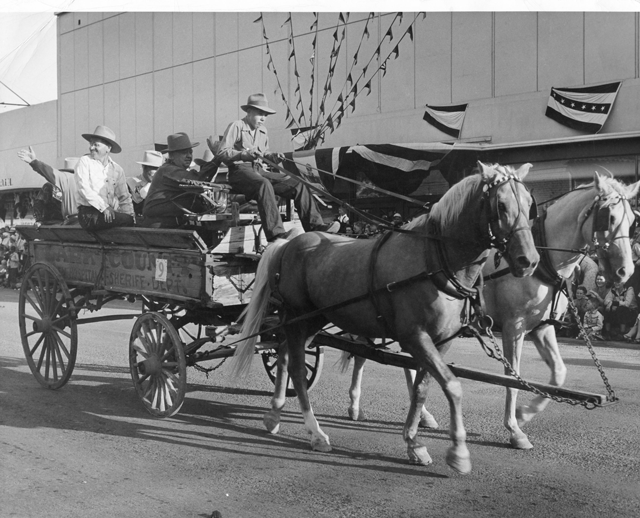
Rollie’s older brother Delbert drives the wagon with Rollie in the back, 1940 – courtesy of the family
In his high school days, Gibbs rode bulls. It wasn’t till ’55 that he started steer wrestling, and he won the first rodeo he entered. Wide World of Sports was televising that event, and “I was twenty feet tall and bullet proof,” Rollie laughed. He competed at rodeos from Cheyenne, Wyo., to Denver, Salt Lake City, Ogden, Spanish Forks, Prescott, Phoenix, Scottsdale, and more. And when steer wrestling greats like Willard and Benny Combs hazed for him, he was on top of the world. “I thought, man, I was King Kong.”
He competed, on and off, for 36 years, and won his hometown rodeo, Helldorado Days, in 1977. A year later, he was asked to be the chairman for the rodeo. Rollie also served three years as chairman of the Helldorado Rodeo Queen pageant. During his year at the helm of Helldorado Days, he had a midnight performance for the workers on the graveyard shift.
Gibbs served as president of the Wilderness Circuit from 1979 to 1982, and helped with the Nevada High School Rodeo Association as an advisor and as president. He worked to bring the high school state finals to Las Vegas. The first time, it was hosted at the Star Dust arena. But when the arena was turned into an RV park, there was no other outdoor facility in Vegas to host it. Rollie went to the county commissioners and worked with them to build Horseman’s Park. Gibbs, in his ingenuity, used local supplies: drill stem pipe from the Nevada Test Site (now the Nevada National Security Site) for posts, leftover lights from the airport, and more. The high school finals was televised for several years by the PBS station, and Rollie secured a Las Vegas High School alumnus; Pam Martin Minick, to serve as commentator. Supporting youth was a big part of his life, whether it was in rodeo or through high school scholarships.
During this time, Rollie had been working for a crane company, with an understanding boss who allowed him to rodeo. When the company passed to the son, he decided to form his own company: the Rollie Gibbs Crane Service. After 26 years with the first company, he took many of his customers with him. He worked on many familiar buildings in town: Caesar’s Palace, the Mirage, the Riviera, the Stardust, at the Nevada Test Site, and more. His skills and dependability were in high demand; when Rollie did a job, it got done quickly and it got done well. “I was working seven days a week, around the clock,” he said.
An example of his hard work was the Landmark Tower. The tallest structure in Las Vegas when it was begun, he and his crew built 26 concrete floors in eleven days, pouring a foot an hour.
Rollie Gibbs (left) and Liz Kesler (far right) on behalf of the Cowboy Reunion present a check to Cindy Schonholtz (center) and the Justin Cowboy Crisis Fund – courtesy of the family
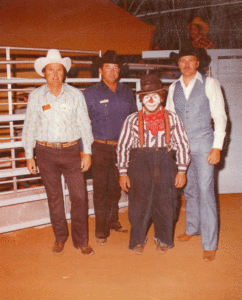
(l to r) Co-Chairman Gail Gibson, Chairman Rollie Gibbs, John Taylor and Co-Chairman Don Helm. The 1987 Elk’s Helldorado Rodeo in Las Vegas, Nevada – courtesy of the family
Rollie and Naomi – courtesy of the family
As owner of Rollie Gibbs Crane Service, he donated much of his time to charities, helping build the Ronald McDonald House, a Salvation Army warehouse, and more. He’s volunteered his time with Habitat for Humanity, and served as Cub Scout leader, receiving the Meritorious Service Award.
Rollie worked as a pickup man for Cotton Rosser and Flying U Rodeo, and served as a judge as well, judging rodeos from the 1960s into the ‘80s. He was on the board of the Miss Rodeo Nevada organization, produced a Little Britches Rodeo in Overton, Nev., and a high school rodeo in Pahrump, Nev.
Since 2008, he’s been president of the Las Vegas High School Alumni Association, and with his guidance, the association has paid out nearly $100,000 in scholarships for high school youth.
Rollie is currently on the board of directors for the Original Cowboy Reunion, begun by Buster and June Ivory and Liz Kessler. The group meets every year in Las Vegas during the National Finals Rodeo.
He built his own home in the early 1980s in a prestigious part of town, Section 10. He and his wife host parties and events at their home, weddings, memorials, Rollie’s high school reunion, church gatherings, and, each year, their rodeo friends when they are in town for the Cowboy Reunion.
A few years ago, he ran into a classmate from high school. Naomi Lytle had been a Helldorado Rodeo Queen, but after marriage, had moved out of town. Her husband died, and when she visited Las Vegas, they reacquainted and got married five years ago. “She dearly loves the same things I do,” Rollie said. Together, they’re spending their retirement days traveling the world, visiting Ireland, Scotland and England; Alaska, the Caribbean, Montreal, and more.
Rollie has had tickets to the NFR since it moved to Vegas in 1985. Four seats in the fourth row belong to him, and he goes to all ten performances. He also loves to visit the Gold Card Room, where the PRCA’s gold card members visit.
Looking back on his life, he recalls the good days. “I can’t say I’ve had a bad part of my life,” he said. “I’ve lived in the best of times.” And at the age of 82, he’s not done. “I’m not dead yet. I’ve got plenty of other things to do.”
Red Bluff, Calif. – A new event is coming to the Red Bluff Round-Up.
Breakaway roping will be one of the competition events at this year’s Round-Up, held April 20-21-22 at the Tehama District Fairgrounds.
For cowgirls only, breakaway is similar to tie-down roping. The cowgirl on horseback in the box at the south end of the arena, nods her head when she and her horse are ready to go. The calf is released from the chute and the cowgirl ropes the calf. The cowgirl stops her horse, and while the calf runs, the end of the rope, which was attached to the saddle horn, breaks away, signaling the end of the run. Good breakaway runs will be two or three seconds in length.
It’s a fun addition to the Round-Up, says local breakaway roper Suzanne Williams. Williams, who lived in Gerber and recently moved to Susanville to coach the Lassen College rodeo team with her husband Dan, will compete in Red Bluff.
Fans will enjoy the breakaway roping for two reasons, Williams believes. It’s fast paced, and it features women. PRCA rodeos usually involve women in the barrel racing only, and spectators may like to see another women’s event. “The fans like to see the cowgirls,” Williams said. “In our day and age, when women are empowered, it’s nice to see them get to rope.”
Williams grew up on a ranch ninety miles from Winnemucca, Nev. and began breakaway roping when she was eight years old. As a kid, her parents allowed her to compete in three junior rodeos a year, but once she got to high school, “I was all in,” she said. She has always “made” her own horses, riding horses she trained herself instead of buying them trained. In college, she won the all-around title at the College National Finals Rodeo twice (2001, 2003), and has competed at the Women’s Pro Rodeo Association (WPRA) Finals Rodeo three times, finishing as reserve world champion breakaway roper in 2015 and 2016.
The breakaway roping at the Round-Up will be sanctioned by the Women’s Pro Rodeo Association (WPRA). The first round of competition will take place during slack on April 19; the 24 fastest breakaway ropers will go on to compete in the performances (eight in each performance.)
The Round-Up will add $2500 to the purse for the breakaway roping, and Williams thinks that will entice breakaway ropers from all over the nation to come to Red Bluff. “We’ll see a lot of California cowgirls. It’ll draw cowgirls from all over, because of the added money. It’s worth driving out here.”
Williams said the little girls in the crowd will appreciate seeing the breakaway ropers. “I think it helps (them), seeing the cowgirls in another event,” she said. “All those little girls out in the stands, waiting to watch.”
The Red Bluff Round-Up will be held April 20-22. Performances begin at 7 pm on April 20, at 2:30 on April 21 and at 1:30 on April 22. Tickets range in price from $14 to $30 and can be purchased online at www.RedBluffRoundup.com, at the Round-Up office (530.527.1000) and at the gate. For more information, visit the website.
Rodeo title cements a love of community in Franklin resident
Franklin, Tenn. (March, 2018) – Tonya Sanchez has never strayed far from the Franklin Rodeo.
The Franklin resident spent most of her growing up years in her hometown, attending the rodeo, and in 1986, even served as the Franklin Rodeo Queen.
The rodeo does not have its own queen anymore; rodeo officials estimate the local pageant was eliminated about twenty years ago.
But in the 1980s, each high school in Williamson County: Fairview, Franklin, Page and Battle Ground Academy voted on one girl to represent her school at the rodeo pageant. Sanchez, who ran for the pageant when she was sixteen, made signs, hoping to get the votes to represent Page High School.
Then, those four girls won the Franklin Rodeo Queen title by selling the most tickets. Sanchez and her girlfriend hit the pavement hard, going door to door, knocking on lots of doors.
It was a great experience, she said. She got to know and meet other people, and most were so welcoming, inviting her into their homes and talking with her. One of her memorable instances was meeting Miss Jenny Gant. A well-known Franklinite, Gant told her she wouldn’t buy tickets but would donate the money. “She said, “honey, I’m too old to get out but I’ll give you any amount of money you need, and you can put it towards those tickets.’”
Part of Sanchez’s drive to win the rodeo title was to fit in. She and her family were the one of the first Hispanic families to live in Franklin, and the kids at school called her “Taco.” “I was trying to prove that, hey, I belong here, just as much as anybody else.” She didn’t let the nickname define who she was; she used it for motivation. “I knew (the nickname), I loved it, and I embraced it.”
Sanchez loves her hometown and has lived and worked in it most of her life. In high school, her first job was at the Baskin Robbins store. After high school, she worked at Bridal Showcase in downtown Franklin, then at a tuxedo company. During her marriage, she lived in Nashville but moved back after her divorce.
She has been a member of the Franklin Noon Rotary Club, the organization that produces the rodeo, since 2004, sitting out a few years but returning full time last year. She is a Paul Harris Fellows recipient.
Sanchez hasn’t missed many rodeos, either. Her family, including her mom Theresa Sanchez and grandmother, Francis Headrick, still go.
For serving as the Franklin Rodeo queen over thirty years ago, Sanchez received a trophy and a pair of cowboy boots, which she still has. She got to ride in the parade and was recognized during the rodeo each performance.
It was a great experience, one she remembers fondly. It gave her a reason a sense of belonging. “I’ve kept my hands (in Franklin). (As rodeo queen) I wanted to be part of the community, and it made me part of the community.”
This year’s Franklin Rodeo, the 69th annual, is May 17-19 at the Williamson Co. Ag Expo Park. Performances are at 7 pm each night. Tickets are on sale online at www.FranklinRodeo.com and at the gate and are $20 for adults and $10 for kids ages 12 and under. All seats are reserved. For more information, visit the website at FranklinRodeo.com or the rodeo’s Facebook page or call 615-RODEO-11.
Minot rodeo makes changes to schedule, start times
Minot, N.D. (March 22, 2018) –Several changes are in store for the Minot Y’s Men’s Rodeo, hosting the Badlands Circuit Finals Rodeo in Minot, N.D. in October.
This year’s rodeo will be held on October 5-6-7, with a 7 pm start on Fri., Oct. 5, a 1 pm matinee and a 7 pm start on Sat., Oct. 6, and a 1:30 pm kickoff on Sun., Oct. 7.
In past years, the rodeo has had a Thursday evening performance but this year, it is replaced with a Saturday afternoon matinee. The purpose for the Saturday afternoon matinee is two-fold, said rodeo committee chairman Steve Bogden. It will be a convenience for cowboy and cowgirl contestants, as they will not need to be to Minot till Friday, taking away less time from work and school. Bogden also hopes attendance will increase for the Saturday matinee, compared to the Thursday show. “We hope we can get families who haven’t had the opportunity to go to the rodeo because of school or sports.”
The committee will offer discounted tickets for the Sat. matinee. Tickets are discounted by $10 from the other performances. Adult tickets will be $23 for gold and $13 for silver. Kids tickets will be $8.
Evening performances will begin a half-hour later than in past years (7 pm for Oct. 5 and 6).
For those with little ones, mutton busting will be expanded from eight sheep riders per performance to ten, and registration will take place from mid-August to mid-September.
For potential vendors at the Minot Y’s Men’s Rodeo, all booths will be located in the Magic Place, the vendor area on the first level to the north of the building.
The Y’s Men’s Rodeo got its start in 1955 and is a not-for-profit event, with proceeds supporting the Triangle Y Camp at Garrison, N.D.
This year’s rodeo is October 5-6-7; tickets will go on sale in September.
9 Time PRCA Announcer of the Year [ The best part of life is still to come: “I haven’t gotten there yet.” ]
The rich, baritone voice is unmistakable. Step inside a rodeo arena, hear the voice, and without glancing at the announcer’s stand, you know who it belongs to.
Bob Tallman and his warm, personable approach to calling a rodeo has brought the action to millions of people at rodeo arenas across the U.S. and Canada.
The Nevada native, now living in Poolville, Texas, has been around cattle, ranching and rodeo all his life. He was born the first child of John and Irene Tallman in Orovada, Nevada, in 1947. His sister, Maryanne Tallman Smith is full of the same family try, and they were both raised on the family ranch. He remembers as a little boy, using a stick to sweep a patch of dirt clear, to draw pasture lines in it. His dad owned Tallman Lumber Co. in Winnemucca. Bob attended a one room school, but he’d rather be on horseback, in the middle of a thousand head of cattle, as the Tallmans ran their cattle in common with ten or fifteen other area ranches. Sometimes he and the other kids would fall asleep in the herd, with their stirrups tied together so they wouldn’t get bucked off.
John and Irene moved their family to town when Bob was ten years old, the first time the family had running water, flush toilets, and television. He thought it was great, Bob remembered, but it wasn’t long till the ranch called again. “I was back working for six dollars a day, as a buckaroo, driving a Farmall C tractor.”
Bob’s first love wasn’t rodeo. He tried high school football, but it wasn’t for him. At 5’1” and 105 lbs. as a freshman, he lasted for three days of practice. He excelled at golf, and could hit a ball 300 yards. But he loved rodeo cowboys, and he could rope, and that would prove to be a stepping stone towards his lifelong career of announcing. His second grade teacher and her sister, Tillie Boynton Genter and Jayne Boynton Angus, and their husbands, were the ones who got Bob started in rodeo in junior high and high school.
Another integral part of Bob’s young life was 4-H. He was a 4-H state champion horsemanship winner, on the back of a 900 lb. mustang he and a friend had roped, brought home, and broke. He and John DeLong were buckarooing in the pasture when they ran into a bunch of wild mustangs. Bob roped a “little bald-faced sucker,” loaded him onto the truck, took him home, and the next day put a saddle on him. The mustang became his 4-H horse, on which he won the title.
In college at Cal Poly State in San Luis Obispo, Calif., he roped collegiately, “but I wasn’t good enough, and I didn’t care,” he said. What he did care about was spending time with the other cowboys: Ned Londo, Bobby Berger, Dennis Reiners, Larry Jordan, Tom Castleberry, and many more. “They were my roommates, my partners, my buddies.”
He tried to ride bucking horses, too, attending Tuesday night practices where he’d get on eight or ten horses a night. Bob Robinson, the Canadian bull rider, who was helping with the practices, had advice for him. “Bobby, I know you want to be a cowboy, but you’d better find something else.”
It was at a rodeo in Fallon, Nev., in about 1969 where he was roping calves, when he told the stock contractor, “this announcer is pitiful. Can’t you find anybody else?” The contractor told him, when you’re done roping, tie up your horse and you do it. So he did, getting paid $100 a performance, and “I thought I’d never see another poor day,” he remembers.
Bob at about age six, with his hand-me-down Stetson hat
Bob and Kristen Tallman and Daniel and Nicole Pennell, along with their children Canyon and Cashly on a vacation. The family lives near Poolville, Texas – Courtesy of the family
Bob at about age six, with his hand-me-down Stetson hat
That fall, he announced rodeos for Corky Prunty, Diamond A Rodeos in Elko. By that time, he was married to Kristen, and as they drove to the rodeos, they would program their eight-track tapes, with songs by Marty Robbins and Anne Murray, so they were keyed up at the right spot for playing at rodeos. Bob’s pickup had speakers on top of the shell top camper, so he’d drive through town, announcing the rodeo was going on that day.
He was still working three other jobs: for his dad at the lumberyard, as a brake man on the Western Pacific Railroad, and driving freight truck for the Southern Pacific Railroad.
Announcing came naturally to Bob. He knew the contestants well; many of them were his friends, so he told stories about them. “I started building a fan base of friends and people,” he said.
In 1970, he headed to the PRCA convention in Denver, at the Brown Palace Hotel, in a white hat he bought from Cotton Rosser’s clothes store. He brushed elbows with legends in the rodeo business, contract people who were also at the convention to drum up business: Clem McSpadden, Leon and Vickie Adams, Tommy Lucia, Jay Harwood, Mel Lambert, and more.
But nobody would hire him, and money was in short supply. He and Vick Carmen, another announcer, in the mornings would cross the street to a café where coffee was a dime. At lunch, they’d order hot water and add ketchup and crackers to make soup. And in the evenings, they’d order a dinner and split it.
It was at the convention that Bob got his first break: Bob Cook, who, with Jack Roddy and Jack Sparrowk owned Rodeo Stock Contractors, Inc., asked Bob to work for them. On February 2, 1972, Bob moved to Clements, Calif., to work for RSC. The first week, his job was to break down truck tires. He helped gather bucking horses, getting on them to try them out. They “peeled the hide off me from the top of my ankles to my cheek bones,” he remembered.
He drove truck for RSC, got flank straps ready, fed livestock, packed panels, whatever he was asked to do.
All the while, he was living in his shell camper, showering and eating in the house with Canadian saddle bronc riding champion Enoch Walker and his wife Maggie who also worked for RSC.
The next year, Bob announced all of the RSC rodeos plus a few for Flying U Rodeo and Cotton Rosser, feeding livestock after the rodeo in his suitcoat. He worked the National Finals Rodeo in Oklahoma City for livestock superintendent Buster Ivory, from 5 am to midnight every day, for $15 day.
At the time, Kristen stayed in Winnemucca. She had a good job, and they weren’t certain where they would land after Bob’s time with RSC. When she did go on the road with Bob, “we sold everything and bought a truck,” Kristen said, “with a twenty-one foot travel trailer, and that’s what we spent the first five years in, living on the road.”
It wasn’t easy at the beginning. Kristen believed in her husband’s dream of being a rodeo announcer, but no one else did, including his parents. The only person besides his wife who urged him on was her dad.
In 1976, he was asked to announce the NFR with Jay Harwood, and “away we went,” Bob said of his career.
After that, his announcing career blossomed. Mike Cervi searched him out, asking him to announce the Phoenix Jaycees Rodeo, Denver, Houston, Albuquerque, Greeley, and more. He met announcing legend Hadley Barrett, and they worked several rodeos together, which “was the most magical match in the world,” Bob said. “I spent a few thousand days with Hadley Barrett, behind me, in front of me, beside me. He was about the first guy I worked with, side by side, he in the announcer’s stand, I a-horseback.”
At one point in his career, Bob worked every major rodeo in North America, from Florida to Alberta, California to the Northeast, from Houston to Calgary. In 1983, Bob worked 313 performances, keeping up the pace for years.
He had a twin engine 414 Cessna, and when he put sheets, towels and a pillow in the airplane, “that was the day it got worse,” he said. “Instead of going home more often, I went harder.”
When he wasn’t announcing rodeos, he was doing radio and television. Bob broadcast the NFR in Oklahoma City for many years; he was on John Blair Television, CBS Sports Canada, ABC’s Wide World of Sports, FOX Sports, the Great American Cowboy, the Wrangler Network online, and hundreds of television specials, videos, and voice overs.
He and Kristen had a daughter, Nicole, in 1974. Bob was at a rodeo in Spokane, Wash., when she was born, and he celebrated with Larry Mahan and his friends in Spokane. Gary Gist bought champagne, and Cindy Dodge wrote “it’s a girl” on Winston cigarettes. “We gave away cigarettes, and we drank the whole case of champagne,” Bob said.
Five days later, he and Mahan flew to Reno to see the baby. Mahan bought a dozen roses, and when they walked into the hospital, he told Bob, “you stay in the hall.” He handed Kristen the roses, and told Bob, “Ok, you can come in now.”
Throughout his career, he has announced the National Finals Rodeo twenty-three times, nine of them consecutively, more than any other announcer, and was voted the PRCA Announcer of the Year nine times (1982, 87, 97, 99-01, 04, 06, 17). He’s appeared in several films as a rodeo announcer, was the voice of the Wrangler Network online, and is a 2004 inductee into the Pro Rodeo Hall of Fame.
Bob credits the people he’s been around for his success, those who helped him get to where he is today, the committees and contract people he works with, the contestants, and the rodeo audiences as well. “It took me a long time to figure that part out,” he said. “It’s people God puts in your life, and you’re either manipulated by them, or you learn how to deal and get along with them.”
He paints pictures for the fans with his announcing, and he knows how to handle an audience. “You gotta take them right to the edge, but don’t push them over,” he said. “And when they’re just about full, don’t give them anymore. They’ll come back for more tomorrow.”
He says rodeo is a lifestyle, not a sport, and when people buy a ticket to a sporting event like football or baseball, they already know something about it because they have played it. With rodeo, most of the fans have not done it, “so you have to let them taste it through your eyes, and you have to let them feel it by your inflection,” he said. “It isn’t always about winning, but having a better horse in the roping, understanding what an inside spur is in the barrel racing, understanding dedication and preparation.”
Bob Tallman – Brenda Allen
Bob Tallman’s grandchildren Cashly (on the left) and Canyon at their grandpa’s Bull Riders Hall of Fame induction in 2017 – Courtesy of the family
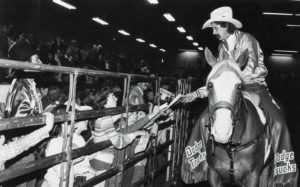
Bob signing autographs in the early 1980s, aboard John and Dottie Taylor’s palomino horse. – Courtesy of the family
He also treats everyone, from the lowliest to the highest, the same. “The guy in the shoe shine stand, and the man who cleans the toilets, they are important.” He follows the example of his Lord in the dignity he gives people. “Jesus treated them the same.” He also helps anyone who asks. “His phone never stops ringing,” Kristen said. “He goes out of his way, no matter where he is, no matter who it is. He’ll answer and talk to a marketing person, for heaven’s sake. He’ll say, ‘what are you selling me today?’”
He’s never worked less than four jobs at a time, and he’s diversified beyond rodeo. He and Kristen run a cow/calf herd, the 3T Angus Cattle Ranch, which sells pasture-to-plate beef. He founded a surveillance company, Pro View Digital Surveillance, with thirty employees and offices around the nation. He also cuts radio ads, serving as the voice for Boot Barn, Kubota tractors in north Texas, Coors, and Dodge. “I never remember not working,” he said.
And he doesn’t plan on retiring, which “drives a lot of young announcers to drink,” he joked. “I ain’t weakening.”
He loves to work, he said, “and I don’t hang around people who don’t like work.” He’s optimistic about his businesses. “I do something every day, in the rodeo business, to make somebody smile and look good. I do something every day, in the surveillance business, that protects people, their families and assets. I do something every day, with the ranch raised black Angus beef, that’s lean and healthy to feed somebody’s family.”
People ask Kristen, is he like this all the time? “What you see at a rodeo is what I wake up to every morning,” she said. “What you see is what you get with Bob.”
She’s not surprised at Bob’s accomplishments. “When Bob does something, he gives 200,000 percent. There’s no halfway with Bob. When he decided this was what he was going to do, there was no doubt in my mind he would do it and be successful at it. And he didn’t have any breaks on the way. He did it all on his own.”
He and Kristen live 250 yards from their daughter and her husband, Daniel Pennell, and their twin grandkids, a boy, Canyon, and a girl, Cashly, who are ten years old. Daniel, an accomplished team roper, builds barns and fences. Nicole sells livestock insurance, and together they follow their kids through their activities: the boy as a roper, and the girl with her volleyball. Kristen often cooks dinner for the family, and they eat together two or three nights a week, and every Sunday night. “We never miss a Sunday night together,” Kristen said. “We’re a very close family.”
Bob and Kristen have been married 49 years, and Bob calls her “the toughest woman on the planet to put up with me.” He has supported her in whatever she has wanted to do, Kristen said. She used to travel with him, but doesn’t anymore, and he understands that. “He’s a very good man,” Kristen said.
Arachnoiditis has hampered Bob’s mobility in the last eight years, but like everything else in his life, he’s met it head on. It is an inflammation of the arachnoid lining in the brain and spinal cord, which causes intense pain and significant disability. Bob was told when he was diagnosed that he would be in a wheelchair in two years, but he isn’t. He has learned to compensate where needed, being careful with steps. He doesn’t let the disease bring him down. “If you dwell on your moments of negativity, that dwell will swell, and clog the view of your future. And if you’re looking for sympathy, buy a dictionary. It’s in there.”
In 2000, he established the Bob Tallman Charities. He raises funds through an annual golf tournament, called the Pasture Pool Classic, for the M.D. Anderson Cancer Children’s Cancer Hospital in Houston. He also hosts the Bob Tallman Wrangler National Finals Rodeo Charity Bowling Tournament, which is held each year during the National Finals. Funds raised from the bowling tournament go to benefit the Speedway Children’s Charities in southern Nevada and the Justin Cowboy Crisis Fund.
He is a past member of the Texas 4-H Foundation, and is involved with the Weatherford (Texas) Christian School, where his grandchildren attend. And he’s optimistic. The best part of life is still to come: “I haven’t gotten there yet.”
Franklin, Tenn. (February 21, 2018) – Tickets go on sale March 1 for the Franklin Rodeo in Franklin, Tenn.
Held at the Williamson County Ag Expo Park, the rodeo takes place May 17-19 and will celebrate its 69th annual event this year.
It’s the longest running event in the county and a tradition among residents, said Bill Fitzgerald, executive director for the rodeo. “The rodeo builds friendships and relationships,” he said. The rodeo is produced by the Franklin Noon Rotary Club, with proceeds going towards local charities. That makes a difference for fans, Fitzgerald believes. “It builds excitement in the community because it’s something people can go to, and they can feel like they’re supporting the community while they’re having fun.” The rodeo is the largest in the state.
While fans are in Franklin for the rodeo, there is plenty to do during the daytime. Franklin is a short twenty-minute drive from downtown Nashville, which features such attractions as the Country Music Hall of Fame, the Ryman Auditorium, Opryland USA, and President Andrew Jackson’s home, the Hermitage.
Franklin is a beautiful historic place with a quaint downtown full of stately homes and perfect for shopping. History buffs will enjoy Civil War sites like the Carnton Plantation and the Battle of Franklin, and foodies can get their fill of barbecue and a wide variety of dining destinations.
Tickets are $20 for adults and $10 for kids ages 12 and under. All seats are reserved. Tickets can be purchased online at www.FranklinRodeo.com or at the gate.
Since the rodeo began in 1949, it has raised over $2 million for local organizations.
For more information, visit the website at FranklinRodeo.com or the rodeo’s Facebook page or call 615-RODEO-11.