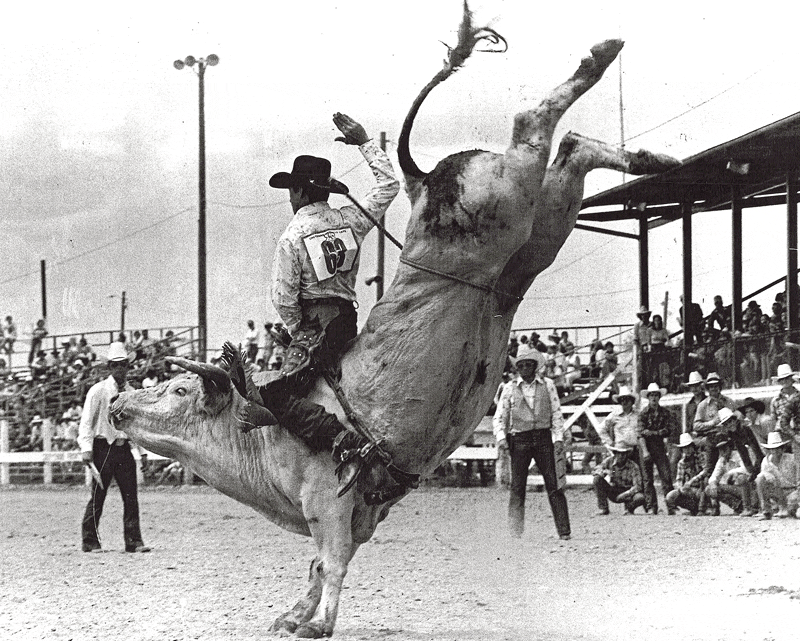
Jerry Beagley has enjoyed a Western way of living from the time he was born. He was born in Medicine Lodge, Kansas, October 2, 1954 to Otto and Evelyn Beagley. He was an only child. His dad was foreman for the Chain Ranch, located in Kansas and Oklahoma. The Chain Ranch ran 2,500 mama cows. His dad always had good horses. In addition to his dad being foreman of the Kansas part of this major ranch he was also in demand as a pickup man at various area rodeos.
When Jerry was 4 years old his dad would put him on calves and run alongside holding him by his belt, so he wouldn’t fall off. Jerry was seven when his parents took him to the 1961 National Finals Rodeo in Dallas. As he watched the cowboys compete he asked his mother, “Do you think I will ever be good enough to compete at the National Finals?” She said, “Of course, son, you will be good enough.” Jerry said his mother never lied to him, so he always knew he could do it. The first big bull he rode was at a rodeo in Turley, Oklahoma at age 12.
As a youngster he competed in Little Britches Rodeos in goat tying, flag races and more. His sophomore year in high school at an FFA rodeo in Freedom, Oklahoma, they were using feisty wild Hereford cows. The stock contractor told Jerry’s dad Jerry couldn’t ride one of his cows. Jerry’s dad bet him Jerry could. Jerry knew his dad didn’t make a lot of money, and was concerned that if he didn’t ride the cow his dad would lose the bet, and his money. Jerry did ride the wild cow, even though he lost both of his boots during the ride. He made the whistle! He also was the Kansas High School Calf Roping Champion. In 1972 he was the Little Britches Bull Riding Champion and All-Around Champ.
“I had extremely positive parents” said Jerry. “ They told me I could do whatever I set out to do. They made me believe in myself. ” He was valedictorian of his Medicine Lodge Senior class.
He attended Fort Hayes (KS) State University and majored in Math. He was on the rodeo team and won the 1974 NIRA Bareback Riding Championship. He transferred to Southeast Oklahoma State University and at the College National Finals, in 1977, held at Bozeman, Montana, he won the Bull Riding Championship and the All-Around.
Sylvia Mahoney, author of “College Rodeo, From Show to Sport” wrote: “Jerry Beagley’s eighty-two-point ride on Black Satin in the final round led to the bull riding buckle and helped his team win the Men’s Team Championship.” That was the year he decided to start concentrating solely on bull riding.
Jerry got his Rodeo Cowboys Association (RCA) permit in 1974 and his card the following year. Previously he had been making a living competing in amateur rodeos. Before he turned pro he had gone to approximately 120 amateur rodeos each year.
Jerry’s mother was right when she told him, at age seven, he would be good enough to go to the National Finals. He went to his first National Finals in 1978. He was the Reserve Champion in 1979, just after World Champion Donny Gay, in spite of the fact he was injured after the 2nd round at the Finals. He also qualified for the 1980 and 1982 National Finals.
Injuries are part of rodeo, some events are more injury-prone than others, and bull riding is one that definitely causes injuries.. Jerry was injured in 1979 when he broke his jaw and had to have stitches in his face due to his injury. The following year, 1980, he qualified again and this time the bull broke his ribs in the second round. He tried for two more rounds to compete but it wasn’t working. Jerry jokingly said, “Yes, I rode bulls — I rode bulls before they began tipping their horns.” This did not deter Jerry from continuing to ride bulls, but when he quit in 1986 he explained it this way, “I quit because I didn’t want to get bitter about something I liked so much. I loved riding bulls.”
Jerry held Bull Riding Schools in various Midwestern locales. It was going so well he taught bull riding as far west as Hawaii and Florida to the east. But that wasn’t enough for Jerry so he took his Bull Riding Schools to Canada, Australia and Brazil. Jerry said, “Lots of students that sign up will never become bull riders. I tried to teach them how to have the right mental attitude, how to win, how to get from rodeo to rodeo, and much more. I wanted them to leave my school having learned something more than just how to ride a bull for their $200.”
The era in which Jerry contested was when those serious contenders found ways to get to several rodeos during the same weekend by flying. He got his pilot’s license and flew in small planes to get to as many rodeos as he could. In 1978 he competed in 175 rodeos and 169 rodeos in 1979. He and Brian Claypool, another rodeo competing pilot, flew together a great deal. Claypool was in a plane that went down somewhere in mountains near the California-Oregon border, May 22rd, 1979. Brian and three other cowboys were killed. The wreckage was not found for months until a hunter found the remains in a remote area. Jerry explained, “If I hadn’t opted to stay home and put together an anniversary celebration for my parents, I would have been on that plane.”
Other cowboys Jerry traveled with were Jerome Robinson, Lane Frost, Ted Nuce, Lyle Sankey, Bobby DelVecchio and Steve Lance . Jerry traveled alone more than he did with other competitors. The work ethic his parents instilled in him early in life kept him on the road getting to as many rodeos as he could possibly get to. In fact, Butch Bratsky said: “They called Jerry ‘Milemarker’ because he got to more rodeos than most cowboys could or would get to.”
Jerry worked extremely hard to get the Justin Sports Medicine Program up and going because he believed it was important in the world of rodeo. He worked with Dr. J. Pat Evans, the doctor that was responsible for keeping Dallas Cowboys football players healthy for their games. Dr Evans started having medical people available at each rodeo to keep cowboys with minor injuries able to compete, and advising them medically if necessary.
The Christmas after Jerry turned 18 his dad gave him a hundred dollar bill. Jerry drove to Tulsa and bought as much nylon parachute cord as the money would buy. “I took it back to college and started braiding and creating reins in the dorm. They make great reins and presently I have quite a group of people braiding for me in their homes. It’s called cottage labor and individuals work making items at home, send it to the company and are compensated for their efforts.”
Jerry owns his own businesses, Jerry Beagley Braiding Company Inc. and Ott Ranch Saddles. He sells horse equipment wholesale, which includes over 400 items, for all kinds of horses – barrel racing horses, calf roping and more. He sells to over 200 stores in the United States. He also sells all over the world, including Canada, Australia, Switzerland and Brazil . Jerry met, at his bull riding school, the man who ended up providing through Jerry’s company the bull riding equipment for bull riders in Brazil. I don’t think it was more than a handshake, but it has been very successful for both of us.” said Jerry. He also met Adriano Moraes, from Brazil, who became the first Professional Bull Riding World Champion three times, 1994, 2001 & 2006. They have had a twenty-plus year friendship. In the early 2000s Jerry received the Small International Import-Export Company of the Year, in Oklahoma.
Martha Josey competed in barrel racing the same time Jerry was competing in bull riding and they became friends. Martha said, “Years ago at the Mesquite rodeo my hand slipped on the reins, when I was competing. When I finished I told Jerry and he created the ‘Martha Josey Knot Reins’ which have been selling for over 40 years. Jerry has such a good work ethic he could out-rodeo every one else. I can’t say anything that isn’t good about Jerry.”
Jerry married Beva Farnham, from Canada, and they had two children. Their daughter Martha who competed in rodeo in various events through college, presently she is a full-time mother to two children. Son, Brian, never was interested in the rodeo world, he found his passion in motorcycles and such. He lives in Canada and has two children.
The National Intercollegiate Rodeo Association Alumni Association was formed in 1982. Jerry became involved to be able to help students go further in their desired professions. He is a Board member and when U. S. Tobacco dropped their support for college students he became a strong supporter of the fund raising part of the organization making every effort to get more sponsors to provide scholarship monies. Sylvia Mahoney said about Jerry: “He is one of the silent people that is always working to discover new ways for the Alumni Association to raise funds to support the rodeo teams. He donated a saddle to be raffled off to raise funds for the project.”
Jerry is a self-made man who has accomplished many things in his lifetime. He has given back by his efforts to rodeo in numerous ways. He has helped many young people just starting their rodeo careers. He is revered by those who competed with him and worked with him. He is his own man – an individual, honest, determined and perseveres, while displaying humility. He admits he owes it all to his parents, friends and Jesus.
Author: Gail Woerner
-
Back When They Bucked with Jerry Beagley
-

Back When They Bucked with Harris Family – Cowtown New Jersey
[ Cowtown Rodeo “Best Show on Dirt”
spanning five generations.]Congratulations to the entire Harris family for their induction of their Cowtown Rodeo, located in Pilesgrove, New Jersey, to the ProRodeo Hall of Fame. Grant and Betsy Harris, 4th generation of Harris’ to own the rodeo are thrilled with the honor. Betsy said, “When I got the call I didn’t recognize the number, and hung up on him. But he called right back. Grant never gets excited, but he’s excited over this recognition by the ProRodeo Hall of Fame.”
Grant’s great-grandfather, Howard Harris, started a livestock auction in Woodstown in 1926. Many farms growing vegetables, corn and hay existed in that part of New Jersey and they all needed mules and horses to do their farm work. The auction was a necessity and did well.
Rodeo in the family started as early as 1929 When Grant’s great-grandfather, Howard Harris, and son ‘Stoney’, started a rodeo in conjunction with the Salem County Fair. The Miller brothers, of 101 Wild West fame, good friends of the Harris family, had a hard time financially and were stranded in Washington D C in 1931. The Harris family bought some of the broncs owned by the Millers, and purchased one-way tickets for some of the Miller cowboys to return to Oklahoma, if they would help put on the Harris’ rodeo in Woodstown, New Jersey. The Woodstown rodeo continued during the 1930s Colonel Jim Eskew, well known rodeo and wild west producer, wintered in Woodstown and also shared his knowledge with the Harris’ family. They also put on rodeos in various locales around the northeast, including the 1932 New York State Fair Rodeo in Syracuse; a Sesquicentennial rodeo celebration for Philadelphia in 1926 and assisted the Madison Square Garden rodeos, in New York City, in the early 1950s.
During the War Years, the rodeo was not held. Howard Harris, Grant’s dad, went to college at the University of Idaho and was on their rodeo team. In 1954 Howard qualified for the NIRA Finals and won the All-Around Cowboy honor. He entered the saddle bronc and bulls events, roped and was in the wild cow milking.
In June 1955 rodeo in Woodstown began again, and Howard named it ‘Cowtown New Jersey Rodeo’. It was held from May through September. ‘Cowtown NJ Rodeo’ joined Rodeo Cowboys Association (R.C.A.) and it was the first summer rodeo to get approval to become a member.
Cowtown Rodeo had a problem after only being in the R.C.A. four weeks. Television was just getting accepted and a Wilmington Delaware Channel approached Howard about televising the Cowtown Rodeo. At this time, 1955, R.C.A. considered television to be ‘taboo’ for rodeo, and would only ‘ruin’ the sport. However, Howard knew having the rodeo on television would be good for Cowtown business and he accepted the Channel’s offer. Not only did the television feature the rodeo, the cameras panned the audience. People came in droves, hoping to be seen on television.
In 1958 an ABC television affiliate, Channel 6 in Philadelphia, had picked up Cowtown New Jersey Rodeo. Although Howard had submitted the plans to R.C.A. it was not approved and ‘Cowtown New Jersey Rodeo’ was on their blacklist. ‘Cowtown’ was receiving such good revenue from being televised Howard continued to allow it to be televised, meanwhile paying a fine of $3,000 to R.C.A, the largest fine R.C.A. had ever assessed, up to that time. By the mid-1960s, the attitude of R.C.A. changed and ‘Cowtown’ was no longer fined nor on their blacklist. In fact, the Harris’ signed a contract with the Philadelphia ABC affiliate and every performance gave them two one hour television rodeos, then it went into syndication. Cowtown outgrew the original arena in 1967 and built the existing arena that seats 4,000 fans today.
Meanwhile, Grant began competing at the age of 5 in the Jr. Bull Riding at Cowtown. By the time he was a teenager Grant continued to compete at Cowtown, as well as other area rodeos, and doing quite well. He joined the professional ranks at age 14 and got his RCA card at 17. He attended Casper College, in Wyoming on a full rodeo scholarship. Grant was the R.C.A.’s Northeast Circuit Saddle Bronc Champion in 1975, ’77 and ’78.
Grant was seen competing so often when Cowtown was being televised, that he had quite a following. When he went to the Denver rodeo in January, 1977, Grant was 23 years old, but he was hounded by teen age girls who were seeing the taped rodeos with him, as a teenage saddle bronc rider, from years past.
Grant was not just a competitor, even in his young years he was always very involved in the working part of the Cowtown rodeo and had gleaned as much as possible from his talented dad. He was also the pickup man for each performance. Junior Meek, a bullfighter and steer wrestling competitor from Texas spent a summer working for the Cowtown Rodeo and also did the bullfighting. He said about Grant’s dad, “He was a real cowboy. If you didn’t think so, just try and keep up with him all day. If you roped ten cows, he’d rope fifteen.” He also said, “Lots of cowboys from the West thought you could go back east and easily win a rodeo. That wasn’t so at Cowtown.”
In 1978 Howard decided to retire, and he and wife, Irene, moved to Oklahoma. Grant and bride, Betsy Douglass, bought the Cowtown rodeo from his parents. Betsy handled the secretarial end of the rodeo and much of the publicity. Eight years later Grant bought the auction company and flea market, that had started in 1929, from his granddad, ‘Stoney’. Betsy held various officer positions in the circuit system once PRCA started the circuit system. She was President of the First Frontier Circuit from 1993 to 2019, and before that was secretary and treasurer. The last four years she has been the stock contractor representative. Betsy traveled extensively across the country representing the northeastern circuit group. She retired in January of this year, after 45 years of service. She still attends the PRCA Convention, held in Las Vegas just prior to the National Finals, as does Kate & RJ. “I go to represent Cowtown Rodeo and Three Hills Rodeo livestock, and go to the secretary/timers meeting, and see my kids and visit with old friends,” Betsy explained.
Grant and Betsy have two daughters, Courtney and Kate, that have been involved in Cowtown as long as they can remember. Courtney married Jake Morehead, and are co-owners of Three Hills Rodeo in Bernard, Iowa. They have three children, Sam, age 16; Lily, age 15 and Cade 13.
Kate and husband RJ Griscom, have owned Cowtown since 2019, when buying it from Betsy and Grant. They have two children, Nate, age 10 and Olivia who is 4. Grant and Betsy, aren’t retired by any means, and still work for Kate and RJ. Plus they still own the flea market, and their 1,800 acre ranch, where they raise enough feed for their beef herd and their rodeo stock.
The 5th generation, including Kate and Courtney, and their husbands are totally immersed in rodeo business, and also are taking the up-and-coming 6th generation to youth rodeos. They raise most of their own bucking stock, but they admit there is more buying and selling than earlier when Cowtown owned all their own stock.
Today Cowtown Rodeo is advertised as “Best Show on Dirt!!” It is held on Saturday night, beginning the end of May and continuing through the end of September. The arena also has the PBR Bull Riding there on particular weekends in July and August.
Kate and sister Courtney were always their dad, Grant’s right hands. From age 10 they worked every summer either at the flea market, the auction barn or the rodeo. Kate admits they didn’t see all of it as work, as some of it was definitely fun. But while they worked growing up they learned every aspect of rodeo.
Kate married RJ Griscom in 2010, and although he was raised on a farm, he had also become a professional electrician. Kate said laughingly: “That only lasted about a year, then he became totally involved with the rodeo, the flea market and auction.” When asked how she balanced her responsibilities for Cowtown Rodeo and their children, she said, “It’s been easy, except right now Nate, age 10, has sports practices and rides bulls. But we make it work. We’ve got great support.”
When asked how she handles what her folks do as well as their own jobs for the rodeo, Kate said, “The folks keep doing what they’ve always done. I won’t take over doing what mom does until she asks me.”
When I asked how they would handle the family going to Colorado Springs to receive their honor of being inducted, who would stay at Cowtown Rodeo and put on that Saturday night performance, she said, “We’ve got a very good group of guys and gals that have been with us for a long time. They know how to do everything. We won’t be worried about it.”
Cowtown Rodeo in Pilesgrove, New Jersey, is in excellent hands. The honor of being inducted in to the ProRodeo Hall of Fame is an honor that surprised the Harris family completely, but according to those who have been to Cowtown Rodeo and know the Harris’ history and what they have accomplished are in agreement – this honor is certainly one they have earned.
Harris Male Ancestors Kept Journals:
Very few families can boast that their history was kept by the male members of the family in diaries or journals. But the Harris family from Woodstown/Pilesgrove, New Jersey, can give you accounts of happenings from the time they arrived in America 327 years ago.
The Harris ancestors came from Wales in 1696. They landed in Manhattan and continued on to Salem County, New Jersey, where they settled, receiveing a deed to their property dated 1696. Their Salem County livestock brand was registered with the King of England in 1706.
Various men of this family did interesting things during those early days. Their experiences and adventures would never have been remembered if these early ancestors had not used diaries and journals to pass on the history of their family and what they accomplished.
During the Revolutionary War John Harris joined the Continental Army and fought at Valley Forge with George Washington. His responsibility was to take cattle and wagon loads of food to the soldiers. He was also a bombardier, responsible for aiming the cannon during battle. Later he was assigned to an area in western Pennsylvania because the government anticipated the British would attack them from the West at this location – but it never happened. It was the custom of the government to give soldiers money when they mustered out. But because the government ran out of money, they gave Captain John Harris a parcel of land at the confluence of the Ohio River and the Monongahela River. At that time it was the opinion of everyone that ‘No white man would ever live that far west!” Because of that opinion Captain John sold it for a gallon of whiskey!! Today that area is Pittsburgh, Pennsylvania. Imagine what the family could get for that parcel of land once it became such a viable city.
The Harris family for generations have been fortunate the men of their earliest days here kept journals and relayed such important information through their writings. It is something that 95% of our families wish they had on their families in written form. -
Empty Saddles: Larry Mahan
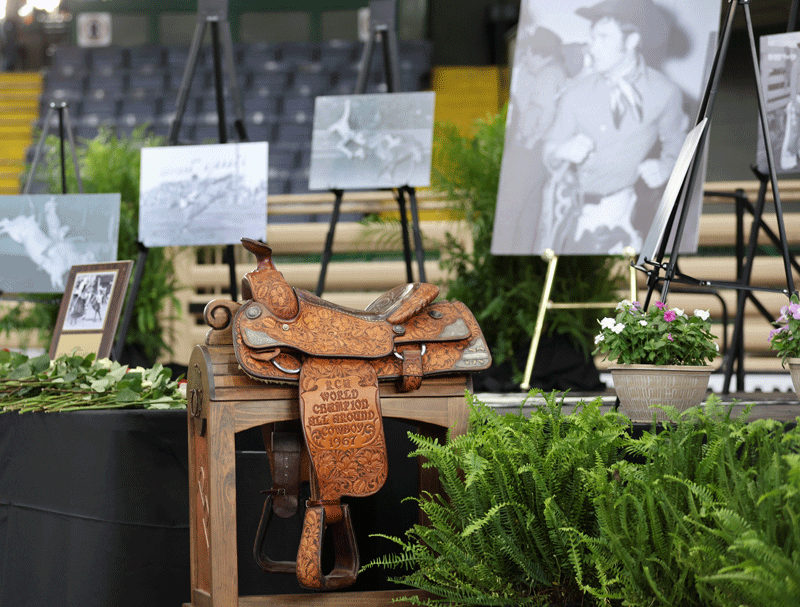
Larry Mahan was the all-around world champion in 1966-70 and 1973. He also was the bull riding champ in 1965 and 1967. He qualified for the NFR a combined 26 times from 1964-75 in bareback riding, saddle bronc riding and bull riding. He was inducted in the inaugural class of the ProRodeo Hall of Fame in Colorado Springs, Colo., in 1979.
Justin McKee, rodeo announcer and Cowboy Channel cowboy minister, was Master of Ceremonies for the send-off for Larry Mahan and friends, on May 16, in Cowtown Coliseum, Fort Worth Stockyards. Justin told the audience it was definitely not a funeral. It was a collection of Larry’s friends who were going to talk about the man and share stories about him because he was someone who had made rodeo bigger and better, in his own way. Larry Mahan changed the world of rodeo. His mentors were Jim Shoulders and Casey Tibbs, and at 6 years old he rode a calf and won $6 and a buckle. He knew what he was going to do with his life – RODEO! But although he admired Jim & Casey he had his own agenda.
He was determined, tough, charismatic, and versatile. He won many World Championships and conquered the sport to his satisfaction. He also did other things – he was in the clothing world, he sang, he had a band, he loved horses, and taught many a young man how to not only learn how to ride roughstock, but he taught them manners; how to do many things it takes to go down the rodeo road when just starting out. But the one thread through the entire program was that he gave back, gave to, and tried to make the Western way of life better. And he did.
Red Steagall was up first and sang a song he wrote on an airplane returning home from the National Finals Rodeo when Larry won the All-Around, and it was about Larry.Next in line was Bobby Steiner who said when he was 13, he met Larry for the first time. Bobby’s dad Tommy Steiner was producing rodeos and he heard his dad and other cowboys talking about this new cowboy from Oregon, they knew he was going to be the next top cowboy.
Billy Bob Harris was a personal friend of Larry’s and didn’t talk much about rodeo but told how Larry was one of those people who was always the center of attention – which everyone in the audience could agree with.Next was a video of Tanya Tucker singing a song about cowboys like Larry.
Bobby Brown, roughstock rider, said, “Nobody could do what Mahan did. Today we have television and rodeos seen daily but when Larry was rodeoing that wasn’t possible. Before television, Larry got the attention that television allows so many of the competing cowboys to become known. He was tough physically and mentally.”Donny Gay saw Larry Mahan on ‘Hamp’ a bull owned by Korkows, in 1968. He said, “I wanted to be just like him. He came to our house by his plane, a Comanche 250, spent the night, we took a load of stock to Rusk, TX, to their rodeo. He won the bareback, the bronc riding and the bull riding. He gave me his chaps and I wore them proudly. When I started flying, he told me, ‘Donny, when you step up on that airplane you take that cowboy hat off, and put on your pilot hat.’ He was my hero.”
Pam Minick said she met Larry in 1971, in 1973 as Miss Rodeo America they ran into one another often, and became very good friends. He was best man at Pam’s wedding to her first husband. She went to see Elvis with Larry in Las Vegas, and Larry was invited backstage to visit with Elvis. She also said, “Larry knew how to give back, he did so many things that improved not only rodeo but the people in and around rodeo. His legacy was to give back.”
Ty Murray fed Mahan’s horses when he was 13 years old. He said, “Larry impacted my life more than any one did – he took me under his wing when I was just 12. He was my Superman!”Trevor Brazile said although he didn’t get to rodeo at the same time Larry did, they lived nearby later. He came over to Trevor’s place to rope calves not for himself, but Larry had a young man working for him and he wanted Trevor to give him some pointers. Trevor also said, “I don’t think there was anyone in any other sport that could measure up to Larry Mahan.”
Cody Lambert said Larry took rodeo to another level. He said Larry had a bumper sticker on the back of his saddle that said, “This is not a dress rehearsal.” He said he and Ty, who were good friends, often repeated that saying when they were competing for the big bucks.
Cody also said, “Larry would call after he had been to my place and tell me he was so impressed with the relationship I have with my son.”
Brooke Graham sang a song she had written about her grandpa but sung it with Larry in mind.
Rudy Gatlin said he always called Larry “May-horse” instead of Mahan because he was part man, part horse. He said, “Larry loved those horses.” Then he sang Larry’s theme song, “Rodeo O de O”Former Texas Ranger Brantley Foster told that he had a son named Brandon that had a brain tumor. When Larry met Brantley and met Brandon he was working for the Wide World of Sports but he would call Brandon about every week and they just talked. Brandon died when he was just 18. Ranger Foster had many other stories about Larry, but “he didn’t want to talk about those,”
Chris Cox, well known horse trainer, said he met Larry in 1985. He said, “Larry loved horses, we talked a lot about horses and how they change our lives – horses are so forgiving. But they never forget.” He looked at the audience and said, “I’ll bet you never bought a horse from Larry Mahan. He never sold a horse he loved them so much.
Sonny Burgess ended the stories by singing, “Mamma, Don’t Let Your Boys Grow Up to be Cowboys”.
Justin ended the Celebration with a Prayer. A good send-off for a cowboy who made rodeo step up, who made too many friends to count, loved rodeo and horses, and gave to and back for the rest of his life. He will be missed. -
Profile: Justin Rumford
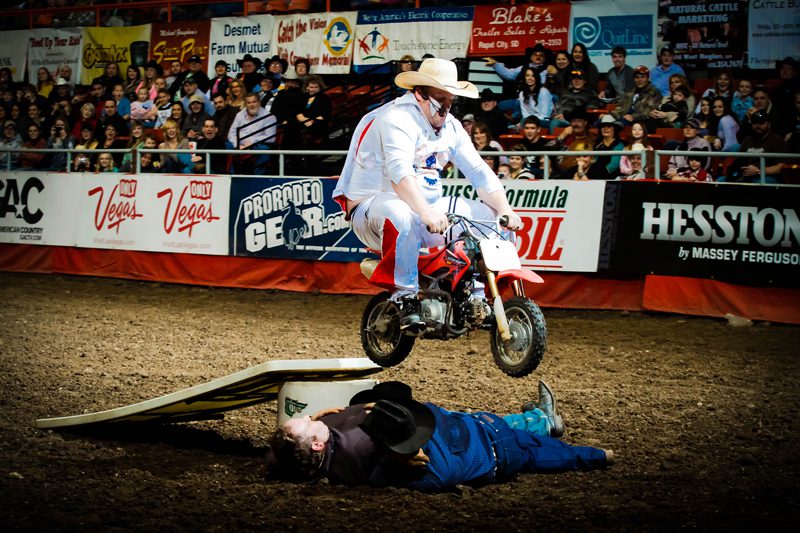
Justin Rumford Discusses The Evolution Of A Rodeo Clown
“Someone told me that rodeo clowns are just cowboys that can’t make it competing. I love being a rodeo clown. It’s my dream job! I win every performance.”
Justin Rumford is a third generation rodeo cowboy. He’s tried many positions in rodeo and finds the one that he enjoys the most – Barrelman & Funnyman.
Justin grew up in Abbyville, Kansas, in a family that put on rodeos – Rumford Rodeo Company. His grandfather started it, and his father followed in it. Today the company is run by his sister, Haley, and her family, under the name Bridwell ProRodeo, out of Red Bluff, California.
Justin rode saddle broncs and steer wrestled and qualified for the High School Finals in both events. He also went to the NIRA Finals, in both events, when he received a rodeo scholarship for Northwestern Oklahoma State University. He graduated with a degree in Agriculture and Business Finance in 2004.
Justin was inspired by Lance Brittain, a PRCA bullfighter, and went to Rex Dunn’s Bullfighting School. He fought bulls, starting in his Senior year of high school, but a bullfighting accident in 2001 at Denver, that punctured his colon made him decide bullfighting was not for him.
He hit the rodeo road hard after college trying to qualify for the PRCA National Finals. He concentrated on his steer wrestling career. He had a friend, Shane Henderson, who bankrolled him for awhile. Justin was riding other people’s horses in steer wrestling, so when he did win money, 25% went to the horse owner. Entry fees were costly. He remembered, “I got to North Platte (NE) and I had $34 in my pocket. I decided I couldn’t go on. I was done!”
Benny Beutler, of Beutler and Son Rodeo, asked Justin why he was so frustrated. When Justin told him about his dilemma Benny offered him a job. “Come work for me and you can still compete.” Justin began driving trucks, hauling horses, for Beutler and Son Rodeo. “I always loved bucking horses and so working for Benny and hauling his horses was a perfect fit for me. I continued to bulldog and I started winning – Phillipsburg (KS), Loveland (CO), and Burwell (NE). In no time I had won $15,000 and I was still working for Benny.”
The Pretty Prairie, (KS) barrelman got word his father had just had a stroke and had to leave the rodeo. Suddenly the rodeo had no barrelman. Someone suggested Justin, to stand in for him, because he was always behind the chutes joking with everyone. Justin agreed and said, “I had fun with the audience – and I got a good check.” Mike Greenleaf, a Kansas amateur stockman, encouraged Justin to become a funnyman. He thought about it and decided to try it. That was 2011.
“ Cervi Rodeo Company offered me 10 rodeos, without even seeing me perform,” Justin said. He also informed other PRCA stock contractors. Justin’s first full year of clowning he had 100 performances and was voted PRCA Clown of the Year.
Lecile Harris, PRCA funnyman, signed Justin’s PRCA card, along with Rob Smets, former bullfighter, and Bob Tallman, rodeo announcer. Justin asked Flint Rasmussen, former rodeo clown, for advice about the profession. Flint’s answer was, “Justin, the best prop you have is the one you put under your hat.” Meaning Justin’s own mind.
His acts were varied. At first he hauled two bucking horses he owned. Justin would harass the bronc riders, until the announcer, would ask him, “Do you think you can do any better?” He was challenged. When Justin rode a bucking horse he always got laughs. When asked if he rode them backwards or did something funny like the clowns did many years ago? Justin said, “No, just a fat dude on a bucking horse was all it took to get laughs.” He also named his Spiderman act, his Gorilla act, and several more acts. He has received the PRCA Clown of the Year honor a total of ten times since becoming a rodeo clown/barrelman.
Justin explained that rodeo has changed so much it’s harder to entertain. He said that former bullfighter/rodeo clown, Ted Kimzey, was his very favorite when he was growing up. When asked why, he said because Ted’s acts were great, and his barrelman toughness. “People don’t realize how hard the knocks are for ‘the man in the can’ when the bull hits the barrel. Ted took some real hard knocks,” explained Justin.
He described the ‘good old days’ the older rodeo fans remember, “A rodeo clown had 10 to 15 minutes to perform an act a couple of times during the rodeo.” And he was right. The rodeo clown also jumped in when a cowboy had to be revived or when something needed to be repaired and entertained the fans. He wandered through the bleachers.
Justin continued to explain, “Today’s rodeo requires an act to be minimized to maybe 3 ½ minutes. I love the older generation, which I respect so much. But in today’s rodeo our responsibilities for entertaining are very different.” He said a daily production meeting before each performance may be pages and pages long, going over the events, and actions by each person that works on the rodeo, whether they are in the arena, in the announcer booth, working the chutes or behind the scenes. Each person’s actions must be accounted for, sometimes down to the minute.”
He explained: “We are paid to do a job. We do what we are asked to do.” He gave an example of what is required. “A PRCA rodeo is required to have one or more ambulance on the grounds with the proper medical team available. If it should happen that the amblance has to leave the grounds, the rodeo is to STOP until the proper medical people can either return or be replaced. I was at a rodeo which had two ambulances, and both had injured guys and had to leave the rodeo grounds. I wear an ear piece that production people can tell me when I need to urgently do something to keep the rodeo going. I jumped into the arena, yelling “Stop the Rodeo” but not to alarm the audience I started joking to keep the audience involved. Once the ambulance returned to the grounds, I got word, through my ear piece, to finish my banter and the rodeo went on.
“A few days later,” said Justin, “ I was told the rodeo company got a scathing letter saying: ‘ The rodeo clown that came in to the arena and stopped the tie down roping, just when Tuf Cooper, a World Champion, was just about to rope his calf. How thoughtless was that rodeo clown to do such a thing. What was the rodeo thinking!!’ I was compelled to contact the person who had sent the letter and explain what the PRCA rules are about the medical team being at the rodeo, and why I did it. Her response was ‘Oh, I didn’t know that.’ ”
Justin went on to explain that because professional rodeo is on television daily, and he worked Denver, Rapid City, San Antonio, and Austin with very few days in between performances he has been on television so much recently. “I have to stay current on what is happening in the world, and what is happening in the community where the rodeo is being held. I do talk a lot about what I learn from current happenings, and I usually throw in fun facts about the city we are in.” You can tell Justin enjoys interacting with the audience, and they it’s obvious the fans have a lot of fun with him.
His rodeo clown heroes from the past, before we had so much television coverage, were only seen when a person went to a rodeo. Today, with the Cowboy Channel playing 750 rodeos a year, he is sometimes on the television screen almost daily. That requires a great deal of variation and patter that the spectators and audience enjoys. It seems to be working very well for Justin. He was quick to say, “We have to adapt or we go away.”
Justin admits most all the rodeo clowns and bullfighters are good friends, and truly band together. They help one another out when ever necessary and enjoy communicating wherever they happen to be. They all have smart phones and it’s easy to keep up with one another, no matter where they are performing.
Justin is a family man. He met Ashley Van Hoesen, at a rodeo. She was Miss Rodeo Oklahoma in 2005. They dated for two years and married in 2007. She graduated with honors in Business from Oklahoma University. She was a registered nurse but put nursing on hold to be able to travel with Justin. She became an integral part of the rodeo business, taking care of all the business end of rodeo. He says Ashley loves rodeo just as much as he does.
In 2013 they were blessed with triplets. Two girls and a boy, named Livi, Lola (after Justin’s grandmother) and Bandy (after Justin’s best friend, Bandy Boswell). The family travels in their RV with Justin, unless school gets in the way. It is evident the family is most important to Justin and often if they aren’t able to travel he’ll slip home, to Ponca City, OK, when he can.
Justin has been picked as the PRCA Clown of the Year ten different years. He has been the Coors Man in the Can three years. He was the PRCA Comedy Act of the Year in 2018. In 2014 he was the barrelman for the PRCA National Finals.
Now during the National Finals he hosts the “Rodeo Vegas” after-rodeo party at the Mirage Hotel & Casino every night. During the day at the Convention Center where the largest Trade Show is held, he has “Rump Chat Live”, on a stage where he and “Hambone” Hilton, rodeo music director, interview cowboys and cowgirls as well as other prominent people. Justin says they have 1.8 million downloads with 138 interviewing episodes. Additionally, Ashley researches and recommends purchasing commercial real estate for a group of six rodeo cowboys as investments – 5 bullfighters/rodeo clowns, and one announcer.
Justin is living his dream job. He enjoys everything he does. His family is totally behind him. The fans are, too. Flint Rasmussen’s advice,”The best prop he has, to be a rodeo clown, is what he puts under his hat – his mind. Justin understands his audience and realizes and accepts the changes that are happening in the world of rodeo. And as Justin says, “If we don’t adapt we go away.” Justin doesn’t plan to go away any time soon. -
CHARLES ‘BUD’ TOWNSEND
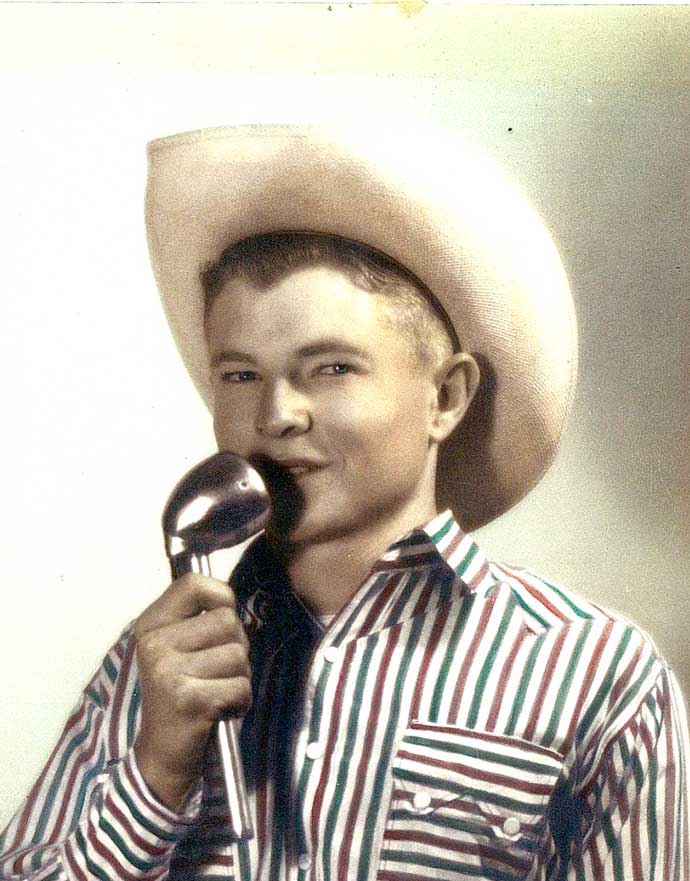
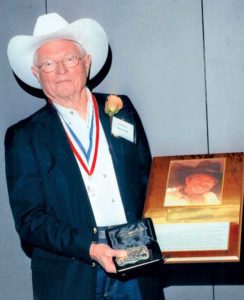 CHARLES “BUD” TOWNSEND, age 93, of Canyon, Texas, passed away January 21, 2023. He was born November 5, 1929 in Nocona, Texas and grew up on his grandfather’s farm. In his youth he and his friends rode steers but he only won 2nd one time. His rodeo competition was brief. Bud enjoyed mimicking the rodeo announcers to his young friends. When an announcer did not show up at a Ringgold Texas rodeo his friends urged him to volunteer. He announced on a crystal microphone which would stop working if it got too hot.
His professional rodeo announcing career began in 1946 when he was 16. For the next 50 years he announced rodeos for Bobby Estes, Homer Todd, Cotton Rosser, Beutler Brothers, Everett Colborn, the Steiners and Walt Alsbaugh. At Rodeo Cowboy Association conventions he booked rodeos from Fort Worth, TX to Omak, WA; Greeley, CO to Belle Fourche, SD; Ponca City, OK to North Carolina and the Deep South.
Bud continued his education, attending Midwestern State at Wichita Falls, TX, Baylor University and received his PhD in history from the University of Wisconsin. He became professor of history at West Texas A & M in Canyon, as well as Texas Tech and Hardin Simmons. He spent 27 years at West Texas A&M, and retired Professor Emeritus. He always said he learned to teach history, in such a way his students enjoyed learning, from his time spent in rodeo during summers.
He married Mary Smith before she graduated from high school but she never quit learning. Mary received her Master’s degree and taught school. They had three children, Bill, Mary and Charles. When Bud and Mary retired they traveled the world, including horse races at Saratoga, New York.
Bud was inducted into the Texas Rodeo Cowboy Hall of Fame in Fort Worth; received an American Cowboy Culture ‘Lifetime Achievement Award’ and ‘All Around Cowboy Award’ in Lubbock; Rodeo Historical Society’s Rodeo Hall of Fame at the National Cowboy & Western Heritage Museum, Oklahoma City; and The Cowboy Hall of Fame in Fort Worth. He also received Canyon’s Man of the Year honor in 2019.
He won the 1975 Wrangler Book Award at the National Cowboy & Western Heritage Museum for his book, “San Antonio Rose, The Life and Music of Bob Wills”. He also won a Grammy for his album notes, “Bob Wills & His Texas Playboys: For the Last Time”. Bud continued to interview western musicians and collecting their stories. He also announced at the Lubbock Cowboy Symposium for years. His memory of his rodeo experiences never failed him and his speaking engagements never ceased.
Bud was preceded in death by his wife, Mary, and his son, Charles ‘Buddy’ Townsend Jr.
He is survived by his son, Dr. Bill Townsend and wife, Dr. Janet Townsend of Canyon, TX; daughter Dr. Mary Townsend and husband, Dr. Michael Guttenplan of Scottdale, AZ; and Cindy Townsend Aycock, surviving wife of Charles ‘Buddy’ Townsend; seven grandchildren and twelve great-grandchildren. Memorials can be made to the Charles R. and Mary Townsend Scholarship at West Texas A&M University. WTAMU Foundation, WTAMU Box 766, Canyon TX 79016-0001.
Funeral Services were held Thursday, January 26th at 2 PM at Crossroads Country Church, 14425 Farm to Market Road 1541, Amarillo, TX 79118. Burial will be in the family plot at Dreamland Cemetery in Canyon.
-

Back When They Bucked with Mel Potter
Cranberries are about the farthest thing you can think of from rodeo – and yet – one of the most interesting, versatile and capable cowboys for the last sixty years has had both cranberries and rodeo as primary interests in his life. Mel Potter is a cranberry farmer – a proven professional roper – a stock contractor – and breeds, raises and trains some of the top horses in the rodeo arena.
Here is Mel’s story: Granddad Melvin Potter began raising cranberries in Wisconsin in 1880. The family marsh where cranberries come from is still in operation today. His son, Roy, followed in his footsteps, as did Roy’s son, Mel Potter. The cranberry business goes dormant during the winter. As Mel says, “Wisconsin is like Siberia in the winter.” The cranberries are frozen in the marsh during the winter, but when spring comes the cranberries come back to life. Mel’s family also raised mink, and that could have been the catalyst for why Mel got an Animal Science degree from the University of Arizona.
Mel was born in 1935 to Roy and Josephine Potter. When he was 9 his family began spending the winters in Arizona. Mel went to school in a two-room school with twenty other students in grades 6th through 7th. Back in Wisconsin all of Mel’s contemporaries were into the regular sports – baseball, basketball and football. But at Mel’s school in Arizona the kids at school rode horses and roped or rodeo’d as often as they could. It was not surprising that Mel took up roping and team tying (which was big in Arizona at that time). He even rode a few bulls. He knew he wanted to be a cowboy. Mel competed in 13 Junior Rodeos and during high school he qualified for the 1951 High School National Finals, held in Sulphur, Louisiana.
At rodeos in Arizona, Mel watched the ropers from that area that always won – John Rhoades, Lynn and Chuck Sheppard. Mel was all ready competing at area Rodeo Cowboys Association (RCA) rodeos. He said at that time RCA would let non-members compete, but if you started winning any money you had to join. Mel was only 16 when he started winning, so he joined in 1951.
Mel and Wendy were married in 1954. They went off to the University of Arizona where Mel was on the rodeo team. He won the All-Around at the University of Arizona rodeo when he was a senior. They have two daughters, Jo Lynn Alexander, born in 1958 and Sherry born in 1975.
After graduation Mel and a friend, Russ Gregg, got the bright idea to travel back up to Wisconsin and compete in some of the rodeos there. They thought all the ‘toughs’ (top winning cowboys)) would be at rodeos in other locales, not Wisconsin. They just knew they could win lots of money. It was quite a shock when they got to their first Wisconsin rodeo at Madison and all the ‘toughs’ were there, too! Mel and Russ joined the labor list at the rodeo and that helped them get paid enough to be able to compete. The biggest surprise is those ‘toughs’ looked after Mel and Russ, and they also got lots of free advice from them, which they appreciated and needed.
As time went on Mel’s roping kept getting better. He qualified in the calf roping event for the first National Finals in 1959. He won the 5th go-round and won $434 at the Finals. After the Finals he went home in Wisconsin. He realized he had a worn-out stationwagon, a horse trailer that needed new tires, a crippled horse, and enough money from his winnings to enter maybe seven or eight rodeos. His dad, who Mel described as a hard-headed businessman, said, “What do you think of rodeo now?” That’s when Mel decided to go in the cranberry business. However, he continued to compete in rodeos. In fact, he learned to fly so he could get to more rodeos and still be able to work. He also moved his legal residence to Arizona.
A few years later Mel, Jack Brainard and John Snow decided that the big money in rodeo was in the stock contracting business. Brainard had learned a great deal about stock contracting by being associated with stock contractor Leo Cremer, from Montana. Both Mel and Jack had competed and John was a rodeo announcer. The three men started a new company in 1964 named Rodeo, Incorporated (Rodeo, Inc.). They heard Oral Zumwalt, a well-known stock contractor from Missoula MT, was selling out and they purchased 10 good broncs from his string. Most of Rodeo Inc’s rodeos were in the mid-west as well as State Fairs in Indiana, Illinois, Kentucky, Iowa and Minnesota.
Mel said, “One day I got a call from Feek Tooke, who said he had some horses we could use. I had never heard of Tooke and I called my friend, Bill Linderman, President of RCA, and ask him about Tooke. Bill said, ‘If you can get his best horses you’ll have the best bucking stock in the business. But I think he’d rather sell you his wife than his horses.’” The three partners flew up to Ekalaka, Montana and Tooke showed them his horses. He knew all their breeding and history. Tooke said, “These are my best old horses, and he pulled out 20 for them to buy.” Tooke said he would take $500 a horse. As the three owners of Rodeo, Inc. stood there figuring out how they would borrow the money, Tooke said: “Boys, just pay me what you can now and pay the rest when you make it.” And with a handshake the deal was made.
“We bucked ‘em at our first rodeo after that and they darn near bucked every cowboy off, no matter who they were. They were rank broncs. The first year we had them we sent six to the National Finals,” explained Mel. In 1966, Rodeo, Inc. had the NFR Top Saddle Bronc, Tea Trader. Their bronc Sheep Mountain got that honor in 1967. Major Reno was Top Saddle Bronc for 1968 and for 1969 Major Reno tied with Big Bend’s Trade Wind for Top NFR Saddle Bronc. They were all Feek Tooke bred broncs. “All the breeding programs in professional rodeo, at that time, except Kesler, were out of Feek’s horses. He sent us horses two more times, which were top rate. We were lucky to have had such a relationship with him. I was a pall bearer at his funeral,” said Mel.
“On one of the flights back from Feek’s we didn’t know exactly where we were but we saw a rodeo being held. We landed and it was Mobridge, North Dakota. We saw a bronc that was so good, named Chief Crazy Horse, we bought him for $127.50. He was one of the best we ever owned, too. We were stock contractors for ten years before we had out dispersal sale, during the National Finals. I never worked so hard at anything as I did then. But I learned so much during those years. The last three years we made money and had some great rodeos,” Mel laughed. “I feel like I’ve been on vacation ever since.”
When asked, Mel said Dean Oliver and Jess Goodspeed were two of his biggest competitors. “Jess Goodspeed taught me how to beat the top guys,” admitted Mel. “He bought some of the best calf roping horses.” Other competitors he mentioned were Toots Mansfield, Roy Cooper, Don McLaughlin, and Cody Ohl. For steer roping he named Guy Allen and Shawn Burchett.
Mel admits when he first began contesting he didn’t realize how important the horse was in roping. He learned quickly having a good horse was a necessity. Mel’s first horse, at age 16, was Pal, an unregistered gelding out of Oklahoma Star and a Bert mare (both sire and dam are in the AQHA Hall of Fame). In time Mel observed that 50 to 60% of the cowboys in timed events were riding horses that came from Driftwood, an AQHA Hall of Fame horse. His friend, Dale Smith, allowed him to compete on his great horse, Poker Chip, from the Driftwood strain. Mel realized then how much a great horse can improve one’s ability to win.
The Potter Ranch in Marana, Arizona, is well known in the horse industry as being a top Driftwood breeding ground. Mel and wife, Wendy, are partners. They married in 1954 and have two daughters. Jo Lynn Alexander, who was an All-Around Cowgirl in High School, and Sherry Petska, World Champion Barrel Racer four times. Wendy also barrel raced and qualified for the 1970, ’71 and ’72 National Finals.
Mel first bred his roping horse, Red Ghara (a Bert mare) to Speedywood, a son of Driftwood, which produced Speedy’s Redwood, (they nicknamed “Charlie”). The colt’s ability at a young age was just what Mel was looking for. He has been quoted as saying Driftwood genes produce early maturity coupled with longevity and speed. There have been numerous well-known and successful Driftwood bred horses, from Potter breeding, in the past 50 plus decades. Mel says Dinero is probably the best horse he ever bought. Dinero has had 18 horses go to the PRCA National Finals over the years in barrel racing, team roping and steer wrestling. Hailey Kinsel’s great horse, DM Sissy Hayday, better known as ‘Sister, is Dinero bred. Daughter Sherry and husband, Cory Petska have won over $400,000 on Dinero.
Mel admits there came a time when daughter, Sherry, was winning Barrel Racing World Championships he became known as “Sherry’s dad”, in the rodeo, but those things only make him smile. He said her horse, MP Meter My Hay, better known as ‘Stingray’ was probably more famous, at that time, than any of the other great Driftwood horses.
Regardless of the reason why rodeo people know the name Mel Potter, you can bet it’s because of something Mel has done, and done well. He’s been recognized for the good things he has done in the sport of rodeo, the breeding horse world, stock contracting and obviously the cranberry world, too. Potter & Son is one of the largest supplier to the Ocean Spray Cranberry Consortium. “Cranberries allowed me to do these rodeo and breeding activities that I, and my family love so much. I was still roping until two years ago,” said 87 year old Mel. -

Back When They Bucked with Chuck Sylvester
he 2022 Ben Johnson Memorial Award honoree fits the requirements to a T! Charles Walter Sylvester Jr., better known in rodeo as “Chuck” is the recipient this year which will happen during the Rodeo Historical Society’s Rodeo Weekend at the National Cowboy & Western Heritage Museum in Oklahoma City on November 12th. Chuck becomes the 24th cowboy to receive this award. The honoree has been given annually since 1998 when Clem McSpadden was chosen to receive the prestigious award.
The requirement of the Ben Johnson Memorial Award, given annually to a living person who has been involved in the rodeo industry for a number of years and has contributed to the growth and betterment of professional rodeo. Involvement with youth and/or community activities also is a pre-requisite for the honor. The recipient must be someone who, like Ben Johnson, Jr., creates a positive image for rodeo and the Western lifestyle.
Chuck was the General Manager of the National Western Stock Show & Rodeo, from 1978 to 2003. This important January Denver event has so many different activities going on it is mind-boggling to imagine his responsibilities. During his leadership the ‘National Western’ changed from a nine day event to sixteen days and the attendance increased considerably. Chuck brought the Draft Horse Show to ‘National Western’ in 1981, the event’s 75th anniversary. In 1985 he brought Jerry Diaz, well-known Charro, with his amazing roping artistry and many more talents which spawned a new addition — the Mexican Extravaganza & Rodeo which became one of the night shows of the ‘National Western’. Chuck was also responsible for expanding the facilities with the addition of the building of the Event Center. It took Chuck, and Board member Pat Grant, speaking with every business group in Denver to raise the interest for a bond to be passed that was necessary for the building to happen.
In 1995 the new building, called Equestrian Center, was opened. The horse show events moved in, as well as the Dancing Horses Night Show. The Mexican Extravaganza & Rodeo took the place of equestrian events in the Coliseum, along with Professional Bull Riding. When Chuck retired in 2003 he was quoted to say: “My job description for forty years was finding someone else to do the job! They are the ones to put on the show.”
During Chuck’s tenure as General Manager of the ‘National Western’ he served on the Professional Rodeo Cowboy Association (PRCA) Board of Directors two different times. The first, in 1985, was when the National Finals moved to Las Vegas. He admits it was enjoyable but tedious. The Vegas location brought bigger crowds, but the need for more seating. They added seats, between the arena fence and the original first row, and called them Gold Buckle Seats. The additional revenue from seat sales helped pay expenses. Chuck decided to do the same thing at ‘National Western’, by adding more seating and call them God Buckle Seats. They sold out, and ‘National Western’ made an extra $100 thousand the first year. His second time to be on the PRCA Board, was between the mid-1990s and his retirement at NW. Although the circumstances were different he considered it “a real enjoyment but challenging serving on the PRCA grievance committee. Harry Vold was Chairman along with Dean Oliver and Bill Smith.” One of Chuck’s highlights on the Board was promoting and getting final approval to introduce and start “Extreme Bull Riding.”
It is obvious that Chuck Sylvester thinks ‘outside the box’. When asked to be the chairman of the National Western’s 100th Anniversary in 2006, for the parade he chose to have over 200 loose ewes herded by Border Collies down 17th Street, through the heart of downtown Denver.
A special event Chuck never misses happens once a year – the Roundup Riders of the Rockies, of which he has been a member for 35 years. They take a week-long horseback adventure in the back-country of Colorado during late July; many memorable moments have happened during this time for him. He was selected “Colt of the Year” his rookie year, 1987, and “Roundup Rider of the Year” in 1999. He became a Life Member in 2012. 2022 is the 74th year for Roundup Riders of the Rockies.
Chuck’s great-grandfather, Charles E. Miller, homesteaded the family farm in 1866. It is located on the South Platte River, in LaSalle, CO. Chuck and wife, Roni Bell, are the fourth generation of the family to live there. He was born in 1937, the youngest of four. He always felt fortunate that his parents were hard working farm people. In jest, Chuck said he felt like Abraham Lincoln because the house he lived in had no electricity, indoor running water, plumbing, telephone, TV and toilets. However, there was always food on the table and lots of love from his parents and family.
Chuck began rodeoing in high school at Greeley and continued when he went to Colorado A&M in 1955. As a Rodeo Club member, in college, he helped produce the ‘Little National Western Stock Show Skyline Stampede Rodeo’ at Colorado A & M (now named Colorado State University). While in college he won the bull riding in Logan, UT, and placed in the saddle bronc event at Pocatello, Idaho. Chuck graduated with a degree in Animal Science in 1961 and a masters in Ag Economics in 1985.
Employment for Chuck always involved agriculture, rodeo or the western way of life. He worked for A.S.C. and Soil Conservation Offices; for Farm Chemical as a salesman; and as Assistant Boulder County Agent. His interest in helping youth began by working with County 4-H programs. His judging team won the ‘National Western’ Livestock judging contest in 1965. He also was involved with the Boulder County Fair and the Longmont Jaycee Rodeo. This set his career course for life with fairs, rodeos, livestock and equine events.
The Colorado State Fair hired Chuck as Assistant Manager in 1969. During his tenure he helped plan the Fair’s 100th Anniversary in 1972. As part of the anniversary he re-introduced the Draft Horse Show and inaugurated the Colorado Centennial Farm Award, which is given to family farms that have been working farms for over 100 years in the State of Colorado. This Award requires the families of farms qualifying for this Award to complete a written form proving their eligibility.
Seeing the need for a non-existent organization to handle certain ag-related, rodeo-related or stock-related events Chuck was never hesitant to form a new organization so those active in the program could be treated or judged fairly. He did so by helping form the Association of Rodeo Committees and the Colorado Association of Fairs and Shows. He held the office of President with both groups to get them up and running properly.
When Chuck retired from the National Western Stock Show & Rodeo he never missed a beat. He soon became the Executive Producer of “There’s Got To Be A Pony,” written by Roni Bell under the pseudonym Arem Roder. It was a performance requiring a huge cast blending Pueblo Symphony, Dr. Jacob Chi conductor, symphonic music with equestrian performers presented at the Evening with Dancing Horses. Some of the cast members who were also associated with rodeo included Jerry Diaz, Vicki Adams, Hadley Barrett, Austin Anderson and Greg Whitaker.
A cattle-raiser on his Wyoming ranches for over fifty years Chuck finally sold all his cattle in 2009 and presently leases his ranches. He continues to buy land in Wyoming because, “Wyoming is more ‘agriculturally friendly’ than Colorado.”
A past President and director of the Godfrey Ditch Company Chuck has also been on the Weld County Fair Board, a member and former director of the Greeley T Bone Club, past board member of Colorado Boys Ranch, the Continental Divide Trail Alliance, just to name a few of his additional activities.
Protecting private property rights hit a nerve with Chuck and in 2007, he and wife, Roni, co-founded the so-called Good Neighbor Law, and subsequently helped with three more Good Neighbor programs. In 2009 Chuck co-founded Land and Water USA which gathers facts, truth and solutions that will protect one’s Land and Water rights. He and wife, Roni, have worked with scientists, educators, politicians, attorneys and research analysts from around the world to teach people what constitutes private property, and how to defend that property on federal land.
In September, 2013 a flood devastated their 145 year old farm and 110 year old farm house. After seven months of restoration, they were finally able to move back in to their home and their Colorado Centennial Farm. You can find Roni on her old Ford tractor, she named ‘Bar B’, and Chuck on his front-end loader, as they work together to move dirt and trees to make their farm the best it can be.
As the 2022 honoree of the Ben Johnson Memorial Award Chuck Sylvester joins the following earlier recipients of this prestigious honor: Clem McSpadden, Buster Ivory, Dale Smith, Chuck Sheppard, Don Harrington, A. J. “Jack” Cooke, Jim Shoulders, Mel Potter, Cotton Rosser, Larry Mahan, Billy Minick, Neal Gay, Dean Oliver, Walt Garrison, Bill Smith, Tater Decker, Joe Beaver, Mike Cervi, Jack Roddy, Kelly Riley, Clyde Frost, Doug Clark, and Carl Nafzger. -

Back When They Bucked With Butch Tirelli
Roland ‘Butch’ Tirelli was born January 14, 1941 in the Knickerbocker Hospital in New York City to Rachel Lopez and Frank Tirelli. Butch grew up in Brooklyn. Although his father was not in his daily life, he did have an ‘off and on’ relationship with him. Butch’s mother married a man named Cohen when Butch was just a toddler. Cohen was a good father, but money was scarce. Butch’s mom saved her pennies to be able to give Butch dance lessons.
At age 12, Butch and his mother were leaving the CBS Studio 54 Dance Studio in New York City; they were headed home by way of the subway, when Butch saw a marquee advertising the Madison Square Garden Rodeo. ROY ROGERS — RODEO – 200 COWBOYS!! Butch excitedly said to his mom, “Mom, mom! We gotta go see that!” She told him she didn’t have money for a ticket. They passed by the Belvedere Hotel, across the street from Madison Square Garden. Butch saw dozens of cowboys going across the street from the Belvedere and entering the Garden. One cowboy, in particular, stood out – he wore a purple shirt and had initials, C. T. on his denim jacket.
Being from Brooklyn, Butch walked up to the cowboy and said, “Hey, I’ve never been to a rodeo. Can you get me a ticket?”
The cowboy grinned, reached in his back pocket and handed him two tickets and said, “Here kid, have a good time!”
Butch was thrilled!
Although the seats were up in the top of the Garden a man sitting next to his mother offered Butch his binoculars so he could see the cowboys ‘up close and personal’. Butch never went to another dance lesson. He was hooked! He was going to be a cowboy – NO MATTER WHAT IT TOOK!
Young Butch went to all the Saturday afternoon cowboy movies. He watched how they walked, how they sat on their horse, and how they held their reins. He secretly practiced ‘holding reins’ with his belt.
In 1954, he saw an advertisement in the newspaper for a horse for sale. Butch asked his mom if he could buy it – the price of the horse was $125.
“Go ask your dad, Butch,” she said.
Although he seldom saw his dad, he was hesitant — but this was important. Surprisingly his dad handed over $125. Butch worked very hard to get the money to be able to feed and take care of his horse, Melody. He got up at 4AM to assist an Italian man groom his horse before he went to deliver ice. He also worked at the hack stables. Eventually he moved Melody to Bergen Stables.
One of the boys he met at Bergen Stables was Joe McBride who also had plans of being a cowboy. Joe introduced Butch to the Black Diamond Wild West Show that put on performances in the area. Joe worked for them doing odd jobs. Butch hoped that he might get a job with them, and be able to ride some of the stock. The day finally came when Butch got a chance to ride a bull in a performance and he was ready — he thought.
When the time came, he asked, “Hey Joey, how do I get off?”
Joe told him, “Just let go.”
Butch admits it was a little wilder than he anticipated. He landed on his head.
Sixteen year old Butch and his friends spent hours at Bergen Beach Stables in Brooklyn. In fact, they called a building on the grounds their ‘clubhouse’. It even had a television set. One day the kids were all watching the Cowtown New Jersey Rodeo. Atomic Power, one of their best bulls just bucked a rider off when his friend said, “Butch, I’ll bet you could ride Atomic Power.”
His friends had never been able to throw Butch off the barrel they had tied between the trees to practice their ‘bull riding’.
His friend’s statement made him think about it. He called Cowtown New Jersey and when the secretary answered the phone Butch said, “I want to ride Atomic Power.”
The secretary’s answer was, “You have to draw him.”
Innocently young Butch didn’t realize what she meant by ‘draw him’. He thought she meant he had to take a pencil and draw a picture of Atomic Power.
He responded, “I don’t want to draw him, I want to ride him!”
The secretary finally realized he was a kid and encouraged him to come to Cowtown and enter the bareback event instead. And that is what he did. According to Butch he did OK.
There were several western-style towns around New York for entertainment. In 1958 he went to ‘Dodge City’, on Long Island where he met Colonel Jim Eskew for the first time. Another show in New Jersey called ‘Cowboy City’ he often enjoyed. He met real practicing cowboys and asked lots of questions about riding broncs and bulls.
By 1959 the Black Diamond Wild West Show was back in Staten Island. Jack Jackson, head cowboy, was a steer wrestler and bronc rider that had previously worked for Colonel Eskew. He hired Butch and told him to get on as much stock as he could. But when Jackson was handing out paychecks, at the end of show at Staten Island, when he got to Butch, he closed the cash box.
Butch asked him why he didn’t get paid, Jackson said, “I’ll kill you off in two weeks.” Butch knew he wasn’t very big, he only weighed 110 pounds, but he knew he could do whatever he was asked to do. He was so mad and said to Jackson, “Hey old man, I’ll piss on your grave!”
Instead of being offended Jackson just grinned and handed him $10 and directions to get to Syracuse, New York, in time for their next ‘gig’.
When Butch realized he was being hired he asked how was he suppose to get there, Jackson answered, “See, you’re doing it all ready!”
Butch found that they were loading the bucking chutes on wheels and going to haul them behind a vehicle to Syracuse. He hopped in and headed north.
Butch’s friend, Joe McBride, gave him wise advice when he started working with the wild west shows: “You have to buy a loaf of Wonder Bread and some peanut butter and jelly and some ‘rodeo chickens’ (bologna) and carry it in your duffle bag – you never know if you’re going to get paid or not in these wild west shows.”
Cowboys from the east often travel back and forth from New York to Florida to rodeo, depending on the time of year. Butch was no different, and went to John Evans’ ranch in Florida. He met Red Wilmer there, and Red offered to let Butch use his Severe-made bronc saddle, to ride at the Webster (Florida) rodeo. Butch won the bronc riding on that saddle. Butch won the bareback riding and bull riding at that rodeo as well as fought bulls.
When Butch went to California he worked on Andy Jauregui’s ranch. He rode some bulls Andy had chosen to go to the National Finals. Years later Butch, who had worked as a stunt man, met Bobby Jauregui, Andy’s great-nephew who was also a stunt man, and relayed this story. Jauregui said, “I grew up hearing about this little New York guy that rode those bulls – so you’re the one!”
Butch also travelled the rodeo circuit with Buddy Heaton, the bullfighter and funnyman, from one side of the country to the next. Buddy was known for his antics and creativity in and outside the arena. Butch admitted he learned a lot of do’s and don’ts from this experience.
Although Butch was doing OK as a roughstock rider, he found he enjoyed the producing end of rodeo and wild west shows, too. Because he was of Puerto Rican descent Gerry Partlow, a producer of wild west shows, sent Butch to Puerto Rico to ‘make a deal’ to produce a rodeo there. Butch, who didn’t hesitate, did make a deal. The Diamond P Wild West Show, produced by Gerry Partlow, with lots of help from Butch, held the “Gran Rodeo Americano” in Puerto Rico in 1964, and again in 1965. The first year they didn’t make much money, but everyone got paid and sent home. The following year the event was highly successful.
By 1978 Butch was the producer of another successful wild west show in Caracas, Venezuela which included well-known cowboys, such as; Hub Hubbell, announcing; John McBeth, Saddle Bronc Champion; performers – Tommy Lucia, J. W. Stoker, Gene McLaughlin. He leased King Brothers bucking stock, pickup men, flags, etc. The show was successful and as Butch proudly said, “Everyone was paid, and everything came back to the States, down to the final paper clip!”
Butch Tirelli is a multi-talented cowboy. Being small in stature never stopped him from thinking he could be a giant. He also made his mark in the fashion industry which began when as a kid he bought six antique trunks from a junk dealer for $10 each. He did not know what was inside the trunks. They happened to be full of beautiful ladies silk chiffon blouses and gowns.
“I took them to Manhattan’s most expensive boutiques and sold them all. I made $1,500.” That experience started him buying vintage clothing at a low price and selling it much higher. He took other Wild West Shows out of the country, which were held successfully and every performer got paid and returned home.
Today Butch is involved in manufacturing saddle pads for barrel horses called EQUFLX, purchased through Master Saddles, used by world champion barrel racers. The blankets he designed and manufactured are used with the Master light weight barrel saddles. His talents and abilities have truly made a big wandering trail through the cowboy world. His versatility might have kept him from doing more as a competing cowboy, but the youngster from Brooklyn truly did fulfill his dream – to be a cowboy — NO MATTER WHAT! -
Original Wrangler Bullfights Hall of Fame
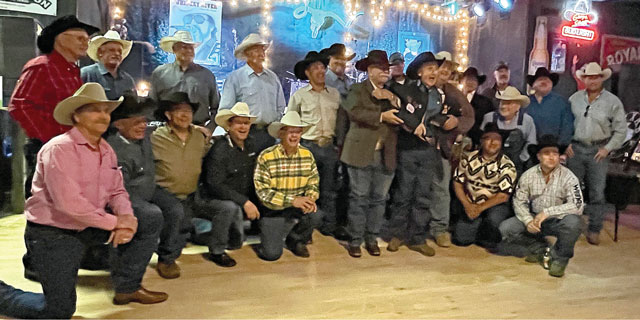
The second annual Original Wrangler Bullfights Hall of Fame was held at Lil Red’s Longhorn Saloon in the Stockyards of Fort Worth, Saturday evening, October 16th. The Induction includes bullfighters from the second season, of the 1981 to 2000 Wrangler Bullfight Tour. A few more awards and honors were bestowed on people who were instrumental in getting this historic first time Professional Rodeo Cowboys Association (PRCA) event up and running..
The Wrangler Bullfight Tour was started forty years ago in 1981, after several bullfighters from that era, Jim Sutton, a 2nd generation rodeo producer and stock contractor, and David Allen, the rodeo representative of Wrangler, at that time, got together and convinced the PRCA, it was sorely needed. The professional bullfighters and barrelmen had not had their own professional event to show their exceptional ability in fighting bulls prior to this Tour event. The Tour was held at various PRCA rodeos throughout the year. The bullfighters that were competing that year would compete at a set number of events and their scores were kept until the end of the season. The top six would then compete at the National Finals, which was being held in Oklahoma City, at first. Each of the six would fight one bull each night for four nights. The bullfighter with the top score would become the World Champion Bullfighter.
Jim Sutton, from Onida, South Dakota, for two years added to some of his rodeos an extra added attraction of four bullfighters that would fight Mexican Fighting Bulls. He would include this in his advertising prior to the event. In time, it was evident the bullfighting brought more spectators to his rodeos, just to watch this event. The results of his ‘experiment’ were the catalyst to cause PRCA to include the Wrangler Bullfight Tour.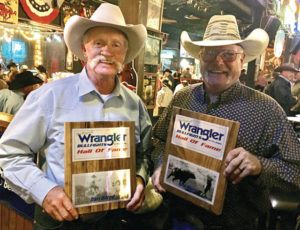
Darl Allred & Eric Viers – courtesy 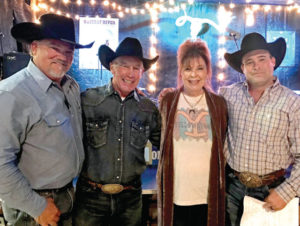
James Pierce, Rob Smets, Shelley Burmeister Mowery & Robert Blue Jeanes – courtesy 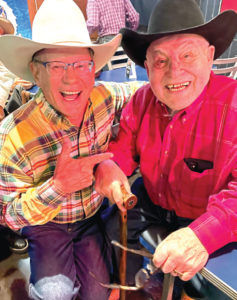
Stacy Tomack & John Taylor – courtesy The Original Wrangler Bullfights Hall of Fame was the idea of James Pierce, a 1991 bullfighter with the Wrangler Bullfight Tour. He fought bulls from 1990 to 2005, and calls Thibodeaux, Louisiana, home. He has taken the reins of this Hall of Fame, with other former participating bullfighters from the Wrangler Bullfights Tour – plus Craig & Jane Copeland who own Lil Red’s Longhorn Saloon the home of this annual affair. The plaques of all inductees are on display in Lil Red’s Longhorn Saloon.
Those honored this year were: Leon Coffee; George Doak (deceased) with son George Jr. accepting for his dad; Eric Viers; Darl Allred; Steve Mowry and Kirby Birney whose acceptance was told by his daughter, Cody, Miles Hare and Michael ‘Smurf’ Horton. Stock Contractor of the year was Mr. Harry Vold (deceased) who was represented by his daughter, Kirsten who also accepted the Bull of the year, Crooked Nose, owned by Harry Vold.. Barrel Men honored were Tom Feller and John Taylor. The Resistol Supporting Legend Award was given to Jim Sutton and David Allen.
Those doing introductions and more during the program were: Robert Blue Jeanes, former bullfighter and PRCA Bullfighter Director; five time World Champion Bullfighter Rob Smets; and Shelley Burmeister Mowery, former Miss Coors and very involved in the early day development of the Wrangler Bullfight Tour. All three did an outstanding job by not only giving the credentials for those receiving honors and awards, but also relayed personal stories of these special folks.
It was a packed house and the main comment made was those in attendance were so grateful to see so many rodeo people – the rough and tough bullfighters, rodeo friends, they hadn’t seen in years, and all were smiling! Just to name a few of the former bullfighters in the audience were Rick Young, Ronny & Donny Sparks, Todd Propson, David Burnham, John Novotny, Steve Tomac, Jim Bob Feller, Miles Hare, Rob Smets, Doug Forzani, Eddie Hatfield, Barry Hankins and many more.
Additionally a 3rd annual Knox Concrete Fund/Fun Raising Charity Golf Tournament was held by the Original Wrangler Bullfights Hall of Fame in collaboration with Cowboys Helping Cowboys Charity Events, which is ramrodded by Dave Samsel, former NFR bull rider, to benefit injured rodeo athletes in need.
Also, at the Saturday night event a live auction was held, with a variety of rodeo and bullfighting related items to be bid on, including branding irons, donated by Kirsten Vold, that in the past were used to brand Crooked Nose, Bull of the Year, also a painting of George Doak fighting a bull by Buster Kenton, plus many other items. The recipients of this year’s Golf Tournament and auction by Cowboys Helping Cowboys were Kirby Birney, Inductee Bullfighter; Jeff Collins, World Champion Bareback Rider; and Cody Ohl, World Champion All-Around and Tie Down Roper. -
Back When They Bucked with LaTonne Sewalt Enright
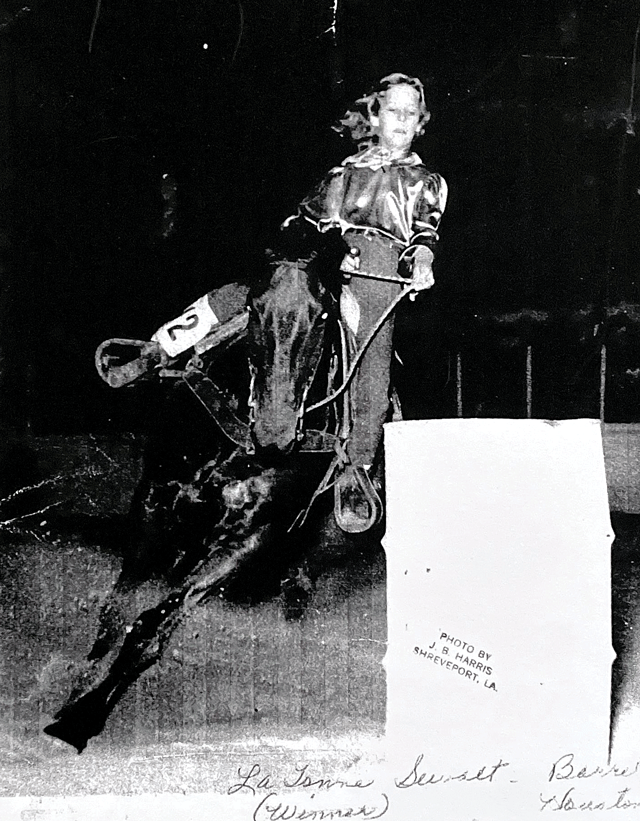
LaTonne Sewalt in Houston, 1951 – J.B. Harris LaTonne Sewalt remembers the first barrel race she was in at Comanche, Texas. She was 9 years old and was riding her horse, Little Joe, just for fun, on a trick-riding saddle her folks had given her. She wasn’t even in western clothes, she was wearing shorts! The barrel race was about to start when her dad, Royce Sewalt, said, “OK, LaTonne, you’re next,” as he pointed at the arena gate that was opening. She was off and running. Little Joe was completely spooked when he saw the bright silver barrels they were headed for. He’d never seen bright shiny barrels before and he purposely stayed way far away. They didn’t score very well.
LaTonne and her dad, a top-rated calf roper, trained Little Joe, a half-thoroughbred and half-Quarter horse, in the roping pen at home. They were using three old rusty barrels. Little Joe wasn’t quite ready for those ‘strange’ looking barrels. When they got home LaTonne’s dad painted those old rusty barrels bright colors, and in short time Little Joe never gave the color of the barrels another thought. He got better and faster.
LaTonne went with her calf-roping dad to most all of his rodeos. Some rodeos didn’t have a barrel racing yet and when they did it was often called a “sponsor” event. If they did have barrel racing, her dad entered LaTonne and Little Joe.
In early 1950 the Houston Rodeo had barrel racing for the first time. LaTonne and Little Joe won. She rode her bay horse around the clover leaf six times to outride her older and more experienced competitors. She was only 11 years old. She received $695 for winning, plus a buckle. Roy Rogers, the cowboy movie star featured at that rodeo, was appalled when he saw that the buckle little LaTonne received had a bucking horse on it. Rogers told her he would have a second buckle made for her. He also gave LaTonne a kiss as she received her winnings.
Rogers got a photograph of LaTonne and Little Joe taken by a photographer at Houston and gave it to the Nelson Silvia Buckle Company, which had provided the buckles for the Houston rodeos. When LaTonne received the buckle there she and Little Joe were emblazoned on the buckle. In fact, that design was used extensively for years by Nelson Silvia on buckles being made for barrel racing events.
LaTonne went to eight rodeos in a row and won all the go-rounds and averages: Childress, Jacksboro, and Texarkana, Texas; Memphis, Tenn.; Little Rock, Ark.; Colorado Springs, Colo.; Burwell, NE and an all-girl rodeo at Tulsa, Okla. for a total of $3,997. Her competitors were adult women, including Billie McBride, Florence Youree, Wanda Harper Bush, Margaret Owens, Amy McGilvray and Sherry Combs. “I’m sure they hated to see me enter,” said LaTonne. She won the 1950 World Champion Barrel Racing title at the Tulsa Pavilion, which was indoors, at the All Girl Rodeo Finals. LaTonne, still only 11, won $4,665.82 that year, and had 316 points higher than her nearest opponent Margaret Montgomery. The Girls Rodeo Association had only been in business since February of 1948 and this was their very first Finals.
LaTonne Sewalt was born January 23, 1939 to Royce and Myra Sewalt in Brownwood, Texas. Royce was a calf roper and competed in rodeos because he was good enough to make a living at it. He used the money to buy cattle, which he would raise and then sell. He won the RCA World Champion Calf Roping title in 1946. LaTonne always wanted to be with her dad, whether he was just outside around the horses and cows, or at a rodeo. “It was a lot more fun than being in the house”, said LaTonne.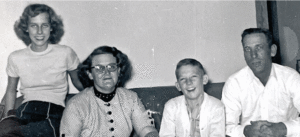
LaTonne and her family – Courtesy 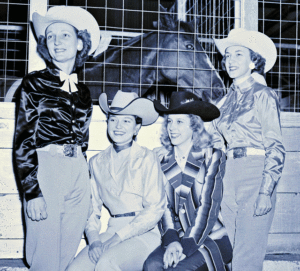
Billy McBride, unknown, LaTonne, & Florence Youree – The Dickinson Research Center 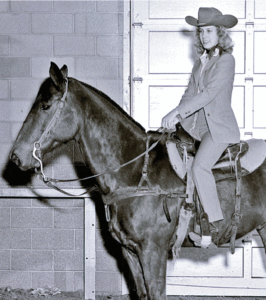
LaTonne and her horse – The Dickinson Research Center Once she started to barrel race, LaTonne’s mother made all her outfits. LaTonne had a fascination with trick riders and her mother designed the clothes for her daughter similar to what the trick riders wore, which were very beautifully designed. Her younger brother, Ronnye, also roped calves, like her dad. “Mom was our biggest cheerleader,” said LaTonne, “She built our confidence and deserved a lot of the credit for our success.”
LaTonne also won the GRA Barrel Racing World Championship again in 1954. She truly feels that her horse, Little Joe, never got the credit he deserved for being such a versatile and great horse. On occasion, she let some of the other barrel racers use Little Joe, and he always gave them all he had. Often they would be in the money, too. “He seldom knocked over a barrel or lost to another horse,” LaTonne remembered. In addition to his barrel racing talents, her dad also used the little bay gelding in calf roping and as a hazing horse. Little Joe died in 1958 due to a twisted intestine. Although she tried competing on a couple of other horses they just never could do what Little Joe had done.
LaTonne graduated from Afton (Okla.) High School as valedictorian of her class in 1957. She continued to compete in barrel racing until 1960, but didn’t rodeo full time. But she always took time off from school to compete at the Fort Worth and Houston rodeos. The WPRA Reference Guide showed her in fifth place in 1958 and in 13th place in the barrel racing event in 1959. Until 1968, LaTonne was the youngest girl to ever win the Barrel Racing World Championship. That year, 10-year-old Ann Lewis, of Sulphur, Okla., won the title.
LaTonne married Joe Green, a bull rider, in 1958. They had one daughter, Kellye Ann. They divorced later. Fred Enright became her husband in 1962, who was a former football and track coach who had moved into sales. They had daughter, Rene Michelle. LaTonne graduated from college cum laude in 1967 with a Bachelor of Arts Degree in Business Administration and a Masters Degree in Business Education.
LaTonne was inducted to the Texas Rodeo Cowboy Hall of Fame in 2004. Her dad, Royce Sewalt was inducted in 2002, and brother Ronnye, in 2001.
LaTonne today – Courtesy LaTonne taught accounting and typing, now called keyboarding, for 35 years at Paschal High School in Fort Worth. She retired from teaching in 2003. She moved to Decatur, Texas, to be near her daughter, Rene Fuller, when her husband became ill. He died in 2016. Today she is enjoying her five grandchildren and 10 great-grandchildren. She says they are all within a short distance so she gets to see them often.
-

Rodeo Clown Reunion
Where Laugh-Getters & Cowboy Savers Relive the Past
The ProRodeo Hall of Fame and the Douglas County Fair & Rodeo is the destination for the 23rd Rodeo Clown Reunion. It is a time for retired bullfighters, funnymen and barrelmen to gather and reminisce, don their only familiar baggy britches and personal make-up, and spend time doing what they did “back in the good old days”. They sign autographs, perform old acts and kibbitz with the fans. When they have a few minutes to catch their breath in between gigs, they visit with other honorees and tell stories of earlier arena days and things that happened they well remember and other rodeo clowns who are no longer with us.
The purpose of the Rodeo Clown Reunion is to show these seniors that we are grateful for what they did in the rodeo arena entertaining the audience and saving the bull riders from serious harm and more. Their abilities to promote a rodeo and put a smile on the spectators faces is so important to the success of an event and we are grateful for their years in this profession and their willingness to entertain.
On August 6th, the honorees will be at the ProRodeo Hall of Fame with programs, acts, and autographs. It will be a day which anyone can spend with these characters and cowboy heroes, asking questions and learning about the life of a rodeo clown. How did they happen to choose this profession? How dangerous is it to stand in front of a raging bull and keep the bull riders from harm? Is the barrel really a safe haven when a bull is charging?
August 7th and 8th the honorees will be in Castle Rock at the Douglas County Fair & Rodeo assisting in many annual venues including the mutton busting, and autographing and performing in their rodeos at 7 PM on Saturday, and 1 PM on Sunday.
Since the original 1974 Rodeo Clown Reunion that was held in Roseburg, Oregon, during the Umpqua Valley Rodeo, the Reunion was held there four more years, then in 1991 it was held in Moses Lake, WA. Since that time it had been held in a variety of locales, more centrally located, in conjunction with PRCA rodeos. The 1993 Rodeo Clown Reunion was held in Guthrie, OK; then in Colorado Springs, 1995 & 2000 during the Pikes Peak or Bust Rodeo;
Rodeo de Santa Fe was our destination three times, 1997, 2011 & 2017; Deadwood Days of ’76 in 2002 & 2009; and once at rodeos at Springdale, AR, 1999; Stephenville, TX, 2004; Pendleton RoundUp, 2006; Sheridan, WY, 2012; Dodge City, KS, 2008; Coffeyville, KS, 2015; and during the Day of the Cowboy weekend, 2018, at the Stockyards at Fort Worth.
During the years the Reunion has been held we adjust the events, other than the rodeo, to suit the area. At Deadwood we traveled to Mount Rushmore and Chief Crazy Horse Monuments in addition to the rodeo. In Guthrie, OK we toured the National Cowboy & Western Heritage Museum and had a Clown-Mule Race at Remington Park, the local pari-mutual horse track in Oklahoma City. At Moses Lake we traveled to the Grand Coulee Dam by bus. At Dodge City we caravanned to the town of Greensburg, that had just been totally demolished by a tornado, with a pickup full of books the honorees had gathered together to help start a new library for the ravaged community.
We have second generation rodeo clowns attending this year. Greg Doering, the son of Karl (deceased), has attended each reunion since it’s inception. Other multi-generational families attending are: Jerry Wayne Olson, a third generation rodeo clown, who followed in the footsteps of his deceased dad, Jerry, and grandfather, LaRue Olson. Other two-generation honorees are: Don Bowman and his twin step-sons Dan & Pat Ariaz; Melvin Fields and son Devlin, and John Clark and son, Kelly. Dixie Reger Mosley, the only woman rodeo clown who clowned for 12 years and was also a charter member of the Girls Rodeo Association. So far, forty-four rodeo clowns have registered from 17 states and Canada. Their accumulated years in the rodeo arena as a funnyman, bullfighter or barrelman add up to 939 years.
Every honoree’s story is different in some way. A few retired after 5 decades in the arena. Others retired earlier, some due to injury and others had a variety of reasons for moving on. Some concentrated on being funny and fighting bulls. Others were more inclined to fight bulls while others got their adrenalin rush by hearing the audience laugh. Regardless of how they spent their years in the arena the one common denominator is they have all continued to keep their sense of humor.
Come join us, you’ll be glad you did. For more information regarding the upcoming Rodeo Clown Reunion contact me at email: rodeogal@airmail.net.
-

George Doak, Bullfighter-Funnyman, Passes
George Doak was always quick to say the 28 years he was in rodeo were the ‘best years of his life’! George passed away peacefully on the evening of April 27th, with his wife by his side after an illness of several months. When George could no longer talk on his phone the rodeo world knew George was in trouble. His funeral will be held at 2PM, May 18, 2021, at the Lone Star Cowboy Church, at 21627 Eva Street, Montgomery, TX 77356.
George was born in 1937 and raised by his aunt and uncle in Fort Worth. At the age of eight when asked what he wanted to do when he grew up he quickly answered, “Be the best rodeo clown in the world!”. Many a rodeo hand, during his 28 year era, will tell you he made his 8 year-old dream come true.
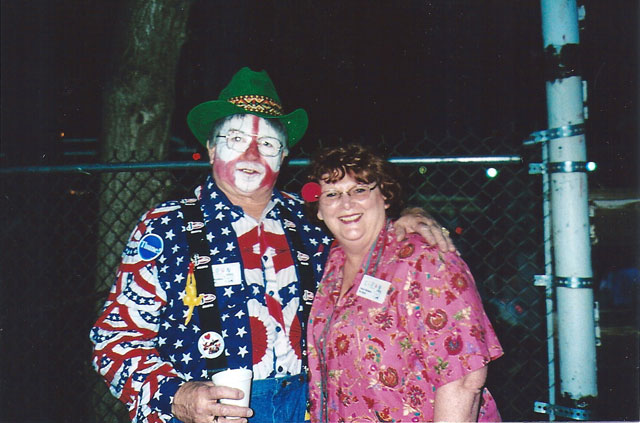
He began his rodeo career in 1953 at Mesquite, Texas, when he and two high school friends were riding bareback horses and bulls. His friend ‘hung up’ and George went to his rescue. After several years in college learning to be a mechanical engineer, for his aunt and uncle, he gave it up and went to Cowtown, New Jersey, for Howard Harris where he fought bulls through 1960. The Cowtown, New Jersey Rodeo was on television in 1958 and the entire country watched George fight bulls.
He joined the Rodeo Cowboys Association in 1961 and booked 21 rodeos including Walla Walla, Ellensburg, Pendleton and Lewiston, the Big Four in the northwest. They had watched him on television earlier, and knew how good he was. From that introduction to professional rodeo he was hired from one end of the country to the other, and border to border. He spent ten years traveling with Junior Meek, a bullfighter, too. In 1971 he worked the National Finals Rodeo, and again in 1977. In 1979 he helped put the Wrangler Bullfights together and judged various events including the 1981 Wrangler Bullfight Finals. He also worked the National High School Finals three times, the National Intercollegiate Rodeo Association Finals in 1969, and received numerous awards along the way. He retired in 1981 at Pendleton, Oregon, where he fought bulls for 19 years.

He was inducted in to the Pendleton RoundUp Hall of Fame in 1983, the ProRodeo Hall of Fame in 2000 and the Texas Rodeo Cowboy Hall of Fame and the Texas Cowboy Hall of Fame that year, too. He was inducted to the Rodeo Hall of Fame in the National Cowboy & Western Heritage Museum in 2001, and the Cowboy Capital Walk of Fame in Stephenville, TX, in 2002. He became the President of the Rodeo Cowboy Alumni organization in 2004 and held that office for ten years.
George and Quail Dobbs, clowned the American Bi-Centennial Rodeo, in Philadelphia, PA in 1976. George put Quail’s make-up on him the first time he clowned. George and Junior Meek performed at the Royal Easter Rodeo in Sydney, Australia in 1971. In 1977 he was made an Honorary Shriner by the Ardmore, OK, Shriner Club, the first person to get this award by that chapter. He appeared in the Academy Award Winning Documentary Film of 1972, “The Great American Cowboy”. He was a judge for the Miss Rodeo America Pageant in 1988 and 1989.
George had three boys, George Jr., Steve and Mike. He married Reada Vincik in 1998 and they lived in Montgomery, Texas.
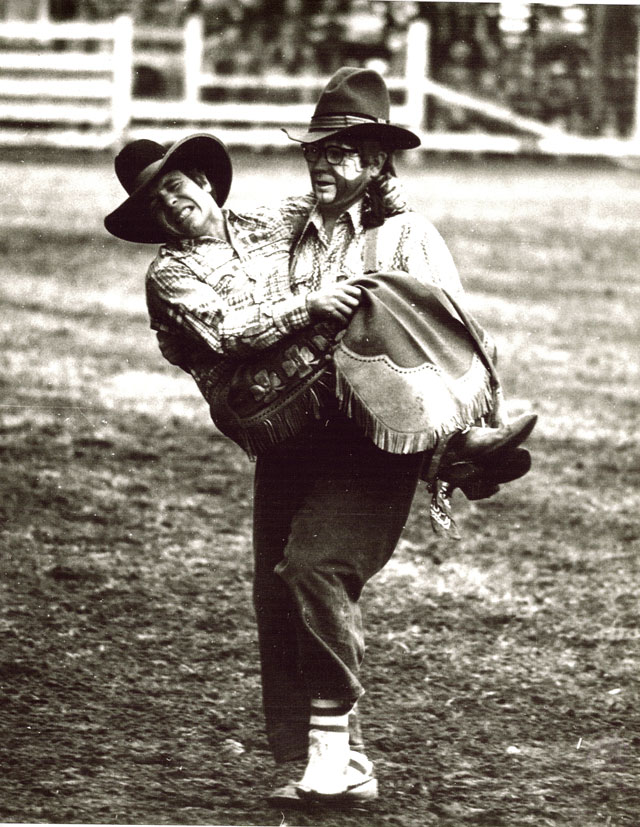
George never left rodeo or his rodeo friends. It was not unusual to see George at numerous cowboy reunions that were held in various places throughout the country, rodeos across the nation, Rodeo Clown Reunions, and inductions at the various Halls of Fame for rodeo persona. George worked for Cavender’s Western Stores, and enjoyed working for friend, Bunky Boger, retired bullfighter, who created the TicTacToe Chicken that was featured in various casinos across the nation. After all, George, thought a lot of his rubber chicken that was his constant companion on the rodeo road.
George is survived by his wife, Reada Kay Doak; sons George Doak, Jr and wife, Laquitta and Michael Doak and wife Laura; Step-son Derron Vincik and wife Amy, step-daughter Lenece Smith and husband Raymond Smith Jr; grandchildren: Colby Doak, Cassie Hamlin, Samantha Doak, Amberly Andress, Nicolas Doak, Jordan Johnson, Katelyn Macalla, Kelsey Vincik, Kingsley Vincik. Skye Smith and Steele Smith; great-grandchildren Jett & Jake Doak, Chase Hamlin, Ballie Sessom, Gage & Brielynn Andress and Royer and Amberi Doak, plus many other loved ones.
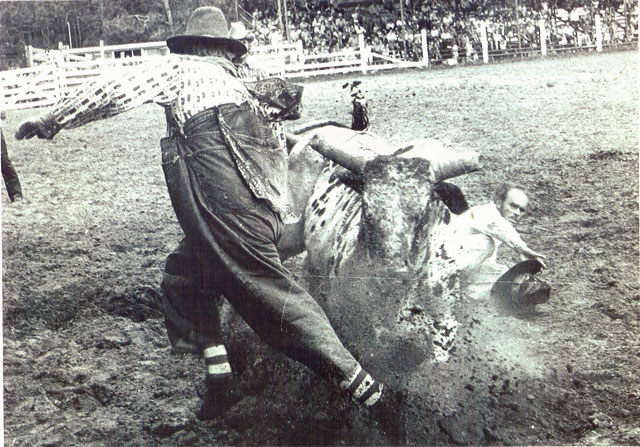
George was preceded in death by his son, Steven Lyle Doak.
Memorials for George should be sent to the Justin Cowboy Crisis Fund, at 101 ProRodeo Drive, Colorado Springs, CO 80919 and/or the Rodeo Cowboy Alumni, Scholarship Fund, 6064 Appleton Rd SW, Albuquerque, NM 87105.