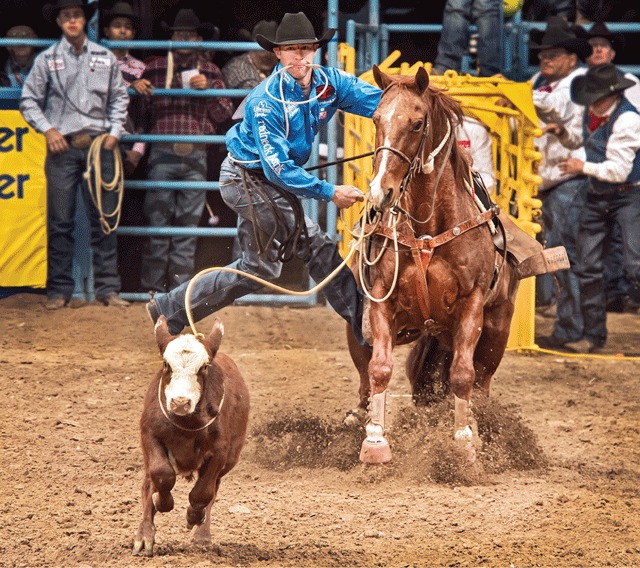
Nine-time WNFR qualifier Hunter Herrin has been involved in a variety of sports, especially rodeo, since childhood. Within the last few years, the 33-year-old from Apache, Oklahoma, has added a new pursuit—hunting—to his list of interests thanks to his son, Houston. “I’m learning more from him than he is from me,” says Hunter. “He’s 11 and he really enjoys deer hunting. I’ve done a whole lot more of that in the last three years than I have in my entire life.” Hunter is no stranger to long nights on the road and admits that he’s not the deer hunting kind of early riser, but he’s enjoyed the new experience nonetheless. “If you are out there when the earth wakes up, it seems to be refreshing, the way the animals move and the birds wake up when the sun starts to rise. It’s pretty cool. You can reflect on this, that, and the other, and enjoy the moment.” Houston, who learned about the hunting lifestyle from his grandpa, has harvested several deer. The meat is often shared among the family, and Hunter enjoys a bowl of deer chili.
Tracking calves is still his favorite pursuit, however, and rodeo is another thing that Hunter and Houston enjoy doing together. Family has often cheered him on from the stands at rodeos like the WNFR and The American, which he won in 2016, while Hunter and Houston spend several weeks in the summer on the road together. “He enjoys getting to hang out with his buddies that I’ve rodeoed with, like Shane Hanchey and Marty Yates. He’s a big fan of them and they spend time with him on the road.”
Hunter made a run at the winter stock shows and rodeos, working to find the balance between recovering from his October 2017 hip surgery but still getting a start on the 2018 season. “With a surgery or injury, you change your goals and double down and work harder like I should have in my 20s,” says Hunter, who first qualified for the WNFR in 2006. He was his son’s age when he started roping, encouraged by his step-dad, Bob Nunn. Hunter junior rodeoed and focused more on basketball and football in high school, but rodeo was back on his radar in his late teens. “I went to three semesters at Weatherford in Oklahoma and did college rodeo there, and in the winter of ’05, I started rodeoing full time. My parents bought my PRCA permit for me in ’04.” When Hunter stepped up his competition in 2006, it was the first of four consecutive qualifications to the WNFR. He went through a pattern of getting horses ready for the finals every other year, and in 2014, his horse Dualin Demon “Rambo” won PRCA Tie-Down Roping Horse of the Year.
Presently, Hunter is working on several horses that he anticipates being ready to rodeo on in the fall. “But I’m looking for that kind of rodeo horse now. Clint Akin has a horse that I rode in Houston and there’s a possibility I can rodeo on him some, but we’re still keeping our eye out for one that fits the mold of what we’re looking for.” Hunter and his dad train horses and have three in particular they’ll start hauling this summer. With the exception of his first year at the WNFR, Hunter has qualified for the finals every time on a horse he trained. What fuels his horses is equally as important as their training, and he recently started feeding Nutrena’s SafeChoice horse feeds. “My horses have done really well on it, and they have a whole lineup of different products to feed depending on what you’re looking to get out of your horse. One thing I’ve noticed is that it does keep their weight on them without them getting overly hot. We have six to seven horses out here and ride four or five of them every day and we haven’t had that problem.”
Along with horse training, Hunter also enjoys going to his son’s baseball games. Houston plays on a summer league but loves any sport that involves a ball. “He’s previously been in football and basketball, and now it’s baseball,” says Hunter. “If it’s a sport, he’s into it.”
Hunter anticipates competing in several rodeos in Texas or California in the next month, such as Corpus Christi and the Red Bluff Round-Up, but he’s mainly focused on being ready to go by June. “If the health comes along and I find a horse, I’d like to rodeo this summer and try to get back to where I was in the past and make the NFR again. If that doesn’t happen, I’ll just try to get everything squared away and for sure go for next year.”
Blog
-
Hunter Herrin
-
Stevi Hillman
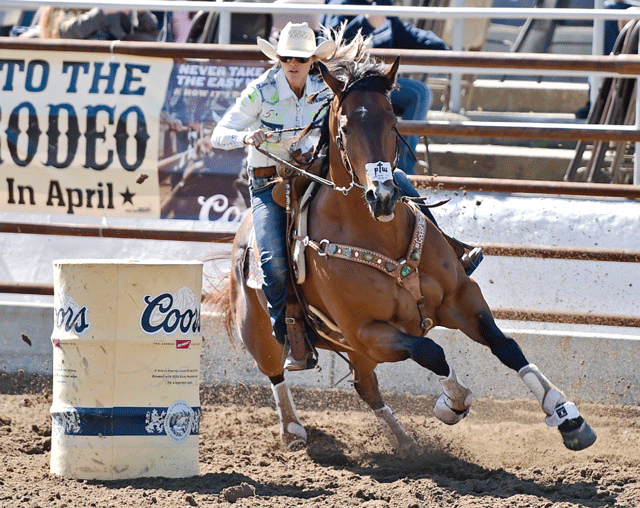
With warmer weather comes barrel racer Stevi Hillman’s favorite time of year. Outdoor rodeos are her and her horses’ forte, and while the two-time WNFR qualifier from Weatherford, Texas, pulled a check in Houston, she won the first two outdoor rodeos of the year at Los Fresnos and Goliad, Texas. “The horses are really ready to be outside,” says Stevi. “I like Cheyenne, it’s a big outdoor rodeo, but I just like the summer run. We get to go from one outdoor rodeo to the next. Some people don’t like it because the weather can change from one run to the next, but I like the challenge, and the travel is fun.”
Stevi took her horses Truck and Layla with her for the California run in April, and she’ll load up Sharpie, the newest addition to her barn, for the summer run. Whether at work or at play, Stevi always saddles up with a 5 Star Equine pad, which she started using even before her rodeo career took off in 2016. “I’m a firm believer in the pads—they last a long time. I really like the quality of the pads. There are some other good pads out there, but with hundredths of seconds’ difference between you and your competitors, going from a good pad to a great pad makes all the difference. I like to represent companies that stand for a good cause and are good people.” Since using the pads, Stevi also noticed her horses needed fewer chiropractic adjustments. “I feel like the pressure of a saddle and the pressure of a pad over time is a huge impact on the horse’s body condition.”
Her latest venture, which Stevi embarked on with her husband, Ty, is raising their own colts and training them. She’s been training horses since childhood, learning from her step-dad, Dave Salzbrenner. They got an embryo out of Martini, the mare that helped Stevi get to her first WNFR in 2016, and bred to Dash Ta Fame, which gave them Pendleton, now a yearling stud prospect. “We flushed our Dash Ta Fame mare this last year to Slick By Design, which gave us our baby this year. We’re not really wanting to get into the breeding business, but our goal is to have a great mare to sell embryos from. I went from training full time with 17 head of horses around here, including our own, to having our own colts, and I have one of the Dunn’s 3-year-olds here in training.”
Horse training led Stevi to the rodeo world when she trained an off-track quarter horse Im A Royal Design “Hammer” and ran him her rookie year in the PRCA, winning Reserve Barrel Racing Rookie of the Year in 2012. He went on to the WNFR with Carlee Pierce and Jana Bean, while Stevi’s mare she trained, Perfectos Dually “J-Lo” took her to Houston, and later, J-Lo ran with Christina Richman at the 2012 WNFR. “A huge part of my rodeo career was getting into Houston for the first time, and I’m very thankful to be able to train such an amazing animal to do so well,” says Stevi.
She grew up with a strong work ethic that included animals’ needs coming first, but Stevi says setting aside time to take care of herself is also important. “It’s (rodeo) a 24/7 job. I talked to someone recently about being out at 11 at night flexing my horse or giving a massage. It really comes down to your passion. At times, you get mentally or physically tired from going 24/7. It’s all about the horses all the time, which is important, but so is taking time for yourself to refresh.” Hot yoga is her favorite way to shift her focus for a few minutes, along with jogging with her husband. “My motivation lately has been that I’m truly blessed to be doing what I love, and how many people get to be in that position? I not only get to do what I love, but I help other people do what they love, and that’s the dream life in my opinion.”
Stevi’s husband feels similarly. Ty, formerly a professional roper, started his business Prepare To Win in 2016. A success coach, he helps clients reach their peak performance in life and in the arena, and his work allows him to travel all year with Stevi. “We listen to all kinds of motivational books, and that definitely sparks conversation around that, and it helps me,” says Stevi. “We’re both very competitive. He’s been my motivation through my competitive years, and my step-dad is a huge inspiration to me and put that fire in me at a young age. Being able to watch people like Lisa Lockhart and Sherry Cervi growing up and being able to talk to them whenever I want has helped, and Jana Bean has been a great help to me.
“My future goals are always to become better, physically and mentally. Competition wise, I always want to win. I know that’s always in God’s timing in what you win and where you’ll go, and I hope for more doors to open this year for me to help more people.” -
Big Picture Listening
One of the most important qualities of a great athlete is the ability to listen. It is a very difficult skill to learn, but one of the most important if you want to be able to improve. You need to be able to listen to your coaches, your peers, judges and many others to be successful.
Here are some problems I see with young athletes when it comes to listening.
First, listening to reply, not to learn or improve from what they are being told. The only reason they hear what you are saying is so that they can reply. When you listen simply to reply your comprehension of the message plummets, simply put you do not hear what is being said. When you are listening to reply you do not hear what is being said because you are thinking about your reply. You are thinking of the justification for your actions or you are just thinking of an excuse. Listen to hear the message.
Second, being able to remove emotion. What do I mean by that? Most of the time when you have a good performance you get plenty of praise and it is easy to listen to how good you are. Where it becomes difficult is when you don’t do well, when things don’t go your way. Most of the time you will be upset after a poor performance or practice and many times this is when your coach will be there to help you. This is the time when it is important to remove emotion. You might be upset, angry or disappointed, but you need to be able to hear the message your coach has for you in these circumstances if you don’t want to repeat the performance.
Third, listen to get the big picture. This is the tough one for many people. Many people hear only what they want to hear. Some will hear only the positive things a coach has to say and ignore the things that they need to work on the most. Some will hear only the negative things and think their coach doesn’t like them. I am pretty sure some don’t hear anything. Whatever the case may be, try to listen to get the big picture. Many times young athletes only see the actions of their last run or ride, and don’t understand why they are being coached a certain way. A good rule is to ask yourself why it was important enough for my coach to tell me that, and how will it make me better. If you don’t understand, ask. The most important part of being a good listener is to understand the message.
Everyone has different ways of relaying messages to you. How well you are able to listen and understand the message will be very important in how you develop as an athlete. -
Phillipsburg Rodeo Gives Annual College Scholarships
Ft. Hays rodeo students benefit from Kansas’ Biggest Rodeo
PHILLIPSBURG, KAN. (April 9, 2018) – Two Ft. Hays (Kan.) State University (FHSU) students have been awarded scholarships courtesy of the Phillipsburg Rodeo Association.
Shae Biedenbender, Westmoreland, Kansas, and Travis Booth, Castle Rock, Colo., have both been awarded $500 scholarships.
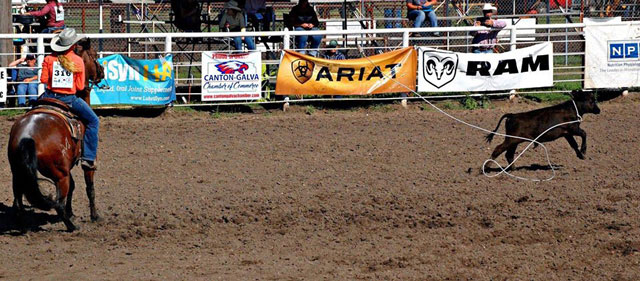
Biedenbener, who is a freshman at Ft. Hays State, competes in the breakaway roping, goat tying, team roping (as a heeler), and will add barrel racing to her repertoire this spring.
She is studying to become an interior designer, having dabbled in it since childhood. After college, she plans on designing the interior of living quarter horse trailers. “Since I’m on the road, I know what people would like in a trailer. I’ve always had a creative mind.”
She is a 2017 graduate of Rock Creek High School in St. George, Kansas and was on the honor roll all four years of high school. Her parents expected her to study. “My dad made it known,” she said, “that he struggled in high school and he made sure his kids knew to take it seriously.” Studies still come first for her in college. “That’s what our (college rodeo) coaches say, too, and I don’t disagree with them at all.”
The scholarship will go towards cost of tuition and books, and she’s grateful for it. “I’m all about helping my family not have to pay expenses,” she said.
She is the daughter of Dan and Meloni Biedenbender.
Travis Booth is a sophomore at FHSU and is majoring in animal science.
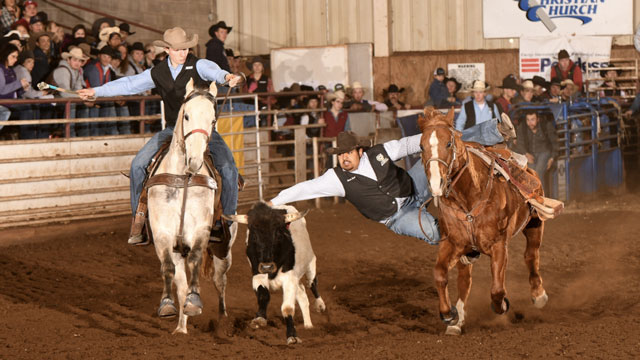
He competes in the steer wrestling and team roping, having begun his collegiate rodeo career at Otero Community College in La Junta, Colo. and transferring to FHSU last fall.
He is appreciative of the scholarship money; “it really helped me,” he said.
Booth plans on graduating in May of 2020 and may choose to go back to Colorado and grow the cattle operation he and his dad have started.
Since 1997, the Phillipsburg Rodeo Association has awarded scholarships to FHSU students who compete in rodeo. The Phillipsburg Rodeo Association is the organization behind Kansas’ Biggest Rodeo, which will be held August 2-4, 2018. For more information on the rodeo, visit www.KansasBiggestRodeo.com.
-
The Douglas County Fair & Rodeo
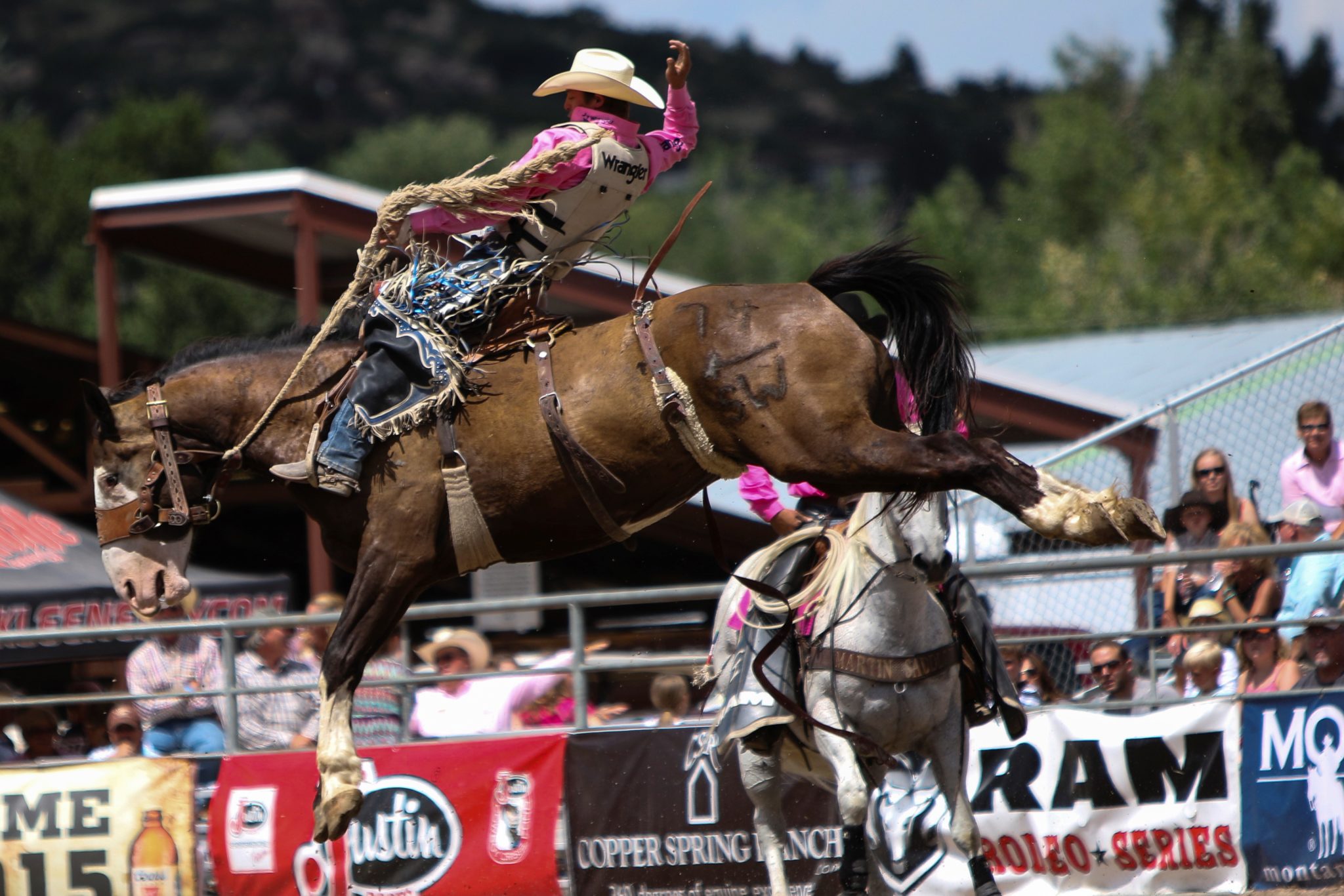
The Douglas County Fair & Rodeo (DCF&R) in Castle Rock, CO Committee and Commissioners are pleased to announce as part of their 100th Celebration, to offer an additional $11,000 added to the purse TOTALING $44,000 for 2018. Rough stock events featured, equal in Team and an outstanding Contestant Hospitality, DCF&R hosts Xtreme Bulls Thurs, Aug 2nd, and three PRCA perfs Aug 3rd, 4th and 5th. Exciting entertainment is also in store with red dirt sensation Cody Johnson, up close and personal on the new Performance Platform overlooking the award-winning facility and arena. Voted Most Improved two years running; make us part of your summer run – Rock the Stock in Castle Rock! DouglasCountyFairandRodeo.com 720/231-5657
-
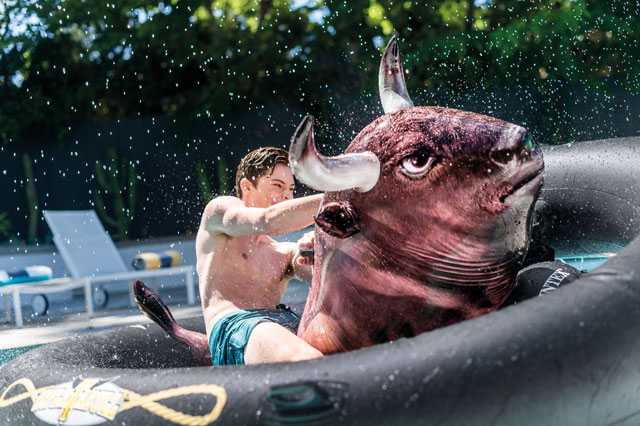
PBR Inflatabull™ Rodeo Bull Ride On Float
Long gone are the lazy days of the dull pool noodle and the boring, simple innertube. This is the pool float renaissance, and they’ve since been replaced by inflatable pizzas, colorful unicorns, and now – Official Rodeo Bulls! Go ahead and leave the cowboy/girl hats, chaps, and most of all, spurs, at home. All you’ll need to take on this bucking bull is your bathing suit, and some courage!
Intex® invites you to climb aboard the New Official PBR Inflatabull™ Rodeo Bull Ride On Float and put your skills to the test! Providing endless hours of challenging excitement for the whole backyard, the PBR Inflatabull, designed for riders 9+, provides a fun test of skill for all competitors. Take on friends, family, and your own best times, to see who’s the top bull rider of the pool party!
Donning the official seal of the Professional Bull Riders (PBR), the Inflatabull is built tough – just like the photo-realistic printed animal it’s inspired by. Made of 18-gauge vinyl construction and with three separate air chambers, the Inflatabull is sure to handle even the toughest of riders with ease. A great accessory outside the pool too, the durability of the Inflatabull gives you the ability to set-up your own rodeo in ponds, lakes, and rivers with ease. But be forewarned, this beast is designed for anything but a relaxing ride down the lazy river!
-
ProRodeo Hall of Fame Announces 2018 Induction Class
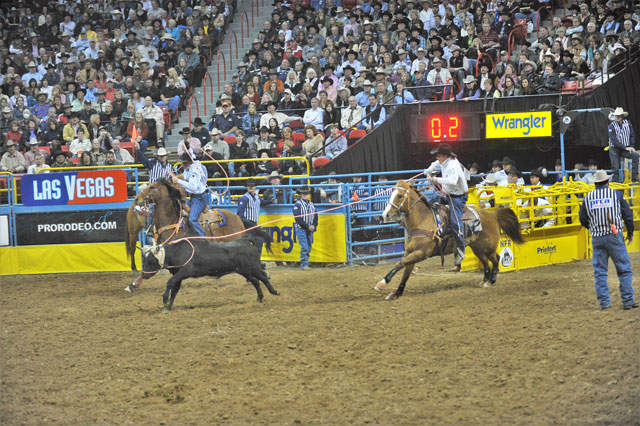
COLORADO SPRINGS, Colo. – Team roping stars Speed Williams and Rich Skelton had no equals from 1997-2004, as each won eight consecutive PRCA world championships.
Now, the duo will be immortalized in rodeo history.
Williams and Skelton headline the 10-member 2018 induction class for the ProRodeo Hall of Fame. The ceremony takes place Aug. 4 at the ProRodeo Hall of Fame in Colorado Springs, Colo.
Williams and Skelton join gold buckle-winner Deb Greenough (bareback riding, 1993), contract personnel recipient Leon Coffee, stock contractor Billy Minick, rodeo notable Walt Garrison and the committee for the Black Hills Roundup in Belle Fourche, S.D., as the PRCA inductees.
For the second time in the history of the ProRodeo Hall of Fame – 2017 being the first – barrel racers from the Women’s Professional Rodeo Association (WPRA) will be among the class of inductees, and their class includes Kristie Peterson, Billie McBride and a WPRA equine inductee, French Flash Hawk (Bozo).
In addition to the 10 inductees, former PRCA Chief Operating Officer Kay Bleakly will receive the Ken Stemler Pioneer Award, which honors individuals in recognition of their groundbreaking, innovative ideas and forward thinking.
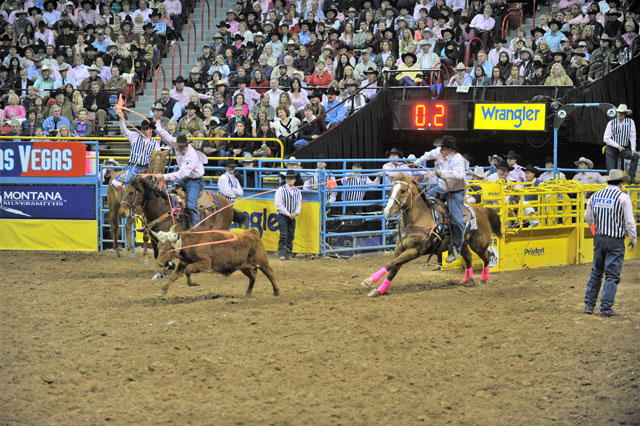
Williams and Skelton were the pinnacle of team roping for nearly a decade.
“I remember going to the high school finals and stopping in the ProRodeo Hall of Fame and I was blown away with the history of ProRodeo,” Williams said. “It’s a great honor to be inducted into the Hall of Fame. Rich and I had a fairytale career and words don’t really describe how I’m feeling.”
Skelton also was taken aback to receive this prestigious honor.
“This is cool, and I don’t know when this will sink in,” said Skelton, who still competes on the PRCA circuit. “I wanted to make the NFR and I wanted to win the world, and then things just kept going our way. When you look back at it, we had good horses, and everything was set up at that time and that’s all we thought about and that’s all we did was rope. To me, we had so much success because Speed changed the heading and started roping fast and I just tried to be consistent.”
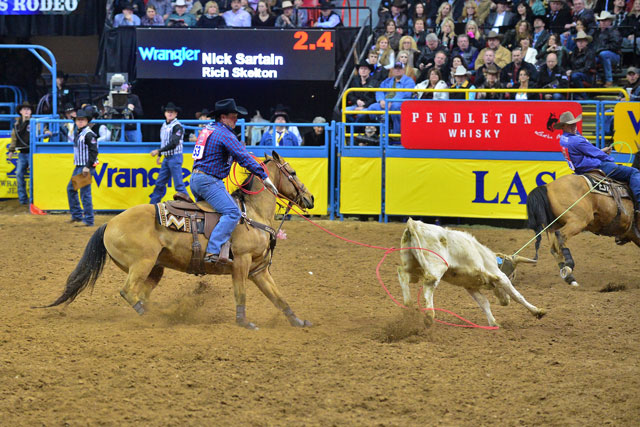
Williams qualified for the Wrangler National Finals Rodeo 15 times (1988, 1994, 1996-2008), and Skelton has 22 NFR qualifications on his résumé (1990-2006, 2009-10, 2013-15).
“I don’t think there was any secret to our success,” Williams said. “We came together at the same time and we had the same desires and we wanted to rodeo and that’s what we did every day, but I never even dreamed that we would win eight gold buckles in a row.”
Peterson, a four-time world champion, and her great horse French Flash Hawk, better known as Bozo, will fittingly go into the Hall together. Following on the heels of Charmayne James and her great horse, Scamper, it was Peterson and Bozo that ended James’ streak of 10 straight world titles, capturing their first of four world titles in 1994.
Although Peterson and Bozo were not successful in defending their title in 1995, the duo would return to the top of the sport in 1996 and then win three straight.
“How wonderful … that is just awesome,” Peterson said upon learning the news of the induction honor. “I feel very honored and humbled. To go in with Bozo is definitely the carrot on top. I am just speechless.”
When asked how it felt to follow James and Scamper, both in the arena and now into the ProRodeo Hall of Fame, Peterson simply said, “Being in the shadow of Scamper is a great place to be.”
McBride joins Peterson and Bozo in the Hall as another four-time WPRA champion. She will be inducted posthumously having passed away at the age of 90 on May 10, 2017.
McBride first saw barrel racing at an open rodeo event in 1937 and decided at 10 years old that it was the path she wanted to travel. McBride was a charter member of the Girls Rodeo Association (GRA), formed in her hometown of San Angelo, Texas, just over a decade later.
“She would be overwhelmed and thrilled,” said Alva Jean Meek, McBride’s daughter. “We are approaching the one-year anniversary since we lost her, but this news would have made her ecstatic. The GRA was a big part of her life, and she put her heart and soul into the earlier association.”
Greenough, 54, qualified for the National Finals Rodeo 13 consecutive years (1988-2000), tied with Joe Alexander for the fifth-most overall NFR qualifications in PRCA history. His 15 career NFR go-round wins at the NFR is also fifth most in his event. Greenough won a bareback riding world title in 1993 and a NFR average title in 1992.
Greenough was also known for his success within the Montana Circuit, where he went on to win five circuit titles. Greenough remains tied for the most National Circuit Finals Rodeo wins among all bareback riders with three career wins, in 1995-96 and 1999.
Coffee cried tears of joy when he found out he was selected for induction into the ProRodeo Hall of Fame.
“It kind of brought me to the milk right there, it brought tears to my eyes, that’s an old cowboy phrase for it made you cry,” Coffee said. “To know that my heroes, my friends and heroes, who are in there, and I’m in there with them – that’s just something I dreamed of. I’m just tickled to death to be in there and say, ‘Yes, I am in the PRCA Hall of Fame.’ It’s pretty wild.”
As a PRCA Gold Card Member and NFR barrelman, Coffee has enjoyed a long and lively career in ProRodeo as one of only three cowboys to be both a barrelman and a bullfighter at the NFR.
Since 1973, this Texas cowboy has fought bulls at the NFR twice (1979, 1984) and was a barrelman at the NFR in 1991, 1994 and 1997. Coffee also won PRCA Clown of the Year and was in the Top 3 every year from 1984-2001.
“I enjoy putting smiles on faces, and my motto of life is God put me on Earth to do two things – make people happy and help people out, and I can do both in the arena,” Coffee said.
Coffee also worked at the first National Circuit Finals Rodeo in 1987, the Texas Circuit Finals Rodeo (1980-82, 1992, 1996-97, 2003-04) and the Canadian Finals Rodeo twice (1985-86).
He was featured in many movies, including “8 Seconds” and “My Heroes Have Always Been Cowboys.”
Garrison was two different types of cowboy, a fullback with the Dallas Cowboys and a ProRodeo competitor. He went on to combine his stardom with football and rodeo to raise more than $4 million for multiple sclerosis with his Walt Garrison All Star Rodeos over the course of 20 years.
“I think that dad played football as a career, but he got really fortunate when he retired from the NFL and Copenhagen/Skoal hired him to be a spokesperson,” said Walt Garrison’s oldest son, Marty.
The Texas cowboy was instrumental in the U.S. Smokeless Tobacco and Winston sponsorships in ProRodeo and the programs those sponsors provided – such as the Winston Scoreboard, sponsorships for individual cowboys and helping college rodeo athletes get scholarships.
“His first love was rodeo, no doubt, ever since he was really young,” Marty Garrison said. “That’s what he would have done had he not played football in college and then got drafted by the Dallas Cowboys. His whole life, his love was rodeo.”
Minick was short on words when he received the phone call that he was being inducted into the ProRodeo Hall of Fame, only because he hadn’t had time to process his new place in immortality.
“It took my breath away at first,” said the 79-year-old Minick. “I got a few tears. To be among those guys, even the past and the present and future cowboys, it’s kind of like that famous old quote that’s been said by all the cowboys, and even in song. ‘All I ever wanted to be was a cowboy.’”
Minick, born and raised in Fort Worth, Texas, began his professional rodeo career in 1959, enlisting in the Rodeo Cowboys Association after winning titles both in high school and college. Minick qualified for the National Finals Rodeo as a bull rider in 1966. In 1968, Minick purchased the Harry Knight Rodeo Company from Knight and legendary entertainer Gene Autry.
The Billy Minick Rodeo Company eventually produced top NFR bucking stock, including the bucking horse Streamer in 1972 and the bull Tiger in 1973. Tiger would also win Bull of the Year in 1974.
Through the years, Minick helped to produce such rodeos as the Fort Worth (Texas) Stock Show and Rodeo, Rodeo Houston, the San Antonio Stock Show & Rodeo, the Santa Rosa Roundup (Vernon, Texas), Cheyenne (Wyo.) Frontier Days, and many more.
This summer marks a historic year for the Black Hills Roundup in Belle Fourche, S.D. Not only can the rodeo now boast being an inductee to the ProRodeo Hall of Fame, but this year will also be its 99th annual competition.
The Black Hills Roundup started when 15,000 people gathered in a field in Belle Fourche to raise money for World War I in 1918. At the time, the population of Belle Fourche was 1,410.
The next year marked the first time the rodeo took place.
“The board and committee put a lot of time and effort into it,” Black Hills Roundup Chairman Clay Crago said. “It’s pretty special to us to see the recognition and get into the Hall of Fame.”
The big number of people to attend continues today, with an estimated 10,000-15,000 attending a parade during rodeo week in the town of about 6,000.
The historic rodeo, which is 100 percent volunteer-run, also boasts that President Calvin Coolidge attended in 1927.
With the 2018 class included, the ProRodeo Hall of Fame will have enshrined 267 people, 34 animals and 29 rodeo committees.
The WPRA contributed to this release.
-
RED BLUFF CROWNS CHAMPIONS
RED BLUFF CROWNS CHAMPIONS
World champions, contenders leave northern California with gold buckles
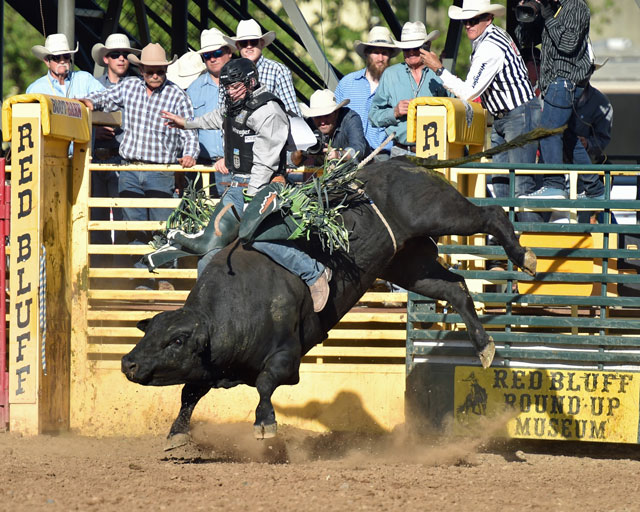
Red Bluff, Calif. (April 22, 2018) – Two world champions won their events at the 97th annual Red Bluff (Calif.) Round-Up this weekend.
Tyler Pearson, the reigning steer wrestling champion, and Zeke Thurston, the 2016 saddle bronc riding champion, both collected gold buckles for their efforts in Red Bluff.
Pearson, Louisville, Miss., had a combined time of 21.0 seconds on four runs to win the steer wrestling. He had seen another cowboy make a 5.2 second run on his steer earlier this week, and “I knew I had a chance. I trusted in the horse and the hazer, and all went well.”
Pearson’s first world championship, won last December at the Wrangler National Finals Rodeo (WNFR), has been a big confidence booster. It was a “dream come true,” he said. “It was one of those story book endings, and it’s rolled over to this year. It’s been fun.” Pearson is currently ranked in the top ten in the PRCA world standings.
The horse Pearson rode has his own special resume. Outlaw, a twenty-year-old palomino, has been ridden by the last four Red Bluff champions: Pearson this year, Chance Howard in 2017, Ty Erickson in 2016, and Tyler Waguespack in 2015.
Owned by Waguespack, the horse does well with long scores and larger arenas, and at this year’s Round-Up, was ridden by five cowboys: Pearson, Erickson, Waguespack, Timmy Sparing and Rowdy Parrott.
Outlaw is a former barrel horse who was purchased by Waguespack five years ago. “My dad and I got to playing around with him one day, and we wound up training him (for steer wrestling) one summer. We found out what he was good at, and we took him into rodeo kind of slow.”
Outlaw is well loved by his riders and his owner. “I’m really proud of him and how he performed today, and really proud of all the guys who rode him,” Waguespack said.
The saddle bronc riding title went to Zeke Thurston.
The world champion from Big Valley, Alb., scored 86.5 points on the Calgary Stampede horse Urgent Delivery. It wasn’t the first time the two had met.
Five years ago, when he was eighteen, he rode the horse at the Canadian Finals Rodeo during the novice saddle bronc riding, winning the round. “I rode that horse when he was just a baby and I was pretty young myself,” he said. “We were both pretty green. He’s a big strong bucker but I made a good ride on him and got a little money for it.”
Thurston is the son of Skeeter Thurston, a six-time WNFR qualifier. The world title the younger Thurston won two years ago was “awesome. That’s the pinnacle of our sport, what everybody works their way towards. Every year I rodeo, I rodeo for a world title.”
He and his wife are expecting their first child in August.
The tie-down roping title went to an Oklahoma man.
Tyler Milligan, Pawhuska, Okla., had a time of 38.2 seconds on four runs to win the Round-Up buckle.
Milligan is the 2017 Resistol Rookie Tie-Down Roping of the Year, a title that goes to the contestant in each event who has won the most money during their rookie year.
He was aboard a fifteen-year-old sorrel named Big Time, who has enabled him to do well. “He’s the best horse I’ve ever had,” Milligan said. “I wouldn’t have won near what I won last year without him. He’s phenomenal. He’s the same trip every time.”
Milligan is all business in the rodeo arena, not letting wins or misses affect him. “I just keep doing the same thing, just take one calf at a time. Every time you win, it’s a confidence booster. But I always try to stay the same, not get too high or too low.”
Other Red Bluff champions include bareback riders Jamie Howlett, Weatherford, Texas (87.5 points); team ropers Cody Snow, Los Olivos, Calif. and Wesley Thorp, Throckmorton, Texas (29.1 seconds on four runs); barrel racer Jessi Fish, Franklin, Tenn. (34.53 seconds on four runs) and bull riders Jordan Hansen, Ponoka, Alb. and Garrett Tribble, Bristow, Okla. (88.5 points each).
During the rodeo, which was the annual Tough Enough to Wear Pink event, a VIP rodeo package was auctioned off. Rose Crain and Dan Davidson, owners of Haleakala Ranch, purchased it for $26,000. The “Run for the Roses” package includes a trip to the Kentucky Derby, a behind-the scenes tour from an official veterinarian, hotel stay, and round-trip airfare. Monies raised during the Round-Up’s “pink” campaign go to breast cancer treatment at the St. Elizabeth Imaging Center.
Next year’s Red Bluff Round-Up will be held April 19-21, 2019. For more information on the rodeo, visit RedBluffRoundup.com.
Results, Red Bluff Round-Up, April 20-22, 2018
All-around winner: Rhen Richard, Roosevelt, Utah (tie-down roping and team roping)
Bareback Riding – 2018 Red Bluff Champion: Jamie Howlett, Weatherford, Texas
- Jamie Howlett, Weatherford, Texas 87.5 points on C5 Rodeo’s Virgil; 2. Zack Brown, Red Bluff, Calif. 87; 3. (tie) Bill Tutor, Huntsville, Texas and Jake Brown, Cleveland, Texas 85 each; 5. (tie) Seth Lee Hardwick, Ranchester, Wyo., Mason Clements, Springville, Utah, and Kaycee Feild, Spanish Fork, Utah 84.5 each; 8. Steven Dent, Mullen, Neb. 83.5
Steer Wrestling 2018 Red Bluff Champion – Tyler Pearson, Louisville, Miss.
First round:
- (tie) Jesse Brown, Baker City, Ore. and John Henry Franzen, Riverton, Wyo. 4.8 seconds each; 3. Nick Guy, Sparta, Wisc. 5.1; 4. Curtis Cassidy, Donalda, Alberta 5.2; 5. (tie) Rowdy Parrott, Mamou, La. and Ty Talsma, Avon, S.D. 5.3 each.
Second round:
- (tie) Stan Branco, Chowchilla, Calif. and Aaron Vosler, Cheyenne, Wyo. 4.2 seconds each; 3. (tie) Bridger Chambers, Stevensville, Mont. and Brad McGilchrist, Marysville, Calif. 4.4 each; 5. Jesse Brown, Baker City, Ore. 4.6; 6. (tie) Rhett Kennedy, Chowchilla, Calif. and Sterling Lambert, Fallon, Nev. 4.7 each.
Third round:
- Bridger Chambers, Stevensville, Mont. 3.8; 2. Ty Erickson, Helena, Mont. 4.8; 3. (tie) Dirk Tavenner, Rigby, Idaho and Tyler Pearson, Louisville, Miss. 5.1 each; 5. Harley Cole, Okotoks, Alb. 5.3; 6. (tie) Taylor Gregg, Walla Walla, Wash. and Cody Cabral, Hilo, Hawaii 5.4.
Finals:
- Ty Erickson, Helena, Mont. 4.5 seconds; 2. Tyler Pearson, Louisville, Miss. 4.9; 3. Tucker Michael Allen, Oak View, Calif. 5.0; 4. Jesse Brown, Baker City, Ore. 5.1.
Average:
- Tyler Pearson, Louisville, Miss. 21.0 on 4 head; 2. Bridger Chambers, Stevensville, Mont. 21.8; 3. Ty Erickson, Helena, Mont. 22.6; 4. Aaron Vosler, Cheyenne, Wyo. 23.8; 5. Will Lummus, West Point, Miss. 24.1; 6. Jesse Brown, Baker City, Ore. 24.4.
Saddle bronc riding 2018 Red Bluff Champion – Zeke Thurston, Big Valley, Alb.
- Zeke Thurston, Big Valley, Alb. 86.5 points on Calgary Stampede’s Urgent Delivery; 2. (tie) Rusty Wright, Milford, Utah, and Taos Muncy, Corona, N.M. 85 each; 4. Jesse Wright, Milford, Utah 82.5; 5. Chuck Schmidt, Keldron, S.D 82; 6. (tie) Ryder Wright, Milford, Utah, Wade Sundell, Boxholm, Iowa and Louie Brunson, New Underwood, S.D. 81 each.
Tie Down Roping 2018 Red Bluff Champion – Tyler Milligan, Pawhuska, Okla.
First round:
- Cooper Martin, Alma, Kansas 9.1 seconds; 2. Randall Carlisle, Athens, La. 9.6; 3. Tyler Milligan, Pawhuska, Okla. 9.9; 4. Jordan Ketscher, Squaw Valley, Calif. 10.0; 5. Ty Baker, Van Horn, Texas 10.3; 6. Dakota Eldridge, Elko, Nev. 10.5.
Second round:
- Timber Moore, Aubrey, Texas 8.6 seconds; 2. Fred Whitfield, Hockley, Texas 8.8; 3. (tie) Reese Riemer, Stinnett, Texas and Tyler Milligan, Pawhuska, Okla. 8.9 each; 5. Jake Pratt, Ellensburg, Wash. 9.0; 6. (tie) Rhen Richard, Roosevelt, Utah and JC Malone, Plain City, Utah 9.3 each.
Third round:
- Adam Gray, Seymour, Texas 8.1 seconds; 2. Bo Pickett, Caldwell, Idaho 8.4; 3. Cooper Martin, Alma, Kan. 8.8; 4. Dakota Eldridge, Elko, Nev. 8.9; 5. Cimarron Boardman, Stephenville, Texas 9.1; 6. (tie) Ty Baker, Van Horn, Texas and Rhen Richard, Roosevelt, Utah 9.7 each.
Finals:
- Tyler Milligan, Pawhuska, Okla. 8.9; 2. Cooper Martin, Alma, Kan. 9.4; 3. Ty Baker, Van Horn, Texas 9.7; 4. Bo Pickett, Caldwell, Idaho 9.8.
Average:
- Tyler Milligan, Pawhuska, Okla. 38.2 seconds on 4 head; 2. Cooper Martin, Alma, Kan. 39.5; 3. Ty Baker, Van Horn, Texas 39.7; 4. Rhen Richard, Roosevelt, Utah 40.9; 5. Adam Gray, Seymour, Texas 42.7; 6. Bo Pickett, Caldwell, Idaho 43.1.
Team Roping 2018 Red Bluff Champions – Cody Snow, Los Olivos, Calif. and Wesley Thorp, Throckmorton, Texas
First round:
- Bubba Buckaloo, Kingston, Okla./Clint Summers, Lake City, Fla. 6.6 seconds; 2. (tie) Jr Dees, Aurora, S.D./Cody Cowden, Atwater, Calif. and Chant DeForest, Wheatland, Calif./Bronc Boehnlein, Riverside, Calif. 6.8 each; 4. Cody Snow, Los Olivos, Calif./Wesley Thorp, Throckmorton, Texas 6.9; 5. Ryan Reed, Modesto, Calif./Dalton Pearce, San Luis Obispo, Calif. 7.3; 6. Brenten Hall, Jay, Okla./Chase Tryan, Helena, Mont. 7.6; 7. Brock Hanson, Casa Grande, Ariz./Ryan Motes, 7.7; 8. Riley Minor, Ellensburg, Wash./Brady Minor, Ellensburg, Wash. 7.8.
Second round:
- Luke Brown, Rock Hill, S.C./Jake Long, Coffeyville, Kan. 6.3; 2. CJ DeForest, Jr., Wheatland, Wyo./Andy Holcomb, San Juan Batista, Calif. 6.7; 3. (tie) Cody Snow, Los Olivos, Calif./Wesley Thorp, Throckmorton, Texas and Charly Crawford, Prineville, Ore./Ty Arnold, Midway, Texas 6.8 each; 5. Spencer Mitchell, Orange Cove, Calif./Clay O’Brien Cooper, Gardnerville, Nevada 7.0; 6. (tie) Zane Barnson, Washington, Utah/Cole Wilson, Lake Shore, Utah and Kaleb Driggers, Hoboken, Georgia/Junior Nogueira, Presidente Prudente, Brazile 7.3 each; 8. (tie) Joshua Torres, Ocala, Fla./Jonathan Torres, Ocala, Fla and Levi Simpson, Ponoka, Alb./Jeremy Buhler, Arrowwood, Alb. 7.4 each.
Third round:
- JB James, Jr., Bennett, Colo./Cesar de la Cruz, Tucson, Ariz. 6.6; 2. Joshua Torres, Ocala, Fla./Jonathan Torres, Ocala, Fla. 6.8; 3. Rhen Richard, Roosevelt, Utah/Walt Woodard, Stephenville, Texas 7.0; 4. Kaleb Driggers, Hoboken, Ga./Junior Nogueira, Presidente Prudente, Brazile 7.2; 5. Cody Snow, Los Olivos, Calif./Wesley Thorp, Throckmorton, Texas 7.3; 6. Jr Dees, Aurora, S.D./Cody Cowden, Atwater, Calif. 7.5; 7. McKennan Buckner, Powell Butte, Ore./Morgan McVay, Sparks, Nev. 8.0; 8. Dale Benevides, Naalehu, Hawaii/Buck McCay, Eugene, Ore. 8.1.
Finals:
- Chad Masters, Cedar Hill, Tenn./Joseph Harrison, Overbrook, Okla. 5.7; 2. Chant DeForest, Bronc Boehnlein, Riverside, Calif. 6.2; 3. Joshua Torres, Ocala, Fla./Jonathon Torres, Ocala, Fla. 6.4; 4. Levi Simpson, Ponoka, Alb./Jeremy Buhler, Arrowwood, Alb. 6.9; 5. Kaleb Driggers, Hoboken, Ga./Junior Nogueira, Presidente Prudente, Brazil 7.9; 6. Cody Snow, Los Olivos, Calif./Wesley Thorp, Throckmorton, Texas 8.1.
Average:
- Cody Snow, Los Olivos, Calif./Wesley Thorp, Throckmorton, Texas 29.1 seconds on 4 head; 2. (tie) Joshua Torres, Ocala, Fla./Jonathon, Torres, Ocala, Fla. and Kaleb Driggers, Hoboken, Ga./Junior Nogueira, Presidente Prudente, Brazil 31.6 each; 4. Levi Simpson, Ponoka, Alb./Jeremy Buhler, Arrowwood, Alb. 32.3; 5. Chant DeForest, Wheatland, Calif./Bronc Boehnlein, Riverside, Calif. 33.2; 6. Jr Dees, Aurora, S.D./Cody Cowden, Atwater, Calif. 33.7; 7. Chad Masters, Cedar Hill, Tenn./Joseph Harrison, Overbrook, Okla. 34.2; 8. Dale Benevides, Naalehu, Hawaii/Buck McCay, Eugene, Ore. 40.7.
Barrel racing – 2018 Red Bluff Champion – Jessi Fish, Franklin, Tenn.
First round:
- (tie) Jessi Fish, Franklin, Tenn. and Katie Pascoe, Morro Bay, Calif. 17.23 seconds each; 3. (tie) Nellie Miller, Cottonwood, Calif. and Jolee Lautaret-Jordan, Kingman, Ariz. 17.27 each; 5. (tie) Kellie Collier, Hereford, Texas and Darby Fox, King Hill, Ida. 17.28 each; 7. Brittany Pozzi Tonozzi, Victoria, Texas 17.30; 8. Jennifer Barrett, Buhl, Ida. 17.32; 9. Tiany Schuster, Krum, Texas 17.38; 10. (tie) Tyra Kane, Weatherford, Texas and Deb Guelly, Okotoks, Alb. 17.45 each.
Second round:
- Jessie Telford, Caldwell, Idaho 17.08 seconds; 2. (tie) Katelyn Scott, Odessa, Texas and Jessi Fish, Franklin, Tenn. 17.30 each; 4. Nellie Miller, Cottonwood, Calif. 17.33; 5. Jody Hale, Echo, Ore. 17.38; 6. (tie) Stevi Hillman, Weatherford, Texas and Jana Bean, Ft. Hancock, Texas 17.39 each; 8. Leia Pluemer, Bosque Farms, N.M. 17.40; 9. (tie) Christine Laughlin, Pueblo, Colo., Jennifer Barrett, Buhl, Idaho and Syd Wheeler, Greenfield, Calif. 17.41 each.
Average:
- Jessi Fish, Franklin, Tenn. 34.53 seconds on 2 runs; 2. Nellie Miller, Cottonwood, Calif. 34.60; 3. Jessie Telford, Caldwell, Idaho 34.63; 4. Jennifer Barrett, Buhl, Idaho 34.73; 5. Jolee Lautaret-Jordan, Kingman, Ariz. 34.75; 6.Katelyn Scott, Odessa, Texas 34.83; 7. Darby Fox, King Hill, Idaho 34.88; 8 Tiany Schuster, Krum, Texas 34.92; 9. Christine Laughlin, Pueblo, Colo. 34.94; 10. Deb Guelly, Okotoks, Alb. 34.95.
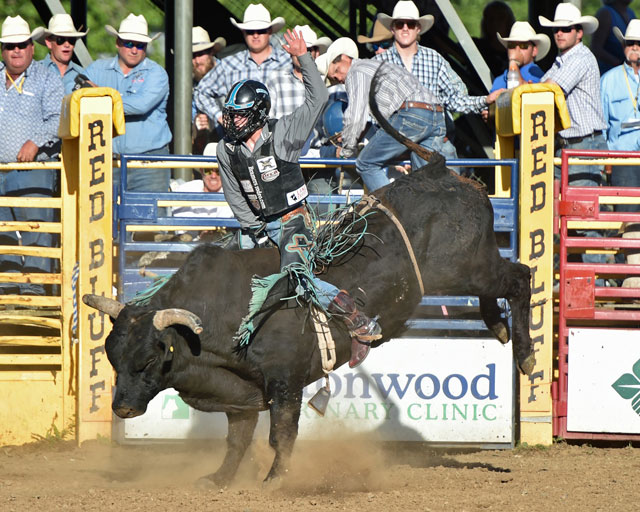
Bull Riding 2018 Red Bluff Co-Champions – Jordan Hansen, Ponoka, Alb. and Garrett Tribble, Bristow, Okla.
- (tie) Jordan Hansen, Ponoka, Alb. 88.5 points on Corey and Lang Rodeo’s Rewind, and Garrett Tribble, Bristow, Okla., 88.5 points on Rosser Rodeo’s Compton Kid; 3. J.W. Harris, Goldthwaite, Texas 86; 4. Joe Frost, Randlett, Utah 84; 5. Tyler Bingham, Honeyville, Utah 82.5; 6. Trey Benton, III, Rock Island, Texas 81; 7. Jesse Petri, Athens, Texas 75; 8. Aaron Williams, Pismo Beach, Calif. 64.
** All results are unofficial. For more information, visit RedBluffRoundup.com. For complete rodeo results, visit ProRodeo.com.
-
On The Trail with Red Top Ranch Trick Riding School
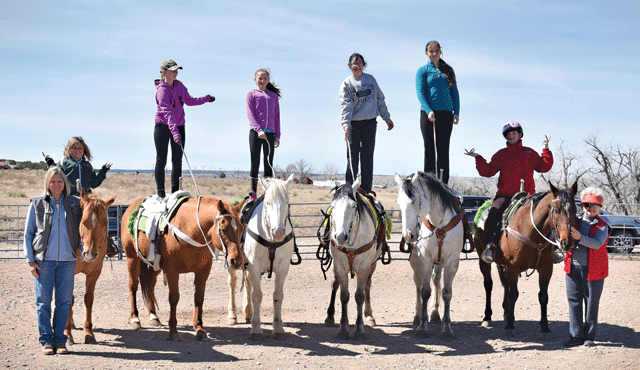
Red Top Ranch Trick Riding school celebrated its 30th years at the Vold Ranch in Avondale, Colorado, this past March. Taught by Karen Vold and Linda Scholtz, a total of 28 students attended one of the four schools. Students traveled from Alaska, Oklahoma, Wisconsin, Pennsylvania, and New York and several other states to attend the three day school.
Karen learned how to trick ride when she was young, “I learned from a lady that worked for us at the riding stables. I trick rode for a living from 14 to 27, when I went to work for Harry,” said Karen. “When I started going on the road, I didn’t have time to do it, so I started teaching.”
Linda came to work for Karen when Karen and Harry’s daughter, Kirsten, was 5. She and her husband, Paul, did the church services and Linda taught Sunday school. She learned to trick ride from Karen in 1978. “I was watching Karen teach Kirsten and I’d never seen it before. I wondered what it was.” Karen told her that she would teach them both. That went on for a year before Linda decided to ride professionally and she got her card in 1980. She and Paul took off for 27 years, part of the All American Trick Riders (Vickie Tyer and Lori Orman). “I fell in love with it,” said Linda. She and Paul continued their ministry at rodeos all over the country.
Warming up. – Rodeo News 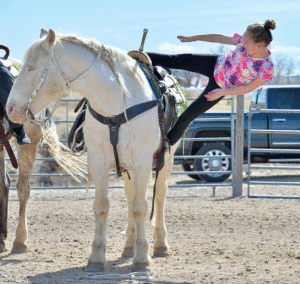
Rubie Sturgeon has been preparing for the school since the middle of February. “I worked out every night. Pullup planks, push ups, and sit ups.” She can do 32 situps in less than a minute and she does yoga too. The 11-year-old from Pittsburg, Penn., believes she is the only one that does trick riding in her area. She is also involved in Equestrian vaulting – Perfect Impulse – they meet every Sunday. “We go to competitions in Virginia and Tennessee.” She likes trick riding because there’s more freedom in it. – Rodeo News 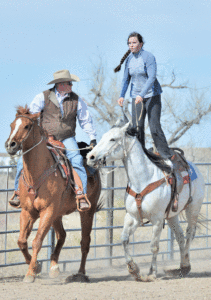
Cory Young ponies Ashtyn Walter from Loveland, Texas. – Rodeo News Linda rode with the All American Trick Riders for 14 years, and during that time someone wanted a lesson. “We started with one lesson in 1987. After that it started rolling along. It started with one weekend,” said Linda. “When we became an official school, we did them for a week. We coordinated it with the local spring break. We advertised a little and it snowballed from there.”
Many of the staff were former students; one from Scotland, who came as a student, is still coming over once a year to rekindle friendships and teach the next generation. Lorna Campbell, from Trinty Gask in Scotland, came ten years ago. “I used to do vaulting and I was too old, and I’d seen it and it looked fun. I ended up getting a couple horses at home and continued.” She shows her talents at Agricultrual shows and Highland games. Unfortunately rodeo is illegal in Scotland, so she isn’t able to trick ride at those events.” Now the clinical trial monitor takes almost a month off to come over and visit and help train the next generation of trick riders. One of her trick riding friends, Mellissa Pfaff, from Broomfield, Colorado, started coming to the class when she was 15.
Mellissa has a BA, four Masters degrees and is midway through her PhD in Education. She teaches high school science and takes time out of her schedule to come every weekend and help. After learning the art, Mellissa went and trick rode all over the country and ended up working for Cavalia for a year and a half. “We worked all over the Us and Canada. “I keep coming back because I love teaching and Linda and Karen changed my life – I’m a better person – trick riding has led me to everywhere I’ve been in my life. It’s a part of my identity.”
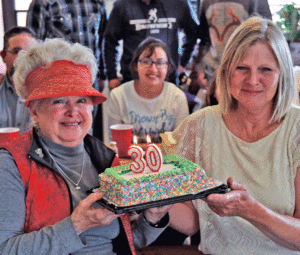
Karen Vold and Linda Scholtz with the cake that was brought to celebrate the occasion. 
Cory Young, from Belton, Missouri, Lorna Campbell, from Trinty Gask in Scotland, and Aaron and Isaac Johnson – brothers. Cory Young has been a pony person for five years, but has worked with Linda for 18 years. He and Aaron and Isaac went to the trick riding competition in 2016 in Las Vegas. “Isaac and I competed in the individual performances,” said Aaron, who placed third and Isaac placed fourth. “Everything I know about horses I learned from Linda and Karen.” Cory went along for support, much like the rodeo minister does at the schools. – Rodeo News 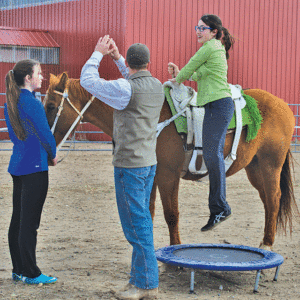
Wyollah Moses, from Keenesburg, Colorado, came to this school for the second time. “I came here last year and had a lot of fun and wanted to come back and learn more – once I get better, I want to perform professionally. My dad is working on a horse for me right now.” The 14 year old has a whole workout routine on her mirror. She hopes to start colts and trick ride when she grows up. “I work at a riding stable in Brighton – cleaning pens, helping the kids, cleaning the tack.” She works so she could buy a trick riding saddle. – Rodeo News The school is open to anyone seven years old and up and any level of experience. “We’ve had students as old 0as 48,” said Linda. “In the past, we’ve had several mothers who gave it a try.”
“It’s harder than it looks,” said Karen. “But by the end of every school, everyone has mastered at least one trick. “We have people from Wisconsin who say this is the best vacation we had as a family.”
Bob Brenner, from Pikes Peak Saddlery, comes one day during the school to help with straps and whatever the students need for the saddles, which belong to Karen and Linda. Linda brought all the horses.
The staff consists of Aaron and Isaac Johnson – brothers. Mellissa and her sister, Mimi, and Lorna, Cory Young, Aaron and Isaac’s mother, Debbie, is one of the cooks, along with Karen’s lifelong friends, Bobbie Fritz. Gail Shivelry also helps in the kitchen along with Cindy Robinson.
“We started this in the first place so the art wouldn’t die, and we’re still doing it,” said Karen. “We have really and truly a fabulous staff and they come back every year. I don’t know why they keep coming. Cory finds ways to share the Word through the avenue of trick riding. “We always have a church service at the last day of the school – It’s shocking when you see students that you had and they introduce you to their kids. It’s hard to imagine it’s been that many years.” -
Wendy Suhn
article by Maesa Kummer
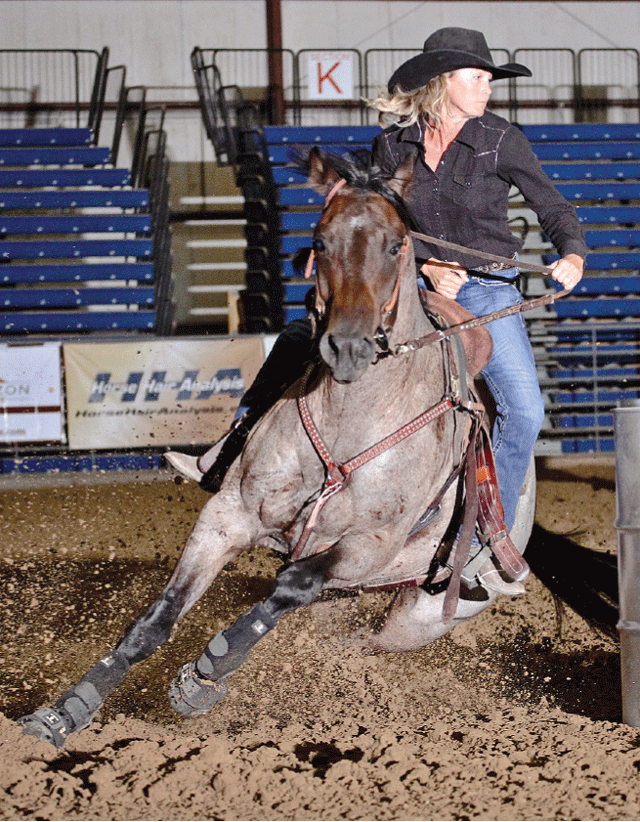
Each day, Wendy Suhn, works to keep her roles as wife, mother, and barrel racer in balance. When she does get time to herself, you’ll find Wendy Suhn working with her horses and preparing for the next race. Sometimes just getting to the races is a victory. She is married to Todd Suhn and they have 2 children, Slate (10) and Zoey (7). They split their time between their residences in Weatherford, TX and Hermosa, SD. She raises, trains, and runs her own horses for barrel racing competition at the futurities, jackpots and rodeos.
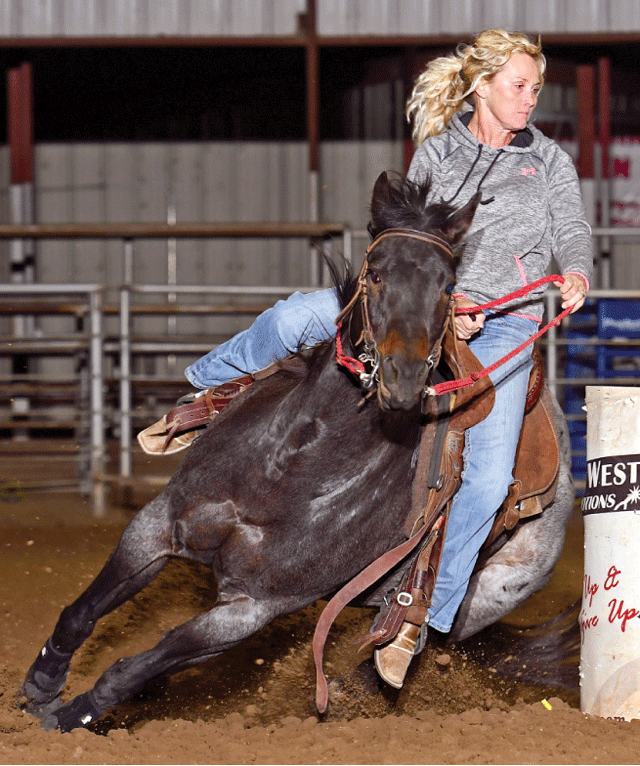
Wendy – courtesy of Fulton Family Performance Horses Currently she is running two horses by A Streak of Fling and has an estimated $50k in earnings between them. “She B Astreakin aka ‘Sheba’ (A Streak of Fling x Wild Fast Bar Girl ) is out of a mare that I used to run barrels on. When we decided to breed her, I was still running her so we wanted to do an embryo transfer. We tried to flush an embryo but when it was implanted in the ‘recip’, we were told that it didn’t take. I continued to run my mare until around March and I took her to the vet because I wanted to rebreed her to A Streak of Fling in the spring and I jokingly remarked about the fact that she looked bred already. It turns out, she was bred and had her baby (She B Astreakin) in May! ‘Sheba’ was my ‘mistake’ baby and it turns out she was the only foal we got out of that mare, so she will probably never leave the place. She has a lot of grit and try like all the ‘Streakers’ have. ‘Sheba’ has her own opinions and strong personality and when you ride her outside, it’s one hand on the horn with her because every now and then she’ll jump in the air and spin around. She is all of 14.2 and I joke that she is as wide as she is tall but she’s a catty little thing and loves to run on harder ground. Right now, at twelve years old, she is running as good as ever!”
“We bought HLH Streakin A Fling aka ‘Redbeer’ (A Streak of Fling x Tinys Gay Jet) as a yearling and he is 9 years old now. He has had to overcome some injuries including most recently, a medial collateral tear on a front leg but since he is so tough, his injury wasn’t easy to determine initially. He runs best in deeper ground and is a bigger, powerful type horse. He has a stiffer style of turning and doesn’t like his face pulled on. We also own his full brother who I am excited to start running.”
“I think the ‘Streakers’ have heart, grit and try and they have the ability to do anything. I’m thinking about getting my WPRA card again this year and hauling both of my horses.” -
Back When They Bucked with Rollie Gibbs
Rollie Gibbs has played several different roles in the sport he loves. He was a bull rider and bulldogger, competing for thirty-plus years, served as chairman of the Helldorado Days Rodeo in Las Vegas, president of the Wilderness Circuit, president and advisor for the Nevada High School Rodeo Association, and chairman of the Old Timers Reunion.
It all started in 1935, when he was born in Las Vegas, the younger son of Bert and Cecilia Gibbs, on the old Miller Ranch, which is now Sunset Park on Eastern and Sunset Roads, back when Fremont Street was gravel.
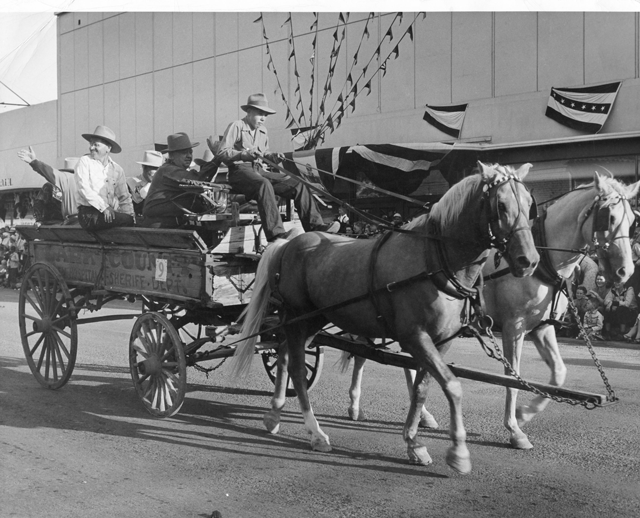
He was a year old when he was in the Helldorado Days Parade, in the back of a little cart while his older brother Delbert drove the cart with a pair of goats. When he was a kid, he and his brother would ride their horses to Bonanza and Second Streets, where they would watch the rodeo and the horse races.
In high school, he rodeoed, riding bulls. One Monday morning, he was up in slack and had to cut school to ride. His parents did not approve of his rodeo; they didn’t want him to get hurt and they did not know that he competed. That evening, he was working with his dad in the front yard, when his dad said, “I hear you can ride bulls.” Father Kenny, from the local parish, had seen Rollie ride and reported it to his dad. The cat was out of the bag.
After graduating from Las Vegas High School in 1954, Rollie went pro. For a while, he didn’t have to buy his Rodeo Cowboys Association card; Chuck Shepard, a judge, would waive the fee for him at the rodeos Chuck was at. One time, in Salt Lake City, June Ivory cornered Rollie, telling him Shepard wouldn’t be there, so he’d have to buy his card.
Rollie steer wrestling at the Silver Bird Hotel in 1980 with Jerry Jones hazing. It was a 5.5 second run. – courtesy of the family 
Rollie’s older brother Delbert drives the wagon with Rollie in the back, 1940 – courtesy of the family In his high school days, Gibbs rode bulls. It wasn’t till ’55 that he started steer wrestling, and he won the first rodeo he entered. Wide World of Sports was televising that event, and “I was twenty feet tall and bullet proof,” Rollie laughed. He competed at rodeos from Cheyenne, Wyo., to Denver, Salt Lake City, Ogden, Spanish Forks, Prescott, Phoenix, Scottsdale, and more. And when steer wrestling greats like Willard and Benny Combs hazed for him, he was on top of the world. “I thought, man, I was King Kong.”
He competed, on and off, for 36 years, and won his hometown rodeo, Helldorado Days, in 1977. A year later, he was asked to be the chairman for the rodeo. Rollie also served three years as chairman of the Helldorado Rodeo Queen pageant. During his year at the helm of Helldorado Days, he had a midnight performance for the workers on the graveyard shift.
Gibbs served as president of the Wilderness Circuit from 1979 to 1982, and helped with the Nevada High School Rodeo Association as an advisor and as president. He worked to bring the high school state finals to Las Vegas. The first time, it was hosted at the Star Dust arena. But when the arena was turned into an RV park, there was no other outdoor facility in Vegas to host it. Rollie went to the county commissioners and worked with them to build Horseman’s Park. Gibbs, in his ingenuity, used local supplies: drill stem pipe from the Nevada Test Site (now the Nevada National Security Site) for posts, leftover lights from the airport, and more. The high school finals was televised for several years by the PBS station, and Rollie secured a Las Vegas High School alumnus; Pam Martin Minick, to serve as commentator. Supporting youth was a big part of his life, whether it was in rodeo or through high school scholarships.
During this time, Rollie had been working for a crane company, with an understanding boss who allowed him to rodeo. When the company passed to the son, he decided to form his own company: the Rollie Gibbs Crane Service. After 26 years with the first company, he took many of his customers with him. He worked on many familiar buildings in town: Caesar’s Palace, the Mirage, the Riviera, the Stardust, at the Nevada Test Site, and more. His skills and dependability were in high demand; when Rollie did a job, it got done quickly and it got done well. “I was working seven days a week, around the clock,” he said.
An example of his hard work was the Landmark Tower. The tallest structure in Las Vegas when it was begun, he and his crew built 26 concrete floors in eleven days, pouring a foot an hour.
Rollie Gibbs (left) and Liz Kesler (far right) on behalf of the Cowboy Reunion present a check to Cindy Schonholtz (center) and the Justin Cowboy Crisis Fund – courtesy of the family 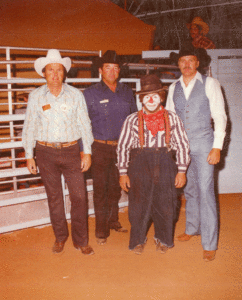
(l to r) Co-Chairman Gail Gibson, Chairman Rollie Gibbs, John Taylor and Co-Chairman Don Helm. The 1987 Elk’s Helldorado Rodeo in Las Vegas, Nevada – courtesy of the family 
Rollie and Naomi – courtesy of the family As owner of Rollie Gibbs Crane Service, he donated much of his time to charities, helping build the Ronald McDonald House, a Salvation Army warehouse, and more. He’s volunteered his time with Habitat for Humanity, and served as Cub Scout leader, receiving the Meritorious Service Award.
Rollie worked as a pickup man for Cotton Rosser and Flying U Rodeo, and served as a judge as well, judging rodeos from the 1960s into the ‘80s. He was on the board of the Miss Rodeo Nevada organization, produced a Little Britches Rodeo in Overton, Nev., and a high school rodeo in Pahrump, Nev.
Since 2008, he’s been president of the Las Vegas High School Alumni Association, and with his guidance, the association has paid out nearly $100,000 in scholarships for high school youth.
Rollie is currently on the board of directors for the Original Cowboy Reunion, begun by Buster and June Ivory and Liz Kessler. The group meets every year in Las Vegas during the National Finals Rodeo.
He built his own home in the early 1980s in a prestigious part of town, Section 10. He and his wife host parties and events at their home, weddings, memorials, Rollie’s high school reunion, church gatherings, and, each year, their rodeo friends when they are in town for the Cowboy Reunion.
A few years ago, he ran into a classmate from high school. Naomi Lytle had been a Helldorado Rodeo Queen, but after marriage, had moved out of town. Her husband died, and when she visited Las Vegas, they reacquainted and got married five years ago. “She dearly loves the same things I do,” Rollie said. Together, they’re spending their retirement days traveling the world, visiting Ireland, Scotland and England; Alaska, the Caribbean, Montreal, and more.
Rollie has had tickets to the NFR since it moved to Vegas in 1985. Four seats in the fourth row belong to him, and he goes to all ten performances. He also loves to visit the Gold Card Room, where the PRCA’s gold card members visit.
Looking back on his life, he recalls the good days. “I can’t say I’ve had a bad part of my life,” he said. “I’ve lived in the best of times.” And at the age of 82, he’s not done. “I’m not dead yet. I’ve got plenty of other things to do.”