Rodeo Life

Blog

  • FRANKLIN RODEO CHAMPIONS DETERMINED

    FRANKLIN RODEO CHAMPIONS DETERMINED

    Cowboy makes winner’s circle even with life’s detours; Tennessee cowboy wins first in the bull riding


    Franklin, Tenn. (May 19, 2018) – For the second year in a row, the saddle bronc riding title at the Franklin (Tenn.) Rodeo went to a Louisiana man.

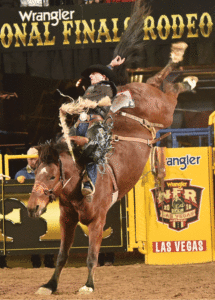
    Joey Sonnier III, New Iberia, La., made an 86 point ride on the J Bar J Rodeo horse Sweatin’ Bullets.

    It was a horse he was looking forward to getting on. As he worked in his saddle shop last Monday, and found out what horse he’d drawn, he gave out a shout, causing the people in the western store next door to come running.

    Sonnier is in his second career as a saddle bronc rider, after having faced down a drug addiction.

    He started his pro rodeo career in 1998, but after becoming addicted to pain pills after a shoulder surgery, he quit riding in 2002.

    In 2014, he faced down his demons, lost fifty pounds, and came back to rodeo.

    He’s done well with his second chance at life.

    “Everybody calls it my second career,” Sonnier said. “It’s awesome.” He won nearly $14,000 at the RAM National Circuit Finals Rodeo in Florida last month, and is ranked tenth in the PRCA world standings.

    The difference between the second Joey and the first Joey? In one word, he said, “God. Everything goes better with God’s plan than with my plan. His plan is always better than mine. That’s what my life’s been, detours. A lot of them were my own choices, and even when I make a bad choice, God gives me another opportunity.”

    In addition to rodeo, Sonnier has another business, making bronc saddles, saddles specifically designed for saddle bronc riding. He started his business a year ago, with four saddles being ridden by cowboys. Now there are 31 cowboys using his saddles.

    But his saddle business will have to be sidelined for a while, as he pursues a chance at a qualification for the Wrangler National Finals Rodeo. The top fifteen in the standings vie for a chance at a world championship at the WNFR each December in Las Vegas, and Sonnier hopes to be among them.

    His goal: “to keep preparing myself for the opportunities God gives me, and at the end of the year, if  I get to go to the (Wrangler) National Finals, then that’s what it’s meant to be.”

    Sonnier is married to Michelle; they have three children, Kade (18), Kenley, eight, and Kylie, two.

    The bull riding title went to a Tennessee cowboy.

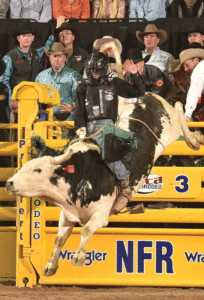
    Gray Essary III, Somerville, Tenn., scored 87 points on the J Bar J bull Cold Dice.


    He has been riding since he was ten years old, having won the Tennessee High School Finals Rodeo bull riding title in 2012 and the National Inter-Collegiate Rodeo Association title three years later, while a student at Ranger (Texas) College.

    Essary was looking forward to his ride. “I drew a really good bull,” he said. “I knew I had the bull to win it on. I just had to do my part.” Cold Dice carried Chase Dougherty to a round win at the Ft. Worth, Texas rodeo earlier this year.

    Other winners from the 69th annual Franklin Rodeo are bareback riders Daylon Swearingen, Rochelle, Ga., Tim O’Connell, Zwingle, Iowa, and Blade Elliott, Centreville, Ala. (all three with 81 points each); steer wrestler Denell Henderson, Dmascus, Ark. (3.7 seconds); team ropers Cyle Denison, Stephenville, Texas and Lane Siggins, Coolidge Ariz. (4.1 seconds); tie-down roper John Douch, Huntsville, Texas (7.9); and barrel racer Ericka Nelson, Century, Fla. (17.59 seconds).

    Next year’s rodeo will be held May 16-18, 2019. The rodeo is the annual fundraiser for the Franklin Noon Rotary Club.

    Cutline: Gray Essary III, Somerville, Tenn., won the bull riding title at the 2018 Franklin Rodeo. The 23 year old competed in high school and college rodeo. Photo by Ruth Nicolaus.


    Results, Franklin Rodeo, May 17-19, 2018

    Bareback riding

    1. (tie) Daylon Swearingen, Rochelle, Ga., 81 points on J Bar J Rodeo’s Dairy Day, Blade Elliot, Centreville, Ala., 81 points on J Bar J Rodeo’s Dairy Day, and Tim O’Connell, Zwingle, Iowa, 81 points on J Bar J Rodeo’s on Two Lounges; 4. Taylor Broussard, Estherwood, La. 79; 5. Steven Dent, Mullen, Neb. 78.5; 6. Scotty NeSmith, Morristown, Tenn. 77.5

    Steer wrestling

    1. Denell Henderson, Damascus, Ark. 3.7 seconds; 2. (tie) Juan Alcazar, Jr. Okeechobee, Fla. and Drew Slade, Brooklyn, Miss. 4.1 each; 4. (tie) Quinn Campbell, Robertsdale, Ala. and Lane Bateman, Sorrento, Fla. 4.2 each; 6. Mike Cliver II, Westfield, Penn. 4.3; 7. Tooter Silver, Quitman, Ark. 4.4; 8. Olin Ellsworth, Warrensburg, 4.5.

    Team roping

    1. Cyle Denison, Stephenville, Texas/Lane Siggins, Coolidge, Ariz. 4.1 seconds; 2. Cory Clark, Stephenville, Texas/Colton Herrera, Ranger, Texas 4.2; 3. Cory Kidd V, Statesville, N.C./Caleb Anderson, Mocksville, N.C. 4.4; 4. (tie) John Alley, Adams, Tenn./Clark Adcock, Smithville, Tenn. and Keven Daniel, Franklin, Tenn./Brad Culpepper, Sylvester, Ga. 4.7 each; 6. Justin Yost, Mount Morris, Penn. /Chris Soto, Pilesgrove, N.J. 4.9; 7. Will Clark, Erin, Tenn./Tanner Ward, Wister, Okla. 5.0; 8. (tie) Colby Fletcher, Hannibal, Mo. /Patrick Houchins, Frankford, Mo., Ryan Von Ahn, Palmyra, Mo./Chad Mathes, Lawson, Mo.; Kelsey Parchman, Cumberland City, Tenn./Dustin Davis, Terrell, Texas and Jacob Dagenhart, Statesville, N.C./Zack Mabry, Piedmont, Ala. 5.1 each.

    Saddle bronc riding

    1. Joey Sonnier III, New Iberia, La. 86 points on J Bar J Rodeo’s Sweatin’ Bullets; 2. Dalton Kingery, Monroe, Iowa 79; 3. Ray Hostetler, Rochelle, Ga. 78; 4. Bradley Harter, Loranger, Texas 77; 5. Cody Martin, St. Joseph, Mo. 76; 6. Tegan Smith, Winterset, Iowa 74.

    Tie-down roping

    1. John Douch, Huntsville, Texas 7.9 seconds; 2. Shane Hanchey, Sulphur, La. 8.1; 3. (tie) Scot Meeks, Airdrie, Alb. and Zeb Chapman, Auburn, Ga. 8.2 each; 5. (tie) Blake Chauvin, Raceland, La. and T.J. Hobson, Henryville, Ind. 8.4 each; 7. (tie) Cheyenne Harper, Iowa, La. and Fenton Nelson, Marshall, Mo. 8.5 each.

    Barrel racing

    1. Ericka Nelson, Century, Fla. 17.59 seconds; 2. Sable Miller, Malvern, Ark. 17.78; 3. Lindsey Hayes-Banks, Opelika, Ala. 17.79; 4. Lacinda Rose, Willard, Mo. 17.80; 5. Kassidy Lantis, Morriston, Fla. 17.82; 6. Melora Potter, Marion, Kent. 17.85; 7. Chaney Speight, Cooper, Texas 17.87; 8. Wendy Culberson, Okeechobee, Fla. 17.89; 9. Lacey Scott, Madison, Ala. 17.91; 10. Sarah Rose McDonald, Brunswick, Ga. 17.93.

    Bull riding

    1. Gray Essary III, Somerville, Tenn. 87 points on J Bar J Rodeo’s Cold Dice; 2. Mario Lehman, Waterloo, Ind. 84.5; 3. Ty Harris, Arcadia, Fla. 83; 4. Daylon Swearingen, Rochelle, Ga. 70; no other qualified rides.
  • Back When They Bucked with Elaine Kramer

    Back When They Bucked with Elaine Kramer

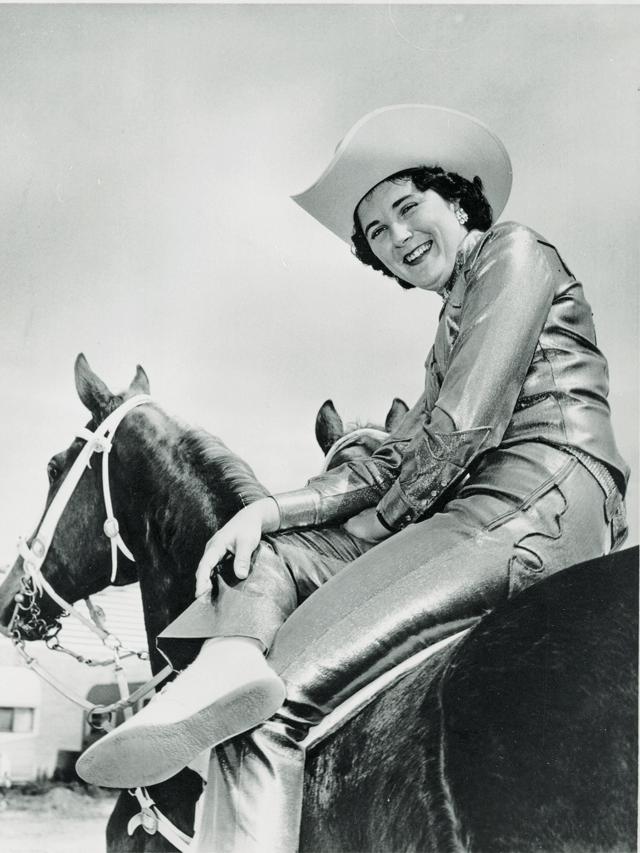
    It all started at the Metro Theater in Prairie du Chien, Wisconsin. That’s where Elaine Kramer saw the horses and maneuvers that would make her famous, to which she would dedicate the next twenty years of her life. The Wisconsin woman was born in 1935 and grew up the middle child of Irvin and Helen Kramer. She and her brothers roamed their farm and the woods, playing cowboys and bank robbers and riding horses. Elaine’s first horse was a pony named Little Beauty, then an American saddle bred, and the farm’s draft horses, which she was able to mount by throwing an ear of corn on the ground. When the horse put his head down to eat it, she’d jump on its neck, then as the horse raised his head, she’d slide down on its back. But it was a chance encounter at the movie theater that determined the course of her life.
    On the big screen, Elaine watched the movie Ride a White Horse and was fascinated. When the credits rolled, she stayed in her seat, reading them, and discovered that the movie was filmed at the White Horse Ranch in Naper, Nebraska.
    Elaine sent a letter to the ranch, asking about it. An invitation came back to come and visit, so she did. It was the summer after her high school graduation, in 1954, and there she learned to roman ride.
    The White Horse Troupe, a group of riders from the White Horse Ranch, performed their act at various events. The Troupe was invited to perform at the American Royal Horse Show in 1954, and when a girl was injured during an act, Elaine was asked to take her place. She was “surprised, excited and scared, and determined to do my very best,” she said. And she did. Her goal became clear: she wanted a horse act of her own.
    She trained her own horses and learned how to roman ride, sometimes with five and even six horses abreast, and often with two jumps. After Sports Illustrated used a photo of her jumping six horses abreast, the Flying Valkyries, a horse act based out of Palm Springs, Calif., saw the picture and asked her to ride with them.
    Elaine performed with them, and also with a troop of performers from Franklin, Indiana, called the Jinks Hogland All Girl Review. The girls jumped horses, roman rode, and had a garland entry. They performed at circuses, wild west shows and horse shows.
    She also worked for two years in Pontiac, Michigan, at John F. Ivory’s ranch, instructing girls on jumping horses and ponies and roman riding. At that time, she jumped and rode a nine horse tandem. Each weekend, Ivory had a horse show and polo games, with hundreds of fans showing up to watch.
    Mr. Ivory helped her start her own roman riding team, and Elaine’s first show was the Dairy Cattle Congress in Waterloo, Iowa. She fell off her horse, but only her pride was hurt. Red Foley, who was performing, came to see if she was OK and gave her a hug.
    Elaine got her Rodeo Cowboys Association membership in 1955, and her career blossomed. She worked for all the major stock contractors of the era: Harry Vold, Bob Barnes, Lynn Beutler, Mike Cervi, Lynn Knight, Rodeos, Inc., and others.

    In 1969, she went to California and worked for Cotton Rosser, spending two years on the West Coast.
    Throughout her career, Elaine had a wonderful time, meeting wonderful people and making memories. One of her more memorable moments, in part because it was a near-accident, came in 1964. She was entertaining at the Toronto Royal Winter Fair, the opening of all winter fairs in Canada, with the queen in attendance. The queen’s rifle battalion was marching out of the arena when someone hollered that she was up. The gate was opened before the soldiers were out of the arena, and as Elaine and her six horses galloped in, she nearly ran over one of the soldiers. He never moved, she remembered, as she maneuvered around him. The next day’s newspapers said that she had made a splash at the Fair, and she was invited to sit with dignitaries in the press box.
    She never had any major accidents, but she recalled a wreck one time in El Paso. She was roman riding a six horse hitch when the right lead horse fell between jumps. The rest of the team landed on each other, and Elaine fell between the wheel horses, the horses she was standing on. She got up, put bridles back on, sorted out the reins, did her act, and got a big ovation.
    Elaine remembers meeting celebrities from all walks of life and doing extraordinary things. She drove the Budweiser hitch, and when Tanya Tucker was in her teens and not yet a big country music star, she sat on Elaine’s lap and told her, “I’m going to buy all your horses.” Elaine had a reply for her: “You don’t have enough money.”
    She usually did her roman riding with a two, four or six horse hitch, going over two jumps, with her trademark act being with the six horse hitch. She trained her own horses, sewed her own costumes, and did a lot of her own driving. Her horses: Flash, Frosty, Flicka, Frisky, Fleet, Fury, Fantasy and Fascination were all sorrels with white faces and four white socks, and if they didn’t have the white socks, she made boots so they looked alike. The horses wore white plumes, white harness, and had white glitter on their hooves.
    Occasionally, her younger brother Keith would help her. Their parents would pull him out of school and send him to the bigger shows and rodeos. He knew how to set the jumps: nine paces between the jumps, and as he got older, he drove truck for her. She taught him how to haul horses, “yelling at me if I took off too fast or hit the brakes,” Keith remembered. Her long-time companion Dan Quinn traveled with her for the majority of the time; they spent 41 years together.
    Throughout her career, she worked the Dallas-Fort Worth Stock Show (where she had a complete wardrobe change for each of the ten performances), Madison Square Gardens, the National Western in Denver, the Cow Palace in San Francisco, was invited to tour Europe, and more. (She didn’t go to Europe; the quarantine for her horses would have taken too long).
    In 1974, she decided to call it quits. One of her horses had passed, and the two wheel horses were getting old. Her knees were bad, and it was time to stay home. Her last performance was in Omaha at Ak-Sar-Ben, where one of her horses came up lame. The veterinarian gave him a shot of cortisone to get him through the show, and the horses were “flawless,” Elaine said. As she styled around the arena for one last round, she got a standing ovation. “My horses pranced out of the arena, as though they knew it was their last performance.” Later, the veterinarian told her if he’d known how dangerous her act was, he wouldn’t have let her ride. She told him, with his help, she had made another safe ride, her last ride.
    “After twenty years of training, feeding, washing and hauling horses and driving many miles, fixing harnesses, sewing sequins on costumes, I concluded I would definitely do it all again,” Elaine said.
    Her career came full circle when, in 1974 at the Metro Theater in Prairie du Chien where it all started, Elaine watched the movie The Great American Cowboy starring Larry Mahan, where a cameo appearance of her act was included.
    After her two decades, she came back to Prairie du Chien to help with her parents’ beef farm. She started a trailer park which she still oversees. Her parents have passed, and now her great-nephew David Kramer runs the farm. The circle may be coming back around; a few months ago, when Elaine was visiting David and his family, she witnessed his two-year-old daughter standing on her rocking horse, just like her great-aunt did years ago.
    Elaine is a 2005 Cowgirl Honoree in the National Cowgirl Hall of Fame and Museum. Her brothers: Keith and Russell, live in Wisconsin, and she has two nieces and two nephews.
    She doesn’t regret a minute of her career. “I never expected what a satisfying fulfillment it would be.”

  • On The Trail with Frontier Rodeo Company

    On The Trail with Frontier Rodeo Company

    story by Cassandra Robledo

    Jerry Nelson’s love for rodeo began in 1991 when a friend invited Jerry and his family to their ranch in south Texas. As the son of a professional baseball player and raised in the city, he didn’t know a thing about rodeo.

    “The first rodeo I went to, shoot, I didn’t know how you dressed. I was an oilfield guy,” Jerry said. “I wore a short sleeve shirt, a baseball cap and a pair of tennis shoes.”

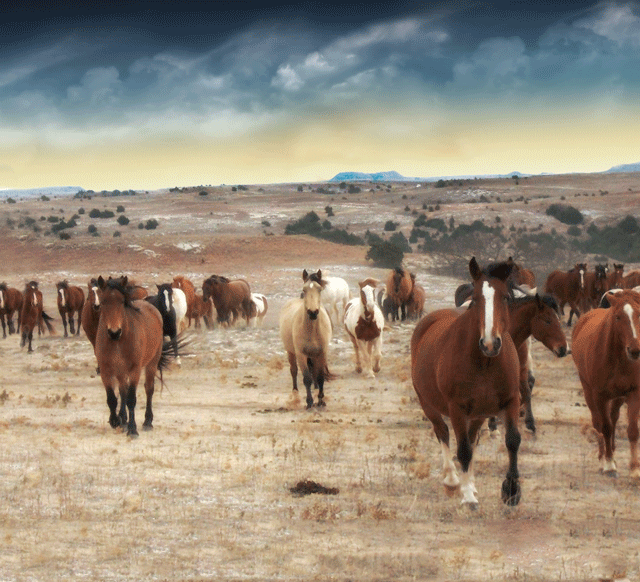
    Fast forward 27 years later Jerry went from leasing 1,900 acres to owning 8,000 acres and leasing some. Today, his ranch covers a vast 9,000 acres across the prairies near Freedom, Oklahoma, with 400 head of bucking horses, 70 rodeo bulls and about 350 commercial cows.

    During the first few years after being introduced to the rodeo scene, Jerry helped produce amateur rodeos. Jerry said he worked his way from the ground up, doing everything from untying calves to working the back pens. The entrepreneur and rodeo stock contractor credits his success to his work ethic and long hours worked.

    “I’m still having fun,” Jerry said.

    In 1993, Jerry built an indoor arena and bought his first set of bulls. He began taking bulls to local amateur rodeos until 1997 when he bought his first pro rodeo card. That same year, he went to one of Harry Vold’s sales in Colorado to buy cows in order to begin his own breeding program.

    Instead of buying the cows he originally planned to buy, Jerry said he left the sale with 10 mares. These mares began his new venture into the bucking horse business, “and the rest is history.”


    Maple Syrup and Big Medicine are two of the most significant horses born out of the mares Jerry bought from Harry Vold. Maple Syrup is one of the first bucking horses he raised. She was talented enough to make multiple trips to the Wrangler National Finals Rodeo and now serves as a broodmare. Big Medicine is Jerry’s stud horse who has sired some of rodeo’s biggest names such as Medicine Woman and Maple Leaf.

    Jerry began Frontier Rodeo Co. at his home in Beaumont, Texas. In 1998, his friend Dan Mundorf bought 100 acres and moved from south Texas to Freedom, Oklahoma. Not long after Dan moved, he leased 1,900 acres in Freedom and began moving his growing operation, leaving Dan in charge.

    Soon after moving to Oklahoma, Dan decided to get out of the horse business. Dan introduced Jerry to Heath Stewart who was hired on not long after. Growing up in a rodeo family, Heath is no stranger to the rodeo world and happily took the job.

    With the same goals, work ethic and love for the industry in mind, Heath gained Jerry’s trust and respect. In 2005, Heath began running the ranch and is now rodeo manager. Jerry said Heath has made Frontier Rodeo what it is today.

    “Most of the reason we’re successful is because of Heath.”

    Heath and Jerry have created a world-class operation with some of the best and most recognizable bucking horse bloodlines in the country.

    “Heath and Jerry have built together an awesome operation,” said Butch Stewart, Heath’s father and coworker. “We’re so proud of them.”

    The first time Frontier Rodeo Co.’s bucking stock made an appearance at the WNFR was in 2005 when they took one horse and three bulls, Heath said. Last year, Heath took 18 horses and 2 bulls to Las Vegas, Nevada, for the 2017 WNFR.

    Frontier starts the rodeo circuit year the second week of January each year. Heath and his staff travel across the U.S. to work up to 25 rodeos a year. For each rodeo, six to eight employees and at least five truckloads of livestock make the trip, Heath explained.

    “The success for Frontier Rodeo Co. is all the people who work for it,” Heath said. “It’s not just me. It’s the people who stay here at the ranch and feed, the pickup men, the guys loading the stock, driving the trucks, announcers and secretaries.”

    The work ethic and professionalism of Heath and his employees quickly gained the respect of many different rodeo organizations throughout the country, said Steven Money, rodeo director for Spanish Fork, Utah’s PRCA Rodeo. Steven commended Heath for the quality of work and livestock he brings each year to Spanish Fork.
    “It’s real exciting to see Frontier come in each year,” Steven said. “We both have the same goals to have the best stock for the contestants.”

    Steven said because Frontier Rodeo helps put on such a great rodeo each year, both Steven and Frontier Rodeo Co. were recognized at the 2017 WNFR. Steven received 2017 Committee Man of the Year and Frontier Rodeo Co. received the 2017 Stock Contractor of the Year award for the third consecutive year.
    Part of Frontier’s success is due to the strategic breeding program set in place to keep new livestock coming each year, said Butch. Selective breeding and training have allowed Frontier to own some of rodeo’s most well known bucking horses such as: Medicine Woman, Full Baggage, Maple Leaf, Show Stomper, Delta Ship and Bad Medicine. Medicine Woman is a 4X PRCA Saddle Bronc Horse of the Year. She is second in the PRCA record books for the most wins (2011-2014-2015-2016). Full Baggage is a 2X PRCA Bareback Horse of the Year (2011 & 2013), and Maple Leaf was the 2013 PRCA Saddle Bronc Horse of the Year. Frontier Rodeo Company has also been awarded the Remuda Award by the PRCA in 2012 & 2016. This award is given to a PRCA Stock Contractor for providing a high caliber herd of bucking horses.

    Every May, Heath and his employees load 70 to 80 young horses and take them to Guymon, Oklahoma, to buck at Robert Etbauer’s arena for their first trip. During the three-hour drive home, Jerry said his wife, Beverly Nelson, names most of the horses. Both Heath and Beverly come up with unique names for all of the horses they keep each year.

    Butch described the yearly cycle that expands up until a horse turns six. Butch said each year their foals are born, yearlings are weaned, 2 year olds are moved and 3 year olds are bucked. The 3 year olds that make the cut are turned out until they turn 4 then bucked at a few local college rodeos, Heath said. Then they are turned out until they turn 6. At age 6, they are developed enough physically to begin their debut on the rodeo circuit.
    “A lot of people don’t understand that it takes that long to bring a horse along to where you can use them in the rodeo field,” Butch said. “That’s why we have a cycle.”

    Jerry, Heath, and everyone employed at Frontier have all participated in creating one of rodeo’s largest and most successful stock contracting companies in the country.

    “My reason for success in the rodeo company is good family and good employees,” Jerry said. “That’s what makes it work.”

    Donnie Gay, eight-time PRCA World champion bull-rider, and Jerry’s pilot and general manager, also contributes to making Frontier Rodeo what it is today. Donnie has worked for Frontier Rodeo for the past 12 years and is in charge of public relations, sponsorship meetings and commentating events for the company.

    Twenty years ago, Jerry pulled up to Rodeo Houston, his first PRCA rodeo as a stock contractor. A lot has changed in the industry since then, including the quality of rodeos and livestock, said Jerry. One thing that has not changed, however, is Frontier Rodeo.

    “We’ve been doing the same thing and don’t plan on changing,” Jerry said.

    Since their very first rodeo, the Frontier Rodeo Co. team has worked to put on a show and leave a good impression each time they pull into an arena.

    “We try to be as professional as we can, and we try to put on the best rodeo there is,” Heath said. “We try to make it as even for every contestant who enters the rodeo. That’s our goal. When we leave a city after doing the rodeo that year, we want the people in that town to leave talking about it until they’re so excited to come back and buy a ticket for next year,” he said.

  • Top Offerings on the 2018 Fulton Family Performance Horse & Production Sale

    Top Offerings on the 2018 Fulton Family Performance Horse & Production Sale

    article by Maesa Kummer

    [ The offering at the 2018 Fulton Family Performance Horse & Production Sale will feature some extremely special prospects that represent the best bloodlines in the industry ]

    Preparations for the 2018 Fulton Family Performance Horse & Production Sale are underway for Friday, August 17, 2018 at the Cherry County Fairgrounds in Valentine, Nebraska! This year’s offering will feature some extremely special prospects that represent the best bloodlines in the industry, including these two-year old features that are sired by the +$3.5 million dollar sire, A Streak of Fling crossed on mares out of the #1 maternal sire, Dash Ta Fame. Progeny from the A Steak of Fling x Dash Ta Fame cross have earned almost $1 million in progeny earnings and are considered a “Magic Cross” according to Equi-Stat.
    Fling A Penny (A Streak of Fling x Short Penny, Dash Ta Fame) — A 2016 sorrel mare that is a full sibling to the infamous, Fame Fling N Bling aka ‘Bling,’ ridden by Sarah Rose McDonald to over +$765,000 in life-time earnings!
    Said McDonald in an article in WPRN (Jan. ’17), “It was so thrilling to be on her back! She got down low, kept a low head set, and left the barrel hard. When she went in the arena, she wanted to win and she hustled hard.”
    Out of the dam, Short Penny (DTF), Fame Fling N Bling was sold on the Fulton sale by Western 37 Barrel Horses as a yearling and the rest is history! Fling A Penny will be the last full sibling to ‘Bling’ offered at the Fulton sale.

    Streakin Kingfatima (A Streak of Fling x Queen Fa Tima, Dash Ta Fame) — This 2016 bay roan stallion is a full brother to proven performers, Streakin Queenie (LTE +$65,000 – owned by Shoppa Ranch) and Streakin Ta Corona (LTE $40,000 – owned by Corny & Maria Wiebe). This has been a top selling bloodline at the Fulton sale, and a full brother, Streakin Fame Boy, garnered $46,000 at the 2016 Triangle Horse Sale.
    Ryann Pedone, trainer and rider of Streakin Queenie, says, “I love how she is her own little being at all times. She maybe weighs maybe 1000 lbs soaking wet and gives me 110% every time we head down the alley. She is one of my favorite equine athletes that I have rode to date!”
    Corny and Maria Wiebe own Streakin Ta Corona and Queen Flingtima (a full sibling sold on the 2017 Fulton sale). “We like the way they are built and how athletic they are. Streakin Ta Corona is really great minded and really hugs the barrel in her turns. This cross is perfect for an amazing barrel horse.”
    Streakin Silk Panties (A Streak of Fling x Famous Silk Panties, Dash Ta Fame) — A 2016 bay roan mare that is out of Famous Silk Panties, the winningest futurity mare of all time (LTE +$237,000). Famous Silk Panties is the dam of several stallions at stud, including The Kandyman (owned by Lee & Hallie Hanssen) and This Fame Is On Fire (owned by Heath Boucher).
    Lisa Fulton commented, “We are extremely excited for this mare and this cross. In the right hands, she will make an excellent barrel prospect and broodmare down the road.”
    These proven performance crosses and more will be an asset to anyone’s program. Visit fultonranch.com for the most up-to-date information on the upcoming sale!

  • Ten Over Talent

    Every year college rodeo coaches across the country search for the most talented athletes to fill their rosters with. We are all searching for the next rodeo stars.
    I am right there with the rest of the coaches, recruiting at rodeos across the country. But over the past few years I am starting to believe that people who have the following ten characteristics will be successful in our sport. Talent is great, but talent alone is never enough.
    Here is a list that many of you have probably read before. I give this list to my students at the beginning of each year. The most talented students are normally not the most successful, unless they have the majority of the following characteristics. Very simply put, talent alone is simply not enough to be successful.
    10 Things That Require Zero Talent.
    1. Being on time. Time management is a great skill that truly requires no talent. You will make time and be on time for what you truly desire.
    2. Work ethic. Don’t let others out work you in the practice pen or the classroom. We are in a competitive sport and if you allow yourself to get outworked in the practice pen, expect the same results in the competition arena.
    3. Effort. What does your 100% effort look like? Do you give it every day?
    4. Body language. How you move and express yourself around your coaches, teammates and judges shape who you are and how you are perceived. It may not seem like a big deal but it is.
    5. Energy. Everyone has energy to devote to a goal especially the first few days, and the decision of how much to give. Those who can show up every day with energy will energize others. It is contagious.
    6. Attitude. If you have a great attitude others will gravitate to work with you. If you have a poor attitude people will go out of their way to avoid you.
    7. Passion. Every great competitor I have ever met has had passion. It is easy to work for what you are passionate about.
    8. Being coachable. Most coaches have worked with people in your situation before; their experience can be invaluable if you allow it to be. Many times contestants only see the picture in front of them, while many coaches are working with you for the big picture. To reach the results you both desire you must work to be coachable.
    9. Doing extra. I see this all of the time; the students who reached their goals first were the ones who consistently worked at their craft beyond what was required.
    10. Being prepared. There is great truth in the saying: Failing to prepare is preparing to fail.

  • Choices

    Being a great student athlete is about easy choices. In fact it is amazing how many things in our life are determined by the easy decisions we make every day.
    As a student every day you have so many easy choices. Every day is full of easy choices.
    The decisions you make, and how easy they are to make are simply a reflection of your priorities.
    It is easy to choose to go to class, if you want to be successful. It is also just as easy to choose not to go to class. You make the choice, you live with the consequences. If it is important to you to get good grades and graduate, it is an easy decision to go to class.
    It is easy to make the decision to go to the gym every day. It may be even easier to make the decision not to go to the gym. You make the easy choice and you either get the benefits from going to the gym or continue along the same path. If you don’t view being in shape as a priority for your sport, it is easy to choose not to go to the gym.
    Going to practice is also an easy decision for many. But it is also just as easy to skip a day of practice. You make the choice to work to get better, or you stay where you are at. Either way you made the decision long before you entered the rodeo. For those that want to be great it is an easy and simple decision. They are there every day ready to work. Excited to work hard in the practice pen to get better. They very rarely find any excuse to miss practice. Their priorities made their decision on practice an easy one every day.
    All of the decisions we make are easy to make, whether they are good decisions or bad decisions they are easy to make.
    The daily decisions you make are one of the single most important factors in deciding how successful you will be.
    Those that can make the easy decision to miss practice are usually the same ones that will never make a career of rodeo or any sport.
    Our priorities and goals make our daily choices easy. Everybody that competes at a high level made the choices and commitment to get there. And for those people the choices were easy.

  • ProFile: Randy Ternan

    ProFile: Randy Ternan

    In the last four and a half years, rodeo judge Randy Ternan has worked 135 rodeos in six associations. He’s currently the GCPRA Judging Director and a director in the AHSRA, while working the 2017 NLBRA finals marked the 30th finals rodeo he’s judged.
    Before the 57-year-old from Phoenix, Arizona, became a rodeo judge, he competed on both ends of the arena, starting with 4 years of steer riding, followed by 12 years of bull riding and 14 years of steer wrestling. He grew up in Alberta, Canada, in a town of 800 people, where rodeo was the entertainment. “A kid said I should enter the cow riding, and I had no spurs, no hat, and no glove, but some bareback riders cut their spur straps down so I had spurs and someone put a hat on my head,” Randy recalls. “That was in 1970, and I shouldn’t have rode the first one, because I’ve had the fever ever since.” He later switched to steer wrestling, and Randy college rodeoed for a year and even competed in Australia for three months. He worked full time at a fertilizer plant and rodeoed on weekends. While he was jumping a steer in 2000, the steer’s horn went through the side of his mouth and into the bottom of his eye socket. He was in a coma for a week and needed two brain surgeries. “But if you take the good out of the bad, because of that accident, they also found out I had a double brain aneurism,” says Randy. He made a full recovery and backed into the box for several more years until he broke his leg. Three plates and 22 screws later, Randy felt it was time to retire, but he wanted to stay involved through judging.
    “The first time I judged, I was just supposed to do steer wrestling and barrel racing, and just before the rodeo, the judge decided I should flag the team roping in an 80-by-140-foot indoor arena,” says Randy. “Because I’d been on both ends of the arena, I was a watcher, even when I wasn’t competing. The first year I judged in Alberta, I got voted to do a finals, and it just progressed from there. I started judging the Grand Canyon rodeos 10 years ago. The association is great — everything is volunteer and they work at promoting their association, and they’ve done a real good job at the finals. I judged their finals the last nine years.” Randy also judges youth, high school, college, PRCA, and Indian rodeos and enjoys the opportunity to travel. “After judging all over the country, I think Arizona is quite lucky to have the core of judges they do. The judges we have here are very good and everybody is conscientious. You have to have thick skin as a judge and know the rule book — and have fun doing it. When contestants thank you for coming, that’s your payback. You don’t need to be a policeman, you just need to know the rules and treat people fairly.”
    Randy also used to work for a toy company, and he built the prototypes for the first rodeo action figures to come onto the market, called Rodeo Champions. Randy had a licensed agreement to do action figures for all the events, and he completed a bull rider and a barrel racer before funding for the project was canceled. Today, he judges part time and manages several rental properties, while his wife, Laurie, works for an engineering company, flying 150,000 miles a year for work. She shows halter and English, and they raise several barrel horses a year. “We have a PC Frenchmans Hayday mare bred to Slick By Design, so that should be an interesting baby next year,” says Randy. He’s taken up team roping as a header in the last year and turned 50 steers so far. “I have a horse like a golden retriever — he’ll take care of me, and I want to keep my fingers! Even though you flag it for 17 years, there’s things you don’t watch for as a line judge. There’s lots to learn,” Randy finishes, “and I think I will enjoy it.”

  • WCRA Crowns its First Event Champions at Debut $400,000 Rodeo in Las Vegas

    WCRA Crowns its First Event Champions at Debut $400,000 Rodeo in Las Vegas

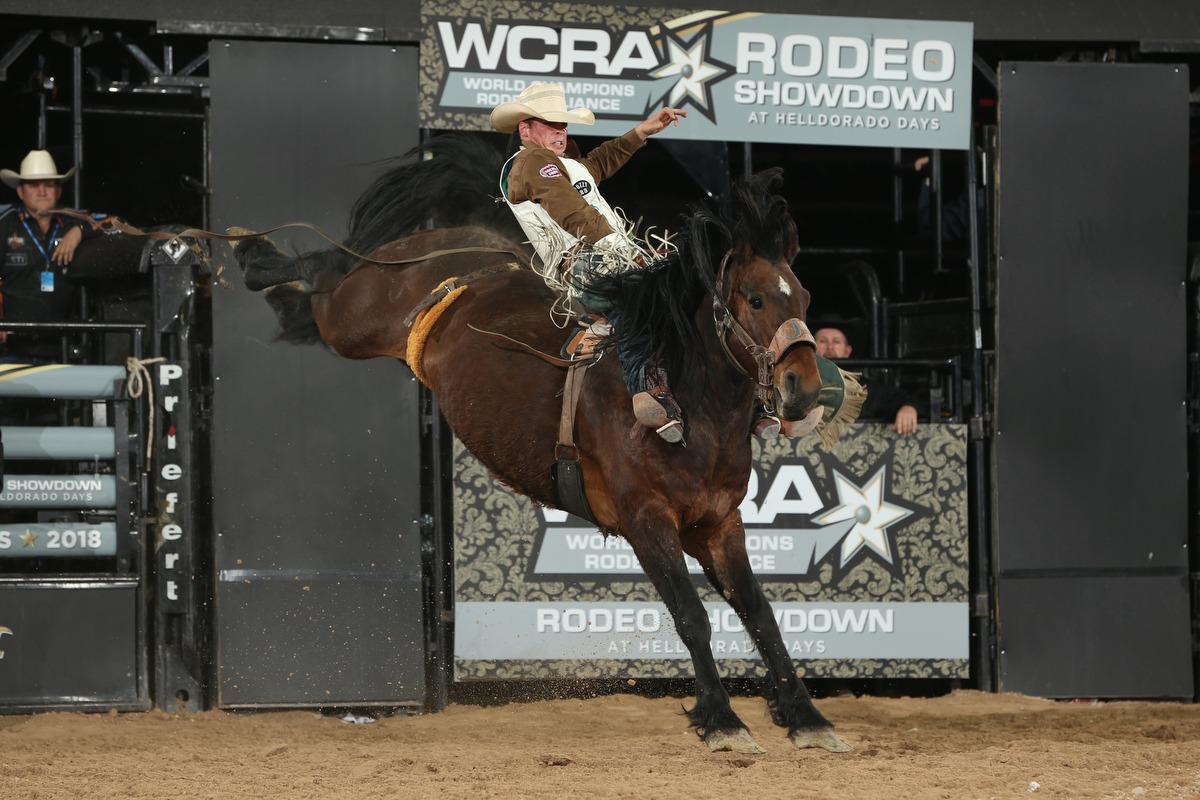
    LAS VEGAS – As Sunday afternoon came to a close and the dust settled at the Thomas & Mack Center in Las Vegas, the WCRA (World Champions Rodeo Alliance) crowned its first event champions at its inaugural $400,000 rodeo in Las Vegas.

    Top bull riders, steer wrestlers, team ropers, saddle and bareback bronc riders, barrel racers and tie-down ropers converged for the all-new WCRA Rodeo Showdown. Following tight competition among the world’s best western athletes during Saturday’s opening round, the top four in each discipline hit the dirt to battle their way to the final round where the top two faced off. In an unprecedented format, the athletes picked either their animal or their position in the final round draft.


    BULL RIDING:

    It came down to two bull riders as the WCRA’s first major rodeo rolled to a close inside Thomas & Mack Center. Claudio Montanha Junior and Jose Vitor Leme (2017 PBR Rookie of the Year) were the last men standing in the final round of the bull riding. In the end, a monster 90-point score aboard Bottoms Up (TNT Bucking Bulls/Hart Cattle Co) earlier in Round 2 sent Leme into the winner’s circle as the inaugural WCRA bull riding champion.


    Leme had made his PBR debut in Las Vegas last November, going a perfect 6 for 6 at the PBR World Finals to win the event and rookie of the year honors. “The first time I set my feet in the U.S., it was here (in Las Vegas),” said the Brazilian cowboy, who played semi-pro soccer and is coming back from a torn ACL. “Every time I come here I feel like a new man.”


    Place – Name Hometown

    1st Jose Vitor Leme – Ribas do Rio Pardo, Brazil

    2nd Claudio Montanha Junior – Ribeirao Dos Indiox, Brazil


    STEER WRESTLING:

    Alabama cowboy Kyle Irwin brought the crowd to its feet on Sunday as he recorded a 5.49-second score after throwing his steer and proving that hustle matters. Irwin went up against Idaho’s own Olin Hannum in the final round, but walked away the champion.


    Place – Name – Hometown – Score

    1st Kyle Irwin – Robersdale, AL – 5.49 seconds

    2nd Olin Hannum – Malad, ID – 10.21 seconds


    TEAM ROPING:

    Clay Smith and Paul Eaves were not messing around during their run as Sunday’s event came down to the wire. After a consistent weekend Smith, a new dad, was excited to walk to the winner’s circle for his belt buckle and check presentation with his partner Eaves. The brotherly duo of the night Riley and Brady Minor were consistent and fast, but fell short of the win in the final round.


    Place – Name – Hometown – Score                                                                                                                                 

    1st Smith/Eaves – Broken Bow, OK /Lonedell, MO – 4.04 seconds

    2nd Minor / Minor – Ellensburg, WA – 8.79 seconds


    SADDLE BRONC:

    Nebraskan cowboy Cort Scheer was the only man to ride in the final round on Sunday with an impressive score of 89.5, including his patented classic dismount. Wyoming’s Brody Cress, who took the Round 1 win on Saturday was bucked off leaving Scheer to stand in the winner’s circle.


    Place – Name – Hometown – Stock – Score

    1st Cort Scheer – Elsmere, NE – Get Smart – 89.5

    2nd Brody Cress – Hillsdale, WY – Owen’s Mistake – Bucked Off


    BARREL RACING:

    Hailey Kinsel, seemingly can’t be stopped. The 23-year old just keeps knocking down big wins including the San Antonio Stockshow and Rodeo this year prior to today’s inaugural WCRA. Kinsel and her horse, Sister, have an impressive history in Las Vegas including four round wins during the WNFR at the Thomas & Mack in 2017, topping off a season during which she won at prestigious rodeos Days of ’47 and The American.

    Place – Name – HometownScore

    1st Hailey Kinsel – Cotulla, TX – 13.937

    2nd Lisa Lockhart- Oelrichs, SD – 19.121


    TIE-DOWN ROPING:

    Marty Yates is a gambling man; instead of playing it safe to beat his opponent Tuf Cooper’s score, he put one wrap on the calf and called it a day.


    Place – Name – Hometown – Score

    1st Marty Yates – Stephenville, TX – 8.59

    2nd Tuf Cooper – Decatur, TX – 10.05


    BAREBACK:

    Richmond Champion, no stranger to big wins, was the original champion of The American. When the heat is on, he knows how to buckle down, ride to huge scores and live up to his surname.


    Place – Name – Hometown – Stock – Score

    1st Richmond Champion – The Woodlands, TX – Straight Jacket – 90

    2nd J.R. Vezain – Cowley, WY – Spilled Perfume – 87.5


    “I’m very proud of this inaugural WCRA rodeo. The atmosphere was fast-paced and electric, and the competition world-class,” said WCRA CEO Gary McKinney. “I want to thank PBR for a great production and the fans for coming out. This weekend proves our alliance is working, and we look forward to our next event.”


    About WCRA

    WCRA is a professional sport and entertainment entity, created to develop and advance the sport of rodeo by aligning all levels of competition. In association with PBR, WCRA produces major rodeo events, developing additional opportunities for rodeo industry competitors, stakeholders and fans. To learn more visit worldchampionsrodeoalliance.com.

  • Back When They Bucked with Ken Stanton

    Back When They Bucked with Ken Stanton

    It was while riding his dad’s milk cows that Ken Stanton got the inspiration to be a rodeo cowboy. The Weiser, Idaho man spent over two decades in pro rodeo, competing in both the bareback riding and the bull riding, and qualifying nine consecutive years for the National Finals Rodeo, six of those years in both of his events.
    He was born in 1941, the youngest of four children of Roy W. and Lillian (Pattee) Stanton in The Dalles, Ore. The family moved to Cloverdale, Oregon, five miles from Sisters, and the kids attended Redmond High School. Ken was an outstanding wrestler, winning the state championship two years and finishing one year as runner-up. As a freshman, he wrestled at 98 lbs. and four years later, at 115 lbs.
    Even though he had wrestling scholarships from Oregon and Oregon State, he chose to go to work, cowboying on a cattle ranch in eastern Oregon. It was winter time and one of the coldest winters, when he was on the wagon, throwing bales, while another worker was driving the tractor. One day, Ken told him, “it’s your turn to throw bales,” and the guy said no. Ken replied, “You are today, because I’m leaving.”
    He took off for Odessa, Texas. He and his older brother Bill had competed in a half-dozen amateur rodeos (there was no high school rodeo then), and together, they headed south. He didn’t win money in Odessa, but a week later, in San Antonio, won $1800, more money than he’d ever seen before. He wasn’t greedy: “I sent most of it home to the folks because I didn’t need it.”
    Ken stayed in the south, rodeoing at Rodeo Cowboys Association rodeos. He got his RCA card in 1960 and was a full time cowboy for the next decade. Bull riding was his favorite, but he was pretty even in his talent at both.

    He was a natural at bareback and bull riding. He was small: only 5’4” and 145 lbs., but wiry and strong. In high school, he had jumped on the school’s trampoline, strengthening his core and improving his balance while entertaining fans during basketball halftimes. And he’d worked hard on his family’s ranch, throwing bales that weighed as much as he did.
    From 1960 to1970, he rodeoed in the south during the winter and headed to the Northwest for the summer. He competed at about fifty rodeos a year, when other cowboys were going to 100 or more.
    And he did well, financially. He estimates he averaged $22,000 a year as income over the ten year period, with his best year earning $28,500. “That was a good income for us,” he said. “It was a lot of money then.”
    He competed at the National Finals Rodeo every year from 1962 through 1970, in the bareback riding eight times and the bull riding seven times. His highest finish was fourth place in the bull riding in 1964. In 1970, he was ahead of Gary Leffew in the bull riding, both having covered eight bulls, till Ken got bucked off his ninth bull and Gary beat him by only 35 points on nine head. “If I’d have rode (the ninth bull), nobody could have touched me.” He finished that year second in the average.
    When he was on the road, his family went with him. He married Ginger Tarter in 1965 and they had three children: daughter Tracy and sons Scott and James. The kids loved being on the road. “They were like rodeo orphans,” Ken said. “The kids loved (being at rodeos) and people loved them.” Some of Ken’s fondest memories were at the Pendleton Round-Up. His parents and Ginger’s parents attended the Round-Up, and they’d take a big box of tomatoes grown by friends of his parents’. The cowboys loved it. “They couldn’t wait for us to get there, and they’d sit there and eat tomatoes,” Ken recalled. “It was like a family reunion.”
    The year 1970 was his last year of full time competition. He spent the next three years working as a general contractor in Colorado Springs, building homes. Then he became a deputy sheriff for Washington County, Idaho, his home county. He worked that job for ten years, handling the civil lawsuit work and some of the jailer duties. He competed in a few rodeos, but not many.
    After ten years of deputy sheriff duties, Ken went to work for a gold mine in Battle Mountain, Nevada, driving a 350 ton haul truck and working there till 2000.
    It was an injury that started on the eastern Oregon ranch and culminated while he was a deputy sheriff that bothered him the rest of his life. On the ranch, he had gotten frostbitten feet while feeding cattle. A few years later, while traveling on slick roads on a cold snowy day with his wife and daughter, the car went into the ditch. Ken ran for help, running eleven miles in two and a half hours and getting frostbite again. The final straw was as deputy sheriff. He was working an accident that started with one car in the ditch on icy roads, and seven hours later, was a seventeen-car pileup. His feet were frozen, and gangrene set in. Doctors amputated two toes in 1974, then a few years later, his feet at mid-arch. In 2004, his left leg was amputated four inches above the knee. His leg’s veins had collapsed.

    The toughest bull Ken saw while rodeoing was Snowman, owned by the Christensen Brothers. The bull had been unridden for five or six years when Ken drew him at Pendleton. He got bucked off at the whistle and remembers seeing Jim Shoulders and Harry Tompkins kneeling in the arena, watching the ride. He also remembers their comment: “that bull can’t be that bad, that kid almost rode him.” It was several more years before someone made a qualified ride on Snowman.
    Ken was part of a unique brotherhood. At the 1967 and 1968 National Finals Rodeos, five contestants: Ken, his brother Bill, Jim Ivory, his brother John Ivory, and Larry Mahan were all graduates of Redmond High School and all members of the wrestling team.
    After his leg was amputated, Ken moved back to Weiser, where he lives with his brother Bill, who also competed at the National Finals Rodeo. Ken and Ginger divorced in 1981. His daughter Tracy, who has five children, lives a few miles away. His sons, Scott and James, live in Boise. Ken has three great-grandchildren.
    He served as bareback riding director for two years, but it wasn’t for him. And he was asked to judge rodeos, but by then, his feet were bothering him and it was difficult to stand for long periods of time.
    His brother Bill, who was a year and a half older than him, had a plane and a pilot’s license and they would sometimes fly to rodeos. Ken remembers one time when they left St. Paul, Oregon, headed south of San Francisco. As soon as Bill got the plane off the ground, he asked Ken to take the wheel for a minute. “Then Bill jumped into the back and said, ‘wake me when we get to Bakersfield,’” Ken laughed. They were cruising at 12,000 feet, and Ken knew Mt. Shasta was 13,000 feet, so he pulled the plane up to 14,000, following the freeway to their destination.
    His dad always knew when his boys had been riding the milk cows. “One of us would get on, and the other would turn her loose,” Ken remembered. “The hard part was ducking under the door.” The next day, those cows wouldn’t give milk, and it would be a dead give-away for the boys’ antics. His dad would ask, “have you boys been riding them cows?”
    Ken is an inductee into the Ellensburg (Wash.) Rodeo and Pendleton Round-Up Halls of Fame. At Ellensburg, he won the bareback riding, bull riding, and the all-around several times. Lewiston, Idaho was also a rodeo he won multiple times.
    Ken loved having his family with him as he rodeoed, and he loved rodeoing. “I wouldn’t trade it for nothing now,” he said. He never won a world title but he stayed in the top fifteen, competing at half as many rodeos as the others. “It’s in your blood or you just don’t do it,” he said. “It’s not easy but it’s a good way to make a living.”

  • On The Trail with Coco van den Bergh

    On The Trail with Coco van den Bergh

    Coco van den Bergh saw her first pair of Wrangler jeans and a Western saddle when she came to the United States as a college exchange student from Holland. Today, the 51-year-old is a breakaway roper in the RMPRA, making her home near Ferron, Utah, at the base of the La Sal Mountains, happily ensconced in the rodeo and Western lifestyle.

    Coco started riding English as a child, first learning to ride bareback on a pony. “In Holland, kids usually go to a stable and ride ponies, and a fun thing they do is give you coins or money, and if you’re able to keep that money between your bum and your horse, you can spend it at their candy store,” she says. Her mother and grandmother both rode horses, and though Coco didn’t have her own horse until she moved to the U.S., she rode horses for friends, including a black Arabian stallion. “I did dressage and jumping, but the most wonderful thing is I lived at the coast, and you can ride your horse through the forest to the beach and go swimming with your horse.”

    All of the disciplines Coco rode gave her a horsemanship foundation that made it easy to start riding Western, and the rodeo community was quick to show her the ropes. “The people are so friendly, and they treat you like you’re a part of their family. It’s so pleasant to go, and it’s fun and educational,” says Coco. “I love to watch human and equine athletes perform. I’ve been an athlete my whole life — I used to fence and figure skate, but horses are my whole life. That’s what I live for.”


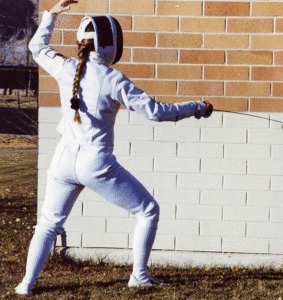
    A love of learning brought Coco to Utah, where she did her research for one of her two master’s degrees in geology, but she stayed for the Western lifestyle. She earned a welding degree taking evening classes, and she’s also tried her hand — and feet — at ballet, field hockey, surfing, sailing, and skiing. Coco was even on the college fencing team at her university in Holland and University of Wisconsin-Madison, competing with other schools much like any other college sport. Coco finished her second master’s degree in geology at University of Wisconsin-Madison at the request of ExxonMobil, where she worked for a year. “It means so much more when you see the landscape and understand the carbonate rocks, or fluvial or volcanic. I just love it (geology) because I love nature. I’ve found Indian arrowheads and pottery, and I love the wildlife you see out in the middle of nowhere by yourself. After that (ExxonMobil) I started my own business as a geologist doing research for oil companies, but the income was too inconsistent, so I got the job I have now so I could live the Western lifestyle.”

    Coco purchased her very first horse in 1996 after moving to Utah, and once she’d run a few chutes for friends, she wanted to back into the box herself. She learned to team rope first before switching to breakaway roping. The first rodeo she entered was in Salina, Utah, and Coco even went to a Stran Smith roping clinic. She has four quarter horses, several of which are bred by Mary Journigan of the K Cross Ranch in Lamoille, Nevada. “My partner, Brad Richman, is a cowboy, and he takes my horses for five months and does nothing but cowboy on them and get them broke for two summers. After that, I take them over and cowboy on them myself because I help the local ranchers.” Coco met Brad in the mountains where he was herding cows and she was helping the local ranchers, and they cemented their friendship looking for several horses that got loose. Coco also welds on the ranches when needed and takes much of her vacation time to work cattle with local ranchers. “I cowboy on my horses for two years before I rope on them. It takes a lot of years to make a good horse, and I get nothing but compliments about them.” She’s especially excited about her 3-year-old gelding, Charlie, whom she started breakaway roping off of in the last few months. “I went to two Clinton Anderson clinics and put that foundation on him, and Todd Fitch put three months on him. My goal is to make it to the RM (RMPRA finals) by basically training this horse all by myself.” Steve Young has also trained a few of Coco’s horses and helped her with the team roping. Brady Ramone works with her in the breakaway, while Coco says the Mascaros, Clowards, Webers, and Foxes have become like family. Her own family, who live in Holland, love that she rodeos, and her mom comes to visit for a month every summer.


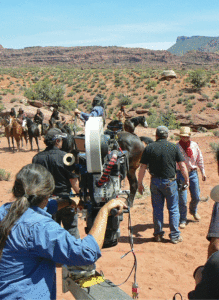
    In 2012, Coco’s horse training earned her a spot in the credits of Disney’s John Carter, a sci-fi movie that she worked on in Moab, Utah. “I worked for three weeks training the horses and then training the actors how to ride. There were five horses from Hollywood, and then a whole herd of horses from Washington.” One of the horses Coco trained — the backup horse to the lead horse from Hollywood — starred in the movie, and she also trained them to accept riders jumping on and off their backs at a lope. “It was so cool, and I got such nice friends out of it too.”
    Along with her horses, Coco runs a small herd of Corriente cattle, which she raises for roping. “It takes time for them to grow horns, so in the meantime, I breakaway on them, and when they’re ready to team rope, they’re already broke in and they run nice and straight. It’s so much easier on the head horse.” She ropes at least four times a week at friends’ arenas, or the indoor arena in town. She’s now the branch manager of a laboratory that analyzes coal and water, and Coco uses her breaks to rope the dummy in the bed of her truck. “I have that Jackie Crawford DVD Elevate, and that’s made a huge difference. I met her at a clinic in Utah one day, and last year I went to her house for a week to rope. Jackie Crawford and Jake Barnes are my heroes and role models.

    “My whole life is horses and roping and rodeo,” says Coco, who’s entering her third season in the RMPRA. “This year, my goal is to make it to the RM finals, and then go to the Rehab Productions open breakaway roping during the NFR in Las Vegas. Another goal is to show people that it doesn’t matter how old you are. Live life to the fullest and make your dreams come true by setting goals, creating a plan, and working hard. Believe in yourself and go for it.”

  • Roper Review: Scott Stickley

    Roper Review: Scott Stickley

    There are a few professions, besides rodeo, that require driving many miles and spending time away from home. One of those occupations is a sales rep, which is what Scott Stickley has chosen to do for the last twenty-six years. Scott, who makes his home in Whitesboro, Texas, is a sales rep for Professional’s Choice, Dutton Bits, Fast Back Ropes, Weaver Leather, and Eight Away Breakaway. Covering Texas and New Mexico keeps him on the road four days a week and puts 65,000 miles a year on his truck.
    “Being a sales rep isn’t rocket science,” says Scott. “You get in your truck and call on accounts. Ninety-five percent of the people in our industry are good people and fun to deal with. It’s not like having a real job. I get to go see people and visit.”
    “My favorite thing about this job is the relationships I’ve built over the years. It’s more of a friendship than a business relationship at this point.”
    Stickley grew up in Iowa roping calves and qualified for the National High School Finals Rodeo three times. He was crowned state champion calf roper during his sophomore and senior years.
    “When I was 18, I moved to Texas. The weather was more favorable for roping and I knew I could rope more often against some great ropers. Shortly after moving I realized the calf roping was very competitive – more so than I had anticipated. Later I met Shaun Burchett, a world champion steer roper, and started roping with him. I grew to love the sport, mostly due to the horsemanship involved. In 1990 I was the PRCA Rookie Steer Roper of the year.”
    Stickley’s first job in Texas was working in a warehouse for a company that sold pneumatic tools. In the early 90’s he went to work for Jimmy Smith, of Smith Brothers, in Denton, Texas, putting on team ropings. He also helped manage the 1,800 head of steers Smith owned and leased.
    Scott soon found himself working “road shows” for Smith Brothers such as Congress and the NFR and eventually went to work in the store full time. There he met visiting sales reps and decided it was a pretty cool profession.
    “At one of the road shows I met Monty Crist, Professional’s Choice, who convinced me to step out of retail and try my hand at being a sales rep,” explains Stickley. “My first lines were Professional’s Choice and Dutton Bits. At the time PC only had about five products so sales were nothing like they are today.”
    Now, years later, Scott has seen a lot of changes in the western industry.
    “Sadly, the smaller ‘mom and pop’ stores are dwindling. The Internet has a lot to do with it, and the larger companies keep expanding. The changes I find exciting is the development of new materials used in sport boots, and rope making. High tech is making its way to the western industry.”
    When not traveling, Scott enjoys spending time with his wife, Regale, and two daughters, Jaci, 19, and Jesi, 14. He also ropes steers and team ropes.
    “I still enjoy this hobby very much. I enjoy roping and like keeping current with the needs, ideas, and changes in products. Staying in the loop helps me service and relate to my customers’ needs.

    COWBOY Q&A
    Do you make your own horses?
    Yes.
    Who have been your roping heroes?
    Roy Cooper, Phil Lyne.
    Who do you respect most in the world?
    Greg Dutton.
    Who has been the biggest influence in your life?
    My dad.
    What’s the last thing you read?
    A book called, Strong Fathers, Strong Daughters.
    How would you describe yourself in three words?
    Humble, self-motivated, good friend.
    What makes you happy?
    Family.
    If you were given one million dollars, how would you spend it?
    I would help our church, put enough away for college for my girls, and save rest away for retirement.
    What is your worst quality – your best?
    My best quality is honesty. My worst is being disorganized.
    Where do you see yourself in ten years?
    Hopefully in ten years, I will be retired and roping in Arizona during the winter.

  • Overcoming Weaknesses

    Overcoming Weaknesses

    My daughter does not like to miss. She’s very cautious, will take extra swings to make sure she catches, and follows instructions to a tee. I have to challenge her to rope fast. Since she doesn’t like to miss, she has trouble taking a risky throw. I really have to push to get her out of her comfort zone.
    My son, on the other hand, is the complete opposite. When Kaleb and Junior came and roped with us before the NFR, Junior quickly became Gabe’s hero. I decided to practice a little reverse psychology on him. To head for Junior, I put him on one of my horses and told him he could come over the top of the chute and rope as fast as he wanted. I truly thought he wouldn’t want to miss for Junior and it actually had the opposite effect. He probably missed the first 10 or 15 steers and I kept thinking any minute he was going to just go catch one. I bet he ran 100 steers in three days and caught less than 30% because every run was two swing and then fire.
    Now in the practice pen he has to catch three “high teamers” and once he does that, he can come over the chute and throw fast. If he doesn’t catch three in a row, he doesn’t get to throw fast. It’s completely different scenario with Hali. If she catches three, then I make her rope fast once. Missing makes her want to catch the next one, where it doesn’t affect Gabriel at all. They are complete opposites with completely different mindsets.
    The both have their weaknesses and I’m always encouraging and pushing them to overcome. Don’t get me wrong… I don’t really get onto my kids in the practice pen. I think it’s important to praise them when they do well. Some parents really get mad and onto their kids when they miss in the practice pen. I find it ironic that they then expect so much of them in competition. As someone who has roped their entire life, and for a living, I understand how complicated it is and how many things can go wrong.
    However, I’m huge on preparation for competition. I expect my kids to watch the roping and pay attention to the steers to give themselves a chance to win. That comes from how I was raised. The only thing my dad ever got mad at me for was when I floated my heel loop… or when I was playing football during the roping. I got in trouble for that a lot. I loved football and there was always kids playing football at the ropings. Other than those two things, I don’t remember getting in trouble for failing. One the way home, my dad would ask what I learned, and what do we need to do next week to better prepare ourselves. Understanding why you failed at competition, and how to prepare yourself or your kids for it not to happen again is key.
    As a young man, in my late teens or early 20’s, I would be gone every weekend and make as many rodeos as possible. One weekend I hauled my back up heel horse and my calf horse, and left my good horse home. When I got back my dad asked me why Medicine Man was standing in the stall. I answered that he was missing the corner and I couldn’t see my shot. My dad’s response was, “Really?” We saddled horses and my dad got on Medicine Man, laid the reins on his neck, and held onto the saddle horn without roping. He did this behind three steers and the horse worked perfectly. He rode up to me and said, “Now do you think it was the horse, or pilot error?” I have never forgotten it and had he not shown me that it was pilot error, I may have quit riding the best horse in the barn.
    My point is you need to have access to someone who understands the sport and horsemanship to recognize the weaknesses, and show you how to work on it and progress.
    Feel free to visit speedroping.com and browse our video library. There are quite a few videos of my kids practicing and competing.