Tami Semas—professional barrel racer, saddle designer, and wife and mother of two—found her niche in the horse industry in high school, and dug deep into her passion after college. The first of her family to rodeo growing up, the 41-year-old from Brock, Texas, learned by trial and error, and her persistence earned her two qualifications to the PRCA Columbia River Circuit Finals, and a place at The American’s inaugural rodeo in 2014. In 2015, she was Equi-Stat’s highest-earning rider of futurity horses, and has trained multiple futurity and derby winners. “Where a lot of people who’ve had parents in that event have the process narrowed down a little bit, I had my biggest successes from my biggest failures,” says Tami. “I’ve spent a lot of time learning from horsemen how to get a horse really broke. I understand the game of barrel racing, and to combine that with horsemanship is kind of my approach. I wanted a very smooth motion in my horses around the turn, and I have learned to get a horse to be soft. I’m a small person—I can’t hold the horse around a barrel—and I’ve learned through various horsemen how to get a horse to respond through weight, leverage, and positioning to keep them light.”
Searching for a saddle that was balanced for Tami’s smaller stature led her to becoming a saddle dealer for seven years, and ultimately, launching her very own line of Tami Semas Barrel Saddles. “A lot of saddles on the market didn’t feel like they balanced my weight great, and either pushed me forward or back. I ride everything centered, and I bought a saddle from one company that worked pretty good,” explains Tami, who at that time was Double J Saddlery’s highest-selling dealer without a store. “I learned a lot about what many riders were wanting and needing. I came up with some ideas on how I would tweak things if I would ever be able to build my own saddle from scratch.”
Tami quit her dealer job in 2014, and she approached a manufacturing company about building her own saddle that same year. “A lot of things are the same with saddle parts, but they can be put together to have a uniquely different feel,” Tami explains. Her saddle came out in the 2015, her best futurity year to date, and the Tami Semas Barrel Saddle was a success. They now sponsor several athletes, including Hallie Hanssen, a futurity horse trainer from South Dakota. After two-and-a-half years, Tami decided to go out on her own for manufacturing, and with the aid of her custom tree maker and a new manufacturer, the latest line of Tami Semas Barrel Saddles will launch this fall.
Of equal importance to a balanced saddle is the saddle pad underneath, and 5 Star Equine became one of Tami’s sponsors the year her first saddle came out. “I’m a firm believer in their product. I’d used their pads over the last 10 years, and they’ve been a sponsor over the last 3 years, and we also promote them with our saddles,” says Tami, who is also using 5 Star’s new line of leg gear. “The things I use for my barrel racing and riding I call timeless tools. I’m not someone to use the latest and greatest thing that’s come out on the market; I’m going to use the tools that have stood the test of time, and I believe 5 Star is a product that has stood the test of time. That 100 percent natural wool has always allowed my horses’ backs to breathe well, especially down in Texas. I want a pad that absorbs shock, breathes well, fits comfortably on my horse, and can withstand weather conditions, and 5 Star has been that product for us.”
Tami, who trains all of her horses, sold her futurity horses this year, thinking 2018 was her year to rodeo. But when her horse Smooth N Famous, who won nearly $200,000 during his futurity career, had an injury this year, she had to turn him out to pasture and make a new plan. That became running and seasoning a 6-year-old, Colour Me Gone, she trained and sold but bought back recently. “I’ve pretty much seasoned him at the pro rodeos, and I’ve gone to Northside, which is an open rodeo every weekend. I always like the Diamonds and Dirt Derby, and we just keep training horses this year and selling them. Next year we’re hoping to have our horse better seasoned for the rodeos,” says Tami.
Her 15-year-old daughter, Madison, traveled with her most of the summer, and enjoys riding and other sports, while Tami’s 16-year-old son, Myles, plays football. Aaron, Tami’s husband, rode bulls for 18 years and qualified for the WNFR 7 times, while he’s also one of the founders of the PBR. “He’s doing some fixer-upper homes down here and ropes, and when you have a family and kids at this age, it’s definitely a busy time. What we’re doing is just trying to train good horses, build a good saddle, and let the horses tell us where we’ll be going.”
Blog
-
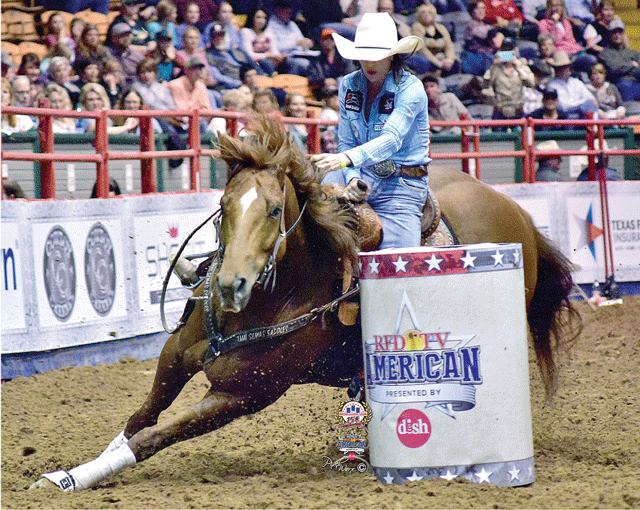
Tami Semas
-
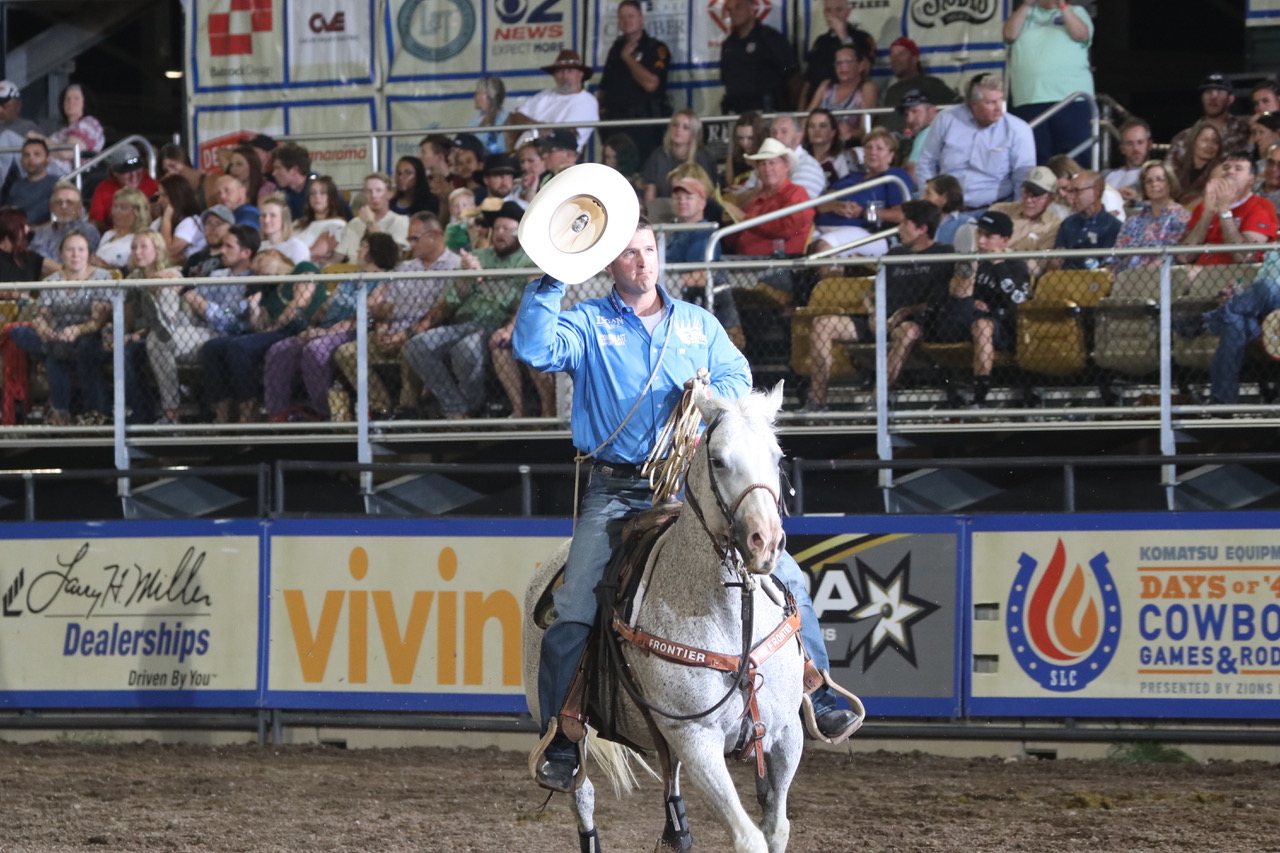
ProFile: J.C. Malone
All-night drives, truck-stop coffee, fast food, and a laundry list of expenses that never seem to end. There are thousands of easier occupations than the life of a professional rodeo cowboy, and it’s pretty tough at times to make it pencil, even for a world-class-caliber contestant. One big check can be a game-changer that loosens the financial noose from around your neck. Just ask J.C. Malone.
The 33-year-old, family-man tie-down roper from Plain City, Utah, works multiple day jobs to make ends meet and complement his cowboy career, in order to cover his mortgage. So the opportunity to compete at the million-dollar, July 19-21 and 23-24 Days of ’47 Cowboy Games & Rodeo was a big deal. And the $27,800 that hit his roping hand while the silver medal was being placed around his neck at rodeo’s end in Salt Lake City was huge.
“This one rodeo was worth as much as my best month ever,” said Malone, who finished 18th in the world in 2015 before ending the 2016 season in the 16th-place heartbreak hole. “Twenty-five grand’s a lot of money, and when you get a check like that at one rodeo, it really makes a difference in your year. It’s a lot more typical to work your butt off for three months to win that much.
“Between trucks, trailers, horses, fuel, food, and entry fees, there is so much overhead in our sport. This is a very hard way to make a living. So this kind of money coming into our sport is a breath of fresh air. Money like this pays stuff off, and lets you invest in something for your future, and your family.”
After two consecutive close calls, Malone broke through last season, and achieved his lifelong goal of qualifying for his first Wrangler National Finals Rodeo in 2017. After having a “decent” 2018 winter, he says his spring and summer seasons were “pretty slow. Salt Lake saved my year.”
Malone and his wife, Mandy, have two young kids. Treyson is 7, and his little sister, Macie, is 4. The Malones recently built a house, that’s also home to Mandy’s nail salon. Add “Mr. Mom” to J.C.’s list of day jobs when he’s not off rodeoing. He’s also a horseshoer at home and on the rodeo road, and works alongside his dad, Bryan, on their J.B. Trailer Conversions business.
Malone took advantage of the World Champions Rodeo Alliance’s Virtual Rodeo Qualifier system to punch his ticket to the Days of ’47. He nominated three Professional Rodeo Cowboys Association rodeos, in Hayward and Redding, California, and St. Paul, Oregon, and earned the points it took to get him into Salt Lake by placing in a round at St. Paul.
“We all have our favorite rodeos—rodeos we love, where we feel like we have an advantage,” Malone said. “Those are the ones I’m going to nominate, where I like my chances of winning something.”
The top two times from each of the preliminary performances advanced to the Gold Medal Round in Salt Lake, and Malone moved on by being 7 flat on his first calf, and tying at the top with Kyle Parrish of Stephenville, Texas. Malone then rose to the Gold-Medal-Round occasion, and turned in the first 6-second run of his career. Gold Medalist Cory Solomon, who cashed checks totaling $52,400 for first, was 6.6, and Malone was hot on his heels at a sizzling 6.7.
Contestants are currently busy using the Virtual Rodeo Qualifier system to try and secure a spot at the $500,000 WCRA Semifinals, coming November 15-18 to the Lazy E Arena in Guthrie, Oklahoma. In addition to the Days of ’47, the WCRA will host three “majors” in 2019, each of which will feature a $1 million guaranteed payoff.
“This money makes a difference in my life, and that’s for second,” said Malone, who got it done with the help of close friend Cody Hill’s 18-year-old gray mare, Lucy. “I can’t say that about very many rodeos in my career. We’re going to finish a barn at home, and take the kids to Disneyland this fall. This kind of money makes it possible to call this sport a career instead of a hobby, and money is what makes any sport truly professional.
“Salt Lake was such a first-class event. I wish every rodeo was just like it. I love rodeo more than anything, and would love to see more chances of this caliber for cowboys. The competition is so tough, and we all know they aren’t going to give it away. But the opportunity is there, and that’s something we’re all very thankful for as cowboys.” -

Back When They Bucked with Jane Douthitt
The wife of one of the biggest rodeo stars of his time led an interesting life of her own.
Even though Jane Douthitt often lived in the shadow of her husband, Buff Douthitt, she managed to be involved in a variety of activities.
Her life started on June 21, 1936, the daughter of R.C. and Ola Francis Kirkland, near Knox City, Texas. Her father was a rancher, and she and her brother were always on horseback. Living fifty miles from the nearest grocery store, horses and riding were their entertainment.
She graduated from Guthrie High School in 1952 and went to college at Texas Tech in Lubbock, majoring in business. She did not compete in collegiate rodeo; she had other plans. “I had my mind made up,” Jane said. “I didn’t have time to do anything but get my education. I had my life to get on with, in my mind.”
After college, she moved to Wichita Falls, where her dad’s kinfolk lived. She competed in barrel racing at amateur rodeos, riding borrowed horses. At the time, local ranchers would sponsor barrel racers, furnishing the horse and paying the cowgirl’s entry fees, and that’s how Jane rodeoed.
She competed in several pageants, finishing as runner-up for Miss Wichita Falls Queen and winning the Miss Rodeo Archer City title in the mid-1950s.
Her brother was in college in Wichita Falls when she met the man who would become her husband.
Jane had admired the looks of Buff Douthitt, a tie-down roper, steer wrestler, and roper in the wild cow milking (at that time the wild cow milking was often included in pro rodeos) when a picture of him with a group of other cowboys at Madison Square Gardens in 1946 hung in the ranch office where her dad was general manager. At the age of ten, she had pointed to his face and declared to her mother, “here’s the man I’m going to marry.”
She convinced her brother to take her to Vernon for a pro rodeo, and at the dance after the rodeo, Buff asked her to dance. She didn’t recognize him; he wasn’t dressed western but had on dress clothes and dress pants. “Gee, I thought he was cute, but I was determined that I was going to find me a pro cowboy,” she said. “So I turned him down. What a mistake that was.”
Jane and husband Buff in 2005 – courtesy of the family 
Jane at the December 2017 Ladies of Pro Rodeo Banquet in Las Vegas. 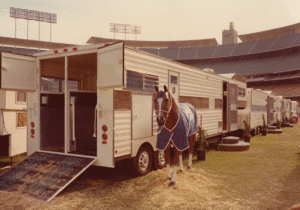
The first horse house trailers on display at the Quarter Horse Congress in Columbus, OH in 1972. The next day, on a date with another cowboy, she was introduced to Buff and she realized who he was. “I knew I had made a big mistake,” she said.
She dated a couple of cowboys, seeing Buff occasionally, but he never paid any attention to her. In January of 1956, she was about to get his attention. She was at the Ft. Worth Rodeo, sitting with the contestants’ wives and girlfriends, looking down the stairs where the contestants were. “I was conniving,” she laughed. “I saw him start up the stairs, and I just happened to be going down the stairs.” This time, he stopped; they shook hands and talked a bit, and he asked her to the dance that night.
By the time the dance was over, they knew they would marry. “I say it was God,” Jane said. “It was His design, from start to finish. It was wonderful. We were still just as in love to the day he passed away.”
They married in September of 1957 and rented a house, no bigger than a studio, in Wichita Falls. He rodeoed and Jane traveled with him, as her job with the oil company allowed. Their first child, April, was born in 1959.
In 1958, Jane quit work to travel with Buff. At that time, they lived in Throckmorton, where her parents had moved. Three years later, Buff helped train race horses at Hialeah Race Track in Miami, Florida, and Jane and April spent the time with him. Buff and Jane bought a used Air Stream Trailer to live in while in Florida.
In 1962, the family moved to Ardmore, Okla., where they had some horses and cattle on fifteen acres. Buff continued to rodeo and that year, their son Jason was born.
It was in the 1960s that Jane took another role with rodeo. She had timed rodeos for Beutler Bros. but decided if she was on the road with Buff, she could be earning some money, too. She learned to secretary rodeos and worked for Hoss Inman, Mel Potter of Rodeos, Inc., and others. This was before computers, when a secretary had to do all the work by hand, including typing day sheets. Often, Buff would drive while she balanced a typewriter on her knees and put together judges’ sheets. “I have always said that if you can (secretary rodeos) and not make a mistake, you can do anything in the world. Boy, what a responsibility,” Jane said. “I loved it.”
While Buff rodeoed and his family and children traveled with him, they traveled in a car with a horse trailer, staying at hotels. But that year, the price of a room at the Holiday Inn went up $10 a night, “and that was bad news for every cowboy,” Jane remembered. That fall, Buff started planning and designed “horse house trailer”. He, along with a carpenter, in the Douthitt garage, started building a trailer that included a compartment to house horses. When spring came, the Douthitts left for the rodeo trail in their own custom designed horse house trailer, and everybody who saw it wanted one, Jane said. For several years, Buff tried to build one or two in the slow season to sell in the spring.
In 1969, Buff quit rodeo competition and the family moved to the Ft. Worth area, where they bought a small manufacturing plant to make the horse house trailers. Two years later, they couldn’t keep up with the demand, expanding their manufacturing area and making not only horse house trailers but travel trailers, motor homes and hippie vans.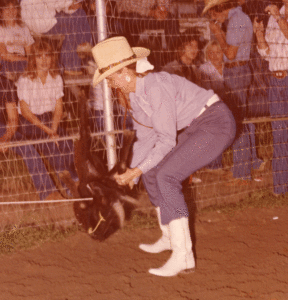
Jane goat tying in 1979 – Cimarron 
ne at age 4 riding ‘Ole Danger.’ “He was my first gown up horse and dad would saddle him at 4 am and I rode him until dark everyday.” – courtesy of the family 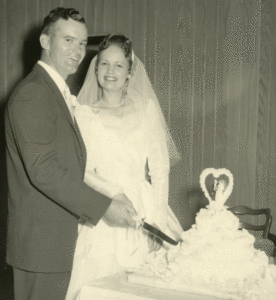
Jane & Buff at their wedding in 1957 Then the oil embargo hit in 1974 and fuel was in short supply. The general public cut back on driving and “cowboys quit pulling trailers,” Jane said. The heyday of their business was over.
But they adapted to the times, and instead of building trailers, switched to contracts with the U.S. government. They built latrines for the troops in South Korea, relocatable housing, “skid towns” – portable housing for pipeline workers, and residential housing that ended up in Houston. Their products went to a variety of foreign countries, including Syria, Saudi Arabia and Iran, countries in Africa, and to Hawaii. Their business, called MBM International Inc., was headquartered in Ft. Worth. At its height, it employed over 3,500 people in the Dallas-Ft. Worth area.
In 1981, they decided to retire and sold the business to a foreign company. Jane stayed on with the company for another year, helping them get on their feet. The couple decided to move to Hawaii, but it wasn’t as much fun to be residents there as it was to be tourists.
So they flipped a coin to determine where their retirement home would be. Buff had grown up in New Mexico, Jane in Texas, and the flip decided the state. New Mexico won out, and the couple moved to Santa Fe. They became involved in the state’s movie industry, providing livestock for movies. Buff served as a movie consultant and played some cameo roles.
Jane took a position with the Edgar Foster Daniels private foundation in Santa Fe, a foundation that funds operas around the world. It was a job she loved. Buff team roped locally, and Jane usually went with him. She loved team roping and she loved watching him compete. Together, they competed in the ribbon roping at senior pro rodeos. Jane ran for other ropers, too. “I could really run at that stage of my life,” she said.
In 2006, tragedy struck. At the age of 43, their son Jason died in a gun accident. It hurt Buff and Jane terribly. “That about killed us both,” Jane said. She retired from the foundation.
In 2014, a horse was tangled in an arena panel when Buff went to release him. No one was around when the accident happened, but it appeared that the horse drug Buff before kicking him, breaking vertebrae C1 through C5, his shoulder and four fingers. Doctors put four metal rods and 22 screws in his neck, and he was hospitalized for several months. He died in September of 2016. Jane had lost her business partner and husband. It took over a year for her to move through her grief.
Now she stays busy, with an office complex she purchased in downtown Santa Fe. She loves to read, travel, and spend time with April’s sons, who are 23 and 18 years old.
She looks back on her beginning, a modest start on a ranch in Texas, and is sometimes amazed at what she and Buff did. “I still wonder how two kids raised on ranches could accomplish what we did.”
It was a good life, she said, and rodeo was a big part of it. “I loved rodeo. I loved watching Buff” compete.
Buff was inducted into the National Cowboy Hall of Fame in 2001 and Jane was honored at the Ladies of Pro Rodeo Banquet in Las Vegas last December. -
On The Trail with the Dickens Family
story by Shiley Blackwell
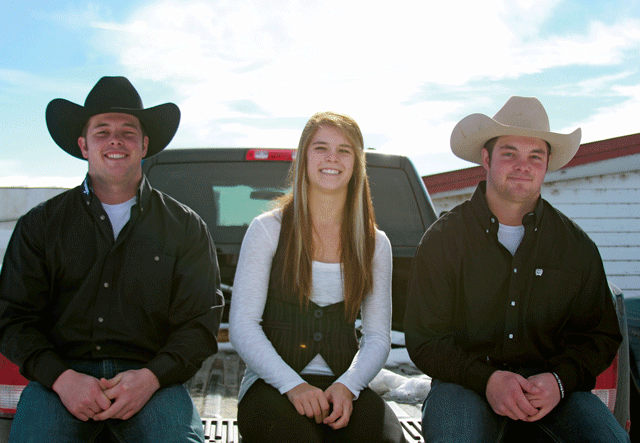
Last month, college junior Maddy Dickens was racing to the National Intercollegiate Rodeo Association barrel racing reserve championship on her main mount, Bucky. This month, you can catch them on the WPRA rodeo trail. “It’s all I’ve ever done,” she says. “When I take a step back, there’s nothing else I’d rather be doing.”
Maddy rodeoed for Odessa College this last year, taking the southwest region all-around and barrel racing titles. This fall, she plans to rodeo for Tarleton State University while majoring in business administration and finance. “It’s motivating knowing that putting the time and the work in will eventually work in my favor,” she comments.
“This is my second year having Bucky. I got him before I went to school my freshman year in college. His name is Bucky because he tried to buck me off an embarrassing amount of times. He had never bucked until I got him, so he was renamed to Bucky. He’s 11 this year, and so this is his first year going to a lot of pro rodeos… He’s one in a million, and I’m really lucky.”
Maddy’s main support system is her family, as rodeo is a way of life for the Dickens, who call Loveland, Colorado home. Brothers, Joey and Kyle, are PRCA tie-down ropers. Dad, Skip, a former all-around cowboy, is always behind the chutes helping. Mom, Lisa, was a trail rider turned barrel racer, former rodeo photographer and now the self-dubbed family videographer.
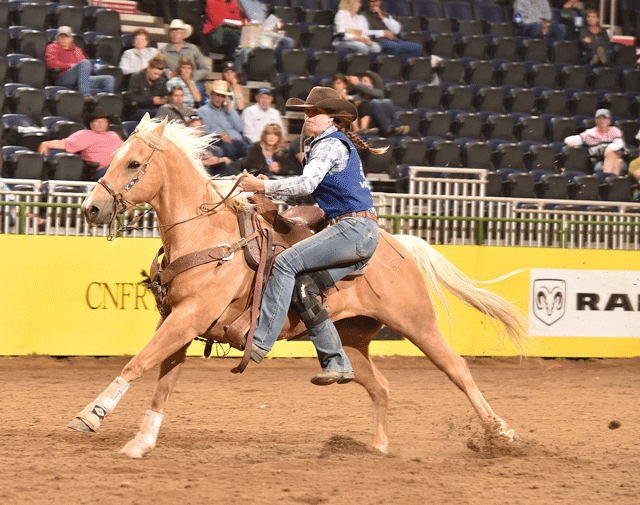
Maddy at the 2018 CNFR – Hubbell Over the years, all three kids were members of the Colorado Junior Rodeo Association, National Little Britches Rodeo Association, Colorado State High School Rodeo Association and NIRA. Kyle and Maddy were also members of the Colorado Junior High School Rodeo Association (which was formed after Joey was in junior high). “We traveled with 6 horses, 3 kids and 1-2 goats,” Lisa adds. “Our own mini circus.”
While all three kids are now grown, they still support one another through the thick and thin of rodeo life. “My brothers have gone a lot more than I have, so they have a lot more ‘on the trail’ sense of everything,” Maddy says. Both brothers rodeoed for Colorado State University and competed at the College National Finals Rodeo themselves. “They’ve helped me a lot with my mental game, how to enter the rodeos, where to go and other things you learn as you go. I’ve been able to pick up from them a little bit because they’ve been going so much.”
Kyle says, “It’s nice to be able to help her. I feel like she’s had a lot of the same mental hurdles that it took me awhile to struggle through and figure out.” He has tried to “at least decrease the learning curve” for Maddy.
Mastering the mental game has proven to be even more important for Kyle and Joey, as they both quit their jobs in January to rodeo full-time. Joey, the oldest, remarked that Kyle was the driving force behind it all, as “he’s been planning this for years.”
“I just felt good about my abilities and felt good about my horses. It was something I wanted to try and not wonder ‘what if?’” Kyle says. It’s the one thing I enjoy the most, and if I can make a career out of it, I might as well try.” Joey and Kyle share a rig and in Joey’s words, they’re both trying to win. “It’s good to go with someone who has the same goals,” Kyle adds. “It’s good to have a supporter.”
Their transition from weekend warriors to full-time calf ropers has been fairly smooth. The biggest difference? “When we were working full-time, we had to cram in a lot more rodeos on the weekend so we could get as many in as we could,” Kyle says. They’ve realized they don’t need to exhaust themselves getting to rodeos since they have more time as full-time contestants.
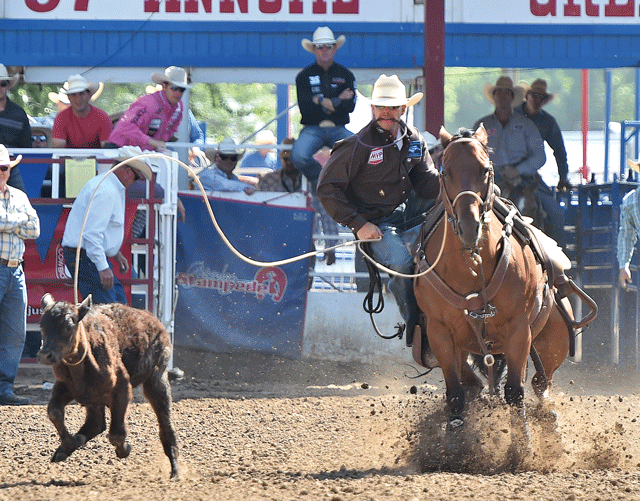
Kyle Dickens at the 97th Annual Greeley Stampede – Hubbell And when the rodeo trail gets tough, Joey says perspective is everything. “I’ve had a real job… You know what I mean? I’m not one to complain about rodeo being hard.” For Kyle, remembering his goals pushes him on the trying days. The drive to accomplish what he set out to do motivates him, and he believes it’s “pretty counter-productive” to quit, even when that feels like the easier route.
Joey looks to his dad as his role model, as Skip “had to figure it out on his own.” Skip has worn many hats in supporting his kids’ rodeo pursuits– from practicing with them every day after work to teaching them the fundamentals of roping. He recently retired from his job, and now helps with the horses, keeps the rigs running and calls vets when they’re on the road.
“Rodeo is just something we’ve always done as a family. It was great. It was awesome,” Lisa adds. “Where other parents may have said, ‘Yeah, I don’t see my kids on the weekends,’ we were with the kids from junior/peewee age all the way through high school. We got to spend time with our kids all the time… I wouldn’t trade a minute of it. We loved, too, the opportunity to meet people from different parts of the country and the lasting friendships you make.”As Skip and Lisa have helped their kids over the years, they recognize the valuable lessons it has brought. “They learned how to be good sports in and out of the arena, whether they win or lose,” Lisa states. Responsibility is one of the greatest quality rodeo instilled in their kids. “You have to take care of the animal. You have to practice. If you don’t do well, if you don’t win, you don’t pay for your fees. And I think they’re learning that as they go down the road and are trying to make money at it,” Lisa says. “They have to be accountable for everything they do.”
While they experience the ups and downs of the rodeo trail, the Dickens kids know they have one another to lean on. “They tease each other, and they really like to pick on Maddy,” Lisa laughs, “But they are right there behind her, offering advice. They support each other all the time. They call Skip on things and ask his advice… As a mom, that’s really, really cool.”
“Every time the boys rope or Maddy runs barrels, I get videos, I get phone calls of what’s going on— ‘What could we have done? This was good, this was bad,’” Skip adds. “Just that interaction is great… That’s the biggest cherry on top of the sundae to me.”
Joey tie down roping at the 97th Annual Greeley Stampede – Hubbell The Dickens children attribute much of their success to Skip’s and Lisa’s early sacrifices for them, but their parents wouldn’t even call it a sacrifice. “I think the only thing sacrificed was time, and spending time with your kids goes without saying. It is not a sacrifice. It is what you do,” Lisa says.
“That’s the best thing to me— The kids want to spend time with us,” Skip adds. “All three of the kids help one another all the time. They are their main supporters. And I think that’s really the best part… We get along and work as a family to try to make this work, and I think that’s incredible.”
-

Scott Kormos
[ Eight-time WNFR qualifier Scott Kormos currently sits at 15th in the PRCA world standings. ]
“The first time I watched the NFR, I was 8 or 9 years old, and at that moment, I thought ‘I want to be there and compete.’ So I think it was a goal of mine from the very start,” says Scott Kormos. The 38-year-old tie-down roper from Teague, Texas, has eight WNFR qualifications to his name, last competing on the arena floor of the Thomas and Mack Center in 2013. Currently, he’s sitting 15th in the PRCA world standings, traveling with fellow tie-down roper Caleb Smidt.
With his gold buckle dreams hinging on horsepower, Scott started feeding his horses Nutrena five years ago and calls it the best decision he ever made. “I got a call from them asking if I wanted to be on their team, and it’s been a blessing from the start. The way my horses look, feel, and perform—there’s nothing better. I’ve seen a really big upside. I have a couple practice horses I ride when I’m home, and one is 18 and the other is 20, but they look 12. They’re strong and they stay healthy. I feed the SafeChoice Senior to all my horses, young and old. It’s really good for the stomach—a lot of performance horses are having stomach problems, especially traveling, so this is easier to digest. I got on it and I haven’t looked back since.”
Scott also attributes his horse Aggie’s endurance through the summer run to his feed. “You’re out here a long time going up and down the road, and you have to take care of the horses. If they’re not sound and feeling good, then we’re not going to win.” Scott purchased Aggie, now a 13-year-old, four years ago during the San Antonio Rodeo at the ranch horse sale. “The people who’d owned him had never roped on him, so we trained him and started hauling him a little bit last year. I’ve been riding him all year this year, and he seems today as good as he did at the start of the year. He’s just a little young to a lot of this, but he’s feeling his way through it.”
Scott and Aggie often return to enter at their meeting place at the San Antonio Rodeo, and the Houston Livestock Show and Rodeo is another one of Scott’s favorites, from the added money to the hospitality. “There’s not another rodeo we go to like it all year long. They feed you three times a day, have plug-ins and stalls—it’s just unreal,” says Scott. “Through the summer, I just try to tell myself it’s not going to last too long, and just try to drive through two to three months on the road. At my age, it’s about getting enough rest and eating good. I try to look past the travel and focus on the goal I’m trying to get to.”
At the end of the rodeo trail, Scott’s family waits for him. His wife, Laine, is a full-time nurse, and they have three children, Kade, Lawson, and Letty. “Last year, Kade came out with me a couple months to rodeo, but the boys are all about sports and football. Letty will be 3 in October and she shows a lot of interest in the horses, so she may be a little cowgirl.” When he’s home, Scott shoes horses, a skill he picked up as a 16-year-old working with Ricky Luke, who also coached him in roping. Scott’s dad, Michael Kormos, is an electrician, as well as a team roper, and Scott works with him on occasion. In November, Scott is also hosting his third tie-down and breakaway roping school in Buffalo, Texas.
“My dad roped steers and I got started roping steers a little bit at a young age, but I started roping calves and I loved it as soon as I started doing it. I love everything about it—the horses, the competition—there are so many things you have to do besides ride and rope. You have to be a good horseman, and you have to score good, rope, flank, and tie. There are so many more things about it that intrigue me,” Scott explains. “My ultimate goal this year is to make the NFR. I think that’s everybody’s goal out here, so I’m trying to get the finals made and have a chance to compete out there.” -

2018 Caldwell Night Rodeo comes to a close
2018 Caldwell Night Rodeo Champions
Bareback Riding – Connor Hamilton, Calgary, Alberta, 173.5, $7,405
Steer Wrestling – Tyler Waguespack, Gonzales, La., $8,447
Team Roping – Luke Brown, Rock Hill, S.C., and Jake Long, Coffeyville, Kan., 16.2, $3,588 each
Saddle Bronc Riding (tie) – Hardy Braden, Welch, Okla.,
and Ryder Wright, Milford, Utah, 176 points and $5,576 each
Tie-Down Roping – Trevor Brazile, Decatur, Texas, 27.3 seconds, $5,544
Barrel Racing – Stevi Hillman, Weatherford, Texas, 51.32 seconds, $7,628
Bull Riding – Derek Kolbaba, Walla Walla, Wash., 89 points, $7,445
CALDWELL, Idaho (Aug. 18, 2018) – Fans would be hard pressed to find any better action than they saw at the Caldwell Night Rodeo during Championship Night on Saturday. Just ask anyone of the 8,000 that were in attendance.
In anticipation of the championships, Saturday night’s tickets were all sold in advance and were gone early the afternoon of the final performance. The rivalry between the Rowdys in the east stands and the Civies in the west stands was going strong all night and rodeo contestants fed off the energy of the fans.
One of those contestants, bareback rider Connor Hamilton, made the trip here from Calgary, Alberta, and while he has competed at big rodeos in his home country, nothing was quite like Caldwell for the Professional Rodeo Cowboys Association rookie. Hamilton rode at the first performance last Tuesday. His 85.5-point ride on Outlaw Bucker’s Awkward Todd was the high-marked ride of the night and as such got Hamilton a trip around the arena on a saddle horse for a victory lap.
Then he won the rodeo after riding Powder River Rodeo’s award-winning horse Craig at Midnight for 88 points. He had just watched world champion Kaycee Field score 88 on another horse from the Wyoming stock contractors, Bobcat. He was also up against the reigning world champion Tim O’Connell who finished third with an 85.5.
When it was all said and done, Hamilton won the championship with the highest total score on two rides at 173.5 points. Hamilton is currently third in the bareback riding rookie of the year standings with $11,892 in season earnings. He added to that significantly with the $7,405 that he won here.
The saddle bronc riding record was nearly in jeopardy Saturday night. Shaun Stroh set the arena record here in 2010 with 91 points. Two men came close to matching it and again it was horses from Powder River Rodeo that got these cowboys 90-point rides.
Hardy Braden from Welch, Okla., was first to go. He rode Miss Chestnut and took the overall lead. He had to wait thru several more competitors to see if it would hold. One of those competitors was the reigning world champion Ryder Wright from Milford, Utah.
Wright got on Double Take and with another outstanding effort got a 90. They had also tied in the first round and ended up splitting the win here with 176 points. That earned each of them $5,576.
The big winner here was steer wrestler Tyler Waguespack from Gonzales, La., who downed three steers in 12.8 seconds. He won $8,447. Trevor Brazile won his fourth tie-down roping title here and added $5,544 to his earnings. Brazile who holds the arena record at 7.3 seconds had a total time of 27.3 on three runs for the championship.
Barrel racer Stevi Hillman was the only repeat winner from 2017. Hillman rode MCM ImASharpGuy to the title last year. This year she was on Cuatro Fame a horse that she calls “Truck” for the win. They had three runs that added up to 51.32 seconds earning $7628.
Plans for the 85th Caldwell Night Rodeo are already underway. The dates for next year’s rodeo will be Aug. 13 – 17. More information is available at www.caldwellnightrodeo.com.
CALDWELL, Idaho, (Aug. 18, 2018) — The following are final round and overall results from the 84th Caldwell Night Rodeo.
Bareback Riding: (final round) 1, (tie) Kaycee Field, Spanish Fork, Utah, on Powder River Rodeo’s Bobcat and Connor Hamilton, Calgary, Alberta, on Powder River Rodeo’s Craig at Midnight, 88 points and $1,450 each. 3, Tim O’Connell, Zwingle, Iowa, 85.5, $900. 4, Caleb Bennett, Tremonton, Utah, 85, $600. 5, Logan Patterson, Kim, Colo., 75, $350. (Total on two) 1, Hamilton, 173.5, $3,371. 2, O’Connell, 171.5, $2,584. 3, Feild, 171, $1910. 4, Bennett, 169.5, $1,236. 5, Patterson, 157, $787. (on one) Cody Kiser, Carson City, Nev., 84.5.
Steer wrestling: (final round) 1, Shayde Tree Etherton, Borden, In., 3.6 seconds, $1,204. 2, Blake Knowles, Heppner, Ore., 4.3, $996. 3, Tyler Waguespack, Gonzales, La., 4.4, $789. 4, Kyle Irwin, Robertsdale, Ala., 4.8, $581. 5, Tom Lewis, Lehi, Utah, 5.0, $373. 6, Taylor Gregg, Walla Walla, Wash., 5.2, $208. (total on two) 1, Waguespack, 12.8, $3,943. 2, Knowles, 13.4, $3,429. 3, Etherton, 13.6, $2,914. 4, Irwin, 14.8, $2,400. 5, Lewis, 15.1, $1,886. 6, Gregg, 15.4, $1,372. 7, Hunter Cure, Holliday, Texas, 22.5, $857. 8, K.C. Jones, Decatur, Texas, 24.3, $343.
Team roping: (final round) 1, Luke Brown, Rock Hill, S.C., and Jake Long, Coffeyville, Kan., 4.8, $1,080. 2, Chad Masters, Cedar Hill, Tenn., and joseph Harrison, Overbrook, Okla., 6.0, $810. 3, Cody Snow, Los Olivos, Calif., and Wesley Thorp, Throckmorton, Texas, 6.1, $540. 4, Jake Orman, Prairie, Miss., and Will Woodfin, Marshall, Texas, 6.2, $270. (total on three) 1, Brown and Lont, 16.2, $3,588. 2, Orman and Woodfin, 17.7, $3,120. 3, Snow and Thorp, 18.3, $2,652. 4, Jesse Stipes, Salina, Okla., and Jake Smith, Broken Bow, Okla., 18.6, $2,184. 5, Masters and Harrison, 18.9, $1,716. 6, Clay Smith, Broken bow, Okla., and Paul Eaves, Lonedell, Mo., 21.1, $780. 7, Brenten Hall, Jay, Okla., and Chase Tryan, Helena, Mont., 23.1, $780. 8, Jr. Dees, Aurora, S.D., and Cody Cowden, Atwater, Calif., 23.2, $312.
Saddle bronc riding: (final round) 1, (tie) Hardy Braden, Welch, Okla., on Powder River Rodeo’s Miss Chestnut, and Ryder Wright, Milford, Utah, on Powder River Rodeo’s Double Take, 90 points and $1,450 each. 3, Bradley Harter, Loranger, La., 89, $900. 4, Joey Sonnier III, New Iberia, La., 87.5, $600. 5, (tie) Rusty Wright, Milford, Utah and Chase Brooks, Deer Lodge, Mont., 86.5, $300. (total on two) 1, (tie) Braden and Ryder Wright, 176, $2,514. 3, Harter, 173, $1,612. 4, (tie) Sonnier, Brooks and Mitch Pollock, Winnemucca, Nev., 171.5, $727. 7, Rusty Wright, 170, $379. 8, Wade Sundell, Boxholm, Iowa, 168.5, $285.
Tie-down roping: (final round) 1, Rhen Richard, Roosevelt, Utah, 9.3 seconds, $884. 2, Ty Harris, San Angelo, Texas, 9.7, $732. 3, Trevor Brazile, Decatur Texas, 9.8, $580. 4, Treg Schaack, Canyon, Texas, 10.1. 5, Ryle Smith, Oakdale, Calif., 10.3, $275. 6, Kody Mahaffey, Sweetwater, Texas, 11.3, $153. (total on three) 1, Brazile, 27.3, $3,531. 2, Richard, 27.5, $3,070. 3, Harris, 28.8, $2,610. 4, Marty Yates, Stephenville, Texas, 30.7, $2,149. 5, Smith, 31.2, $1,689. 6, Schaack, 31.4, $1,228. 7, Taylor Santos, Creston, Calif., 31.7, $768. 8, Kody Mahaffey, Sweetwater, Texas, 33.1, $307.
Barrel racing: (final round) 1, Stevi Hillman, Weatherford, Texas, 16.84, $1,429. 2, Teri Bangart, Olympia, Wash., 17.09, $1,071. 3, Darby Fox, King Hill, Idaho, 17.18, $714. 4, Ivy Conrado, Hudson, Colo., 17.21, $357. (total on three) 1, Hillman, 51.32, $2,893. 2, Conrado, 51.61, $2,480. 3, Bangart, 51.75, $2,066. 4, Amberleigh Moore, Keizer, Ore., 51.99, $1,781. 5, Darby Fox, King Hill, Idaho, 52.01, $1,378. 6, Brittany Pozzi Tonozzi, Victoria, Texas, 52.02, $1,102. 7, Andrea Busby, Brock, Texas, 52.26, $827. 8, Lynette Clyde, Heber, Utah, 52.46, $551. 9, Carley Richardson, Pampa, Texas, 52.85, $413. 10, Tammy Fischer, Ledbetter, Texas, 56.9, $276.
Bull riding: (first round winners) 1, Derek Kolbaba, Walla Walla, Wash., 89 points on D&H Cattle Company’s Bad Boy, $7,445. 2, Garrett Smith, Rexburg, Idaho, 88.5, $5,707. 3, Eli Vastbinder, Athens, Texas, 86, $4,219. 4, (tie) Trevor Kastner, Roff, Okla., and Brady Portenier, Caldwell, Idaho, 85.5 and $2,233 each. 6, Jeff Askey, Athens, Texas, 82, $1,241. 7, Sage Steele Kimzey, Strong City, Okla., 81.5, $993. 8, Parker Breding, Edgar, Mont., 76.5, $744.
-
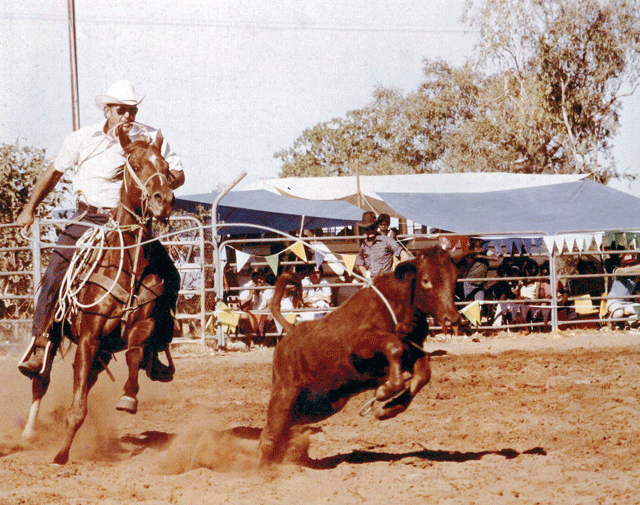
Back When They Bucked with Buddy Cockrell
Buddy Cockrell got to do a wide variety of things throughout his life. The Texas-born cowboy competed in high school and college rodeo, played college and professional football, owned ranches in Australia and Brazil and a gold mine in Costa Rica. He was born in 1934 and raised by his mother, Alice Gray Cockrell, and maternal grandparents, O.H. and May Etta Ingrum east of Pampa, Texas, on a farm and ranch.
His granddad started him cowboying and working when he was six years old, and Buddy learned to rope from Perry Franks, a hired hand on the OK Ranch where they lived, a well-known Texas roper and Turtles Cowboy Association member.
Buddy learned to steer wrestle in an unusual way. His uncle had horned purebred Hereford cows, and there was a cattle trail on the place, not far from the house. On horseback, Buddy would run a Hereford down the fence line, diving off his horse and onto the cow. He wasn’t usually able to throw the cow, but it gave him the chance to learn how to plant his feet, slide and get an arm hold. One day, one of the cows’ horns broke, and his granddad asked how it happened. Buddy never said a word, and no one found out. And when he began steer wrestling the real way, with a hazer, “he said he never knew how easy it was,” his wife Geneva said.
Each morning, he and his older brother Lee would milk before school, get on the bus and ride twelve miles. They attended a one room school till they got to junior high, where Buddy’s height and size gave him an advantage in sports. He was a natural athlete, lettering in the shot put, basketball, and football, and playing defensive end and offensive tackle in football.
In 1953, the year he graduated, he played on the Pampa High School basketball team, which was state champs. He was the regional heavy weight Golden Glove boxing winner and was chosen to be on the National High School All American Football team. He was also competing in rodeos by then, match roping other cowboys and winning. Buddy sharpened his roping and steer tripping skills by gathering and branding calves and doctoring for screw worms.
The summer after high school graduation, he competed in the Texas High School Finals Rodeo and won the boys’ all-around saddle by placing in the calf roping and winning the steer wrestling. He competed in pro rodeos that summer, winning some and losing some. “I won more than I lost, or I couldn’t have kept going,” he said. “Money was tight at home and I needed all I could bank for college.”
Buddy steer stopping at Windy Ryan Memorial Roping 1998 – Dudley 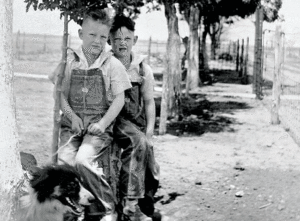
Lee & Buddy 1940 – Courtesy of the family 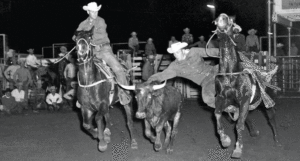
Buddy steer wrestling – James Cathey Buddy was in the field when Pop Ivy, one of the Oklahoma Sooner football coaches, visited. “I was out on the tractor plowing late one evening when a man stopped by. He had come to recruit me and offered me a scholarship,” Cockrell said. “It was better than driving a tractor, so I agreed.”
He played two years at Oklahoma University, under the tutelage of Bud Wilkerson and as part of the team’s 47 game winning streak. He didn’t rodeo, as Wilkerson didn’t want him to. Then Hardin Simmons University’s coach Sammy Baugh came calling. He offered Buddy a football and rodeo scholarship, so he transferred, doing both sports at Hardin Simmons and earning a business degree with a minor in economics. He competed once at the College National Finals Rodeo.
After college, Buddy headed back to Pampa to work on the family farm. But football wasn’t over for him. Pop Ivy had moved on to coach with the Saskatchewan Rough Riders, and he called Buddy, asking him to play for them. Buddy drove to Canada and signed a one year contract. When he got home, he found out he had been selected by the Cleveland Browns in the twenty-eighth round of the draft. But he stuck with his word and spent a year playing ball in Canada.
The next year, he went to Cleveland to play for the Browns. But during a scrimmage before the season started, he was blindsided by one of his own players, injuring his right knee. It required surgery, and Buddy never played for the Browns. He worked hard to rehabilitate the knee.
By this time, Sammy Baugh, his college coach, was coaching the New York Titans. He called Buddy and wanted him to come to New York. Buddy spent three years with the Titans (they became the Jets in 1962). The Denver Broncos asked him to play, but by then his knees were bad and he quit football.
Buddy returned home to rodeo and farm. He roped calves and steer wrestled, often traveling with his brother Lee, who was a calf roper. He competed close to home and added steer roping to his repertoire. His best season was in 1977, when he was the PRCA season champion steer roper. There were three years (1976-1978) when two champions were awarded in each event. World championships were determined by the highest amount of money won at the NSFR. Season champs were awarded based on total season earnings. Buddy earned $11,386 that year; Guy Allen, ninth during the regular season, won the world title with earnings of $2,585 from the NFSR.
He and his brother never drank; they had seen the effects of alcohol on their father. But that didn’t stop Buddy from having a good time. Good friend and fellow steer roper Howard Haythorn remembers that Lee and Buddy would get one room with one bed while rodeoing. Lee would take care of horses, eat a good solid meal and go to bed. Buddy would be gone all night, having a good time and coming in when Lee was getting up. “Lee would get more sleep but I had more fun,” Buddy laughed.
Wherever Buddy went, fun and good times followed. He wasn’t scared of anything. His wife Geneva relates a tale of when he, Larry Nolan, Tom Henry, and Tuffy Thompson were headed to a steer roping in Nebraska. Their pickup died and there was no way to start it. Buddy said, “If I can get that big horse out of the trailer, I promise you I can pull this pickup and you can jump it.” Nobody believed him, but Buddy hooked his horse to the pickup, got it to move, and the pickup started.
That same trip, the four of them were at their destination, where they ate supper and checked into a hotel. Two women in the bar decided to follow them to the hotel. Buddy and Tuffy were upstairs in their hotel room, with Larry and Tom on the first floor. All of a sudden, they heard a bang and glass flying. The women had accidentally driven their car into the wall, at Larry and Tom’s room. Buddy said, “what’s going on?” and Tom’s reply was, “girls, if we’d have known you were coming, we’d have opened the door for you.”
After his football career, Buddy had several businesses. In 1971, he built a 25,000 head cattle feed lot east of Pampa, selling it seventeen years later. He and two other men built a 10,000 head hog operation outside Lefors, Texas, selling their hogs to Jimmy Dean’s processing plant in Plainview, Texas.
In 1980, one of Buddy’s biggest adventures began. He flew to Australia to buy carrier airplanes. While he was there, he looked up an old rodeo friend, Carey Crutcher. Crutcher convinced him to buy a ranch (called a station in Australia) and Buddy was in the cattle business Down Under. The Blina Station was 640,000 acres with approximately 12,000 head of cattle. It was 100 miles from the closest town, Derby, and Buddy stayed six months of the year, while his son, Dan worked at the ranch year round.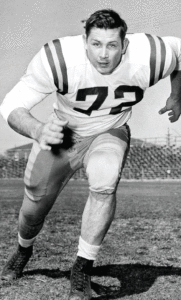
1972 at Oklahoma State University where he played for two years, under the tutelage of Bud Wilkerson and as part of the team’s 47 game winning streak – Courtesy of the family 
Buddy steer roping at the Wyoming State Fair, Douglas, Wyoming 1976 – Jan Spencer 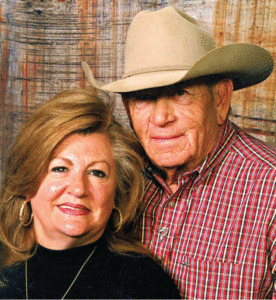
Buddy and his wife Geneva, 2013 – Courtesy of the family While he was in Australia, he attended and competed in rodeos, introducing team roping to the Australians, supplying timed event cattle for them, and winning an all-around saddle at his last rodeo in the country.
He loved working at the station. The cattle were wild, some of them never having seen humans, and they would catch the bulls by roping them, tying them to the massive trees in the outback, and winching the animal into trailers. Then they were hauled back and put with the herd in the corral. One of Buddy’s worst injuries came when roping a bull. The bulls had been mustered and hauled into the corral. When Buddy roped one, it took off over a feed trough, catching the rope around his leg and breaking it. The bone was sticking through the skin, when Dan, his son, put him in the back of the pickup and drove him to Derby. There, doctors wrapped it, readying it for a flight to Perth for surgery. Buddy insisted that it was wrapped too tightly, but the doctor didn’t listen. When he was in flight, he asked the attendant to loosen it, cutting off over half of it to relieve the pressure. “He’s had some wild wrecks,” his wife Geneva said.
Buddy’s business ventures didn’t end in Australia. He, along with partners, briefly owned a gold mine in Costa Rica and a ranch in Brazil.
He didn’t ever touch alcohol, but he loved his Coca-Cola. He kept a cooler of it in the back of his pickup, and often drank 42 oz. a day.
He was an excellent horseman, Howard said, and his daughter Amy was too. “She was a good hand.” He knew good horseflesh, his wife Geneva said. “He has a super, super eye for a good horse,” although he hasn’t ridden for three years.
Buddy and his first wife, Joyce Moyer, had three children: Mel, Dan and Amy. He met his second wife, Geneva, in 2000, and together they have five children, nine grandchildren and three great-grandchildren. Amy and her husband Kyle Best ranch near Douglas, Ariz. Dan and his wife Drucy ranch at Higgins, Texas, and Mel lives at Amarillo. Geneva has two sons: Ty and his wife Kimberly Harris and Krece Harris, all of Decatur, Texas.
At age 83, Buddy has Myasthenia gravis, a neuromuscular disease that weakens the skeletal muscles, causing difficulty in swallowing, walking and talking, and double vision. He got bucked off a horse three years ago, and since then, his health has declined.
But Buddy has always met life’s challenges with a smile, ready to tackle them. “He lives life to the fullest extent,” Geneva said. “He’s been very blessed, and he’s always thought he was bulletproof.” He doesn’t worry about things. “He’s led a very carefree life. I worry and get grayer and grayer, and he says, why worry about it? Things will work out if they’re supposed to.”
Howard Haythorn loves his old friend. “He’s a giant of a man, and not only in stature but in personality. He’s larger than life but he’s soft-spoken. He’s a lot of fun to be around.”
Buddy is a 2010 inductee into the Texas Panhandle Sports Hall of Fame and a 2014 Texas Cowboy Hall of Fame member.
He’s had a life that he would never have guessed, said his wife Geneva. “I don’t think he could have even dreamt up what would happen. He’s always been the kind, when he saw an opportunity that he was going to rise to the challenge.”
“I’ve been blessed,” Buddy said. Life “has been good to me.” -
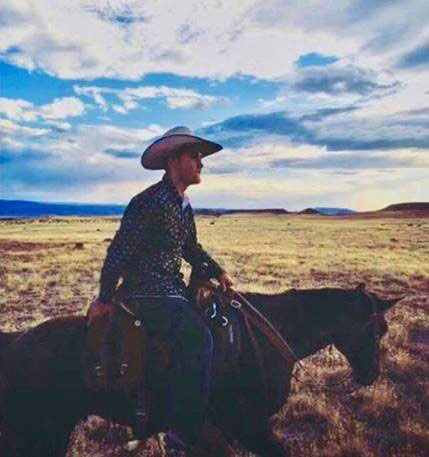
First Annual Hunter Norman Memorial Bulls & Ranch Broncs Event Attracts Huge Numbers In Colorado
GRAND JUNCTION, Colorado (June 28th, 2018) – Nearly 500 spectators, 51 competitors, local business owners and countless family and friends turned out in large numbers to attend the 1st Annual Hunter Norman Memorial Bulls & Ranch Broncs event on Saturday, June 23rd, 2018. With fans filling the grandstands and riders packing the bucking chutes, people flocked to the event at the Mesa County Fairgrounds in Grand Junction to honor and pay tribute to respected Western Slope ranch bronc rider, Hunter Norman who lost his life in a tragic accident in early May.
The highly attended event is just a testament of the profound impact that 20-year old Fruita Monument High School graduate Hunter Norman had on the Western Slope community and beyond. With competitors coming in from Wyoming, Utah, Arizona and throughout Colorado and premier bucking stock from Ty Farris, Lonny Lancaster, Bryan Flynn and Wes Clegg of 7C Buckers, the event showcased fierce competition, big payouts and prizes in one of the best rodeo events to hit the Western Slope. 9-time PBR World Finals qualifier Tony Mendes made his return to bull riding at the event after a two-year hiatus to honor the memory and spirit of the beloved cowboy.
“It’s a blessing and an honor that everybody showed up and attended this,” Mendes said. “It speaks volumes on what Hunter represented as a cowboy. He had heart. He’d always show up with some young kid wanting to learn how to do it. He put a lot back into this sport and I guess that was my biggest thing with coming back. I haven’t been on a bull in two years and the love that that kid showed my sport, I really wanted to be a part of this event.”
“Hunter made an impact on my life because he always wanted to help somebody else,” Mendes said. “Hunter would show up at the practice pen out in Fruita and pay 10 bucks for some other kid to ride. He always gave back to the kids and always tried to help everybody. You’d never see him turn his back on nobody. To be a part of an event like this and to see everybody brought together doing what we love to do — that’s being a cowboy — it’s an honor and privilege. He had a heart. Hunter had a big heart. That’s why he made such a big impact and that’s why you see these people here. When he did something, he did it with his heart. He did it because he wanted to be a cowboy.”
Family and long-time friends of Hunter organized the event in just five weeks with the help of an incredible outpouring of support from sponsors and donations. The annual memorial event will continue to celebrate the young cowboy’s life through his love and passion for ranch bronc riding and plans are already underway for next year’s event to potentially include a concert, raffle and silent auction.
“It was a pleasure to work with Scott Norman and his team to host this event to honor the memory of his son, Hunter,” said Stacy Pinnt, Mesa County Fairgrounds Event Coordinator. “I think for this event’s first year, it was a big success and we look forward to working with them to make this event an annual one that just gets bigger every year.”
One of the special moments from the evening featured “Hunter’s Last Ride” where a horse wearing just Hunter’s saddle was sent out from the bucking chute just before the short round. As the horse ran across the arena, fellow competitors and friends threw out their cowboy hats to show their respect for Hunter Norman.
Winners List – 1st Annual Hunter Norman Memorial Bulls & Ranch Broncs:
Ranch Broncs
1st Place: Tyler Williams ($2700 + custom hat from Rocky Mountain Hat & Boots and Hunter Norman Buckle from A Cut Above)
2nd Place: Wes Rosengreen ($1620 + Hunter Norman Memorial Spurs from A Cut Above)
3rd Place: Dallin Anderson ($1080 + Hunter Norman Memorial Jacket from Bud Signs)
High Point Ride in the Long Round – 81 points: Travis Harrison & Kasey Rosendahl (Custom-made Bronc Halter from Tel Campbell + rein donated from The Horse in Sport)
Bulls
1st Place: Nate Hoey ($2600 + Hunter Norman Memorial Buckle from A Cut Above)
2nd Place: Wyatt Hamilton ($1560 + custom hat from Rocky Mountain Hat & Boots)
3rd Place: Wyatt Bronson ($1040 + Hunter Norman Memorial Jacket from Bud Signs)
High Point Ride in the Long Round – 82 points: Wyatt Hamilton (Custom-made Bull Rope from Beast Master Rodeo Gear)
“We wanted to make this event the No. 1 stop in the month of June. The crowd turned out and the ranch bronc riders and bull riders showed up. I’m going to say this is one of the biggest events Mesa County has had in a long time,” said two-time Colorado Bullfighter of the Year Tyler Williams, one of the event organizers. “Hunter, being only 20 years of age, had a big impact on a lot of people. It’s crazy to know the impact that he had. Community members and the family came together to make this event happen, and it means the world to us.”
Special thanks to buckle sponsors Diamond Peak Cattle Company and Twin Butte Ranch and stock contractors Ty Farris, Lonny Lancaster, Bryan Flynn and Wes Clegg of 7C Buckers. Special thanks to event sponsor Growing Spaces Greenhouses based in Pagosa Springs, Colorado and short round ranch broncs sponsor Joe and Beth Madaris from Trading Post Liquors in Grand Junction. And, special thanks to Mike Smith J for donating his beautiful custom flag art work for the silent auction item.
For information on next year’s event and sponsorship opportunities, please contact Scott Norman at 970-471-5900.
-
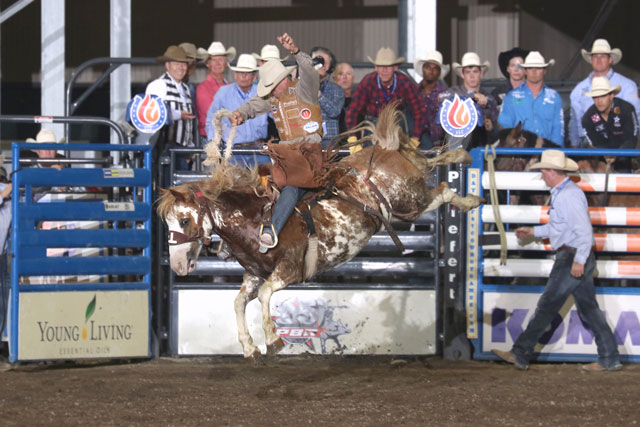
Gold Medals Awarded at Days of ’47 Cowboy Games & Rodeo in Salt Lake City
SALT LAKE CITY (July 24, 2018) – It was a golden night on Tuesday at the Komatsu Equipment Days of ’47 Cowboy Games & Rodeo presented by Zions Bank in Salt Lake City with gold, silver and bronze medals awarded to the champions.
The night started off similar to 2017 with bareback rider Wyatt Denny atop the medal podium after turning in an 88-point ride aboard Sankey Rodeo’s Sozo. Denny of Minden, Nev., added a second gold medal to his collection and another $50,000 to his bank account.
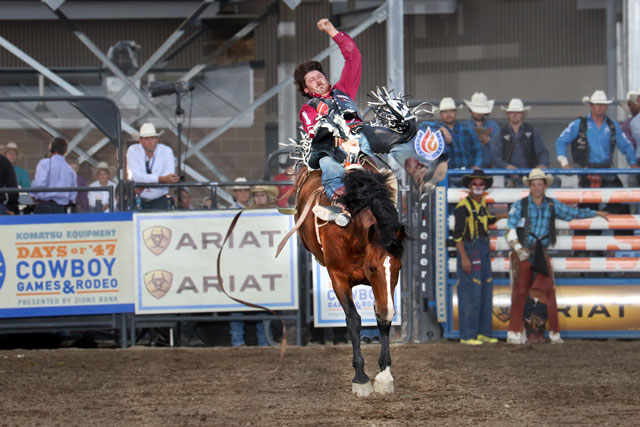
Wyatt Denny – Cowboy Images “I had that horse a few weeks ago so when I saw I had drawn him tonight I was pretty excited,” said Denny. “It is great to be back here and capture another gold medal.”
Taking the silver medal was JR Vezain of Melstone, Mont. It took two horses but Vezain made the second one count after receiving a reride. He tallied 85 points on the second horse, which was Andrews Rodeo’s PTDS Power Play to take second and a check totaling $25,000. There was a tie for third with Ty Breuer of Mandan, N.D. and Tristan Hansen of Victor, Idaho, who both spurred their way to 84.5 points. Due to the tiebreaker rules, Breuer received the bronze medal as his score coming in was a half a point higher than Hansen. However they will share the money each receiving $9,000.
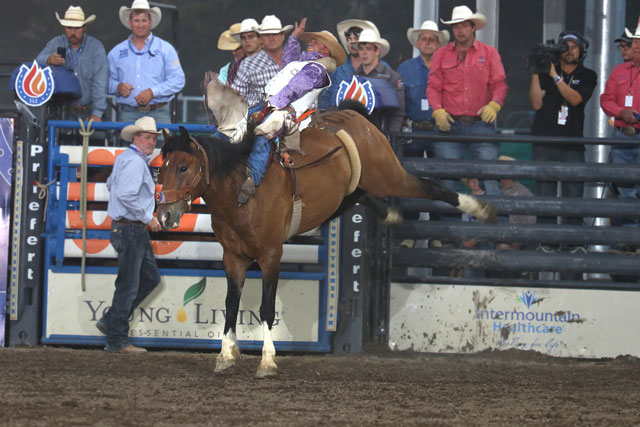
JR Vezain – Cowboy Images Saddle bronc rider Cody DeMoss joined Denny as a repeat champion after spurring Bar T Rodeo’s Pinto Pass for 87.5 points. DeMoss adds another gold medal to his collection and another $50,000 in cold hard cash. This was actually DeMoss’ third time to win the Days of ’47 Rodeo.
“I really like this rodeo,” said DeMoss moments after receiving the gold medal. “I was in Cheyenne earlier today and have to thank Stace Smith for flying me over here and for Young Living Farms and their essential oils to help me move tonight. I pulled a hamstring and have been rubbing their oil all over. I am a big believer in their product.
“God has blessed me here at this great arena in front of these great fans.”
Taking the silver medal was Wyatt Casper of Pampa, Texas with an 86.5-point ride on Bar T Rodeo’s Hell Boy. Isaac Diaz and Taos Muncy tied for third with 86 points rides but it was Diaz who collected the bronze medal after coming into the Finals with a half point better ride than Muncy. Diaz rode Andrews Rodeo’s Fire Lane, while Muncy did battle with Bar T Rodeo’s Son of Sadie.
Not to be outdone by the cowboys, barrel racer Hailey Kinsel repeated as the gold medalist at the Days of ’47 Cowboy Games & Rodeo. Kinsel of Cotulla, Texas, and her mount DM Sissy Hayday “Sister” turned in a lighting fast 17.09 second run to lead the way and continue their winning ways.
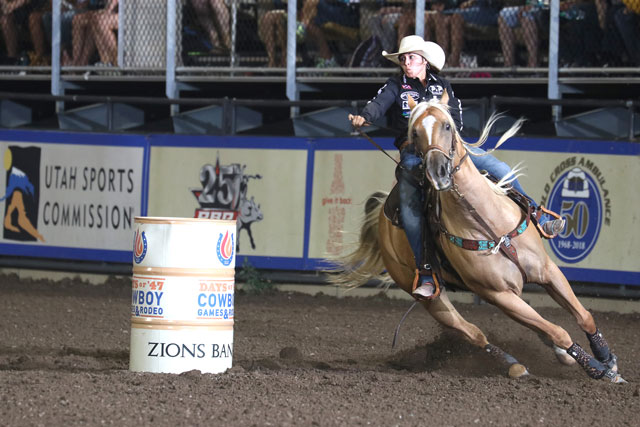
Haily Kinsel – Cowboy Images “I have faith in God and he never let’s anyone down who puts their faith in him,” said Kinsel when asked what her secret was to dominating the barrel racing. “Plus, I have a great yellow mare who believes the same.”
Joining Kinsel on the medal stand for the second year in a row was Lisa Lockhart of Oelrichs, S.D. Lockhart moved up one spot capturing the silver medal in 2018 with a time of 17.19 seconds aboard An Oakie With Cash “Louie.” Two-time world champion Brittany Pozzi Tonozzi took the bronze with a 17.24 aboard KissKiss BangBang “Mona.”
There was a new man atop the podium in the steer wrestling as defending champion Ryle Smith received a no time. Justin Shaffer of Hallsville, Texas, and a former Ram National Circuit Finals Rodeo Champion won his first gold medal and picked up $50,000. He stopped the clock in 4.2 seconds. Close on his heels was Rowdy Parrott of Mamou, La., with a 4.4 and Bridger Anderson of Alva, Okla., with a 4.5.
It was a family affair in the team roping with brothers Kellan and Carson Johnson atop the podium with their very first gold medals. Kellan, 19, and Carson, 17, stopped the clock in 4.1 seconds to add $50,000 each to their bank accounts. Their father, Jhett, won the PRCA world title in 2011 as a heeler and is now watching his sons make a name for themselves in the rodeo arena. The duo who call Casper, Wyo., home also turned in the fastest time in the semifinals just 24-hours earlier with a 4.9-second run and collected $3,200 each for that run.
Matt Sherwood of Pima, Ariz., teamed with Will Woodfin of Marshall, Texas, this week and they finished as silver medalists with a time of 4.3 seconds. Another brother team took the bronze when Riley and Brady Minor stopped the clock in 4.4 seconds.
Tie-down roper Cory Solomon brought his A-game to Salt Lake City on Tuesday night standing atop the podium with his first gold medal. Solomon of Prairie View, Texas, stopped the clock in 6.6 seconds to capture the win and $50,000 that goes to the champion. His run was the fastest of the event with Utah cowboy JC Malone hot on his heels with a 6.7-second run. Malone of Plain City added $25,000 to his bank account and a silver medal to his trophy case. Rounding out the top three was Caleb Smidt of Bellville, Texas, with a 7.0.
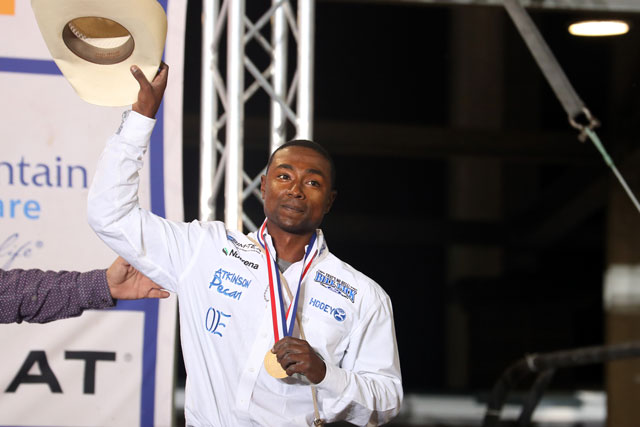
Cory Solomon – Cowboy Images Bringing the night to an exciting close Derek Kolbaba rode PBR and PRCA bull of the year D&H Cattle Sweet Pro’s Brusier to an 89.5-point ride. Kolbaba of Walla Walla, Wash., added $50,000 and his very first gold medal to his resume. Fellow PBR rider Alisson De Souza joined Kolbaba on the podium as the silver medalist and the only other one to have a qualified ride on the final night. De Souza of Brazil rode Broken Arrow’s Cut the Cord for 87 points. Garrett Smith of Rexburg, Idaho, captured the bronze after coming into the finals with the highest marked ride of 86.5 points.
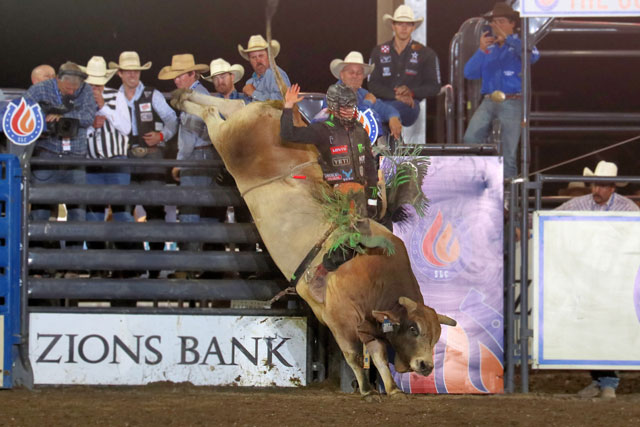
Derek Kolbaba – Cowboy Images The Komatsu Equipment Days of ’47 Cowboy Games & Rodeo presented by Zions Bank, is taking place at the $17.5 million state-of-the-art Days of ’47 Arena at the Utah State Fairpark, custom designed and built for rodeo. The venue—an outdoor arena located in the heart of Salt Lake City—features over 10,000 stadium-style seats.
For only the fourth time in the history of rodeo, riders will had the opportunity to compete for Gold, Silver or Bronze Medals. The first two times were in conjunction with the Olympic Winter Games in Calgary (1988) and Salt Lake City (2002), when rodeo was part of the Cultural Olympiad and the third being the Days of ’47 Cowboy Games and Rodeo in 2017. The medals awarded at the Days of ’47 Cowboy Games & Rodeo were produced by OC Tanner, the same company that made the Olympic medals for the champions of the 2002 Olympic Winter Games.
CBS Sports Network will air a recap of the final performance on tape delay on July 25 at 5 pm. MT. CBS will air a highlight show of the Days of ’47 Cowboy Games & Rodeo on July 29 at 11 a.m. MT.
Results: – Performance 5 – July 24, 2018
Bareback riding:1. Wyatt Denny, Minden, Nev., 88 points on Sankey Rodeo’s Sozo, $50,000; 2. JR Vezain, Melstone, Mont., 85 on Andrews Rodeo’s PTDS Power Play, $25,000; 3. (tie) Ty Breuer, Mandan, N.D., on Sankey Rodeo’s Thunder Monkey, and Tristan Hansen, on Summit ProRodeo’s Revolving Door, 84.5 points, $9,000 each.
*tie for third for medals was broken based on score coming into the Finals. Breuer had an 85.5 while Hansen came in with an 85.
Gold medalist: Wyatt Denny
Silver medalist: J.R. Vezain
Bronze medalist: Ty Breuer
Steer wrestling: 1. Justin Shaffer, 4.2 seconds, $50,000; 2. Rowdy Parrott, Mamou, La., 4.4, $25,000; 3. Bridger Anderson, Alva, Okla., 4.5, $12,000; 4. Hunter Cure, Holliday, Texas, 6.6, $6,000.
Gold medalist: Justin Shaffer
Silver medalist: Rowdy Parrott
Bronze medalist: Bridger Anderson
Team roping: 1. Kellan Johnson, Casper, Wyo./Carson Johnson, Casper, Wyo., 4.1 seconds, $50,000 each; 2. Matt Sherwood, Pima, Ariz./Will Woodfin, Marshall, Texas, 4.3, $25,000; 3. Riley Minor, Ellensburg, Wash./Brady Minor, Ellensburg, Wash., 4.4, $12,000; 4. Derrick Begay, Winslow, Ariz./Cory Petska, Marana, Ariz., 4.5, $6,000.
Gold medalist: Kellan Johnson/Carson Johnson
Silver medalist: Matt Sherwood/Will Woodfin
Bronze medalist: Riley Minor/Brady Minor
Saddle bronc riding: 1. Cody DeMoss, Heflin, La., 87.5 points on Bar T Rodeo’s Pinto Pass, $50,000; 2. Wyatt Casper, Pampa, Texas, 86.5 on Bar T Rodeo’s Hell Boy, $25,000; 3. (tie) Isaac Diaz, Desdemona, Texas, on Andrews Rodeo’s Fire Lane and Taos Muncy, Corona, N.M., on Bar T Rodeo’s Son of Sadie, 86, $9,000 each.
*tie for third for medals was broken based on score coming into the Finals. Diaz had an 86.5 while Muncy came in with an 86.
Gold medalist: Cody DeMoss
Silver medalist: Wyatt Casper
Bronze medalist: Isaac Diaz
Tie-down roping: 1. Cory Solomon, Prairie View, Texas, 6.6 seconds, $50,000; 2. JC Malone, Plain City, Utah, 6.7, $25,000; 3. Caleb Smidt, Bellville, Texas, 7.0, $12,000; 4. Bryson Sechrist, Apache, Okla., 7.3, $6,000.
Gold medalist: Cory Solomon
Silver medalist: JC Malone
Bronze medalist: Caleb Smidt
Barrel racing: 1. Hailey Kinsel, Cotulla, Texas, 17.09 seconds, $50,000; 2. Lisa Lockhart, Oelrichs, S.D., 17.19, $25,000; 3. Brittany Pozzi Tonozzi, Victoria, Texas, 17.24, $12,000; 4. Chani Graves, Sulphur Springs, Texas, 17.32, $6,000.
Gold medalist: Hailey Kinsel
Silver medalist: Lisa Lockhart
Bronze medalist: Brittany Pozzi Tonozzi
Bull riding: 1. Derek Kolbaba, Walla Walla, Wash. 89.5 points on HD Page’s Sweet Pro’s Bruiser, $50,000; 2. Alisson De Souza, Brazil, 87 on Broken Arrow’s Cut the Cord, $25,000; no other qualified rides.
*Garrett Smith received the bronze after having the highest score coming into the final round.
Gold medalist: Derek Kolbaba
Silver medalist: Alisson De Souza
Bronze medalist: Garrett Smith
-
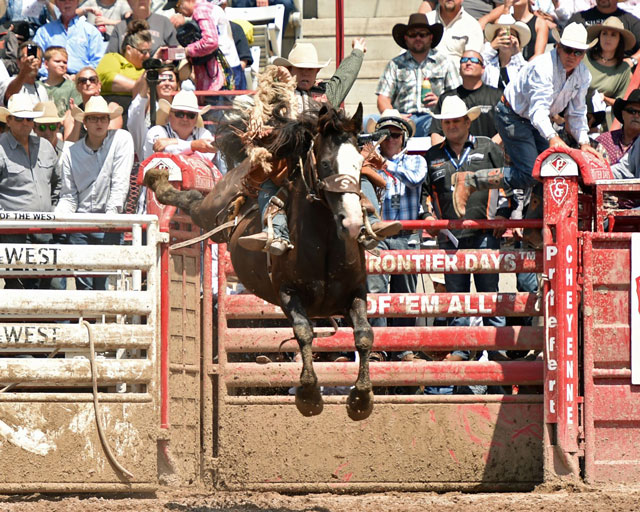
Brody Cress Makes History at 122nd Cheyenne Frontier Days
CHEYENNE, Wyo. — July 29, 2018) — It’s been 86 years since a saddle bronc rider won back-to-back championships at Cheyenne Frontier Days (CFD), but local favorite Brody Cress was not intimidated by history.
The 22-year-old from nearby Hillsdale won his hometown rodeo in 2017, an accomplishment that fueled the rest of his season and helped him win his first Wrangler National Finals Rodeo championship last December. Cress is sponsored by CFD and proudly wears the legendary rodeo’s iconic arrowhead logo on his chaps and his shirts. “There’s no other rodeo I’d want to represent,” he said.
Last year he came into Championship Sunday in second place and had to ride two broncs after being awarded a re-ride. He won the title by half a point. This year he came in with the overall lead and had to wait on Texan Wyatt Casper’s re-ride to see if his lead would hold for his second, record-setting CFD Championship. The crowd of 12,401 erupted with cheers and were on their feet when Cress took his victory lap around the arena.
The biggest money winner at the 122nd “Daddy of ‘em All” was steer wrestler Levi Rudd. The Chelsea, Oklahoma, cowboy earned $21,396. When the day began he had already collected more than $11,000 in the first and second rounds. He added nearly $900 for fourth place in the final round and about $9,500 for winning the overall championship by 1.1 second.
Rudd had competed at CFD twice in the past but had never done well. “I was happy after I won the first round since I’d never done any good here,” he said. Rudd started the week ranked 50th in the Professional Rodeo Cowboys Association (PRCA) steer wrestling standings. He more than doubled his season earnings after his win here and jumped about 20 spots in the standings.
Three-time world champion bareback rider Will Lowe started the day in sixth place, but an 88-point ride on Sankey Pro Rodeo’s Black Tie earned the Canyon, Texas, cowboy his third CFD championship and nearly $16,000. He previously won here in 2009 and 2012. Lowe, who has qualified for 14 National Finals Rodeos (NFR) is grateful to still be riding at the highest level 10 years after winning his first title in Frontier Park.
“It’s so awesome to be able to still be here, riding with these guys and still be competitive,“ he said. The win here should help his quest for a 15th NFR berth.
Lowe joins three legendary cowboys – Jim Shoulders, Joe Alexander and Clint Corey – as the only ones to win three bareback riding championships here.
Idaho bull rider Ruger Piva has accomplished something in the past year that many bull riders never will in their entire careers. Last September Piva, now 23, won the Pendleton Round-Up in Pendleton, Oregon. This week he competed for the first time at CFD, rode all three of his bulls and left with more than $10,000 in prize money and a Cheyenne Frontier Days title. The 23-year-old former high school and college wrestler can now claim wins at two of the most historic and prestigious rodeos in North America.
“If you had told me two years ago that I would win Pendleton and Cheyenne within a year, I wouldn’t have believed you,” Piva said. “Cheyenne felt a lot bigger than I expected. I hid in the ready room and watched the action on the tv screen.”
He received congratulations from four-time world champion J.W. Harris, who finished second. As Harris walked away, Piva asked Harris for an autograph. “He’s one of my heroes,” Piva explained.
For the second year, weather affected the Championship Sunday competition. Last year it rained, but this year a tornado warning issued during the rodeo resulted in a weather delay of about 20 minutes. When competition resumed, rain and hail came down, particularly during the barrel racing.
World champion Nellie Miller and her horse Rafter W Minnie Reba, that she calls “Sister,” were on the course during some of the worst of the weather, but the California duo made a solid run. Although they did not win money in the final round, their total time of 53.21 seconds earned Miller the championship. She won $19,530 and helped boost her lead in the 2018 Women’s Professional Rodeo Association (WPRA) standings. Miller and her father, Sam Williams, raised and trained Sister, who got her name because she is a half-sister to the horse Miller rode to her first NFR in 2010.
Second-generation rodeo athlete Brodie Poppino of Big Cabin, Oklahoma, came into Championship Sunday ranked fifth in steer roping. It was the first time he qualified for Championship Sunday in seven years of trying.
Poppino won the final round by nearly six seconds, riding his 22-year-old horse named Shaggy, a full brother to the horse his mother, Tana Poppino, rode to qualify for the NFR in barrel racing. “He stays in the pasture most of the year and about a month before we start legging him up for Cheyenne,” Poppino said.
“This is one of the most prestigious, one of the oldest rodeos in the world. It’s called “The Daddy” for a reason,“ he said. “Everybody wants to win this one. It’s a dream come true.”
Tie-down roper Shane Hanchey credits his horse Si, the 2017 horse of the year, for helping him come from seventh place to win his first CFD title. The former world champion and eight-time NFR qualifier had the second-fastest time on Sunday. Although he did not place in the first two rounds, he earned more than $13,000.
“I never really dreamed of winning this rodeo,” he said. “I weigh 140 pounds. All I’ve ever heard since I was about four years old is how big the calves were and how little people didn’t fare very well (at Cheyenne). I don’t show emotions very much, but this win’s got me shook up.”
Coming from the middle of the field to take the title was a trend in the roping events. Tennessee’s Chad Masters and Oklahoma’s Joseph Harrison were sixth in team roping when the day began, but out-paced the rest to win the final round. Their total time of 26.4 earned Masters his second CFD title (his first was in 2009) and Harrison his first.
Trevor Brazile of Decatur, Texas, won his eighth CFD championship when he took home the all-around title for the fourth time. He has also won a team roping and three steer roping championships at CFD.
2018 Cheyenne Frontier Days Rodeo Champions
Bareback Riding – Will Lowe, Canyon, Texas, 253.5 points, $15,808
Steer Wrestling – Levi Rudd, Chelsea, Oklahoma, 24.0 seconds, $21,396
Team Roping – (header) Chad Masters, Cedar Hill, Tennessee, 26.4 seconds, $10,752
(heeler) Joseph Harrison, Overbrook, Okla., $10,752
Saddle Bronc Riding – Brody Cress, Hillsdale, Wyoming, 252.5 points, $13,123
Tie-Down Roping – Shane Hanchey, Sulphur, Louisiana, 34.9 seconds, $11,345
Barrel Racing – Nellie Miller, Cottonwood, California, 53.21 seconds $19,530
Bull Riding – Ruger Piva, Challis, Idaho, 252 points, $10,281
Steer Roping – Brody Poppino, Big Cabin, Okla., 46.4 seconds, $10,801
All-Around – Trevor Brazile, Decatur, Texas, $6,486 competing in tie-down, team and steer roping
CHEYENNE, Wyo., July 29, 2018 — The following are final round and overall Cheyenne Frontier Days results.
Bareback Riding: (final round winners) 1, (tie) Shane O’Connell, Rapid City, S.D., on J Bar J Rodeo’s Beyond Bugs, and Will Lowe, Canyon, Texas, Sankey Pro Rodeo’s Black Tie, 88 points, $1,450 each. 3, Ty Breuer, Mandan, N.D., 86.5, $900. 4, Lane McGehee, Victoria, Texas, 86, $600. 5, (tie) Seth Lee Hardwick, Ranchester, Wyo., and Bill Tutor, Huntsville, Texas, 82.5, $300 each. (overall winners) 1, Lowe, 253.5 points, $8,615. 2, McGehee, 252, $6,605. 3, O’Connell, 251.5, $4,882. 4, (tie) Breuer and Tutor, 250, $2,584 each. 6, Hardwick, 249, $1,436. 7, Caleb Bennett, Tremonton, Utah, 247.5, $1,149. 8, Tanner Aus, Granite Falls, Minn., 247, $861.
Steer Wrestling: (final round winners) 1, (tie) Blake Mindemann, Blanchard, Okla., and Nick Guy, Sparta, Wis., 8.3 seconds, $1,752 each. 3, Dru Melvin, Hebron, Neb., 8.8, $1,386. 4, Tom Lewis, Lehi, Utah, 9.8, $1,141. 5, Levi Rudd, Chelsea, Okla., 9.9, $897. 6, Stetson Jorgensen, Blackfoot, Idaho, 10.1, $652. 7, Curtis Cassidy, Donalda, Alberta, 10.4, $408. 8, Jacob Edler, Dacoma, Okla., 10.5, $163. (overall winners) 1, Rudd, 24 seconds, $9,493. 2, Guy, 25.1, $8,255. 3, Dru Melvin, 27, $7,017. 4, Cassidy, 27.1, $5,778. 5, Mindemann, 27.4, $4,540. 6, Lewis, 28.1, $3,302. 7, Jorgensen, 29.2, $2,064. 8, Edler, 29.3, $825.
Tie-Down Roping: (final round winners) 1, Ryan Watkins, Morgan Mill, Texas, 10.9 seconds, $1,737. 2, Shane Hanchey, Sulphur, La., $1,510. 3, John Douch, Huntsville, Texas, 11.5, $1,284. 4, Scott Kormos, Teague, Texas, 12.1, $1,057. 5, Sterling Smith, Stephenville, Texas, 13.8, $831. 6, Clint Cooper, Decatur, Texas, 14.1, $604. 7, Ty Harris, San Angelo, Texas, 14.5, $378. 8, Adam Gray, Seymour, Texas, 16.1, $151. (overall winners) 1, Hanchey, 34.9 seconds, $9,835. 2, Watkins, 36, $8,552. 3, (tie) Kormos and Smith, 36.6, $6,628 each. 5, Douch, 37, $4,704. 6, Cooper, 37.4, $3,421. 7, Harris, 37.7, $2,138. 8, Gray, 39, $855.
Saddle Bronc Riding: (final round winners) 1, (tie) Cort Scheer, Elsmere, Neb., on Sankey Pro Rodeo’s Marquee and Wyatt Casper, Pampa, Texas, on Stace Smith ProRodeo’s Resistols Top Hat, 87 points, $1,450 each. 3, Brody Cress, Hillsdale, Wyo., 86, $900. 4, (tie) Spencer Wright, Milford, Utah, and Dawson Hay, Wildwood, Alberta, 85.5, $475 each. 6, (tie) Joey Sonnier III, New Iberia, La., and Isaac Diaz, Desdemona, Texas, 85, $125 each. (overall winners) 1, Cress, 252.5 points, $7,334. 2, (tie) Casper and Diaz, 250, $4,889. 4, Scheer, 247, $2,689. 5, Sonnier III, 246.5, $1,711. 6, Hay, 245, $1,222. 7, Zeke Thurston, Big Valley, Alberta, 244, $978. 8, Wright, 243.5, $733.
Team Roping: (final round winners) 1, Chad Masters, Cedar Hill, Tenn., and Joseph Harrison, Overbrook, Okla., 7.6 seconds, $1,813 each. 2, Dustin Egusquiza, Mariana, Fla., and Kory Koontz, Stephenville, Texas, 9.2, $1,500. 3, Erich Rogers, Round Rock, Ariz., and Clint Summers, Lake City, Fla., 9.3, $1,188. 4, Kaleb Driggers, Hoboken, Ga., and Junior Nogueira, Presidente Prude, Brazil, 9.5, $875. 5, Turner Harris, Killdeer, N.D., and Ross Carson, Grassy Butte, N.D., 10.1, $563. 6, Shay Carroll, Hico, Texas, and Jason Duby, Klamath Falls, Ore., 12.5, $313. (overall winners) 1, Masters and Harrison, 26.4 seconds, $8,939. 2, Driggers and Nogueira, 28.1, $7,773. 3, Egusquiza and Koontz, 28.5, $6,607. 4, Harris and Carson, 29.2, $5,441. 5, Rogers and Summers, 29.5, $4,275. 6, Derrick Begay, Seba Dalkai, Ariz., and Cory Petska, Marana, Ariz., 32.4, $3,109. 7, Carroll and Duby, 32.7, $1,943. 8, Ty Bach, Mt. Vernon, Texas, and Trey Johnson, Weatherford, Texas, 33.1, $777.
Barrel Racing: (final round winners) 1, Stevi Hillman, Weatherford, Texas, 17.66 seconds, $4,940. 2, Lisa Lockhart, Oelrichs, S.D., 17.70, $3,705. 3, Shali Lord, Lamar, Colo., 17.85, $2,470. 4, Jackie Ganter, Abilene, Texas, 17.87, $1,235. (overall winners) 1, Nellie Miller, Cottonwood, Calif., 53.21 seconds, $10,003. 2, Hillman, 53.26, $8,574. 3, Lockhart, 53.28, $7,145. 4, Ganter, 53.54, $6,192. 5, Lord, 53.81, $4,763. 6, Lacinda Rose, Willard, Mo., 53.90, $3,811. 7, Michelle Darling, Medford, Okla., 53.92, $2,858. 8, Sherry Cervi, Marana, Ariz., 53.99, $1,905. 9, Kelly Yates, Pueblo, Colo., 54.09, $1,429. 10, Laura Lambert, Wiggins, Colo., 54.33, $953.
Bull Riding: (final round winners) (only four rides) 1, Eli Vastbinder, Athens, Texas, 89 points on Dakota Rodeo’s Soup in a Group, $1, 800. 2, Ruger Piva, Challis, Idaho, 85.5, $1,400. 3, J.W. Harris, Goldthwaite, Texas, 82, $1,050. 4, Trevor Kastner, Roff, Okla., 81, $750. (overall winners) 1, Piva, 252 points, $8,881. 2, Harris, 250, $6,809. 3, Kastner, 238.5, $5,032. 4, (on two) Vastbinder, 176.5, $3,256. 5, Koby Radley, Montpelier, La., 173.5, $2,072. 6, Jeff Askey, Athens, Texas, 168, $1,480. 7, Parker Breding, Edgar, Mont., 166, $1,184. 8, Gray Essary III, 165.5, $888.
Steer Roping: (final round winners) (only three times) 1, Brodie Poppino, Big Cabin, Okla., 13.9 seconds, $2,415. 2, Kenyon Burns, Lovington, N.M., 19.7, $2,100. 3, Cody Scheck, Kiowa, Kan., 20.2, $1,785. (overall winners) 1, Poppino, 46.4 seconds, $8,974. 2, Burns, 51.1, $7,803. 3, Scheck, 57.5, $6,633. 4, (on two) Tuf Cooper, Decatur, Texas, 29.7, $5,462. 5, Bryce Davis, Ovalo, Texas, 32, $4,291. 6, Quay Howard, Canyon, Texas, 32.3, $3,121. 7, (tie) Jim Locke, Miami, Texas, and Jarrett Blessing, Paradise, Texas, 33.1, $1,366 each.
Wild Horse Race: (final round winners) 1, Bobcat of the Rockies, $848. 2, Mo Green, $636. 3, BMC Construction, $424. 4, Davis Dental, $212. (overall winners) 1, Bobcat of the Rockies, $7,949. 2, Mo Green, $6,076. 3, Dizzy Heifer Cattle Co., $4,388. 4, BMC Construction, $2,542.
-
Going for First or Just Catch?
We made our first trip to the Junior High School National Finals in Huron, SD, last month where Hali had qualified in the Breakaway.
She had roped well at regional finals and was 5.1 or 5.2 on two and won second. Then at Texas Junior High Finals she roped a 2.4, 2.7, a 3.2 and won second. At nationals last month she was 2.7, 2.8 and a short 3 and ended up winning third. The fact is you’re not always going to win first.
The conversation I had with her was that by roping conservatively her loops were high percentage shots. Everywhere we went there were girls who went faster. It came down to the short go at nationals and Hali was third high call. Josie Conner had roped two good calves and won the first round and second in the second round. She had a 6/10-second lead on us going into the short round.
We had been working on roping faster, but the catch percentage is not high. However, at the one-head jackpot Hali did rope fast and was 2.1. It wasn’t the prettiest loop. It hit him in the head and wrapped around and caught him.
At the finals you are able to watch the stock on film to see what they do. I always did this when I was rodeoing because I felt it was just part of being prepared by knowing what to expect from your steer or calf. We watched Hali’s short go calf three times run about 15 feet then hard right. We have a similar calf at home and he’s not a high percentage catch when trying to go fast. She asked what I thought she should do in the short round. I told her she could be really fast if she wanted to try and get a good start, swing twice, and fire. But in doing so there’s a 50/50 chance of catching him. If she did that and missed I didn’t want her to be devastated by trying to win first.
I said, “When you back in the box, do whatever you have to do to win first and let the other girls have to beat you. If the girls in front of you go fast, then you need to go fast.”
Personally, when coming back in the top three, my goal has always been to do whatever I needed to compete. When Hali backed in the box she needed to be a middle 4 to lead the roping and her catch ratio is pretty high if that’s all we need to do. She went and caught him and then the other two girls went and did their job and caught their calves.
She wanted to win first but the thought of driving home after missing would have been too hard. If she had taken a low percentage throw and missed and then the high calls had broken the barrier or missed, she would have been devastated. That’s the price you pay when you gamble. You have to live with when you don’t win. Had we tried to go fast, our success rate would have been low because our calf did not do what we expected. He went 50 feet before going right. So it ended up being a smart thing by going and catching.
Ultimately my advice to my daughter is if she rolled the dice and it didn’t work, I wanted her to hold her head up and keep a smile on her face because she tried to win first and she knew the odds going in. Sometimes it’s not about winning first. There were over 100 contestants and the first time she made nationals.
As parents you want your child to win, but you have to understand the risk when they try to go fast and recognize the percentages of what they’re capable of doing and not be upset when they miss. To me, understanding your odds is part of rodeo. Hopefully next year our “going fast” catch percentage will be much higher and she’ll feel more comfortable rolling the dice. If your child doesn’t have a high catching percentage, it’s not reasonable to be upset if they miss while trying to go fast.