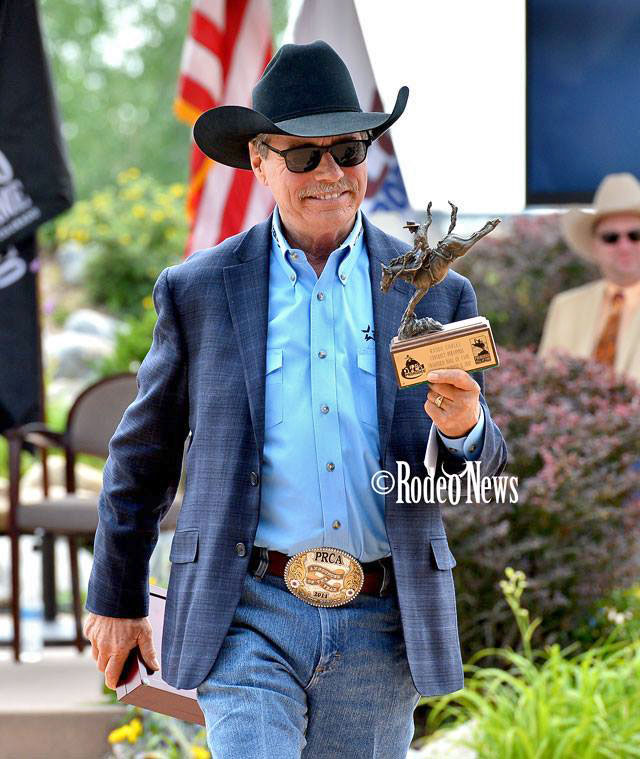
COLORADO SPRINGS, Colo. – The contract personnel for the Dec. 6-15 Wrangler National Finals Rodeo and the Nov. 2-3 Clem McSpadden National Finals Steer Roping were announced Wednesday by the PRCA.
For the sixth straight year, two of the announcers for the Wrangler NFR remain the same. Randy Corley, of Silverdale, Wash., and Wayne Brooks, of Lampasas, Texas, will be on the microphone for the 10 nights in Las Vegas. They will be joined by announcer Roger Mooney, of Ellijay, Ga.
Corley, who was inducted into the ProRodeo Hall of Fame in 2017, will be making his 18th Wrangler NFR appearance, while it will be the eighth of Brooks’ career. Mooney will be announcing for the first time at the Wrangler NFR.
Livestock superintendent John Barnes, of Sutherland, Iowa, makes his 13th consecutive Wrangler NFR appearance. The chute bosses are Tony Amaral, of Marysville, Calif. (timed event) and Tom Neuens, of Powell, Wyo. (roughstock). Benje Bendele, of Dublin, Texas, is the music director.
Sunni Deb Backstrom, of Congress, Ariz., is the Wrangler NFR secretary, which marks the 13th year in a row she has been selected and the 16th overall. Dollie Riddle, of Vernon, Texas, is the assistant secretary.
Timer Jayme Pemberton, of Terrell, Texas, is making her third Wrangler NFR trip, and she is joined by Kim Sutton, of Onida, S.D., who is making her fourth trip to the Wrangler NFR. Toby Dunlavy, of Laramie, Wyo., also is one of the timers and will be making her first appearance at the Wrangler NFR.
At the NFSR at the Kansas Star Arena in Mulvane, Kan., Charlie Throckmorton, of Grandview, Texas, and Jody Carper, of Jamul, Calif., will handle the announcing duties.
Throckmorton will be announcing the NFSR for the 18th year in a row, breaking the consecutive-appearance record of legendary announcer Clem McSpadden. Throckmorton also is announcing at the NFSR for the 19th time overall, tying McSpadden’s NFSR record. Carper is making his fourth appearance at the NFSR, and his first since 2015.
Chute boss John Gwatney, of Marquez, Texas, is back for his ninth-consecutive trip, and the arena usher is Butch Braden, of Welch, Okla. Secretary Sandy Gwatney, John’s wife, is making her fifth appearance at the NFSR, all in a row.
Timer Tammy Braden, Butch’s wife, will be joined by Shelly Baumann, of Maypearl, Texas, who is making her second appearance at the NFSR. Jill Franzen Loden, of Riverton, Wyo., is back as the music director for the fourth time.
Blog
-
Contract Personnel Announced for Wrangler NFR, NFSR
-
PRCA | AQHA Horse of Year Nominees Announced
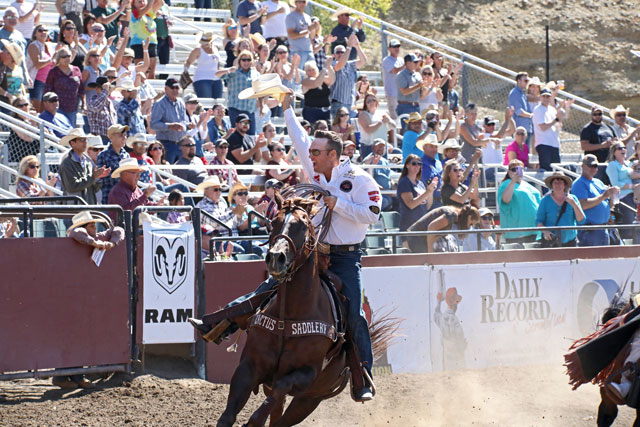
COLORADO SPRINGS, Colo. – It is known that the equine athletes in the sport of rodeo play a vital role in helping every competitor achieve his or her goals.
The PRCA and the American Quarter Horse Association honor the outstanding registered American Quarter Horse in each of the PRCA’s timed-event categories at the annual PRCA Awards Banquet in Las Vegas right before the start of the Wrangler National Finals Rodeo. This year’s banquet is Dec. 5 at the South Point in Las Vegas.
The owner of the PRCA/AQHA/WPRA “Horses of the Year” in each category will be awarded $5,000 and an AQHA bronze trophy. Second place will receive $3,000, and third place will receive $2,000.
The final ballot process will be open through Oct 5 at 5 PM MT for applicable voting PRCA members. Winners in each of the categories will be announced once votes are tallied and made official.
The following are the nominees in each of the timed events:
Heading
Tuffys Badger Chex (Badger), rider: Kolton Schmidt, owner: Ronald Schmidt
RK Tuff Trinket (Bob), rider: Riley Minor, owner: Riley Minor
Pepinic Buck (Festus), rider: Rhen Richard, owner: A & C Racing & Roping
Fantastic Fellow (Fella), rider: Ryan Opie, owner: Ryan Opie
Rodeo Readyman (Junior), rider: Joshua Torres, owner: Joshua Torres
Son O Lena Steel (Boogieman), rider: Erich Rogers, owner: Erich Rogers
Heeling
Dual Chip (Chip), rider: Travis Graves, owner: Travis Graves
CD Rockstar (Rocky), rider: Ryan Motes, owner: Ryan Motes
Mr JB 0839 (Remix), rider: Kory Koontz, owner: Kory Koontz
Nita Win Playboy (Drago), rider: Logan Medlin, owner: Logan Medlin
Prancing Kard(Ted), rider: Jake Smith, owner: Mark Smith
Bay Boy Boonsmal (Biggie), rider: Jonathan Torres, owner: Jonathan Torres
Sparks Peppy Doc (Smurf), rider: Clint Summers, owner: Darren Summers
Leos Highbrow (Sug), rider: Brady Minor, owner: Brady Minor
Apolo Oak (Apolo), rider: Cole Davison, owner: Cole Davison
Zans Colonel Shine (Colonel), rider: Jake Long, owner: Jake & Tasha Long
Lula Dual (Lula), rider: Joseph Harrison, owner: Bobby Lewis
Romancing The Chics (Dude), rider: Trey Yates, owner: Joyce Tisdall
Tie-Down Roping
Time In (Pepto), rider: Sterling Smith, owner: Cassidy Boggs
Little Smart Leo (Big Time), rider: Tyler Milligan, owner: Tyler Milligan
Simon Cow (Si), rider: Shane Hanchey, owner: Shane Hanchey
Arrogant Cutter (Snoopy), rider: Ryan Jarrett, owner: Ryan Jarrett
Tachitas Rey (Bull), rider: Blane Cox, owner: Carl & Lisa Cox
CC Cross Bell 314 (Edgar), rider: Reese Riemer, owner: Reese Riemer
Purples Prince (Grey Pony), rider: Matt Shiozawa, owner: Matt Shiozawa
Big Smokin Otoe (Topaz), rider: Tuf & Clif Cooper & Trevor Brazile, owner: Circle Star Land & Cattle
Lights On Cd (Patron), rider: Richard Rhen, owner: A & C Racing & Roping
Steer Roping
CPR Gun Smokin Peppy (Brown Bomber), rider: Bryce Davis, owner: Bryce Davis
Sixs Rowdy Man (Lawdog), rider, Jarrett Blessing, owner: Jarrett & Jessica Blessing
Cooperslittletoy (Cooper), rider: Chris Glover, owner: Chris Glover
Zans Roany Jae Bar (Ty Roan), rider: Shay Good, owner: Shay Good
At War Leo (Punchy), rider: Cody Lee, owner: Cody Lee
Spade Ronnie (Ronnie): rider: Jim Locke, owner: Jim Locke
Gunoleo (Rolex), rider: Tony Reina, owner: Tutt Garnett
Steer Wrestling
Espuela Bay Light( Ike), rider: Levi Rudd, owner: Jeff Green
Quick Lane (Rooster), riders: Bridger, Chambers, Scott Guenthner, Tanner Milan, owner: Bridger Chambers
Canted Plan (Scooter), riders: Tyler Pearson, Kyle Irwin, Tyler Waguespack, Justin Shaffer, owners: Tyler Pearson/Kyle Irwin
Smokie Poco King Bar (Django), riders: Johnny Asher, Blake Mindemann, owner: Johnny Asher
RGR Ryon (Maverick), riders: Tom Lewis, Several People, owner: Peggy Lewis
Famous Chuck (Chuck), riders: Kyle Whitaker, Nick Guy, Blake Knowles, owner: Kyle Whitaker
Famous Hot Chick (Holly), riders: Chason Floyd, Tanner Brunner, Others, owner: R2m2z
Zoomin Up Front (Zoom) , riders: Hunter Cure & Others, owners: Hunter & Bristi Cure
Barrel Racing
KN Fabs Gift Of Fame (JLo), rider: Ivy Conrado, owners: Kenny Nichols & James Barron
Rafter W Minnie Reba (Sister), rider: Nellie Miller, owner: Sam Williams
Famous French Bug (Sister), rider: Leia Pluemer, owner: Julie Pluemer
In Firewaters Honor (HZ), rider: Mckenzie Morgan, owner: Mckenzie Morgan
Bogie Is A Smash (Smash), rider: Taci Bettis, owner: Taci Bettis
Yeah Hes Firen (Duke), rider: Brittany Tonozzi, owner: Brittany Tonozzi
Cuatro Fame (Truck), rider: Stevi Hillman, owner: Melissa Mouton
DM Sissy Hayday (Sister), rider: Hailey Kinsel, owner: Dan & Leslie Kinsel
LK Sheza Hayday (Zeva), rider: Tammy Fisher, owner: Tammy Fisher
-
MMid-Plains saddle bronc rider receives NLD scholarship
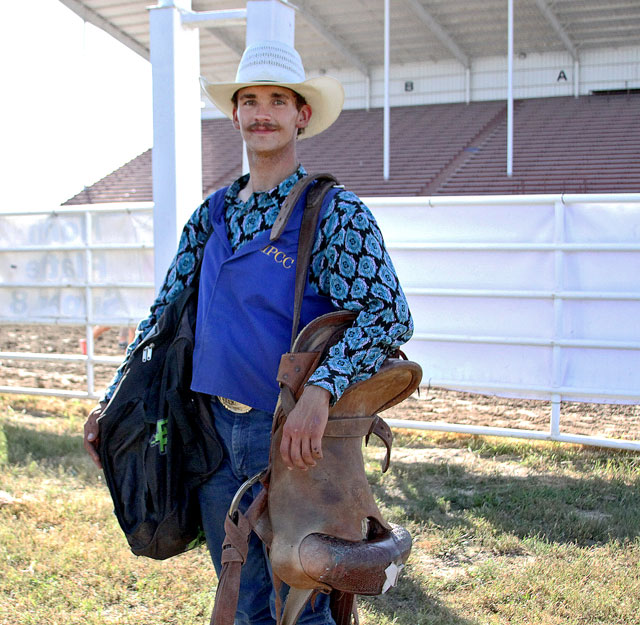
Mid-Plains Community College saddle bronc rider Wyatt Kunkee, of Lexington, is the recipient of a $750 NEBRASKAland DAYS Buffalo Bill Rodeo Scholarship. Kunkee was presented with the award during the MPCC Stampede on Saturday at the Wild West Arena.
Money for the scholarship came from a combination of entry fees from NLD’s Cowboy Kickball Competition in June and NLD funds.
MPCC Rodeo Team coaches Dustin Elliott and Garrett Nokes selected Kunkee for the scholarship based on his performance in the arena and classroom, leadership skills, volunteerism and promotion of the team.
-
Competitive Drive
Minot man satisfies desire for competition with team roping; will rope at Y’s Men’s Rodeo
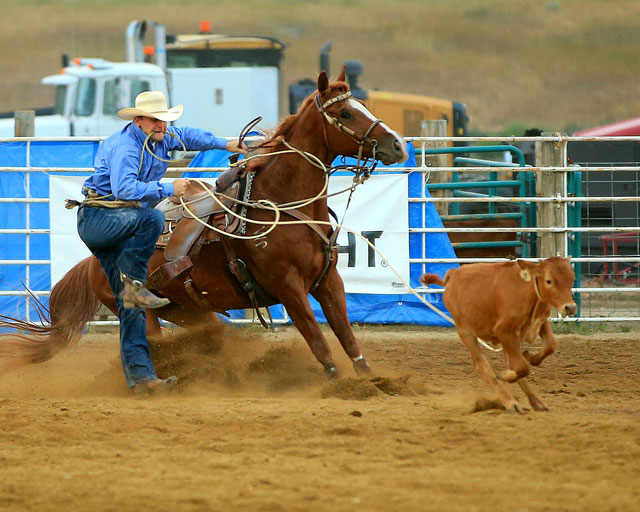
Minot, N.D. (September 17, 2018) – Blake Eggl is competitive.
In high school and college, football fed his competitive drive.
When he graduated from Minot State University in 2012 and school sports were over, rodeo filled the void.
And for the first time, the Minot native will compete at the pro rodeo in his hometown.
Eggl is one of twelve tie-down ropers to qualify for the upcoming Y’s Men’s Rodeo, hosting the Badlands Circuit Finals Rodeo.
To compete at the Badlands Circuit Finals, a cowboy has to be one of the top twelve in his or her event, after the Pro Rodeo Cowboys Association season of rodeos in North Dakota and South Dakota is complete.
Eggl began rodeo as soon as he was able to ride a horse, by the age of seven or eight. He traveled with his dad, Kelly Eggl, also a tie-down roper, and the duo went to rodeos sanctioned by the Rough Riders; those rodeos had events for both adults and kids.
But rodeo was on the back burner during high school and college. “Growing up, I loved football, and still do,” he said. A college scholarship to play football was a priority.
He played for Minot State as a running back and on special teams as an underclassman. His senior year, Eggl was a starter.
After college graduation in 2012, Eggl was back to the rodeo arena. He continued competition in the Rough Riders, traveling with his dad again, and also at PRCA rodeos. His dad had roped at the Y’s Men’s Rodeo, before it hosted the Badlands Circuit Finals, and Blake remembered sitting in the stands, watching. He wanted to rope at the Y’s Men’s Rodeo, but it required being in the top twelve in the circuit.
And each year, there was an obstacle. Two knee surgeries and a back surgery, all from football injuries, limited his rodeo.
This year, he was ready. “This is the healthiest I’ve been since I was 22,” he said. Eggl roped at 35 pro rodeos and another 30-plus amateur rodeos this year.
Juggling work and rodeo has been a challenge. Working for an agricultural company, he’s free to compete on the weekends. Sometimes he would get home on Monday morning in the wee hours and be ready for work by 8 am.
He figures he’s rarely missed a year of the Y’s Men’s Rodeo. Even during college, he’d attend on the Thursday night; football practice and a game took precedence on the weekend.
And this time, Eggl will be at the rodeo, but not in the stands. He’ll be roping. “I’ve always wanted to make the circuit finals, but when it’s in your hometown, man, I really want to make it,” he said. “I’m super excited.”
Eggl, along with the other competitors, will compete four times: Friday, Oct. 5 at 7 pm, Sat., Oct. 6 at 1 pm and 7 pm, and Sun. Oct. 7 at 1:30 pm. The year-end champion and average champion (the contestant with the fastest times or highest scores after four runs) will be determined on Sunday, and qualify for the RAM National Circuit Finals Rodeo in Florida next April.
Eggl is married to Ashley, also a Minot native.
The 64th annual Minot Y’s Men’s Rodeo is October 5-7 at All Seasons Arena at the North Dakota State Fair Center. Note that there is no Thursday night show this year; it has been moved to a Saturday matinee. Tickets range in price from $13 to $33 and can be purchased online at www.MinotYsMensRodeo.com. For more information, visit the website or call 701.833.1761.
-
Bloomer Turns 20
Our Journey to 20 Years
Statistics show that 96% of businesses fail within 10 years, but one brand has stood solid for 20 years under one man’s leadership. A staple in the aluminum horse trailer industry, Bloomer Trailers, has made a name for themselves as a reputable company that produces “only the best” products for 20 years.
In 1998, Randy Bloomer, changed the horse trailer industry for the better. As someone who was involved in the Western industry and had experience with horse trailer sales, Bloomer knew that the livestock safety was a huge component of a trailer and he set out to modernize and revolutionize the industry. Now, 20 years later, the Bloomer Trailers brand is not only used by World Champions in every Western discipline, but it is also being used by top Billboard musicians, race car drivers and more.
This year, Bloomer Trailer Manufacturing is celebrating the memories of their 20 years in the industry. To appreciate their success, we must look back at where it all started. Randy and Kim Bloomer started Bloomer Trailers in 1998 in the middle of chemical alley on the LaMarque/Texas City line. From the start, Bloomer Trailers hired the best people in the industry to help build the brand, some of those key players are still with them today. “We have never stopped challenging ourselves to find a better or safer way to protect our customers and their livestock,” said Randy Bloomer, when speaking about why Bloomer Trailers is different than other brands on the market. Their innovations led to the newest model of the Bloomer Trailer, “The Evolution,” to remind them that they have yet to build the perfect trailer, so they had to keep moving forward and trying new ideas.
In 2002, Bloomer Trailers moved forward in a big way. They started building a state of the art production facility in Central Texas to serve as a convenient location for dealers, customers and their vendors. Upon completion in 2003, Bloomer Trailers moved over forty employees and their families to Salado, TX to help continue the craftsmanship that was expected by their loyal customers. Now, 15 years after moving to Central Texas, the company continues to live by their motto of, “only the best.” Today, Bloomer Trailers has over 80 full-time employees that are proud of the brand they build. Although the brand has grown tremendously, it still practices the principles it was built on. You will still see Randy Bloomer working at shows and visiting with customers and still to this day, he makes a point to be involved daily in the industry.
Bloomer Trailers have the best dealer network in the horse trailer industry, many of the dealers and salesman have been a part of the Bloomer Team for over 15 years and share their sense of pride in selling the best trailer brand on the market. Bloomer Dealers continue to provide an extraordinary experience when purchasing a Bloomer Trailer and their priority has been to provide superior product quality and total customer satisfaction.
Twelve years ago, Bloomer Trailers decided to get more involved in the youth aspect of the rodeo industry. Since 2007, Bloomer Trailers has had a Bloomer Trailers High School Rodeo Team with 33 youth athletes, these athletes are not only Bloomer customers, but they are the best athletes in and out of the arena. Teaching these young athletes how to interview, take pictures, acquire sponsorships and more has been Bloomer Trailers way of giving back. Some of the youth athletes have went on win World Championships, become doctors or have their own families, most of which still own a Bloomer Trailer. It has been rewarding to see former team members remain loyal to the brand long after they rodeo. Several traditions in their Bloomer Trailer are being passed down to the next generation and that is a true testament to the Bloomer brand.
Bloomer Trailers have been used in an array of settings, from little league games, glamping, hunting, beach vacations and more, Bloomer Trailers have truly become a part of their customer’s family traditions. Your trailer is supposed to adapt to your lifestyle, which is why we strive to make a product that can not only handle the miles, but also handle the adventure ahead of you.
In addition to many uses of a Bloomer Trailer, they still are heavily involved in the sport that helped them get to where they are today. The Bloomer Trailers company is involved in a large majority of equine sports, they are the official trailer of the Wrangler National Finals, Rodeo, World Series of Team Roping, The American Rodeo, National Reined Cowhorse Association, Pendleton Roundup, Texas High School Rodeo Association and The Bob Feist Invitational.
As a part of their 20-year anniversary, Bloomer Trailers, has decided to celebrate the memories that have been made in a Bloomer Trailer. Customers have sent in pictures of their trailers from every decade to show that their Bloomer can handle the miles. Although the brand is growing older, the passion is stronger than ever. As for the future, they expect “only the best.”
For more information about Bloomer Trailers please visit www.bloomertrailers.com.
Media Contact: Alexis Bloomer, Breaking Records Media (254)308-2218 alexis@breakingrecordsmedia.com
-
Rodeo Family Reunion
South Dakota, Minnesota families gather in Minot to watch competition, enjoy family
Minot, N.D. (September 24, 2018) – When the Minot Y’s Men’s Rodeo kicks off next weekend, there will be a mini-family reunion taking place.
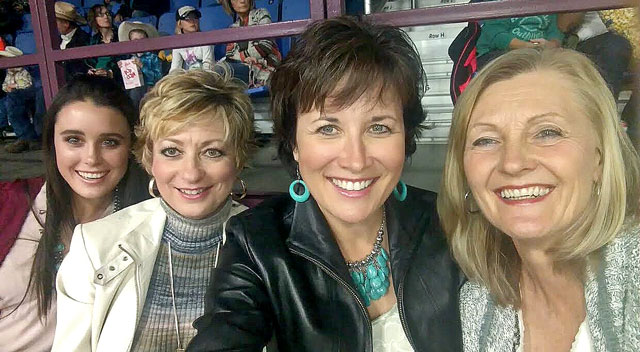
Dane Kissack, a tie-down roper from Spearfish, S.D., his family, and his wife’s family have congregated in Minot the last several years to enjoy each other’s company and the rodeo.
Kissack, his wife Kelli, his parents, Phil and Terri Kissack, his maternal grandmother, Marlene Griffith, Kelli’s mom, Kim Bones, her maternal grandmother, Kari Kannenberg and her aunt LuAnn Grossman, plus a few friends, will be on hand to watch him compete. (Kelli’s dad John will be helping harvest on the family farm in South Dakota.)
The combined families use their time in Minot to hang out, visit, and watch the rodeo.
It’s one of the few times of the year that Dane is at one rodeo for more than a few hours. Usually cowboys get to a rodeo, make their run or ride, then leave when it’s over, headed to the next one. But in Minot, because it’s the Badlands Circuit Finals Rodeo, the top twelve in each event compete in four performances October 5-6-7. That means that Dane is in one place for multiple days, and the families can get together.
Kelli’s family comes from the Minneapolis area, and although Minot isn’t geographically centrally located between Spearfish and Minneapolis, the family can gather and spend several days together as Dane ropes.
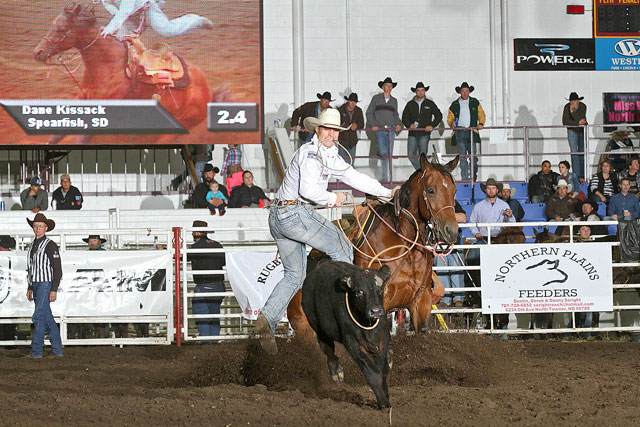
Spearfish, South Dakota’s Dane Kissack competes at the 2016 Minot Y’s Men’s Rodeo. His parents and grandmother, along with his wife Kelli’s mom, grandmother and aunt, along with friends, get together during the Y’s Men’s Rodeo for a mini family reunion. – Peggy Gander, Cowboy Images. They stay in several hotel suites, buy groceries in Minot, and enjoy burgers, steaks and plenty of good food at lunch and after the rodeo each night. It’s a great way to enjoy each other, relax, and enjoy the slower pace of the rodeo.
Minot is also a good time for the women of the bunch to shop. They visit the mall, the special unique shops, and the trade show at the rodeo, then have fun dressing up for the rodeo each day. “It’s a fun time to get dressed up,” said Terri Kissack, Dane’s mom. “We’ll go shopping, we share what everybody got that is new. We have a blast doing that.”
Terri loves coming to the Y’s Men’s Rodeo. Because it’s the best cowboys and cowgirls in the Badlands Circuit, the contestants get special treatment. The rodeo is “a big deal to Minot,” she said. Even as a mother of one of the contestants, “you feel special. We are treated very, very well. Minot is a great place.”
Dane, along with the other contestants at the Y’s Men’s Rodeo, hosted by the Badlands Circuit Finals Rodeo, will compete October 5-7. Performances are at 7 pm on Fri., Oct. 5; 1 pm and 7 pm, on Sat., Oct. 6, and 1:30 pm on Sun., Oct. 7.
Tickets are discounted for the Family Day performance at 1 pm on Sat., Oct. 6, and for the military appreciation performance at 1:30 pm on Sun., Oct. 7. Tickets range in price from $13 to $33 and can be purchased online at www.MinotYsMensRodeo.com. For more information, visit the website or call 701.833.1761.
-

Helping Hand
Abilene rodeo helps Dickinson Co. cancer fund raise monies for people undergoing cancer treatment
Abilene, Kan. (September 17, 2018) – The Wild Bill Hickok Rodeo in Abilene, Kansas is helping to make the world a little bit better place.
During its annual Tough Enough to Wear Pink campaign on Friday, August 3, voluntary donations were picked up in the amount of $2,678.93, to benefit Dickinson County people undergoing cancer treatment.
The monies go to the Elsie Brooks Memorial Cancer Fund of Dickinson County, which provides financial help to Dickinson County residents with cancer.
Since the Elsie Brooks fund began twenty years ago, it has given out over $750,000 to those in need.
The money is useful for traveling expenses, with cancer patients often having to travel to Salina or Manhattan for treatment, said Chris Ostermann, president of the fund. “When you live in Abilene and have to travel to get treatment, it can be (financially) devastating. And if you’re on a fixed income, it’s scary.”
The donations are a “game changer,” Ostermann said. Helping with people’s “personal battles with cancer makes it easier for them.”
The fund’s partnership with the rodeo has been helpful, Ostermann said. “We’re very thankful for the rodeo. It brings recognition for us to the community, that we’re able to help.”
Voluntary donations were picked up at the Abilene rodeo; the Abilene rodeo has partnered with the Elsie Brooks Fund since 2008 and since then, has helped raise $34,480.
For more information on the Elsie Brooks Cancer Fund, contact Chris Ostermann at 785.479.3749. For more information on the Wild Bill Hickok Rodeo, visit the rodeo’s website at WildBillHickokRodeo.com or call the Central Kansas Free Fair office at 785.263.4570.
-
Roper Review: Brook Styron
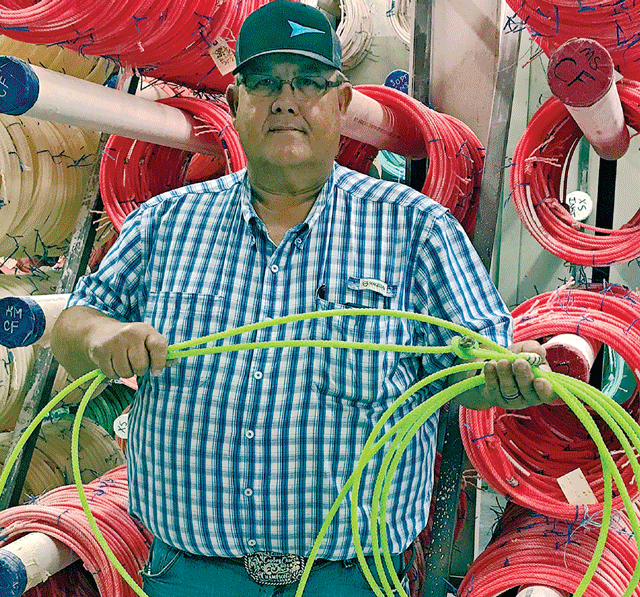
Brook Styron, a Texas native, has seen a lot of changes in the roping industry over the years. He grew up in Granbury, Texas and was introduced to calf roping at twelve years old by a neighbor. That was before team roping had caught on, and Brook continued to rope calves in junior rodeo, high school rodeo and college rodeo.
Now, in his mid-50’s, Brook has worked in the roping manufacturing industry since the early 90’s. As a young newlywed, Brook spent a number of years managing ranches in north and east Texas. He and his wife, Nancy, have raised three kids: Brandi, Sarah, and Bryce.
Styron’s resume includes jobs as a deputy sheriff and telephone installer before settling in the rope manufacturing industry in the early 90’s. He worked at Maverick Ropes and Precision Ropes before settling in at Fast Back Ropes.
Brook has been with Fast Back for twelve years and works in Operation Production where he’s responsible for purchasing string and other raw materials needed to produce ropes, in addition to other duties. He has seen a lot of changes in the rope making industry over the years.
“Back when I first started, we tied a lot of 7/16” ropes which by today’s standards are extremely large. Also most rope companies carried just one or two ropes,” explains Styron. “Now there are numerous rope companies and they all sell a quite a variety.”
Brook loves to rope and used to rope on a daily basis. Now he ropes several times a week and competes most weekends. He’s endured surgery on his right shoulder three times to repair damage from years of repetitive motion, primarily from roping. His last surgery, in March 2017, entailed a complete replacement.
“I postponed each surgery as long as I could,” explains Brook. “By the time I had surgery I could barely rope and each time I came back and was competitive. This shoulder replacement, has made the biggest difference and I feel like I rope better now than I have in ten years.”
Styron has also seen team roping evolve drastically over the years he’s been competing.
“Besides the ropes and cattle getting smaller, the times have gotten incredibly faster. Back when I started, it was before the days of video and there weren’t many schools. Today kids have access to a variety of schools and training videos they can watch on their phone. They learn much more quickly and it definitely shows at the jackpots.”
When not roping or working, Brook and Nancy, enjoy spending time with their grandkids: Ruger, Sadie, and Klara.COWBOY Q&A
How much do you practice?
Twice a week.
Do you make your own horses?
I used to, but as I’ve gotten older, I would rather not spend my time training. Now I just want to rope.
Who have been your roping heroes?
Clay O’Brien Cooper.
Who do you respect most in the world?
My dad.
Who has been the biggest influence in your life?
My wife.
If you had a day off what would you like to do?
Go hunting, fishing, or roping.
Favorite movie?
Remember the Titans
How would you describe yourself in three words?
Confident, generous, out-going.
What makes you happy?
Family and friends.
What makes you angry?
Disrespect.
If you were given 1 million dollars, how would you spend it?
Retire and enjoy life.
What is your worst quality, your best?
My worst is probably my temper. Loyalty is my best quality. -
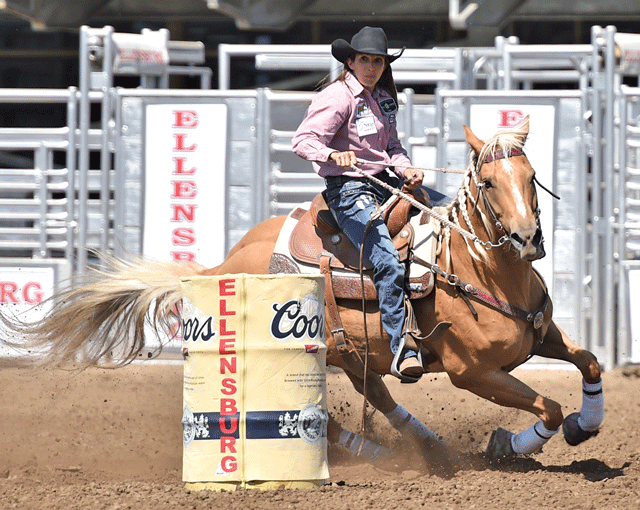
Jessica Routier
Jessica Routier’s goal at the beginning of the season was to finish in the top 30 of the WPRA world standings to set herself and her 7-year-old mare up for a bigger season next year. But when the barrel racer from Buffalo, South Dakota, and her horse, Fiery Miss West “Missy,” won the Badlands Circuit in the barrel racing in 2017, it set them up for numerous opportunities this year. “With the circuit finals money counting and the RNCFR counting, that gave us an opportunity for Calgary, and that money counted, and it all worked out,” says Jessica, who’s currently sitting eighth with $93,843. “I decided I might as well keep going fairly hard, and she’s run great. It’s been a learning year, and I haven’t been out of the circuit a lot before this. But for the most part, everything has gone really well and it’s been an amazing year.”
Jessica, who is also a wife and mother of five, grew up riding cutting horses, along with roping, barrel racing, pole bending, and goat tying in the NLBRA. “I rode a lot of different horses when I was younger, and they were all nice. My mom trained them,” says Jessica. “I was 16 when I found that first special one I really clicked with, and that’s where my favorite event turned from goat tying to barrel racing.” Jessica went on to college rodeo on the National American University team, and has futuritied numerous horses. “I think cutting really shaped the way that I ride barrel horses. I really ride with my seat and my feet, and I ride a bigger saddle,” she explains. “I like my feet out in front of me, and I tend to get along better with smaller horses.”
Finding the right fit of saddle and pad goes along with finding the right horse, and Jessica recently joined the 5 Star Equine team. “I’ve used their pads for a long time. I was always taught to look for no seams or anything that’s going to cause different places of pressure on a horse’s back. You can get a one-inch pad and use it forever and still have a one-inch pad, there are no indentations from the saddle. I love that they’ve been so good to work with on the different options you can have.” Jessica also started using 5 Star’s sport boots this year over the traditional polo wraps she normally uses. “I like that it’s something that’s going to conform to every leg as best as it can. It’s probably impossible to find a boot or wrap that’s going to support a 1,200-pound animal in all cases, but it’s the most protection you can get with the least amount of interference where the legs are going.”
When she’s not on the road, Jessica is home helping her husband, Riley, on their ranch, and she rides horses for Gary Westergren, who owns Missy. “Gary raises a lot of horses and his stud and mares stand in Hot Springs, South Dakota. When his horses come of riding age, they come to my house and we decide what path to take with them. We typically send them to someone to put the first 30–60 days on them and then either my husband or I will work them on the ranch. I’ll start them on barrels lightly if they’re broke enough, but our main focus is being out and experiencing that world until they’re a little older.”
Two horses that stand out in Jessica’s career are Especials Smoothie, who turned Jessica on to barrels when she was 16, and now Missy. “My mom started Smoothie, and then I high school rodeoed on her and won the CNFR on her. I ran her for about 17 years, and now my 10-year-old daughter runs her. She’s 23 now and she’s been an amazing horse. She and Missy are both very similar—they have very big hearts, and they can stand up on any ground and try 110 percent every single time.”
When Jessica is traveling, her mother and several close friends put rides on the younger horses. She does the majority of her riding in the fall and hopes to ride through the winter this year. “Our family and our ranch and horses are what keeps us busy. Our oldest, Braden, is 12 and he loves to ranch and rope and do school sports. Our oldest girl, Payton, is 10 and she’s been trick riding since she was 4, and she also barrel races.” Jessica and Riley’s three youngest daughters, 3-year-old twins Rayna and Rose, and 2-year-old Charlie, love traveling to rodeos as well.
“I just love how honest and loyal the horses are, and I love all the people that you meet. It’s such a kid-oriented thing too that gives your kids goals and good people to look up to,” says Jessica. “It’s an intense competition but everyone is there for each other too. My ultimate goal for the year is to make the NFR, and I would also like to get back to Kissimmee for the RNCFR.” -
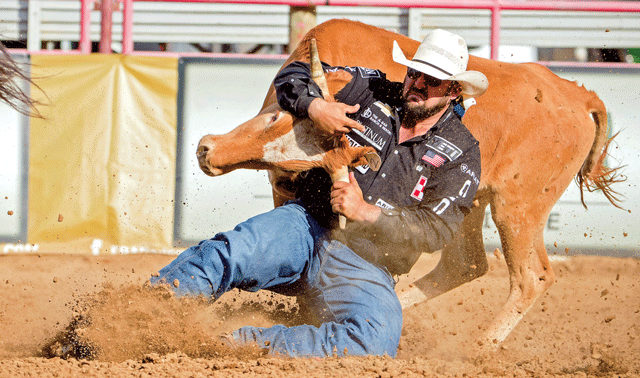
ProFile: Luke Branquinho
Five-time World Champion Steer Wrestler Luke Branquinho won’t be shaking his booty under the bright lights of Las Vegas this December. He’s spent way too much time on the injured reserve list lately for that. But after a couple of comebacks in consecutive years, the living legend is looking forward to the $500,000 WCRA Semi-Finals, which will light up the Lazy E Arena in Guthrie, Oklahoma, during its November 15-18 run.
Branquinho will be there via the World Champions Rodeo Alliance (WCRA) Virtual Rodeo Qualifier (VRQ) system, thanks to a series of recent rodeo nominations. Since his first event back after the latest injury—his hometown Santa Barbara Old Spanish Days rodeo in August, where he finished fifth—Branquinho has been busy nominating circuit rodeos in his quest to qualify for the WCRA Semi-Finals.
As of press time the middle of September, Branquinho had placed at four of those rodeos, and was sitting fifth in the VRQ steer wrestling standings. The cutoff date for cowboys to nominate events for the Semi-Finals—for which the top 150 qualify—is October 29 (nominate now at app.wcrarodeo.com). He was vying to hold onto his spot in the VRQ standings, as the top-eight point-earners bypass the preliminary and progressive rounds, and advance directly into the top-eight finals at the Semi-Finals.
Branquinho has largely planned his nominations strategy around cowboy-friendly conditions.
“I’m nominating rodeos where the cattle are most likely to be even—not where there are three good ones, and eight you can’t win on,” said the Los Alamos, California, cowboy, who won the world in 2004, ’08, ’11-12, and ’14. “If it’s a rodeo where you’re likely to draw a steer that stops with the neck rope or runs so hard you couldn’t catch him with a rope, I’m less likely to nominate a rodeo like that, because too much is out of the cowboy’s control. The older I get, the less likely I am to enter rodeos that are notorious drawing contests.”
The WCRA is going to great lengths to keep competitive conditions fair for all contestants.
“I like a lot of things about the WCRA,” Branquinho said. “As professional cowboys, there just aren’t that many big-money opportunities. With the Virtual Rodeo Qualifier System, everybody has a chance to qualify to get there, and it’ll be a cowboy contest when we get there. I’ve heard people question the VRQ system, but to earn another chance at making good money from a rodeo I’m already going to is a no brainer. You already made the decision to enter that rodeo, why not pay a little extra to have a shot at a lot more money?”
Branquinho turned 38 in September. So what’s left on his bulldogging bucket list?
“I want to win as much money as I can before I retire, and the WCRA will help give a guy that opportunity,” he said. “Obviously, winning another gold buckle to get to six (and tie Hall of Famer Homer Pettigrew’s record) would be a big deal. My older boys (Cade and Jameson) got to see me win one. I’d like (Luke and wife Lindsay’s baby) Bear to get to watch me win one, as well.”
In addition to the Days of ’47 in Salt Lake City, the WCRA will host three “majors” in 2019, for a total of four events featuring a $1 million guaranteed payoff in the coming calendar year.
“I’m excited about all of this,” said Branquinho, whose trademark booty shake after a winning run is always a crowd favorite. “A shot at short-term financial gain is great, but in the bigger picture, we’re talking about the chance at money that helps set a cowboy up for the rest of his life. I want to be a part of it. With the PBR (Professional Bull Riders) as a partner, the WCRA will bring a lot more mainstream exposure to our sport, and that has all kinds of additional benefits and potential for cowboys.
“More money and less travel is something we’ve all wanted for a long time. I look forward to the day when professional rodeo cowboys don’t have to travel like carnies to try and earn a living. Someday, cowboys won’t have to miss their families all the time to make ends meet, and I hope that day comes sooner than later. The WCRA is providing cowboys with some real-deal opportunities. Everybody has a chance to qualify to get there, and the cream will rise to the top. I just hope that in this day and age, I’m not low-fat milk.” -
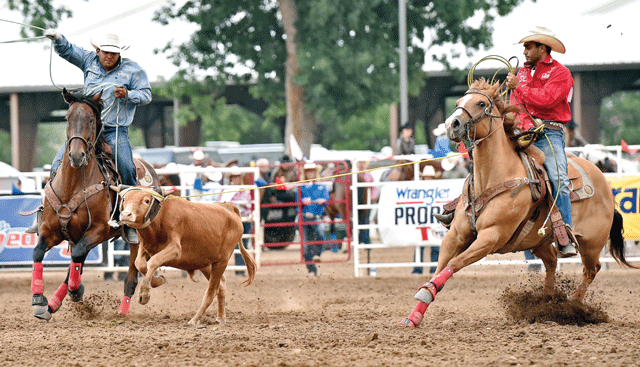
Josh and Jonathan Torres
[ Josh & Jonathan Torres both sit at 17th in the PRCA Standings and share the common goal of qualifying for the WNFR this year. ]
Josh and Jonathan Torres, lately of Stephenville, Texas, share the bond of brothers, team roping partners, and business partners, along with their common goal of qualifying for the WNFR this year. Josh, 29, is the header, and Jonathan, 26, is the heeler, both sitting 17th in the PRCA standings. The brothers spent their early years near Miami, Florida, following after their dad, who rode horses and kept a small herd of cattle. They high school rodeoed for Florida and later moved to Lake Charles, Louisiana, to attend McNeese State University. Despite their three-year age gap, they were able to rope together for two years and qualified for the CNFR in 2012 and 2013, where they won several rounds.
“I just like roping, period. But I like that you have to have somebody that also has the same plan and goal as you,” says Jonathan. “You pretty much have to be a team player for everything, and you both meet other people who help you out. Then you have two people with ideas and strategies, not just one.” Josh feels the same about teamwork, both with his brother and his horses. “It takes such special horses, and when a team is working on getting those horses together, you realize how many you have to go through to get a couple of good ones. I think trying to get on a lot of good horses or make them or find them is the best part about team roping. If I didn’t have a fun head horse to ride, I wouldn’t be doing it. I like to show them off and have fun doing it—that’s what keeps a guy motivated to do what we do.”
Josh’s main rope horse, Junior, is an 8-year-old gelding he purchased from his friend Willie Brooks in Baton Rouge, Louisiana, who asked Josh to season Junior. “He’s extremely smart. I asked my friend if he wanted to sell Junior just because he was so athletic. He’s kind of hard to ride—his feet move so fast, so your mind has to move just as fast. He’s been fun, and I wouldn’t be entering any rodeos if I didn’t have that horse.” Jonathan has ridden his 12-year-old gelding, Biggie, for the last two years, whom he purchased from Brock Hansen. “He’d been rodeoed on before by Cesar de la Cruz, and Brock had him and didn’t need a heel horse. He wants to win, and he’s a powerful, big horse. Biggie is out of a Playboy Boonsmal stud horse, and he’s kind of gritty and cocky.” Jonathan and Josh also took two other younger horses on the road with them this year as backup horses that they’re seasoning.
Whether on the road or at home, they’ve fed their horses Nutrena’s SafeChoice Original for the last five years. “You have to take care of your horse, because that’s what makes your money, whether it’s worming, hay, feed, or clean water—all those things make a difference,” says Josh, who has a degree in animal science. He and Jonathan have even conducted several feed experiments with their horses, and found they had the calmest energy on Nutrena. “It keeps our horses energized, and we might feed three or four times a day. I had a horse that wouldn’t eat very well on the road, but he went to eating that Nutrena and we’ve had really good luck with it on the road. Nutrena is sold all over, so it’s pretty easy to find. We like to have a good-looking herd.”
Along with keeping several young horses at home to work on when they’re not traveling, Jonathan and Josh run Young Guns Productions, LLC, a timed event stock contracting business. “We have Corriente cattle and we lease cattle to cutters. When they get big enough to break in, we use them for jackpots and then lease them to people for practice or ropings,” says Jonathan. “When we’re gone, a couple of our buddies like Cory Clark and Dillon Wingeried help out, or we’ve hired contract help. It’s a team effort!”
Of the many rodeos on their 2018 run, a favorite of Jonathan’s is the Salinas Rodeo, while Josh enjoys San Antonio. “I like Salinas because we’re there for a few days, and they have fresh steers that have never been roped—it’s kind of ranchy and fun,” says Jonathan. Josh adds, “The hospitality is great over at San Antonio, and it’s the loudest rodeo that I’ve ever been to. Your adrenaline is going and it’s a pretty fun and exciting rodeo.” Their goal is to experience the energy and excitement of the WNFR next. “It’s the best chance we’ve ever had this year. I definitely want to thank our parents, Jose and Teresa Torres, and my wife, She’Rae Torres, for helping all of us,” Josh finishes. “And I’m thankful for the relationship we’ve had with Nutrena. Rodeo is a hard deal, and it takes a lot of effort from so many people. The Lord has put certain people in our lives and got us through so many situations good and bad. Because the Lord is so good to us we keep our heads up and remind ourselves to take advantage of every situation as best as possible. We believe in His plan. We just try to do our jobs, believe, and work!” -
Effective Preparation is More Than Practice
Last weekend I was inducted into During my acceptance speech at the Pro Rodeo Hall of Fame I told the story of when Rich and I first started roping together. We went on to win eight world titles together but we weren’t exactly on the same page in the beginning.
On my first day in the practice pen with Rich, we roped his 650-700 lb. steers which he had been roping for a couple of years. I told him these steers were no challenge at all and we’re trying to get ready for the NFR. In my mind I’ve always tried to make it harder at home while preparing.
That’s one reason I like the Hot Heels Supreme. It has a “Jen-Stick” and the legs hit the ground, making it almost impossible to catch at the wrong time. A lot of people come to my house and say they can rope their machines fine at home, but can’t rope mine. I think you should make it as difficult as possible at home. A lot of people want to make it easy in the practice pen. You have to realize you’re trying to train your mind and prepare yourself for competition. So the more you fail at home and learn to overcome obstacles, the better chance you have for success when you leave home. That’s the name of the game.
I told Rich I wanted to buy 20 fresh 350 lb. calves and rope them in our arena set up to NFR arena specifications. You have to realize on our first day of practice we ran probably 30 of Rich’s steers and had 30 clean runs. On the first set of our 20 new calves we ran, we had two clean runs. Needless to say, my partner was not very happy. He was not used to missing and didn’t miss many. But he was willing to try something new. In doing so, after about the 3rd or 4th time we ran them through, we started making some pretty nice runs.
In the practice pen, depending your ability level, it does no good to practice all the time when you know what the steer is going to do. Because when you’re away you won’t know what the steer is going to do. Your practice should not become automatic and easy, keep it challenging and make it worth something. Especially for kids, like maybe who is going to saddle or some other chores.
Put something on the line in the practice pen so that it makes you a little nervous to miss. Make it matter. You want to generate nerves in the practice pen so when you leave home, you won’t get as nervous. The more you can generate nerves in the practice pen, the easier it is deal with it when something is actually on the line.
As I’m doing this article we’re actually doing drills right now for the Junior Rodeo next weekend. My daughter is practicing her ribbon roping. We made a deal that if she did her drills correctly ten times in a row, then she would not have to do a chore that she really does not enjoy. Consequently, her loops were outstanding.
Simulating pressure in the practice pen is probably the most important thing you can do to be able to catch. It’s hard to become successful if you fail under pressure. Then you will start fighting your head the next time you’re in that situation.
I’ve been teaching a lot and most of the next couple of months are booked. Gabe has been helping me and making quite a hand, both at home and away. People ask me all the time if I miss rodeo. Sure you miss the NFR and the excitement and opportunity. But being able to teach and help people and have my kids involved is a dream come true for me.
We entered our nephew, Caden, in the chute dogging for next weekend. They didn’t have many entries and he may only have to throw one down to qualify for state. He wasn’t sure what to do and I needed to show him how it was done. After cracking a few ribs a couple of months ago, I was reluctant to try it. My wife and son had never seen me throw on down. Gabe was a little surprised and maybe a little impressed. We post the kids’ rodeo runs and some practice runs on speedroping.com.