Bubba Paschal was raised in LaPorte, Texas – Southeast of Houston. “My family was involved in rodeo – they always enjoyed horses and my dad (Chuck) rodeoed in high school and bulldogged when I was growing up. He taught us how to bulldog and hazed for me and my brother for the first several years we prorodeoed. My Mom (Cecile) ran barrels and supported us through everything. Shane, my brother, bulldogged and team ropes. We travelled together a lot starting off, he won San Antonio one year but never really went hard enough to make the finals.”
Bubba started off calf roping, adding steer wrestling when he got into high school. “I played around team roping and never did it a lot until recently. I won the PRCA Rookie of the Year in the bulldogging and the All Around in 1995 and made the Finals in calf roping in 1998.” He realized that in order to rope and be competitive, he had to travel and keep up with his horses. “I made the Finals after I started the business (P & P Trailer Sales), but it wasn’t in my heart to stay out there and pound the pavement.” He went just enough to make Houston and go to the big rodeos. “2010 was the last year I roped calves and just went to some local jackpots. Since then I have changed my focus to team roping. They have become the place of old calf roper reunions.”
“I’ve always been somewhat of an entrepreneur. I was always looking how to make and save money. I always knew I wanted to be in business for myself. I started with a load of utility trailers and I was pulling a trailer when I won Rookie, trying to promote and sell them for a new dealer in the Houston area. I was still finishing up college. I refinanced my truck to get the money to buy the first load of trailers. We had a hay pasture with a portable building, and we set that up and I still rodeoed to pay the bills.”
From that hay pasture 18 years ago, P & P Trailer Sales now has five locations in Texas and Oklahoma to serve the needs of their customers. The latest one is in Hockley Texas, northwest of Houston “Every dealership we’ve added has been because of a person, not a place. If the right opportunity comes up, we’ll take advantage of it.” He believes the key to any business is good people. “I’m fortunate to have really good people at every location that are willing to show up and work hard and believe in what we’re selling. When they become part of something they enjoy, they stay. I’ve got several employees that have been with me more than 15 years.” The masthead of his business model is to treat people the way you want to be treated. “That’s how we treat anybody that comes to any of our stores. That’s the mindset that I portray to all our people. You encounter difficult people and all you can do is what you feel is the right thing.” He considers all of his locations and employees as one big family. “Both my grandfathers had tremendous work ethic, and believed to do things right the first time and always do the right thing. I hope I can carry this with me in everything I do.”
“I only get to practice a couple times a week right now, but that’s going to change when my arena is done.” He and his wife Sherry have two children, Cane (7) and Cade (14). Cade is involved in football, baseball, golf and other activities in school. Cane is into soccer and baseball. “I didn’t rodeo until I was in high school so there is no pressure for them to rodeo. Once I get my arena, they will be involved more, but I’ve let them do what they want to do.”
His plans for the future are to keep doing family things, work, and rope. “I’m going to keep looking for opportunities and take them as they come.”
Blog
-
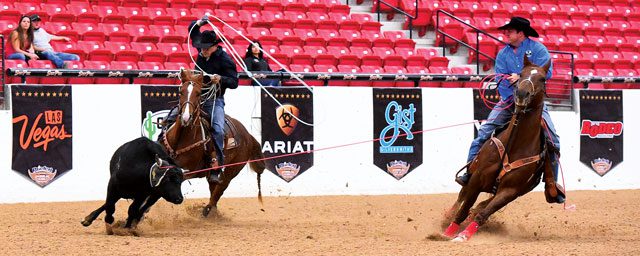
ProFile: Bubba Paschal, P&P Trailer Sales
-
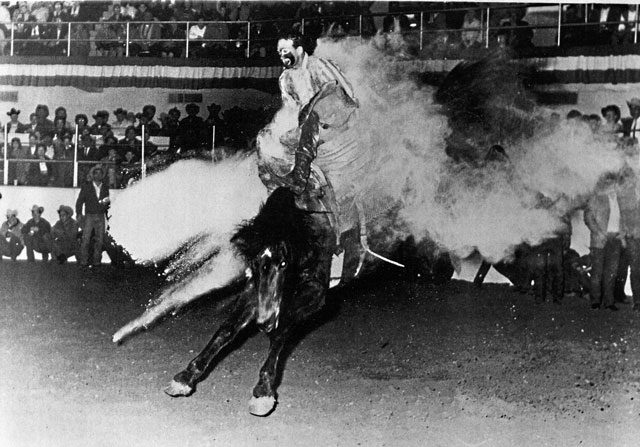
Back When They Bucked with Charley Lyons
Charley Lyons had one of the most unique acts in rodeo, one that has rarely been duplicated.
The Montana man built his reputation as a rodeo clown with his washtub saddle bronc act. With a #3 washtub bolted to a saddle tree and filled with flour, Charley would put it on a bucking horse. He’d sit in it, with legs over the bronc’s neck, and explode from the chute. Crowds loved it and it catapulted Charley onto the nation-wide rodeo scene.
He was born in 1938, the son of Ed and Vera Lyons, in Milliken, Colorado, just outside of Arvada. The city kid grew up with 4-H livestock: pigs, cattle, and horses, and somewhere in his youth, he decided he wanted to be a clown. His first rodeo was an FFA rodeo in Greeley, when he was a senior in high school.
After high school graduation in 1957, he went straight to the rodeo industry. The first few years were slim, but as committee members and stock contractors heard about his acts, he was hired for more and more rodeos.
In addition to riding a saddle bronc in a washtub, Charley had other acts. He had a pure white trick horse named Soapy who would crawl on his knees like an Indian scout, play dead, and sit like a dog. He had a half-Brahma steer named Roberto, who had foot-long horns. Roberto was broke to ride, and Charley rode him in parades and grand entries. He’d also ride Roberto in the barrel racing, dressed in a dress and wig and calling himself Charlotte. He also had a palomino Shetland pony named Dandy, and during the steer wrestling, dressed as Batman, he would bulldog a mini steer named Pistol.
Charley had a variety of solo acts, and he rounded out his repertoire with other acts, involving kids from the crowd (and later, his own kids). They milked his donkey named Ruba or were part of his very large family stuffed into a hollowed-out car.
Charley did more than clown. In those days, rodeo clowns often worked as bullfighter as well, and he was also a contestant in three events: bareback riding, steer wrestling and bull riding. He worked acts between contesting his events, and during the bull riding, the producer saved his bull for the last one. One time, at a small rodeo, they were short of contestants, so he had to work all five events, “and he couldn’t rope worth a darn,” his wife, Carol, laughed. There was no time to spare, he said. “I did all three events and worked two or three acts in between times. In my day, if you didn’t have a few acts, you didn’t get any jobs. Them bullfighters were a dime a dozen, but a clown could stay busy.”
He started out with stock contractor Hoss Inman, from Colorado, and worked many of his rodeos, before fanning out across the country. He worked rodeos in the Dakotas for Korkow and Sutton, in Iowa and Minnesota for Bob Barnes, in Canada for Harry Vold, and for the Christensen Brothers in the Northwest. He worked Pendleton, Ore.; Burwell, Neb.; Deadwood, S.D.; Fort Worth, Texas, and a whole bunch of other rodeos in between.
It was in the early 1970s that Charley and his wife Carol Lehl, who had married in 1961, decided where they wanted to settle. They had traveled across the country and found a beautiful place in Montana, just outside St. Ignatius, and decided to buy a place there. They made an offer on a ranch, it was accepted, and they moved there in 1972, calling the ranch the TUB and incorporating the TUB brand onto their Simmental-cross cattle.
As is typical among bullfighters, Charley had his share of injuries, just “broke a few bones, nothing serious,” he said. He broke his back twice, two legs, both arms, and at a rodeo in South Dakota, was unconscious when his head was knocked off the spinal cord. There was a doctor in the crowd who knew how to adjust it back on.
Some of the nastier bulls he recalls include one of Hoss Inman’s, named the Devil’s Partner, a fighting Mexican bull who would “darn sure come and eat your lunch.” Hoss also had another bull named Shorty who was fun to fight. “If he ever hit you, he’d back up and apologize. They’d have to rope him and drag him out of the arena, every performance.” And it was one of Erv Korkow’s bulls, Sonny Liston, who got ahold of him and knocked his head off his spinal column.
With the washtub, Charley rode whatever horse the stock contractor ran into the chute for him. Stock contractors liked the tub, he said. “They’d take a good solid horse that was slowing down, and he’d be good for another four or five trips” after he’d had Charley and the washtub on him.
And there was no getting off on the pickup man. “There was no way a pickup horse would run into that fog,” he said. “I’d catch my timing, bail out after a while, and try to land on my feet.”
Charley and Carol had three children: C.J., Anna and Katie, and before the kids were in school, they all traveled together. “We had a trailer house, a twenty-footer, and lived on the road,” Carol said. Charley had a two-ton truck with a big box he built on it for the animals, and the house trailer was pulled behind it. The family left in May and returned in October. The truck was full of animals: Charlie’s bulldogging horse, Carol’s barrel horse (she barrel raced for a short time), and the clown act animals: the trick horse, trained steer, donkey, and Shetland pony. When they pulled into a rodeo, it was like “the circus was in town,” Carol laughed.
Charley’s rodeoing slowed down after he bought the ranch. With three kids, 200 mother cows, hay to put up and irrigating to do, he stayed closer to home, and in 1972 he quit rodeo. He worked at a paper mill for a while, retiring in 2006, and the couple sold their cow herd in 2008. They rent out the pasture and continue to put up hay.
In 2014, he was inducted into the Montana Pro Rodeo Hall of Fame. He and Carol attend the rodeo clown reunions and they have never missed a year of the Wrangler National Finals Rodeo for the past three decades. In 2001, his washtub act was recognized and honored in one of the opening ceremonies of the Wrangler NFR.
He loved fighting bulls as much as he did clowning. “It would give me a big thrill to stand out in front of that chute and nod for the producer to turn out his fighting bull.” He fought the first Mexican fighting bulls that were brought into the U.S. at a rodeo Buddy Heaton promoted.
And his rodeo days were good ones. “I met a lot of good people rodeoing, and still have a lot of friends I stay in contact with.”
The couple’s children are married: C.J. to Miae, Anna to Jim and Katie to Ray. They have three grandchildren: Clay, Amanda and Mian.
Charley throws an inner tube around Sammy, a Big Sky Company bull, at the Lewiston, Montana rodeo. – Rathbuy 
One of Charley’s acts was to steer wrestle while wearing a Batman suit. The steer was one of his, named Pistol, and his steer wrestling horse was Dandy. – Rathbuy 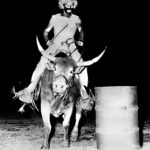
Charley Lyons, dressed as a woman, barrel races with Roberto the steer. – Allen Photo 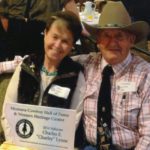
Carol and Charley Lyons celebrate his induction into the Montana Pro Rodeo Hall of Fame in 2014 – courtesy of the family -
On the Trail with Garrison Panzer
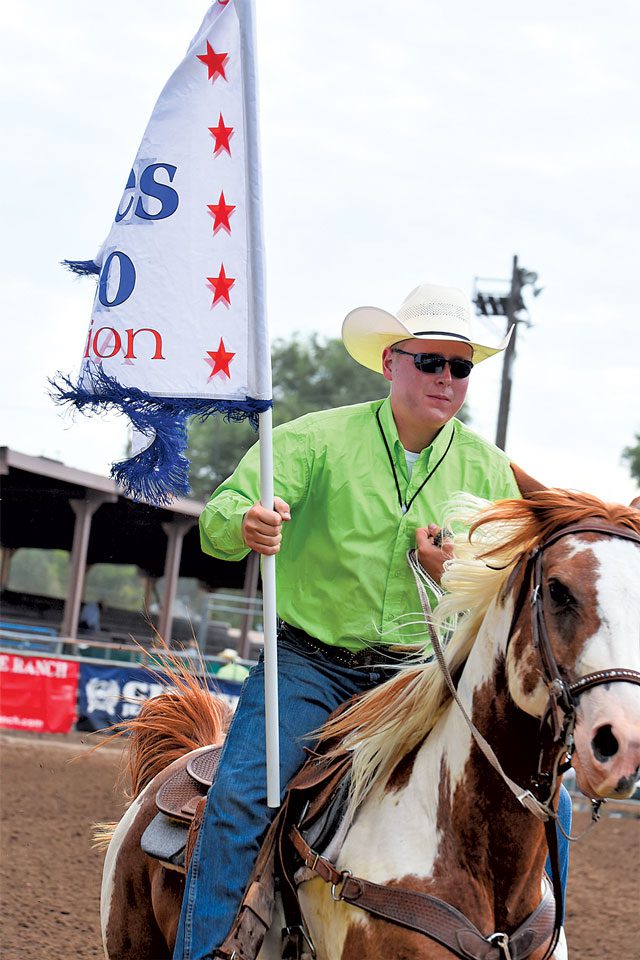
“Be a blessing because you are blessed,” said 18-year-old rodeo announcer Garrison Panzer before switching off the microphone, closing the 2016 Kansas Junior High School State Finals Rodeo. Such are the values of the entire Panzer family, who instilled the importance of serving others in the cowboy from Lakin, Kan., at a young age. A family of rodeo competitors, judges, announcers, timers, and secretary assistants, the Panzers have helped in nearly every aspect of the National Little Britches Rodeo Association in their 30 years with the association.
“We absolutely love the National Little Britches Rodeo Association and everything it does for our kids,” says Garrett Panzer, himself a Little Britches alumni and now a rodeo judge and former member of the NLBRA board of directors. “We’ve gotten everything out of rodeo that we could ever want. We haven’t so much rodeoed with the world championships and buckles and saddles in mind, but instead used it as an avenue to help raise our kids and teach them the strong values of competing, being responsible, and respecting the western lifestyle.”
Garrett and his sister, Dia Panzer-Biddle, grew up in Little Britches, while their dad, Dwayne Panzer, served as a rodeo judge for the association, and continues to do so today. Even from a young age, Garrett knew the rodeo lifestyle and values were what he wanted to instill in his future family. “I played college football two years for Dodge City Community College and then two years at Hastings College. After my playing days were done and I found my wife of 20 years, Kim, we knew rodeo was the avenue we wanted to take with our family,” says Garrett. “I think God really blessed us with two great boys to raise,” Kim adds. “When I was pregnant with Garrison, we attended the baptism of a friend, who was born about five months before Garrison. In part of the sermon, they quoted Proverbs 22:6, ‘Train up a child in the way he should go: and when he is old, he will not depart from it.’ The importance of starting early with a solid, Christian foundation really stuck with me.”
Garrison, the NLBRA youth board president and a ribbon and team roper, was one of the competitors to qualify for the 2003 NLBFR in the newly minted Little Wrangler division. His 15-year-old brother, Hadley, rodeoed for several years before pursuing other sports, but continues to help behind the scenes at Little Britches rodeos and run sound while Garrison announces. The 2016 NLBFR is Garrison’s last as a competitor, but his days with the association are far from over. “I’m in the process of getting my NLBRA judge’s and announcer’s card, and I plan to apply for one of the announcer positions for the finals next year,” he explains. “It’s always been my goal and dream to judge a rodeo with my dad and grandpa, and after this finals, I’ll have a chance to do that.” While he’s qualified for the finals in both his events, Garrison is also announcing the grand entry and portions of the queen contest, along with helping Doug Wade on the production side – and finishing out his third term as the youth board president. “It’s a bittersweet year. I wouldn’t trade any of the ups and downs of the past 13 years for the world. People might say the competition isn’t as tough as others, but if you look at the times and scores turned in, it’s just as tough as many other rodeo associations. And the friendships you build and the rodeo family you have is second to none.”
Beyond Little Britches, Garrison announces rodeos for the NSRA, KPRA, KJHSRA, mini bull ridings, and even the 2016 Oklahoma vs. Kansas Border Bash Rodeo in Guthrie, Okla. “Monty Stueve and I were the two announcers for the weekend, then I turned around and announced the high school rodeo in Lakin,” says Garrison. “I also announced a high school rodeo in McCook, Nebraska, so within a month, I announced a rodeo in three different states. Then I decided to skip a weekend so I could graduate high school, but I have a rodeo to announce every weekend except for three this summer. At first I was worried about being repetitive, but with each rodeo, I’ve gotten more relaxed. I’ve come to realize as long as the contestants are having fun and the crowd is enjoying it, that’s what I need to keep doing!” With the help of his Sports Sound Pro and pointers from several people, including NLBRA producer Janet Honeycutt, he has more than 5,000 songs and sound clips at his fingertips. Garrison announces most of his rodeos from the stand, but he’s debuting his horseback announcing during the NLBFR. “I’ve watched Boyd Polhamus do it a few times, and I can definitely see where you can build a connection with the crowd. I’d like to add that to the performances.”
During the KPRA rodeo in Springfield, Colo., last summer, Garrison announced, while Hadley ran sound, Garrett judged, and Kim was a timer. Garrett’s goal is to judge both the NLBFR and the NHSFR in the same year, while Kim has helped the Little Britches secretaries with their local rodeos the past five years. She plans to continue after Garrison ages out. “I didn’t grow up rodeoing, but my family always had horses,” she says. “My mother was a paraprofessional in Garrett’s first classroom he taught, and she told me I should meet him when I came home from college for Christmas break. We hit it off, and the rest is history! Since I came to be part of the rodeo family, I see so much kindness and generosity. Everyone is more than willing to bend over backwards to help, and I want to pay it forward.” Kim is also the coordinator of the federal programs for her school district, helping migrant and ESL families, as well as coordinating buildings during testing season. Garrett teaches STEM (Science, Technology, Engineering, and Mathematics) to seventh and eighth grade students at Lakin Middle School, while teaching driver’s ed. in the summer, refereeing basketball, and umpiring softball. He has coached football for more than 20 years at both the high school and middle school levels, and became a wrestling coach nine years ago.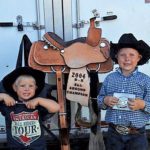
Garrison and younger brother Hadley at 2004 D-K Series Finals in Garden City, where Garrison won his first saddle – Courtesy of the family 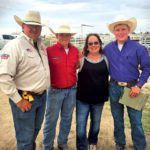
The Panzer Family at First rodeo all four of us worked together, Springfield, CO – Courtesy of the family 
Garrison announcing at his first rodeo association finals, KJHSRA, in Whitewater, KS 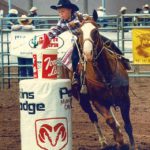
2003 NLBFR, first finals for Little Wranglers, Garrison’s favorite event still today – JJJ Photo 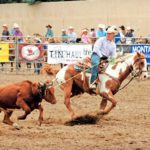
Garrison Panzer 2015 NLBFR in Pueblo, CO An avid athlete, Hadley is attending several wrestling and football camps this summer, and playing baseball on a recreation ball team. “Football is my favorite – I enjoy being around my teammates. I play defensive end, and on offence I play center,” he says. “It’s me and my mom going to games most of the time since Dad is with Garrison at rodeos, and we have some good bonding time.” Hadley will be a freshman at Lakin High School this fall, which Garrison graduated from this spring at the top of his class with Honors. Like Garrison, Hadley will represent his class as the Class of 2020 Vice-President and serve on the Student Council. “We’re very pleased with the young man Hadley’s become,” says Garrett. “He graduated junior high lettering in four sports. Both our boys have learned from sports to compete at the best of their abilities and compromise without compromising their values.”
Throughout high school, Garrison was involved in Student Council (STUCO), band, vocal, golf, and refereeing basketball, while he played lead roles in two high school plays, including King Arthur in Camelot. His cowboy boots even travelled internationally in January when he went on a weeklong mission trip in Guatemala, which included building stoves for the people of Panajachel. A month later, he travelled to England for a week. A recipient of the OSU McKnight Scholarship and President’s Distinguished Scholarship, he’ll be studying Ag. Business at Oklahoma State University this fall and is considering law school in the future. Prior to that, he’s running sound for Jared Slagle at several PRCA rodeos this summer, and plans to keep up his roping through jackpots and helping the college rodeo team.
“It will hit me in August that Garrison’s not going to be able to walk through the door and give me a hug,” says Garrett. “But we’ll be there for him whenever we can. My mom and dad drove four hours to listen to him announce the KJHSRA finals – that’s how our family is. We meet ourselves coming and going sometimes and wonder why we do this crazy life, and I think the result is in the character of our kids. If between Kim and I our boys grow up to be fine gentlemen, then I think we’ve done our job.”
-

Attitudes
ATTITUDES
article by C.J. Aragon,
2010 NIRA Coach-of-the-Year, Odessa College Rodeo CoachAs a coach one of the first lessons I learned is how many rodeo contestants approach competition. Many young rodeo contestants have a difficult time at rodeos because they are concerned with what others are doing. They watch the rodeo and worry about being fast enough to beat someone, or ride better than someone.
Rodeo is indirect competition. Indirect competition means your only competition is yourself.
It is not like football or basketball where you line up across from your opponent. In these sports you are in direct competition with your opponent. If you are better physically and mentally prepared you should beat them, likewise if they are better physically and mentally prepared they should beat you. This is direct competition. Your performance does directly impact your opponent’s performance, and their actions will directly affect your performance.
In rodeo, your performance stands alone. No one scores for you in the timed events. No one else marks them out in the rough stock events. The spotlight is yours.
Your fellow contestants cannot physically dictate your performance. Just like you cannot dictate their performance. I understand that in rodeo there is the variable of the livestock draw, but everyone entered has to deal with the draw. Somedays it will be in your favor, other days the draw works against you.
Being indirect competition the only person that can beat you is yourself. It breaks down to be that simple. The fewer mistakes you make the better you will do. The more mistakes you make the more you will beat yourself. Indirect competition is a simple concept.
If you do your job, and do the best physically and mentally in the practice pen and competition, you have done your part. If you are worried about beating others, you usually just end up beating yourself. Some of the best contestants I have watched on every level from PRCA to junior rodeos do a great job of making rodeo indirect competition. They do the best with what they have drawn each time they nod their head. They come to the rodeo mentally and physically prepared to compete, their performance is not dictated by others.
Some students learn this lesson early on and it shows when they reach higher levels of competition. When you are entered in a rodeo and you are taking care of your business, doing your job there is a lot less anxiety and nervousness before you compete. When you watch contestants who do this well their performance at the rodeo looks just like their performance in the practice pen.
To excel in indirect competition, practice like you compete and compete like you practice. To excel in rodeo, practice like you compete and compete like you practice.C.J. Aragon was named the 2008, 2009, 2010, 2011 Grand Canyon Region Coach-of-the-Year. 2014, 2015 WJCAC Coach-of-the-Year and 2010 National Intercollegiate Rodeo Association Coach-of-the-Year.
-
Work Smarter, Not Harder
Hello ropers! Great to be back writing the second article! I hope everyone had a chance to read and try what was talked about in first tutorial. I am going to follow up where I left off.
Again, fundamentals are where you keep your focus. I always have students calling or sending messages/videos with a problem and every time the problem can be traced back to a fundamental oversight. This is where we dissect the steps I mentioned.
Step one for headers is scoring. This means learning to score yourself so your horse becomes consistent in your commands. If you anticipate the gates opening and your body moves, your horse is going to move as well. Keep your balance equal in your saddle and stirrups and nod with your head, not your back or body. Make sure your left hand is staying consistent with the pressure you have holding your horse. I prefer to use my stomach/abdominal area or saddle horn as a guide so I’m not lifting or moving. This is the start of your run.
Leaving the corner of the box sets the tone for the run. More often than not, headers will leave the corner of the box leaning forward to leave with their horse. Granted this keeps you from going off the back of your horse but it is not correct. This causes you to start your swing later and be out of balance in your swing. The first swing usually goes forward and up and now you have to take extra swings to get your tip down to rope once in position. If we leave the corner of the box balanced with our left hand moving forward, then our weight will remain equally balanced in the stirrups allowing us to square our shoulders and hips to our target. Now our horses are leaving flat, smooth and faster, which means they are out of our way to get the swing started with less effort and match the tip of our loop and swing to the head or horns of the steer.
Watch videos of the open ropers in slow motion and you will see how everyone of them leave the box rotating arms, shoulders and hips to get square to the target. If you don’t do this it definitely does not mean you can not catch, just means you are working harder to achieve the same result as someone who is doing it and you are being less efficient. Work smarter, not harder. Remember it is a timed event!
As we continue from month to month I will break down the “How and Why” of the steps which creates the solid practices. The catch is what makes us feel good but what makes us feel better is to understand how to get better and catch every time as we work in the practice pen.
Until next month, thank you for your time and work on what works and not recreating the same habit that doesn’t work.
Thank you and God Bless!
Krece Harris -
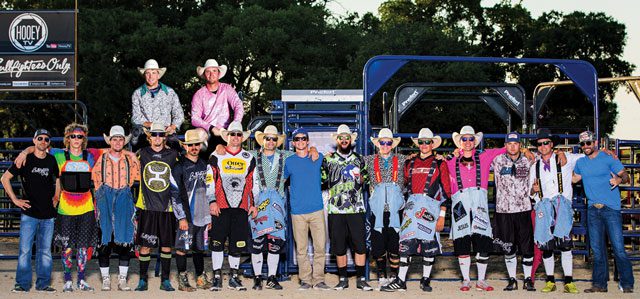
BFO Bullfighters Form Historic Pact
courtesy of Aaron Furguson,
Founder & CEO, Bullfighters OnlyFounded by pro bullfighter Aaron Ferguson, Bullfighters Only (BFO) was created to promote growth, popularity, and acceptance of freestyle bullfighting worldwide. Since its inception, BFO has evolved to become a platform that serves to excite the western community, educate both the avid and casual fans, and present the sport to an entirely new audience.
In a showing of solidarity, the top-ranked bullfighters in the world have formed an exclusive alliance known as the BFO Pioneer Project. Through this coalition, Bullfighters Only can ensure that the direction of freestyle bullfighting is guided by its athletes and guarantee its fans more action-packed entertainment from the sport’s greatest bullfighters.
“To be a part of the Pioneer Project is a blessing,” explains Dusty Tuckness, six-time and reigning PRCA Bullfighter of the Year. “This group of guys is standing together and it’s a brotherhood – bullfighters for bullfighters. BFO is changing the game of freestyle bullfighting.”
Fellow freestyle veteran Ross Hill agrees. “It’s such a ground-breaking movement. The Pioneer Project allows us (the bullfighters) to control the destiny of our sport. This is our passion. We want to advance freestyle bullfighting, not just for this generation, but for the generations to come.”
The talented group is fresh off of another successful BFO Session, an experimental action-sports style event that introduces a new flare to the western sports world. They are now preparing for the BFO’s first stand-alone title fight on June 26, 2016 at the Cedar Park Center – an 8,700 seat state-of-the-art arena near Austin, TX.
Bullfighters Only will also announce partnerships to create a premium global qualification system that spans from amateur events to the World Championship. These partnerships will give non-BFO Pros the opportunity to become part of the current BFO roster and compete on tour. This system will also serve as a way for current BFO Pros to gain extra championship qualification points.
To stay up to date with all of the latest news, follow Bullfighters Only on social media or visit www.bullfightersonly.com. -
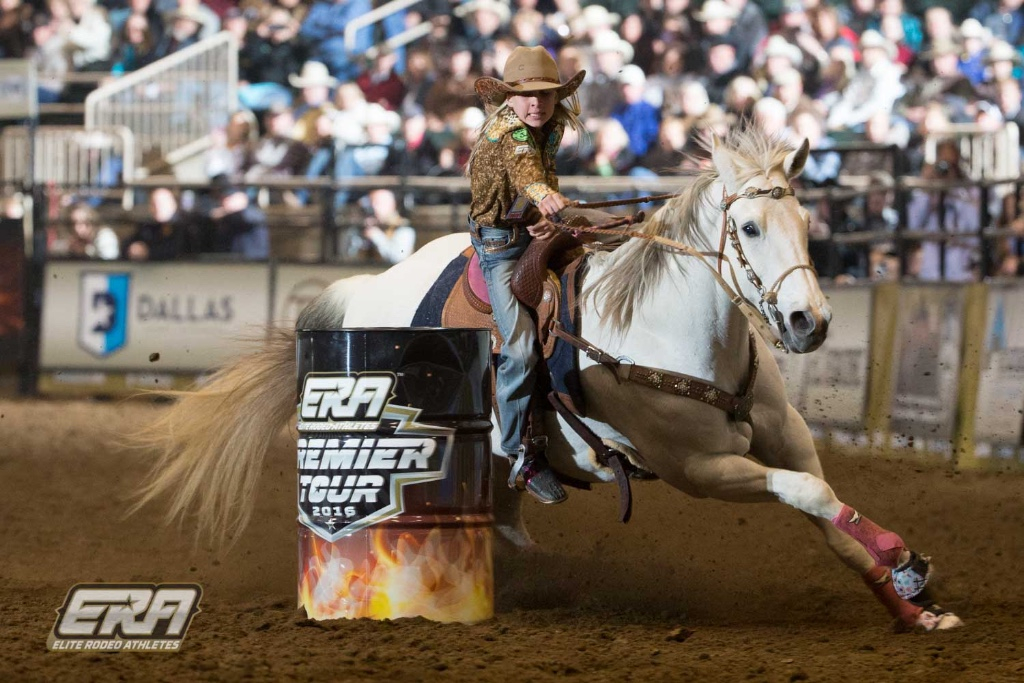
10-year-old Chamberlain leads Race to Dallas in ERA Premier Tour Barrel Racing
Courtesy of ERABegay and Cooper win again atAlbuquerque ERA Premier Tour Stop No. 7ALBUQUERQUE, New Mexico (May 20, 2016) – With a great run working in her favor, 10-year-old Chayni Chamberlain (Stephenville, Texas) now sits atop the Elite Rodeo Athletes (ERA) Premier Tour world standings in barrel racing, tied with Ashley Shafer (Yoder, Wyoming) after Friday’s Stop No. 7 in Albuquerque. Chamberlain ran in 14.27 seconds, tying with Sarah Rose McDonald (Brunswick, Georgia) for third place. When overall season leader Schafer toppled her second barrel, resulting in a run of 19.06 seconds with the five-second penalty, Chamberlain’s 212.5 points for the third place finish were enough to move her into first place alongside Schafer.For the third time this season, the World Championship Team Roping duo of Derrick Begay (Seba Dalkai, Arizona) and Clay Cooper (Gardenerville, Nevada) landed atop the podium as the winners the ERA Premier Tour’s Team Roping competition.Albuquerque fans saw Begay and Cooper produce a 4.62-second run, just one-one-hundredth of a second faster than the second place team of Speed Williams (Jacksonville, Florida) and Rich Skelton (Llano, Texas) (4.63 seconds). For the win, Begay and Cooper earned 275 points which gives them a 425-point lead in the ERA World Standings.In third place behind Williams and Skelton was Charly Crawford (Prineville, Oregon) and Kollin VonAhn (Sac City, Iowa) with a run of 4.78 seconds.Zeke Thurston, the 22-year old saddle bronc rider from Big Valley, Alberta, picked up his first ERA Premier Tour win with an 85.5-point ride on Stace Smith’s Ned Pepper. Tied for seventh place in the ERA world standings, the win moved Thurston into fifth place, now tied with New Mexico’s Taos Muncy. In second place was Isaac Diaz who posted a score of 83 points on Hello Dolly. Bradley Harter’s 81.5-point score on Levi the Boss landed him in third place.The steer wrestling competition generated some of the fastest scores of the season. Each of the Top 3 cowboys dogged their steer to the ground in under 4 seconds – Casey Martin (Sulphur, Louisiana) in 3.62 seconds for the win; Stockton Graves (Alva, Oklahoma), in 3.74 seconds and Nick Guy (Sparta, Wisconsin) in 3.90 seconds. It was Martin’s first win of the 2016 ERA Premier Tour and moved him from ninth place into a tie for sixth place in the ERA world standings with Luke Branquinho (Los Alamos, California).The World Champions reigned supreme in tie-down roping with 3-time World Champion Tuf Cooper (Decatur, Texas) picking up his second victory of the year with an 8.12-second. Behind him in second place was 8-time World Champion Fred Whitfield with a time of 8.28 seconds, and rounding out the Top 3 was 6-time World Champion Cody Ohl.Another first-time winner was Austin Foss (Terrebonne, Oregon) in bareback riding. An 84.5-point ride on Greely Hat Works Sugar Daddy of Cervi stock gave him the 275 points for first place. World Champion Kaycee Feild (Spanish Fork, Utah) rode into second place with an 84-point ride on Utopia (NT Rodeo). The American’s first $1 million winner, Richmond Champion (The Woodlands, Texas) came in third place with 83 points on Black Friday (Stace Smith).Chandler Bownds earned his second win of the 2016 ERA Premier Tour with an 87.5-point ride on Shyster (TNT Rodeo). Cody Campbell and Zack Oakes came in second and third place, respectively.All of the action from Stop 7 will air on Wednesday, May 25 on FS2 (Fox Sports 2) at 9 a.m. ET.Stop 8 of the Albuquerque ERA Premier Tour takes place Saturday at 7:30 p.m. at Tingley Coliseum. Tickets are available at all Ticketmaster outlets, online at ticketmaster.com, via phone at 800 745 3000 or at Tingley Coliseum starting at 12 p.m. on Saturday, May 21.In two months, on July 19-23, the ERA athletes will return to Salt Lake City for the Days of 47 Rodeo taking place at Vivint Smart Home Arena.The 2016 season will culminate with the $3 million ERA World Championships in Dallas, Texas, at the American Airlines Center on Nov. 9-13, where the 2016 ERA World Champions will be crowned. Tickets for the five-day event are on sale now at Ticketmaster.com or by calling 800 745 3000. For more information, visit www.eraprorodeo.com. -
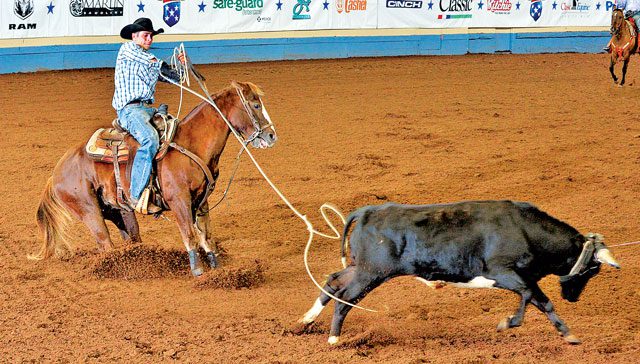
Roper Review: Cody Thornton
On the Friday before Thanksgiving in 2015, Cody Thornton was in the roping pen training an outside horse. He had already headed ten steers and was getting ready to throw his rope on number eleven. As he stood to throw, without warning, his horse buried his head and bucked, hard. And Cody landed, hard. After spending a night sick from pain he ended up at an Urgent Care clinic the following morning where he learned he had fractured his C5 vertebrae. The injury resulted in two rods, four screws, and his C4 and C5 vertebrae being fused together. After spending seven weeks recuperating, Cody started back riding.
Cody grew up in Huntsville, Texas where he was raised roping and catching wild cows. He started team roping about the age of five. While growing up he went to high school rodeos and earning a rodeo scholarship. Cody graduated from Sam Houston University with a degree in General Agriculture and a minor in Management.
For the six years following college Cody chose to train horses, riding up to 13 per month. Putting his degree to good use Cody now manages the Steinhauser’s Feed Store in Navasota, Texas, where they carry just about everything including a full line of feed, ranch supplies, and even home décor. Steinhausers has total of eleven stores located in southeastern Texas.
As a #9 heeler, Cody enjoys rodeoing on the weekends and giving roping lessons. When he’s not working or roping, you can usually find him spending time in the woods hog hunting with his friends and family.
Cody’s dad, Lynn Thornton, is a farrier in south Texas and shoes some of the best barrel horses in the country. His mom, Tamera Gann, is the City Manager of Huntsville, Texas.
Cody owns and lives on 20 acres next to his sister and brother-in-law, Kassie and Chad White. He spends much of his time with them and their two sons, Cougar and Riggins.
How much do you practice?
Three or four times a week.
Do you make your own horses?
Yes.
Who were your roping (rodeo) heroes?
Clay O’Brien Cooper, Leo Camarillo.
Who do you respect most in the world?
The good Lord for sure. My grandpa and my sister.
Who has been the biggest influence in your life?
My sister.
If you had a day off what would you like to do?
Go hog hunting.
Favorite movie?
Lonesome Dove and Where the Red Fern Grows.
What’s the last thing you read?
The Bible.
How would you describe yourself in three words?
Caring, loyal, hard working.
What makes you happy?
Being in the country.
What makes you angry?
Being in the city.
If you were given 1 million dollars, how would you spend it?
Buy a ranch.
What is your best quality – your worst?
Best quality is I’m very honest. Worst quality is being too independent.
Where do you see yourself in ten years?
Having a nice piece of property with a nice herd of cows. -
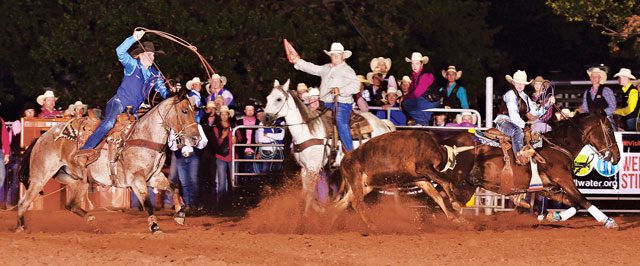
ProFile: Brandi Hollenbeck
Brandi Hollenbeck finished out her second and final year at Garden State Community College winning the Central Plains region in the breakaway and was honored with being female athlete of the year for the college. “We were honored to have Brandi on our women’s team,” said her coach, Jim Boy Hash. “She’s talented enough to go anywhere to compete in the breakaway and team roping. She is a quiet and humble person, and we’re going to miss her.” She graduated with high honors and is part of the Phi Beta Kappa. After graduation, she drove all night to go enter a roping. After that, she headed home to pick up her breakaway horse and head to another rodeo.
“The year is just starting,” she said. “Hopefully this summer and fall will continue to be good.” Brandi is going to be a junior, and she’s headed to Alva to Northwest State University to study ag business and get her degree in that and rodeo for the team.” She is looking into real estate appraisal. “I’m really interested in that. It’s something that is flexible with the lifestyle that I live.”
Brandi, from Hutch, went to Pretty Prairie High School, making the High School National Finals all four years. She won it in 2011, her freshman year, and again in eighth grade. Her fastest time ever is a 1.9 – and she’s done it twice. Her secret to success is the horse power. “That’s one of the key things in my opinion; one that can get from point A to point B in a short amount of time. One that gives me the same shot every time.” Brandi has competed on five different horses since she started roping when she was 6. “I rode my dad’s calf horses then. I pretty much took over my dad’s horses for the first two I rode, them my grandpa (Junior Lewis) trained one and Jerome Schneeberger rode him, one day he told me to (Junior Lewis) get on him and that was that. I rode him until the middle of my sophomore year, and I borrowed my Uncle’s calf horse, and then we came across this horse that my dad knew about. We called the people about a year ago, and they said no, and then they changed their mind. I took him home that day …and the rest is history.”
Brandi learned how to rope from her grandfather and her dad, Shawn. Her whole family will be cheering her on at her second CNFR, Mom, Mardee, little sister, Blair, and grandma, Gaynell Lewis. “She always comes to every rodeo to watch me,” said Brandi. Brandi had the college finals made before the final two rodeos in the season. She was also trying to make it in the team roping, but the #4 header admits she and her partner “had heck. We actually switched ends the last two rodeos. We’re going to work on it this summer and hopefully go in the team roping next year to the college finals.”
She plans to go to the CNFR for the rest of her years in college. “It’s a field that I want to go back to. It’s the NFR for college kids – it’s something you definitely want to be a part of. I went last year and had a blast. It is like a reunion from the high school finals. My parents were out there the whole week and we went up to Casper Mountain. I’m very honored to represent my school and my region.”
“Balancing school and rodeo is hard – for me, school is first. The coaches have scheduled practices every day and it helps to have the classes scheduled to be done at noon, then I can study and then go to practice. I made the Presidents Honor Roll and the Deans Honor Roll.” Biology was the toughest class for her. It wasn’t an everyday class, you had two labs per week at 7:30 and the hybrid part was on your own. I don’t go to the gym, I have really bad burcitis in my shoulder, and I get it injected two or three times a year … main thing is make sure my horse is in tip top shape and make sure he gets out of his pen everyday, and I rope everyday.” -

ProFile: Jacob Smith
Jacob Smith (20 in May) set some goals for himself. “When I won the Mountain Circuit Finals in 2014, I decided that the next year I would win the Year End Title and get the saddle, as well as win the college region. I only rode one bull my freshman year, so I decided to come back and do it.” He focused on handling his business. “I took the momentum I had riding in the summer to the college and it stuck all year.”
The Platte Valley High School graduate in Kersey, calls LaSalle, Colorado, home. He went to the Greeley Stampede when he was little, entering the mutton busting, and decided to be a bull rider. He got on his first bull when he was 12, in the junior high rodeo and continued in the high school rodeo. “I made the Finals for both junior high and high school, and made the National Finals my sophomore, junior, and senior year.” He admits he wasn’t riding as good as he should at the Finals and fixed it by going back to the basics and sticking with it. “Success in this game is keeping your head straight, having a positive outlook, and taking care of your business.”
Jacob is attending the University of Wyoming, studying petroleum engineering. “I’m not sure what I’m going to do with it, for now, I’m planning on rodeoing after I graduate. I’m going to focus on PRCA – I’m going to try for the Rookie.”
His dad (Gary) owns part of a construction company and his mom (Teri) is a homemaker, Jacob is the oldest of four children; two sisters, Maggie (18), Claire (14), and a brother, Eric (16). Eric rode bulls, but now he’s raising his own bulls. The whole family shows up to support him, even though they never rodeoed. They will continue to show up and support him as Jacob makes his first CNFR appearance. He is going to rodeo as hard as he can as soon as school gets out, but other than entering and competing, he’s not doing anything special to get ready for Casper. “I’m going to spend the whole summer rodeoing.” Jacob will make sure he’s got a ticket to the circuit finals, so he will hit at least 15 rodeos in the Mountain States Circuit, and after that he will pick the best and go.
Jacob is holding on to a 3.0 GPA and admits the hardest part is balancing rodeo and school. “We are on the road for five weekends out of the semester, and in reality, it’s hard to study while you’re at the rodeo, so you’ve got to make sure it’s all done before you leave.”
The biggest influence in his life are his parents. “My dad is always working so hard, and is busy every day … he gets up early to make sure the company is running but he still goes to all our sporting events. My mom has taken care of four kids and they have both worked really hard.” -
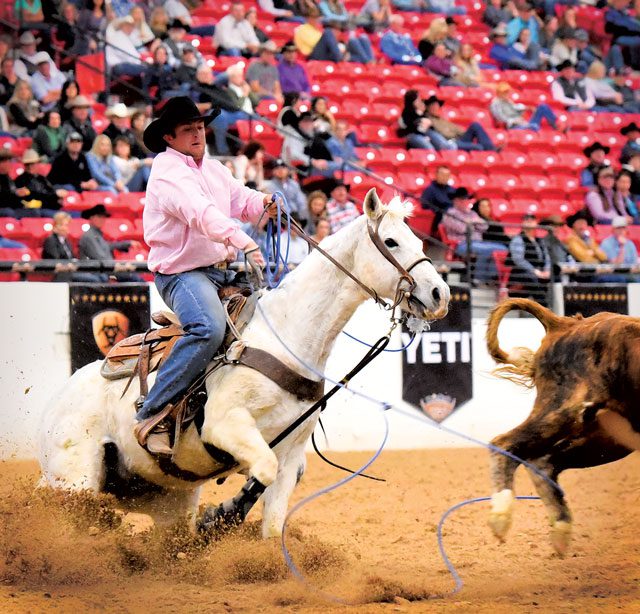
On the Trail with Clayton Van Aken
Clayton Van Aken is a California transplant. Born and raised in Descanso, California, a little town 40 miles southeast of San Diego, he grew up playing baseball and football and roping. He high school rodeoed, making the finals his senior year. Everywhere he roped to compete, he drove at least 300 miles to Phoenix or Oakdale up north to do so. The only child of John and Maggie, Clayton is the first one in his family to compete. “My dad has always roped – he shoes horses – and he’s always telling me he doesn’t know anything about how to enter and how to get the traveling done.”
After high school, he went to the University of Wyoming where he obtained an undergraduate degree in farm and ranch management with a minor in finance. He has been to the CNFR all four years – one time heading, twice heeling, and three times tie down roping – and will make it this year too in the tie down roping. “I roped a lot of calves – I went to six of the pro rodeos and made the amateur rodeos – but I’ve never had a horse that I could go on – I’ve always sold them early on.” He has concentrated on team roping admitting, he can’t tie fast enough to beat the pros going down the road. “I’m more of an 8.2, not a 7,” said the 24-year-old that is currently working on his Masters Degree at Chadron State College in Nebraska. He is taking his classes online and will finish with his Masters in Organizational Management with an emphasis in sports. “My main deal is to look at sports from a business perspective like an agent would do. Put numbers to values and values to talent. That’s how they do it in the big industry – baseball and football – I want to help the program inside and outside the arena.”
His goal is to become a college rodeo coach and integrate that with his growing roping cattle business. Three years ago, Jerry Palm from Centennial, Wyo., approached Clayton with a partnership idea. “I was thinking about going home,” said Clayton. “Jerry brought it up and it’s developed into something pretty cool. We’ve got 130 head of jackpot steers that Jerry buys and I run. This is the third year for this partnership.” The cattle come from Gem, Wyo., get broke in, then get leased or hauled depending on what the customer wants. “We’ve got a lot of two year olds that are good to rope and they are leased out. I’ve got fresh ones coming in.” Clayton puts on a jackpot series in Laramie, Wyo., every Thursday night May through June. He hauls them to other local jackpots and producers, and by the end of June all the cattle are leased or sold for the summer. “I get the jackpots done seven weeks in a row and we end after the college finals, and then I head out after I lease them out for the rest of the summer.”
Then it’s Clayton’s turn to hit the pro rodeo road for the summer, a dream he has had since he was 15. “When I won the Lucky 7 #15 in Laughlin in 2009 with Wade Hooker, I realized I might be good enough to do this.” He got his Rookie card when he turned 18 so he could go to Cheyenne and the close rodeos and the bigger ones. “Those are the ones in our circuit that I could get to while I was in college.” He started his PRCA career heeling for Paul Beckett and made they made the circuit finals twice. “I went down to Texas and started riding this really nice head horse, so I switched and it’s working out – I can’t complain.”
Going down the road with Paul helped Clayton learn the ropes of the road. “He’s been around and knows where to go. He’d always have a plan and be good where we needed to be good.” Now Clayton is heading for Cole Cooper, from Sheridan, Wyo. “We just decided to rope together the other day – I roped with him in Colorado and we finally are going to make it work. The plan is to hit the road this summer and go. Our first one is Guymon and we’ve got our schedule set through the first of July.” Cole’s wife is going to have a baby around July 1, so the plan is to be rodeoing around home then so Cole can be with her. “The way I’ve got it mapped out, we’ll be everywhere. This year if we go hard and give it a good lick we might have a shot at the NFR. But the real goal is to get into the big rodeos like San Antonio, Denver, and Ft. Worth next year. It helps to get the ball rolling.”
For now, Laramie, Wyo., is home. “There’s nothing like this where I come from in southern California. I can rope, rodeo, run cows, and ride horses. What more could I want?”
Clayton at age 4 – Linda Allen 
Clayton at the 5 & under dummy roping in 1997 at Scottsdale USTRC roping with Philip Murrah 
Clayton Roping with Cullen Teller at the PRCA Mountain States Circuit Finals in Rock Springs, Oct. 2015 – Hubbell 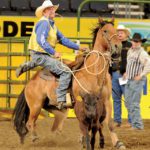
Clayton roping at College National Finals Rodeo – Hubbell -

Back When They Bucked with Liz Kesler
story by Gail Woerner
Liz was born to Chesley Russell and Irene Faulkner Russell on June 10, 1926 in Clay County, Texas just south of Henrietta. She had one sister, Margie, two years older. They lived in a two story home on a farm/ranch located on Old Joy Shannon Road which had belonged to her paternal great-grandparents. Her daddy was born in that house, too.
Their young lives were idyllic for young country girls. Liz and Margie had dolls galore, buggies for dolls, paper dolls, and a trike to ride. They had a swing and playhouses under the trees. They also got together with other children in the community at Sunday School as well as socials that were held in the area.
When Liz was old enough to go to school she went to the Bluegrove School for the first nine grades. There were 15, or so, in her class and several grades were in one room with one teacher. They had programs for parents with students performing. The principal, Mr. Gilbert and his son both played the fiddle. Mr. Gilbert taught Liz to play the bass fiddle. It took some doing, not because Liz had trouble learning, but because Liz wasn’t tall enough to stand and play the bass fiddle. First they removed the peg from the bottom of the fiddle to make it shorter, but Liz was still to short. Solution: They stood her on a box and she played just fine!
Liz was always an honor student and was valedictorian at her grade school graduation. She only attended school for eleven years and the last two years she was at Henrietta High School where she took typing, bookkeeping and regular courses.
Liz Kesler and Dr. Greer 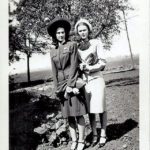
1944 – Margie and Elizabeth Russell 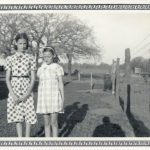
1934 – Margie and Elizabeth Russell 
Anna Lee and Bud Purdy, Liz and Reg Kesler Her dad was always interested in rodeos, both in Henrietta and in Fort Worth. The family always went with him to rodeos and Liz found it a special treat. She was always interested in the events and the rodeo people. When Liz was 17, at the rodeo in Henrietta, one of the timers did not show up. The announcer saw Liz as she was finding her seat in the grandstand and asked her if she would time. She did not hesitate. Obviously she did a good job because it wasn’t very long before she was asked to time other area rodeos.
She was hired by Mr. Gilbert, her former principal, who had become the Superintendent of Schools in Clay County. Her position was Assistant County Superintendent of Schools for Clay County. Her office was located in the court house in Henrietta. She held that position for eight years. Later Liz attended Draughan’s Business College in Wichita Falls to get more business training. She was an excellent administrative person and was eager to gain more knowledge and skills.
Liz met June Bull from Pampa, Texas, and when June finished high school her parents hoped she would want to go to college. Instead it was June’s desire to barrel race. Being their only child her parents were patient with her and agreed. Liz traveled with June Bull to various rodeos around Texas and beyond. At first, Mrs. Bull traveled with them. They always had such a good time and found people in rodeo easy to get to know. It wasn’t long before the rodeo people they met seemed just like family. By the early 1950s they were going to rodeos further from home. Cheyenne Frontier Days, Madison Square Garden Rodeo in New York City, the Boston Garden Rodeo and many others. By this time Liz had resigned her job as Assistant County Superintendent and could travel the country.
In time, Liz went to work for Standard Oil Company, and was offered a transfer with a substantial increase in salary and title. The transfer took Liz to Liberal, Kansas, which seemed like ‘the end of the world’ to her. Fortunately she could still see friends when she worked at a rodeo. She and June learned to secretary rodeos together and soon their reputations as ‘outstanding’ rodeo secretaries spread through the rodeo world.
She often worked in the rodeo office for Everett Colborn, who was the ramrod of the World’s Championship Rodeo. He had some of the biggest and the best rodeos in the country. His daughter, Rosemary, who married World Champion All-Around Cowboy, Harry Tompkins, was generally her dad’s secretary and often Liz would assist or do whatever was necessary.
In 1954 June Bull and Buster Ivory, a bronc rider, were married during the Cheyenne Frontier Days at a Methodist church in Cheyenne. Liz was maid of honor and Jo Decker was matron of honor. Casey Tibbs, World Champion saddle bronc rider and Bill Ward, also a bronc rider were Buster’s attendants. Bill Linderman, All-Around World Champion and President of the Rodeo Cowboy Association, gave June away. Mr. Bull was not ready to give his only daughter up and refused to attend the wedding. It was truly a rodeo wedding.
Liz met Reg Kesler, in Oklahoma City during the 1966 National Finals Rodeo. Liz was a good friend with Jim and Sharon Shoulders, Clem and Donna McSpadden as well as June and Buster Ivory. All these people were good friends with Reg. He was a former three-time All-Around Champion cowboy in Canada who worked every event. He was from Alberta, Canada and went to college there, but was more interested in playing hockey or riding bucking horses. It was evident his life was going to be rodeo. He also collected bucking horses and in 1951 he produced his first rodeo. He had become a well known stock contractor and produced rodeos in Canada and the United States until 1995. Later they became an item.
They married in Bozeman, Montana in 1971 during the NIRA (National Intercollegiate Rodeo Association) Finals. Those attending their wedding in the Methodist Church were Liz’s mother, and niece, Phyllis Jones, and good friends Bud and Anna Lee Purdy. Liz remembers that Byron Walker and Martha Tompkins were among the college students competing at the rodeo. She assisted announcer Don Harrington by identifying the various college contestants and what colleges they represented.
Two days after their wedding Liz was secretary and timer at the Red Lodge, Montana, rodeo. The newlyweds lived in Missoula, Montana and Rosemary, Alberta, Canada, but traveled most of their time on the ‘rodeo road’. They produced rodeos in Denver, Houston, San Antonio, all over the province of Alberta, all over Montana, Idaho and too many other places to mention. Often Reg would be hauling stock to one rodeo and Liz would be heading another direction and putting on a rodeo somewhere else. Reg trusted Liz and knew she had the skills and ability to run a rodeo the right way. Liz often was responsible for getting the cowboys monies to the bank and traveled by herself many miles with never a problem. They were a good team.
Reg was very instrumental with two other men in starting the ProRodeo Cowboy Association Circuit Finals in 1987. It was held in Pocatello, Idaho, and Reg not only helped organize it, he backed it financially, as well as offered his knowledge and his stock for the event. This allowed all 12 circuits in the United States to send their best cowboys in each event to compete against each other. A circuit was made up of one state, or more, depending on the rodeo activity in the states. PRCA cowboys could register for one of the twelve circuits. Liz was the secretary at the very first circuit rodeo held, which was in Montana. She, also secretaried the first National Circuit Finals in Pocatello. This additional level of competition helped the cowboys, who held jobs or were needed on their own ranches and couldn’t rodeo full time, earn more money.
Reg had outstanding broncs for both Saddle Bronc and Bareback events. He had good stallions that bred good bucking stock. Liz once said, “Reg only had to see a horse buck one time to know if it was going to be a good bucking horse.” His horses were chosen as top horses many years in the RCA, PRCA and the National Finals Rodeo. He also had some bucking bulls that were tops, too. He continued in the rodeo business until 1995, when his grandson, Duane Kesler, bought the business. Reg was inducted in to the ProRodeo Hall of Fame, the Canadian Rodeo Hall of Fame, Alberta Sports Hall of Fame and the Rodeo Historical Society Rodeo Hall of Fame in Oklahoma City. He was well respected and appreciated in the rodeo world.
Liz also began teaching others to secretary rodeos and held schools in Canada and also helped train secretaries in the U. S. At that time in rodeo the secretary was much more involved with those entering rodeos as it was all done by telephone directly calling the secretary. There was so much more ‘hands on’ administrative work done by the secretaries. They were working without all the technical machines and computerized programs that are in use today.
Liz, Donna McSpadden, Sharon Shoulders, June Ivory, Irene Harris and Nell Shaw started a Ladies Fashion Show during the National Finals Rodeo held in Oklahoma City in 1967. In the beginning they used contestant’s wives and mothers to model the clothing in the show. The local stores and boutiques were so gracious and allowed the gals to come in to the store and pick whatever they wanted to model. This style show has continued annually during the National Finals Rodeo in Las Vegas. It is still being organized by the wives of today’s contestants. The proceeds from the show, including sales of auction items and cost of the show are now given to the Justin Crisis Fund which helps cowboys that are injured or have a serious financial problem pay bills other than their medical bills.
When Liz’s mother became ill she and Reg came back to live with Mrs. Russell so Liz could help care for her. In 2001 Reg went back to his Canadian ranch on business and was tragically killed in an automobile accident. He was 82. It was a big shock to Liz and the entire rodeo world, Reg was still very active in rodeo.
Reg and Liz were involved with Buster and June Ivory in holding the Cowboy Reunion, during the National Finals each year. Today Liz is the ramrod of the event, held in Las Vegas, and still gathers the ‘movers and shakers’ in rodeo, from all across the United States and Canada, each year. The proceeds from this 501c3 organization, are given to the Justin Crisis Fund, the ProRodeo Hall of Fame and Museum of the American Cowboy and the Rodeo Historical Society.
Presently Liz lives in the family home which has a 130 year history for the Russell family. When her mother died, at the age of 98, Liz became much more active in the community and the county. She is a founding member of the Clay County Historical Society, and was a chairperson for the renovation of the museum. She is also involved in the Pioneer Reunion and rodeo and was chosen Pioneer Reunion Queen in 2000. She is a member of the Bluegrove Baptist Church. Her great-grandparents gave an acre of land for the Bluegrove Cemetery of which she is a member of the cemetery board. She also is a Clay County Memorial Hospital Foundation board member. In 2010 Liz received the Silver Award from the Retired Senior Volunteers of North Texas (which includes 17 counties). In 2013 she was honored as the Outstanding Senior Citizen of Clay County.
In the rodeo world she was honored by the Women’s Professional Rodeo Association in 1984 for her contribution to them which involved making each PRCA rodeo in Montana also a WPRA rodeo for the barrel racing event. At that time WPRA had to get each rodeo committee to agree to their requirements and Liz got the entire state committed. She also received the Montana Governor’s Award for the preservation of our western heritage in 1986. In 1988 Reg and Liz were honored as Outstanding Citizens of Missoula Montana. The Kesler outstanding bucking horse, Three Bars was inducted in to the ProRodeo Hall of Fame in 2004 and Liz accepted. In 2008 Liz and Reg were inducted in to the Texas Rodeo Cowboy Hall of Fame. Liz received the Tad Lucas Memorial Award at the National Cowboy & Western Heritage Museum, in 2010, which is given to women who give above and beyond what is expected of them in rodeo as did the namesake, Tad Lucas. That same year Liz and Reg were inducted in to the Montana Wall & Hall of Fame in Billings. In 2013 Liz was given an American Cowboy Culture Award as Pioneer Woman at the Cowboy Symposium held in Lubbock, TX.
She helped organize and is a member of H.A.N.D.S. which stands for Help A Needy Diva Survive. It is a fifty member group of rodeo women, dedicated to helping any rodeo family member who has been injured or has medical problems and may need help either financially, or emotionally.
Liz has enjoyed her life immensely. She has worked hard at everything she has done, and accomplished much. She has never hesitated to assist when anyone needs help. Liz is actually an important part of three families. Her own family, including her sister Margie, Margie’s children, grandchildren and great-grandchildren, as well as Reg’s children, grandchildren, and great-grandchildren and the rest of her relatives; her second family is the rodeo family which includes everyone who has had the good fortune to meet her or worked with her at rodeos and rodeo functions. Especially the young cowboys, who were just starting out in rodeo and love her so much for all the help she gave them when they were still ‘wet behind the ears’; and last but not least her Clay County family which grows with each and every event Liz participates in.
Liz is truly proud of her heritage and deep Texas roots. She has the manners and demeanor of a lady. She gains the respect of everyone she meets because of her gracious ways. She is no where near finished making memories and living her life to the fullest. Don’t expect to see her sitting in a rocking chair and watching the world go by. She still has much she wants to do, so many events to attend and so many friends to see.