What separates those who are successful in the rodeo business? Over my years as a coach I have watched many students go on to be very successful in the arena and they all share a few key characteristics that seem to separate them from everyone else.
The best student athletes on my team each year are not the most talented on the team. In almost every case the students who win the most have a few characteristics that separate them from everyone else.
Winners are driven to reach their goals. They know what their goals are and so do those around them. Over the years I had a few students on my team that have been extremely successful. They were not shy about telling you what their goals were. They weren’t afraid of working hard to reach their goals. They weren’t afraid of competition. They also took their failures as a learning experience.
Along with treating failures as learning experiences, they were incredibly positive. Not just about what they were doing but to those around them. Their positive energy was contagious, it made them better and it made those around them better as well.
Because of their attitudes they were very coachable. They showed up to practice with energy. They listened to feedback from the coaches. I know there were times when they were coached, and told things that they did not want to hear. They listened anyway. That is one of the keys to any successful athlete, they have the ability to be coached. Not everything is going to go their way, they will not be told what they want to hear, and they learn from all experiences because of their attitude.
Dedication to their craft is a must as well. They study and learn all they can about their sport. They take care of their business. For a college rodeo student, that means getting good grades, becoming a leader, and being the best competitor they can be. These guys spent time in the gym and they really put in the work in the practice pen. Because of their dedication they find ways to win.
Finally they competed fearlessly. This group approached every competition with one goal in mind, winning. They didn’t worry about their competition, they didn’t make excuses. Because of their approach to competition they were able to eliminate distractions and focus on what they were working to accomplish.
I have been blessed to coach several WNFR, and PRR World Finals Qualifiers over the last few years. Every one of them had these traits, and I believe I learned a lot from these students as well. Now it is exciting for me to see these traits in students currently in our program or coming into our program. I truly believe that if you want to be at the top of any sport you need to embrace these traits.
Blog
-
Positive Attitudes
-
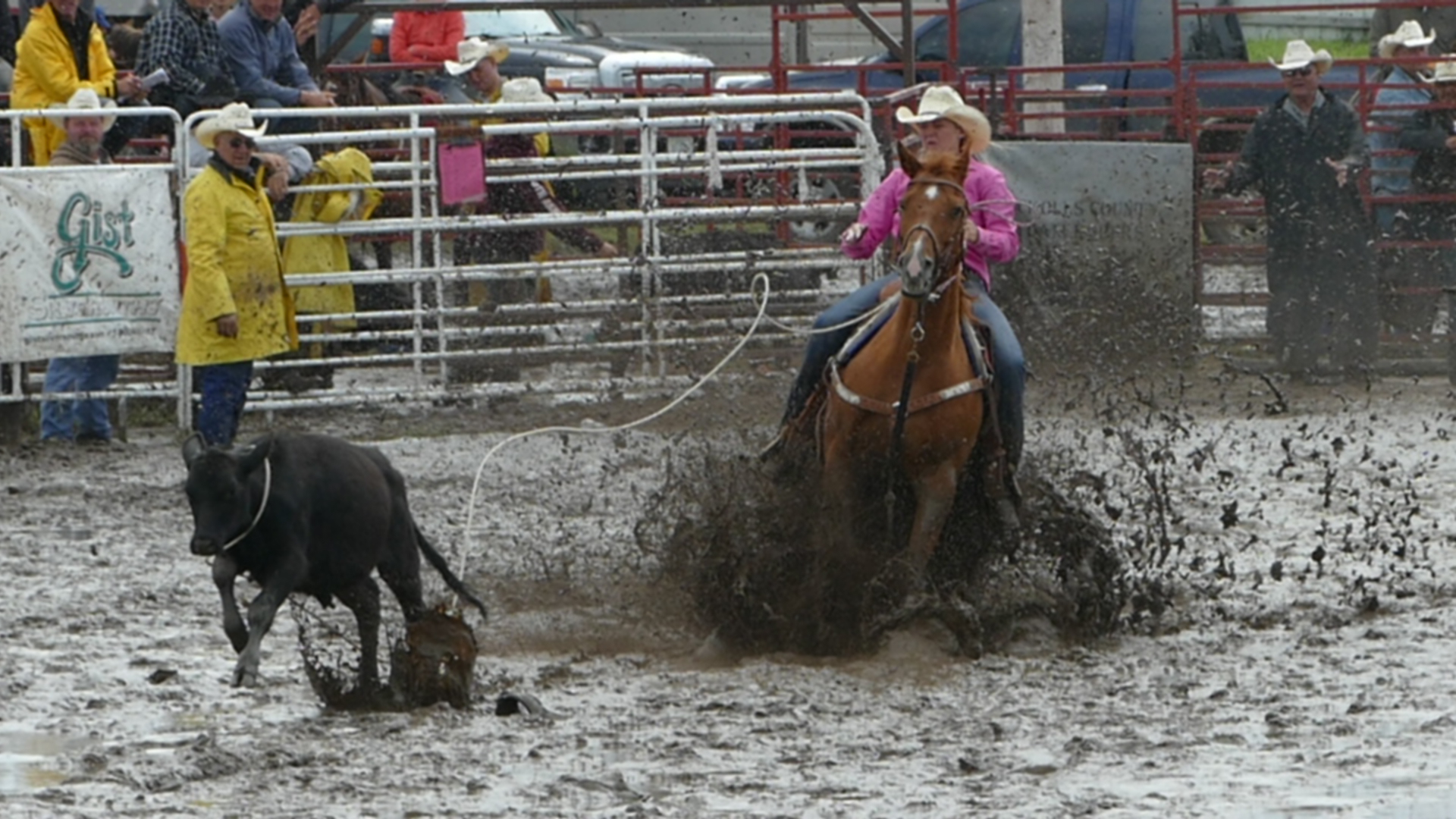
Knocked to her Knees
Gordon cowgirl prevails over knee, hip surgeries; is back to rodeo
Lincoln, Neb. (April 26, 2017) – Morgan Darnell has seen the inside of more surgery rooms than she’d prefer.
The Gordon, Neb. cowgirl, a member of the Nebraska High School Rodeo Association, has had four surgeries in the last four years.
It all started when she hit her knee on a post while riding her horse. When her parents took her to the doctor, no damage had been done, but the doctor discovered that she had OCD: osteochondritis dissecans, a loss of blood flow to the bone, causing the bone to die. OCD occurs most often in the knees, where Darnell’s case was. She had surgery to repair the damage her eighth grade year, spending five months on non-weight bearing crutches.
The surgery wasn’t successful, so she had two more surgeries in 2015, her sophomore year, one to remove a bone chip and cartilage that hadn’t attached in the first surgery, and the other to repair the OCD damage.
The second OCD surgery was successful, but doctors couldn’t get the cartilage on the back of her knee to stay. The cartilage is not on the weight bearing part of the bone, so it doesn’t affect her a lot.
Then, this past November, the sixteen-year-old, the daughter of Buddy and Stacey Darnell, had a fourth surgery, this time for hip dysplasia. Her right hip socket wasn’t big enough for the ball on the end of her femur, so doctors at the University of Nebraska Medical Center cut the pelvis bones, shifted the joint, and pinned it back. Darnell was on complete bed rest for eight weeks to allow it to heal, starting in a wheelchair and working towards part days and eventually full days at school.
All of her surgeries took place during the winter so she didn’t miss any rodeo competition. She played basketball her freshman year but the surgeries kept her from that as well.
Darnell, a junior at Gordon-Rushville High School, is a team roper and breakaway roper, and while she was at home recuperating from hip surgery, she could practice her roping. She wasn’t allowed to move her right leg on her own; her parents moved her from the bed to the couch and back. But as soon as she was able to sit up on her own, the roping dummy (a plastic form in the shape of a steer that is portable) came into the Darnell living room. “She sat on the couch and roped,” said Stacey.
The knee is not one hundred percent, and probably never will be. “Sometimes it will lock up or swell and be painful. I think it’s about as good as it’s going to be,” Morgan said. Doctors told her high impact sports, like getting off your horse at high speed in the goat tying, are out of the question. But if she chose to, she could run and play basketball.
The hip isn’t one hundred percent, either, but it will be. Four screws hold it in place, and within a few years, it will be completely healed. She can ride, and plans on competing this spring for her her third year of high school rodeo.
She and her header Clayton Simons are ranked second in the Neb. High School Rodeo standings in the team roping and she is ranked fifth in the breakaway. She qualified for state finals her freshman and sophomore years, and last year, qualified for the National High School Finals in the team roping with her older brother Cody. At the 2016 state finals, she set a finals record in the breakaway roping with a time of 2.13 seconds.
The surgeries have given Darnell a focus on her career. She had originally thought about being a teacher, but is now considering physical therapy. “I’ve spent a lot of time (in physical therapy) and it seems like something I would enjoy,” she said. “All of my doctors and physical therapists have strongly encouraged me to go into the medical field.”
She has the grades for it; she is on the All-A Honor Roll at Gordon-Rushville, the National Honor Society, and FFA. She has competed at the state FFA competition the last two years; once in ag science and once in livestock judging.
The surgeries have made her mature, too, her mom said. “Lots of times with doctors, she asks her own questions. She’s very positive. She’s been through a lot in three years.”
And this June, she plans on being at the state finals rodeo in Hastings.
The Nebraska High School Finals Rodeo will be held in Hastings at the Adams Co. Fairgrounds June 15-17. Tickets are $7 for everyone ages five and up and are available through the office and at the gate. For more information, visit AdamsCountyFairgrounds.com or hsrodeo-nebraska.com, or call 402.462.3247.
### –
-
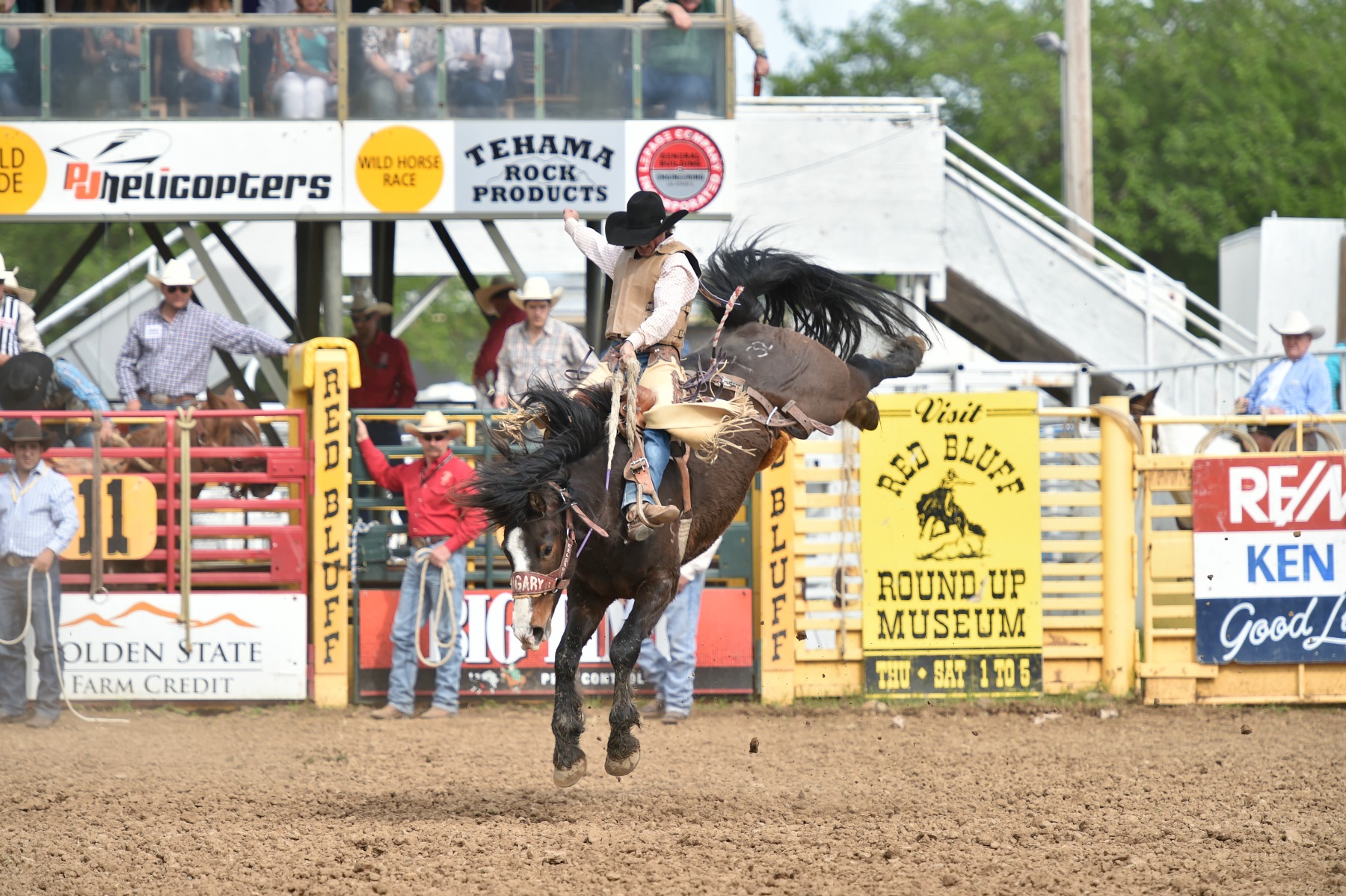
RED BLUFF CROWNS CHAMPIONS
Second year of rodeo, Red Bluff win is confidence booster for tie-down roper
Red Bluff, Calif. (April 17, 2016) – Westyn Hughes knows where he belongs, and it’s in the winner’s circle.
The Caldwell, Texas cowboy secured the tie-down roping title at the 96th annual Red Bluff Round-Up on April 23 with the average win, the fastest times combined on four runs. His time of 40.9 seconds on four head was nearly two seconds faster than the number two man, Cimarron Boardman, of Stephenville, Texas.
Tie-down ropers Luke Landry, Leesville, La. and Ryle Smith, Oakdale, Calif., who trailed Hughes going into the average by a second or less, opened the door for Hughes when they didn’t rope their calves today. “Today I just had to go in there and make a solid run, just get out clean at the barrier, and not have any penalties.” Hughes didn’t have to rope as aggressively, with Landry and Smith out of the lead. “At that point, I didn’t have to take as much of a gamble.”
Hughes, who is nineteen years old, is in his second year of PRCA rodeo competition, having won the Resistol Rookie Tie-Down Roper in 2016, and it’s going well. “This year has started off a lot better than it did last year,” he said. He chalks it up to more experience. “I think I’ve roped smarter in general. The second year of going to the PRCA rodeos has definitely helped me and been in my favor.”
His second trip to the Red Bluff Round-Up is the complete opposite of last year. “The crazy thing is,” he said, “last year, I never caught a calf here. I missed all my calves. It was me, not roping smart, and fighting my head.”
Winning Red Bluff is a big confidence booster. “I just feel like I belong here. Last year, I was struggling, and had in my head, do I belong here? Now I know I do.”
Hughes’ mount is a horse he purchased from Jade Conner of Iowa, La. The eleven year old horse, named Clorox, has “been a big help. He’s got a lot of run and he’s real honest.”
The 2017 Round-Up bull riding title went to Rock Island, Texas’ Trey Benton III, who scored 88.5 points on the Rosser Rodeo bull Heartbreak. Hughes is coming off of two years of injuries which have kept him out of competition and the Wrangler National Finals Rodeo. Within a six week span in 2015, he had surgeries to repair the ACL in one knee and the ACL and MCL in the other knee, and in 2016, he tore his groin, his labrum, and had a minor sports hernia. “I’m getting my feet back under me,” he said. “The past two years, I’ve been getting hurt, and I’m not able to get anything rode.”
Benton is rodeoing a bit differently this year. He is working with a sports trainer and has a plan for rodeo. The plan relates to the mental part of bull riding, since bull riding is “more mental than physical.” He’s also competing at fewer rodeos, being more careful where he rides. “I haven’t been rodeoing as hard as other guys. I’ve been to just fifteen rodeos this year, at the rodeos that fit me, with more added money.”
Other Red Bluff champions include bareback riders Shane O’Connell, Rapid City, S.D. and Tilden Hooper, Carthage, Texas (85.5 points each); steer wrestler Chance Howard, Cedarville, Ark. (19.2 seconds on four runs); saddle bronc rider Hardy Braden, Welch, Okla. (85 points); team ropers Coleman Proctor, Pryor, Okla. and Billie Jack Saebens, Nowata, Okla. (38.1 seconds on four runs); and barrel racer Stevi Hillman, Weatherford, Texas (34.58 seconds on four runs.)
During the rodeo, which was the annual Tough Enough to Wear Pink event, a VIP rodeo package was auctioned off. Rose Crain and Dan Davidson, owners of Haleakala Ranch, purchased it for $35,000. The package includes an engraved Henry repeating Arms Big Boy .44 Magnum/.44 Special with a custom-made scabbard and a silver bracelet with rose-gold accents. The auction winner also receives a behind-the-scenes experience at two of Napa’s top wineries: Clos Pegase and Swanson Vineyards, with a two-night stay at a five-star hotel, a personal tour and connoisseur’s tasting of current and library vintages. Monies raised during the Round-Up’s “pink” campaign go to breast cancer treatment at the St. Elizabeth Imaging Center.
Next year’s Red Bluff Round-Up will be held April 20-22, 2018. For more information on the rodeo, visit RedBluffRoundup.com.
Results, Red Bluff Round-Up, April 21-23, 2017
All-around winner: Ryle Smith, Oakland, Calif. $7,051 in the steer wrestling and tie-down roping
Bareback Riding – 2017 Red Bluff Co-Champion – Shane O’Connell, Rapid City, S.D. and Tilden Hooper, Carthage, Texas
- (tie) Shane O’Connell, Rapid City, S.D. 85 points on Bridwell Pro Rodeos’ Caddy Wagon and Tilden Hooper, Carthage, Texas, 85 points on Bridwell Pro Rodeo’s Raggidy Ann; 3. Jessy Davis, Power, Mont. 84.5; 4. Kaycee Feild, Spanish Fork, Utah 83; 5. (tie) R. C. Landingham, Hat Creek, Calif., and Grant Denny, Minden, Nev., 82.5 each; 7. Richmond Champion, The Woodlands, Texas 82; 8.(tie) Austin Foss, Terrebonne, Ore. and Justin Miller, Billings, Mont. 81.5 each.
Steer Wrestling 2017 Red Bluff Champion – Chance Howard, Cedarville, Ark.
First round: 1. Kody Dollery, Caldwell, Texas 4.7 seconds; 2. Chance E. Howard, Cedarville, Ark. 4.9; 3. Baylor Roche, Tremonton, Utah 5.0; 4. Tyler Pearson, Louisville, Miss. 5.2; 5. Will Lummus, West Point, Miss. 5.4; 6. Luke Branquinho, Los Alamos, Calif. 5.6.
Second round: 1. Curtis Cassidy, Donalda, Alb.; 4.1 seconds; 2. Ryle Smith, Oakdale, Calif. 4.6; 3. John Henry Franzen, Riverton, Wyo. 4.7; 4. (tie) Jarret New, Wimberly, Texas and Kody Dollery, Caldwell, Texas 4.9 each; 6. (tie) Will Stovall, Roberts, Mont. and Sterling Lambert, Fallon, Nev. 5.1 each.
Third round: 1. Cody Pratt, Pueblo, Colo. 4.4 seconds; 2. Ryle Smith, Oakdale, Calif. 4.6; 3. Baylor Roche, Tremonton, Utah 4.7; 4. (tie) Sterling Lambert, Fallon, Nev. and Chance Howard, Cedarville, Ark. 4.8 each; 6. Josh Peek, Pueblo, Colo. 4.9.
Finals: 1. Chance Howard, Cedarville, Ark. 4.3 seconds; 2. Dakota Eldridge, Elko, Nev. 4.7; 3. (tie) Luke Branquinho, Los Alamos, Calif. and Taylor Gregg, Walla Walla, Wash. 4.9 each; 5. Ty Erickson, Helena, Mont. 5.1; 6. Kody Dollery, Caldwell, Texas 5.2.
Average: 1. Chance Howard, Cedarville, Ark. 19.2 seconds on four runs; 2. Kody Dollery, Caldwell, Texas 20.5; 3. Ryle Smith, Oakdale, Calif. 21.4; 4. Ty Erickson, Helena, Mont. 21.7; 5. Dakota Eldridge, Elko, Nev. 22.2; 6. Sterling Lambert, Fallon, Nev. 22.6.
Saddle bronc riding 2017 Red Bluff Champion – Hardy Braden, Welch, Okla.
- Hardy Braden, Welch, Okla. 85 points on Calgary Stampede’s Turbo Rocket; 2. Jesse Wright, Milford, Utah 84.5; 3. (tie) Zeke Thurston, Big Valley, Alb. and Jake Watson, Hudsons Hope, B.C. 83.5 each; 5. Cody Wright, Milford, Utah 83; 6. (tie) Tyrell J. Smith, Sand Coulee, Mont. and Sterling Crawley, Stephenville, Texas; 82.5 each; 8. (tie) Taos Muncy, Corona, N.M. and Allen Boore, Axtell, Utah 82 points each.
Tie Down Roping 2017 Red Bluff Champion – Westyn Hughes, Caldwell, Texas
First round: 1. Marty Yates, Stephenville, Texas 8.9 seconds; 2. D.J. Parker, Hollister, Calif. 9.4; 3. Timber Moore, Aubrey, Texas 9.6; 4. Catfish Brown, Collinsville, Texas 10.1; 5. Sterling Smith, Stephenville, Texas 10.2; 6. Cody McCartney, Ottawa Lake, Mich. 10.4.
Second round: 1. Westyn Hughes, Caldwell, Texas 8.4 seconds; 2. Cooper Martin, Alma, Kan. 8.7; 3. Cy Eames, Gooding, Ida. 8.9; 4. (tie) Luke Jeffries, Maricopa, Ariz. and Cory Solomon, Prairie View, Texas 9.1 each; 6. Clint Nyegaard, Cuero, Texas 9.2.
Third round: 1. Trell Etbauer, Goodwell, Okla. 8.9 seconds; 2. Ryle Smith, Oakdale, Calif. 9.3; 3. Luke Landry, Leesville, La. 10.2; 4. Cimarron Boardman, Stephenville, Texas 10.7; 5. Jake Pratt, Ellensburg, Wash. 10.8; 6. Roger Nonella, Redmond, Ore. 11.1.
Finals: 1. Cimarron Boardman, Stephenville, Texas 8.7 seconds; 2. Kody Mahaffey, Sweetwater, Texas 8.9; 3. Westyn Hughes, Caldwell, Texas 10.0; 4. Monty Lewis, Hereford, Texas 10.1.
Average: 1. Westyn Hughes, Caldwell, Texas 40.9 seconds on 4 runs; 2. Cimarron Boardman, Stephenville, Texas 42.8; 3. Catfish Brown, Collinsville, Texas 43.0; 4. Kody Mahaffey, Sweetwater, Texas 43.5; 5. Trell Etbauer, Goodwell, Okla. 43.8; 6. Jake Pratt, Ellensburg, Wash. 45.6.
Team Roping 2017 Red Bluff Champions – Coleman Proctor, Pryor, Okla. and Billie Jack Saebens, Nowata, Okla.
First round: 1. Coleman Proctor, Pryor, Okla./Billie Jack Saebens, Nowata, Okla. 7.0 seconds; 2. Brandon Beers, Powell Butte, Ore./Joel Bach, Mt. Vernon, Texas 7.6; 3.Clay Tryan, Billings, Mont./Jade Corkill, Fallon, Nev. 7.8; 4. Derrick Begay, Seba Dalkai, Ariz./Clay O’Brien Cooper, Gardnerville, Nev. 8.2; 5. Jake Barnes, Scottsdale, Ariz./Tyler Worley, Bluffdale, Texas 8.4; 6. Ryan Reed, Farmington, Calif./Cody Pearson, Tucson, Ariz. 8.6; 7. Lane Livingston, Seymour, Texas/Dakota Kirchenschlager, Morgan Mill, Texas 8.8; 8. Lane Karney, Creston, Calif./Dalton Pearce, San Luis Obispo, Calif. 9.1.
Second round: 1. Brandon Webb, Carrizo Springs, Texas/Kollin VonAhn, Blanchard, Okla. 6.3; 2. Luke Brown, Stephenville, Texas/Jake Long, Coffeyville, Kan. 6.4; 3. Matt Sherwood, Pima, Ariz./Walt Woodard, Stephenville, Texas 6.9; 4. (tie) Doyle Hoskins, Chualar, Calif./BJ Campbell, Aguila, Arz. And Shay Carroll, Prineville, Ore. and Todd Hampton, Madera, Calif. 7.4 each; 6. Jake Stanley, Hermiston, Ore. and Kyle Lockett, Visalia, Calif. 7.8; 8. Case Hirdes, Turlock, Calif./Cord Forzano, Madera, Calif. 8.1.
Third round: 1. Lane Ivy, Adrian, Texas and Buddy Hawkins, II, Columbus, Kan. 7.1 seconds; 2. Hayes Smith, Central Point, Ore. and Russell Cardoza, Terrebonne, Ore. 7.3; 3. Coleman Proctor, Pryor, Okla. and Billie Jack Saebens, Nowata, Okla. 7.4; 4. Shay Carroll, Prineville, Ore. and Todd Hampton, Madera, Calif. 8.2; 5. Preston Burgess, Hilmar, Calif. and Cody Cowden, Atwater, Calif. 8.7; 6. Jake Cooper, Monument, N.M. and Brady Norman, Springer, Okla. 9.0; 7. Blake Hirdes, Turlock, Calif. and John Chaves, Los Alamos, Calif. 9.5; 8. Cory Kidd V, Statesville, N.C. and Cole Davison, Stephenville, Texas 9.7.
Finals: 1. Blake Hirdes, Turlock, Calif./John Chaves, Los Alamos, Calif. 7.6; 2. Coleman Proctor, Pryor, Okla./Billie Jack Saebens, Nowata, Okla. 8.0; 3. Lane Ivy, Adrian, Texas/Buddy Hawkins II, Columbus, Kan. 8.8; 4. Shay Carroll, Prineville, Ore./Todd Hampton, Madera, Calif. 8.9; 5. (tie) Dakota Eldridge, Elko, Nev./Jordan Ketscher, Squaw Valley, Calif. and Cory Kidd V, Statesville, N.C./Cole Davison, Stephenville, Texas 10.1 each.
Average: 1. Coleman Proctor, Pryor, Okla./Billie Jack Saebens, Nowata, Okla. 38.1 seconds on 4 runs; 2. Lane Ivy, Adrian, Texas/Buddy Hawkins II, Columbus, Kan. 38.5; 3. Shay Carroll, Prineville, Ore./Todd Hampton, Madera, Calif. 43.3; 4. Blake Hirdes, Turlock, Calif./John Chaves, Los Alamos, Calif. 47.4; 5. Cory Kidd V, Statesville, N.C./Cole Davison, Stephenville, Texas 49.6; 6. Jake Cooper, Monument, N.M./Brady Norman, Springer, Okla. 53.8; 7. Jake Stanley, Hermiston, Ore./Kyle Lockett, Visalia, Calif. 54.4; 8. Dakota Eldridge, Elko, Nev./Jordan Ketscher, Squaw Valley, Calif. 57.0.
Barrel racing – 2017 Red Bluff Champion – Stevi Hillman, Weatherford, Texas
First round: 1. (tie) Carley Richardson, Pampa, Texas and Christine Laughlin, Pueblo, Colo. 17.26 seconds each; 3. (tie) Tiany Schuster, Krum, Texas and Kellie Collier, Hereford, Texas 17.37 each; 5. Jana Bean, Ft Hancock, Texas 17.38; 6. Taylor Langdon, Aubrey, Texas 17.42; 7. Jill Welsh, Parker, Ariz. 17.50; 8. Stevi Hillman, Weatherford, Texas 17.56; 9. Jaime Hinton, Bulverde, Texas 17.58; 10. Carman Pozzoon, Aldergrove, B.C. 17.61.
Second round: 1. Stevi Hillman, Weatherford, Texas 17.02 seconds; 2. Sydni Blanchard, Albuquerque, N.M. 17.07; 3. Nellie Miller, Cottonwood, Calif. 17.19; 4. Taylor Langdon, Aubrey, Texas 17.22; 5. Tiany Schuster, Krum, Texas 17.23; 6. Jaime Hinton, Bulverde, Texas 17.33; 7. Kris Gadbois, Escondido, Calif. 17.35; 8. Mary Jo Camera, Ceres, Calif. 17.40; 9. Sami Morisoli, Paso Robles, Calif. 17.41; 10. (tie) Kellie Collier, Hereford, Texas and Brittany Kell, Paso Robles, Calif. 17.42 each.
Average: 1. Stevi Hillman, Weatherford, Texas 34.58 seconds on two runs; 2. Tiany Schuster, Krum, Texas 34.60; 3. Taylor Langdon, Aubrey, Texas 34.64; 4. Carley Richardson, Pampa, Texas 34.71; 5. Kellie Collier, Hereford, Texas 34.79; 6. Sydni Blanchard, Albuquerque, N.M. 34.86; 7. Jaime Hinton, Bulverde, Texas 34.91; 8. Jill Welsh, Parker, Ariz. 34.96; 9. Kris Gadbois, Escondido, Calif. 35.04; 10. Nellie Miller, Cottonwood, Calif. 35.07.
Bull Riding 2017 Red Bluff Champion – Trey Benton III, Rock Island, Texas
- Trey Benton, III, Rock Island, Texas 88.5 points on Rosser Rodeo’s Heartbreak; 2. Tim Bingham, Honeyville, Utah 85.5; 3. Roscoe Jarboe, New Plymouth, Ida. 84; 4. Garrett Tribble, Bristow, Okla. 82; 5. Jordan Hansen, Okotoks, Alb. 81; 6. Cain Smith, Pendleton, Ore. 80; 7. Brennon Eldred, Sulphur, Okla. 76; 8. Jesse Petri, Geneva, Fla. 74.
** All results are unofficial. For more information, visit RedBluffRoundup.com. For complete rodeo results, visit ProRodeo.com.
– ### –
-
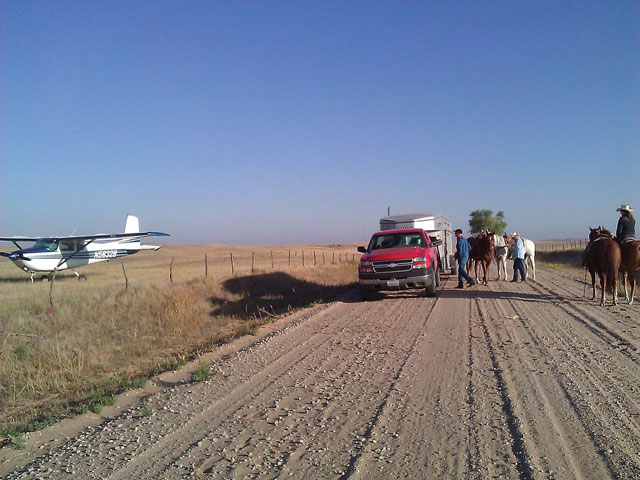
ProFile: Kent Magnuson
Kent Magnuson did his rodeoing when he was young, and now he gets to continue in the sport with his job.
The Kearney, Nebraska man, who grew up riding saddle broncs and tie-down and team roping, was never good enough to make a living at it. But when he quit competing, he turned his attention to flying cowboys and rodeo people around the country.
He began flying small planes in the late 1970s, and introduced himself to Donnie Gay at the National Finals Rodeo in Oklahoma City. At the time, a lot of cowboys were flying from rodeo to rodeo, and Gay, who was in the middle of his eight world title run, was also flying. In 1980, Gay called him and asked him to fly him to events.
Gay sold his plane to Lyle Sankey a few months later, and since Sankey didn’t have a pilot’s license, Magnuson flew him to his rodeos. Other rodeo super stars, including Bruce Ford, Roy Cooper, Bobby Brown, and more than Kent can remember, joined in, guys who were “hard on the rodeo trail.”
After the 1980s, Kent turned his attention to the corporate world, flying for four different businesses, seven days a week, from across the U.S. to Canada, Mexico, and the Caribbean.
Don Gay and Kent Magnuson in the cockpit – courtesy of the family Then, six years ago, he and Gay reconnected. Gay was flying a twin engine Cessna and wanted to learn to fly a turbine airplane. He came to Nebraska and stayed with Magnuson for a week, learning from his experience. Now he and Gay share duties on a Merlin IIIB, a plane owned by Jerry Nelson of Frontier Rodeo. Magnuson flies for Nelson in several different capacities: with his stock contracting firm, his minor league basketball team, the Kentucky Mavericks, and his other businesses.
His schedule varies. He might be flying for two weeks, and then be home for four or five days. Being a pilot requires flexibility. “That’s one of the benefits of having your own plane,” he said, “having 24/7 access. The flight crew needs to be able to launch within an hour. You might go to the east coast or the west coast, you never know where it’s going to be. To me, that’s fun to do.”
The one thing that changes a pilot’s schedule, beyond what the boss says, is the weather. “Our biggest consideration is the weather,” Magnuson said. A second plan is always in place. “If we can’t do this, what’s plan B? Where’s the next closest airport?”
Occasionally, but not often, he’ll fly cowboys to rodeos. He usually flies cowboys over the busy Fourth of July weekend, and in mid-February, flew world champion Sage Kimzey to some events.
The best part, for Magnuson, is the people. He loves them. “The rodeo crowd is a very unique group,” he said. “The rodeo world has a different way of handling people, the way they do things, how they relate to their competitors. They’re friends, and everybody helps everybody. It’s a code of the west. If you can help, you help whoever needs it, regardless of who they are.”
Now he and his wife, Beth Baxter, barrel race and compete in the 4D events. It’s how they enjoy each other’s company. “It’s a real bonding time for us. Neither of us have any other hobbies, or money enough to support another hobby.”
Magnuson, who is in his sixties, loves his job. “My mother and my stepdad (Beverly and Glen Nutter) conditioned me, that you don’t do a job for the money, if you don’t have to. Follow your heart and the money will always be enough, sometimes more, sometimes less. You’ll always want to do the work.
“And after 35 years of flying, I still want to fly every day.” -
Judgement Call
At the last college rodeo I watched some college students question rodeo officials on their calls. Rodeo is officiated by the judges, they are human and they make mistakes. Like many other officiated sports it is very fast paced and the calls are made in the blink of an eye. Under this system the calls will never be perfect and there are always going to be those who question the calls made in the arena.
Every event has an element that is judged or open to a judgement call. Mark outs, the flagger, timers, they all make mistakes, but I rarely if ever felt that someone intentionally made a bad call. I haven’t agreed with all of the calls I have witnessed, but I think they were made to the best of the rodeo officials’ ability.
Here are a few of my takeaways from this weekend and college students protesting calls.
If you don’t agree will the call, don’t make a fool of yourself in and out of the arena after the call. No matter how much you disagree with the call, acting like a spoiled brat is not going to change the call. No one will remember the run in a few weeks, but they will remember how you acted. In many cases your behavior will warrant a conduct fine, you may get by once or twice acting like this but conduct fines are not cheap, and if you make a habit of acting like this you will get one. You may find some people in your corner that will tell you it was a terrible call and that the judge cost you lost of money, but in the end the one person in the arena that agreed with the call was holding the flag. End of story.
Don’t post the video on Facebook, naming the judge and ask all your friends what they think. Just don’t do it. I saw someone from another region do this and tag the judge in the video, I watched the video with the judges at a different rodeo. First the angle you filmed from was not good to make a case either way. Two, the judges watch your video and next time they are flagging at a rodeo you are at they will know to watch you for crossfire. Three you will likely not get the benefit of the doubt on any crossfire calls from that judge in the future, or any of the other judges that watched the video. Finally it was the right call, know the rules of the association you are competing in before you question the call on social media.
Finally the one good example was in the bareback riding where a rider missed his horse out. After the event the rider went to the judge and asked him what he saw, and what he could do better. The judge took the time to explain the rule and how he interpreted the rule in this case. Then he went on to explain how the rule book told them to judge the mark out. Both sides left the discussion feeling better about their conversation about the call.
In all of my year’s rodeoing and coaching, I have never witnessed anyone throwing a fit about a call or posting it on social media, get the call changed. If you plan on rodeoing for a living there are only so many rodeo judges, don’t find ways to make them all dislike you when you are still in college. -
Italian Meatball Hoagie Braids & Pistachio Pudding Cake
Italian Meatball Hoagie
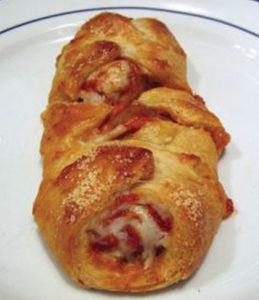
recipe courtesy of Angie Meismer from the CJRA Cookbook
ingredients:
2 (8 oz.) cans Pillsbury Refrigerated
Crescent Dinner Rolls
16 (1/2-inch) frozen fully cooked
Italian meatballs (about 1 lb.)
thawed, halved
1 cup tomato-basil spaghetti sauce
4 oz. (1 cup) shredded mozarella
cheese
1 egg, slightly beaten
1/4 cup grated Parmesan cheeseDIRECTIONS: Heat oven to 375 degrees. Spray 2 cookie sheets with nonstick cooking spray. Separate dough into 8 rectangles. Place rectangles on sprayed cookie sheets. Firmly press perforations to seal. Place 4 meatball halves lengthwise down center of each rectangle. Top each with 2 tablespoons spaghetti sauce and 2 tablespoons mozzarella cheese. With scissors or sharp knife, make cuts 1 inch apart on each side of filling. Alternately cross strips over filling. Brush dough with beaten egg; sprinkle with Parmesan cheese. Bake at 375 degrees for 15 to 20 minutes or until golden brown. Makes 8 sandwiches.
Pistachio Pudding Cake
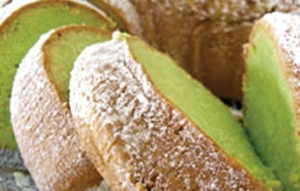
recipe courtesy of Paula Morehouse from the Pioneer Journey Cookbook
ingredients:
1 pkg. pistachio instant pudding
1 pkg. (2 layer size) yellow cake mix
1/2 tsp. almond extract
4 eggs
1½ cups water
3/4 cup oil
1/4 cup flour
a few drops green food coloringDIRECTIONS: Combine all ingredients. Blend then beat at medium speed for 2 minutes. Pour into greased and floured 10” tube or Bundt pan. Bake at 350 degrees for 50 to 55 minutes or until cake springs back when lightly pressed. Cool in pan for 15 minutes. Remove from pan and cool.
This cake recipe was a first place winner in the Bundt Cake classification at the Larimer County Fair three different times. -
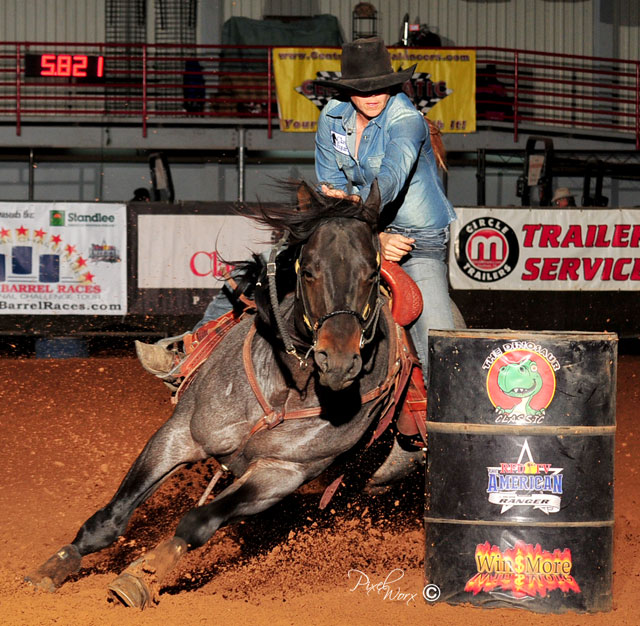
Ryann Pedone
“My brain is just wired to be passionate about what I do,” says 33-year-old horse trainer and breeder Ryann Pedone. “I’m very fortunate – I don’t think everybody gets the opportunity to do what they love so much that they eat, sleep, and drink it. Even though I’ve been knocked down, I’m the type to pin my ears back and say, ‘I’ve got this.’”
Ryann, who is currently training six horses by A Streak Of Fling – including one straight from Fulton Family Performance Horses – started out not on a horse farm, but a dairy in Florida owned and operated by her dad. She was the first of her family to enter the horse world, but her dad, Lee Pedone, jumped in to support her. “My dad took me to my first barrel race when I was almost four, and I just loved it!” says Ryann. She rodeoed in high school, but her passion has always been futurities and derbies, recently winning the long-go at the 2017 Diamonds and Dirt Barrel Horse Classic on Streakin Queenie. “My dad was really great. Anything we had a passion for, he would bust his butt to help us with, or take us to someone who knew more about it. When I was little, we got help from Alan and Wendy Parker. They gave me my very first barrel horse, Idget, and really helped with my horsemanship. They were a huge stepping stone to breeding and training horses.”
Another stepping stone was the broodmare Ryann’s dad gave to her when she was 18. Originally a barrel horse, Kiss Kiss This hadn’t passed vet checks because of her knees, but proved an excellent broodmare, and eventually, the cornerstone of Ryann’s R Barrel Horses breeding program. “She’s been in the top twenty-five of barrel racing broodmares of the decade, and she’s a phenomenal mare. I didn’t know it at the time, but that’s where it all started.”
Ryann finished her finance degree from University of Southern Florida while working on her family’s dairy and running a firewood business, then moved to Texas in 2006 for the horse opportunities. She returned to school, this time in human acupuncture. “I was driving back and forth between Weatherford and Austin. I’d leave Weatherford at five in the morning and go to school until five or six in the evening. I’d go back to Weatherford and ride colts until one in the morning, then do it all over again. I don’t sleep much – I have so much I need and want to do. Some of that might be because I was raised on a dairy where we had no concept of time. We milked cows around the clock.”
While Ryann was living in Weatherford, she met a longtime horse breeder, Eddie Henderson. “I would spend hours talking bloodlines with him, and he did so much for me in that area. I bought some great mares from Eddie, and one of the mares, Barbi Bugs, produced Nastee Leader, the horse that Charly Crawford rides in the heading. I’d also talk to horse trainers like Kassie Mowry, Kelly Conrado, and Pete Oen. I’m always reading and researching, and living here, I’m around very smart and successful people. I keep paying attention to the breeding and bloodlines of successful horses.”
Ryann’s relationship with the Fultons started in 2013 when she went up to look at several of their colts for clients. “I liked their bloodlines, and I met Brian and Lisa and rode some colts. I bought Streakin Lena Whiskey for Shoppa Ranch, and the next year I bought Streakin Queenie for Shoppa Ranch, and my dad and I bought Streakin Ms Wink. In January of 2015, Brian called me and asked if I would take A Dash Ta Streak. I was so excited they would ask me, and I started running him that September. A Dash Ta Streak is how I got to know the family, and I love how honest they are in their sales and how tough Lisa is and Brian was.
“My career as a trainer is coming around. It took a while, and I still have so much more to accomplish. About six years ago, I started getting those better colts I raised and everything started coming together.” Ryann calls 2011 a pivotal year in her career and confidence. The year before, she went to the BFA World Championship on her mare, Cause For A Kiss, having qualified with the second fastest time. They tipped the first-go and were second in the second-go, but when Ryann got to the short-go, her nerves got the best of her. “My weakest thing was my brain, but I was gritty and I kept going. A good friend bought me the book Mind Gym, and I really came on in the fall of 2011, winning rodeos on TCS Runaway Susie. I won the Consolation at Fort Smith on Cause For A Kiss, and futurities on Kiss This Guy, who was voted Futurity Gelding of the Year via Barrel Horse Report.”
Ryann runs her ranch and 80 head of horses, which includes broodmares, babies, yearlings, two-year-olds to five-year-olds, and outside horses. She does it with the help of her dad, and her intern from South Dakota, Shae Volk. “Jax Johnson comes out for one or two months and then goes home for school, and I think he’ll make a great trainer. Lisa Downs is my main girl and she does everything. Sierra Emmett helps me feed on weekends, and my boyfriend, Don Lee, is a vet and a lot of help, and so is Sid Meyers, my farrier.
“I want to end up being a top trainer, competitor, and breeder, raising colts from my program,” she finishes. “I want to be remembered, and I want to help the people that come into my life just like all the people who helped me.”
Ryann also extends her thanks to her sponsors and friends/family: Jeye Johnson and Classic Equine, Equibrand, Martin Saddlery, Platinum Performance, Oxy-Gen, Shefit, the Fulton family, the Ashley family, Janie and Jimmy Shoppa, Kimmi Byler, Lisa McCool, Martha Reeves, Kim Landry, Alan Staley, Shawna Turner, Ronny and Sandi Dickinson, and all of her clients. -

Roper Review: T.J. Jones
Growing up, T. J. Jones knew from an early age he wanted to be a cowboy, a real cowboy. At the age of ten, his dad bought some property in the country and built an arena for his older brother to practice bulldogging.
Not long afterwards, the Jones had some friends come to their place with horses purchased in Mexico that they brought back to Texas to ride and sell. T. J. received specific instructions from his parents not to “mess with the horses,” since he didn’t know how to ride. With as much logic as a ten year can muster, T. J. figured what his parents didn’t know, wouldn’t hurt them. After school, before anyone got home from work, T. J. would catch the horses and ride them. As their friends prepared to leave, they told T. J. to pick out any horse of the bunch to keep. The stocking legged chestnut would be the first horse he ever roped on.
For the first couple of years T. J. and his uncle would chase cows in the pasture but never had any training. But once his cousin, Justin Parish, a trainer and accomplished roper, came to stay. T. J. soaked up all he could learn.
“He told me I could make my own horses and be able to rope,” explains Jones. “It fit me perfectly because it fulfilled my dream of being a cowboy, not a rodeo cowboy, but a cowboy.”
Parish helped young Jones get started with his roping at small jackpots, high school and youth rodeos. T. J. enjoyed success by qualifying for the state finals. In 2002 T. J. and close friend, Justin Walker, won the Pro Youth Rodeo Team Roping year-end championships with T. J. heeling. The following year, T. J. headed for Garrett Wright, winning the title once more.
“After high school I went to some college and pro rodeos,” says T. J. “It didn’t take long to realize I was a big fish in a small pond.”
This prompted Jones to work at and focus on his roping. While training and riding cutting horses, he was offered a chance to work for Allen Bach, where he says, “That was a fantastic opportunity and it helped my roping tremendously.”
T. J. would continue to train horses during the day and work jobs in the evenings to help supplement his income.
“I’ve been fortunate to have access to and advice from some of the best ropers going,” says Jones. “Jake Barnes helped me with the business aspect and the mental game. When my brother, Seth, and I became friends with Ryan Motes, that’s when I saw my biggest improvement.”
Last year T. J. married long time girlfriend, Jacquelyn and they currently live in Weatherford. Now, at 33, T. J. co-owns a successful construction business with his brother and enjoys training a few outside horses.COWBOY Q&A
How much do you practice?
At least four times a week.
Do you make your own horses?
Yes.
Growing up, who were your roping heroes?
Trevor Brazile and Jake Barnes.
Who do you respect most in the world?
My dad first, then Ryan Motes.
Who has been the biggest influence in your life?
My dad and Ryan.
If you had a day off what would you like to do?
I would like to be cowboying somewhere.
Favorite movie?
McClintock, with John Wayne.
What’s the last thing you read?
How Champions Think by Bob Rotella.
How would you describe yourself in three words?
Loyal, proud, hard headed.
What makes you happy?
My wife.
What makes you angry?
When things don’t go as planned.
If you were given 1 million dollars, how would you spend it?
I would pay cash for a place, buy a new vehicle, and buy my wife a barrel horse.
What is your worst quality – your best?
My worst is being too hard on myself. Best quality is loyalty.
Where do you see yourself in ten years?
I see myself owning a successful company, a nice place and getting to rodeo more than we do now. -
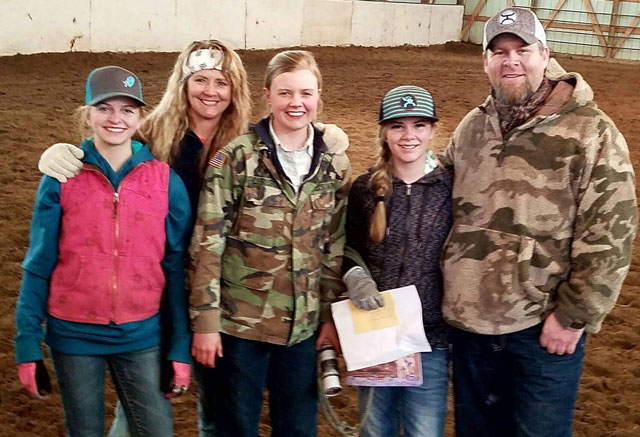
ProFile: Ronda Skinner
Breakaway roper Ronda Skinner is the co-owner of The Bar R Ranch in Idaho Falls, Idaho, a boarding and training facility she first envisioned while driving to school years earlier. Established in the late 1990s, The Bar R Ranch was many years in the making, starting with Ronda saving money as a child to buy her first horse. “My family lived in town in Shelly (Idaho), so I wasn’t able to get my own horse until I had a way to pay for it, and then I rode, rode, rode,” says Ronda, 50. “When I was eighteen years old, I was driving to school, where I was studying to be a legal secretary. I remember very clearly telling myself that I was going to buy at least five acres of ground, and I was going to have horses and an arena and a house. It’s since grown and changed in direction, but that was the original idea.”
Roughly seven years later, Ronda’s opportunity came when her sister and brother-in-law were purchasing 20 acres of ground near Idaho Falls. “They only wanted twelve acres, so they asked me about buying the other ground and helping make payments. It was just a hay field, but I got it paid for, and we found a really ugly mobile home in a potato field. A good friend remodeled the inside and we moved it up here around 1997. That’s when I really started giving lessons, and then starting colts.”
Embarking with her on the business venture was Ronda’s new husband, Bill Skinner. They had met in college, where Bill was Ronda’s biology professor, and they later hit it off when Ronda attended one of Bill’s safety classes. “When Bill asked me to marry him, he said he’d give me a really nice house, a really nice horse trailer with living quarters, or a really nice barn. I chose the barn,” Ronda says with a laugh. “We built it in 1999, and I also finished out my master’s degree in health education.”
Along with horses, Ronda and Bill were also the first of their families to break ground in the rodeo world. Bill was team roping when he met Ronda, and after teaching her to rope, they started team roping together. “That lasted about ten minutes until I saw breakaway, which looked like a whole lot more fun. Bill wanted to be a tie-down roper more than a team roper anyway,” says Ronda. The husband and wife started buying calves, and since they were without a chute, they fashioned one out of two large fence panels and took turns opening the gate. “Bill found me a really good coach and we found some other good coaches along the way. Then we started buying a few rope horses and training our current horses to rope. I greatly benefited from those years leading up to roping because I spent those training horses under the mentorship of Pat Wyse. Putting a basic handle on a horse makes a person a much better horseman, and basic horsemanship makes for better ropers.”
Today, Ronda breakaway ropes in the IMPRA and RMPRA, along with a local association, the GVGRA. “I also do the Jackson Open season, and in the past, I’ve been a part of the ICA and associations in Wyoming and Montana. It helped a great deal that I was already a proficient rider, but learning to get my rope on took a little while. It takes about five hundred calves down the arena before a person figures out how to get their rope on. It’s a constant journey, and I’m still learning.”
Ronda is equally passionate about teaching others of all ages to rope and ride, and she also teaches the foundations of barrel racing. “My early experiences training horses taught me love of molding and channeling horses into their greatest potential, and making them safe companions that are competitive if they have the athletic ability. I like to pass that on to others so they can enjoy their horses, and teach them how to communicate with and listen to their horses.”
Ronda takes in outside horses for training, and occasionally shops for roping prospects. Her own rope horses include a 13-year-old buckskin, Jack. “He’s incredibly fast, and I started him as a two-year-old. A friend owned him at the time, and later I bought him and trained him to be a breakaway and tie-down horse for Bill. I have Roxy, an eight-year-old mare that’s cutting bred. She’s very quick and has quite a personality – she squeals at the calf when she’s coming out of the box. My golden oldie is Boy. I learned to rope on him twenty-six years ago, and I’m still competing on him. I won some money on Boy in Tremonton (Utah) last October, and I’ve given over a hundred riding lessons on him.”
Within the last few weeks, Ronda has returned to her horses and business full time, after working three years in safety oversight for a small environmental group. She originally came across the job opening for Bill, who is a certified safety specialist, but took it instead after doing the job interview on horseback. She and Bill also lived in Kuwait for several years and worked in safety oversight before moving back to Idaho. Bill’s son, David, looked after the ranch, while several of their horses stayed with Bill’s dad in eastern Idaho. Presently, Bill is working overseas at the US Naval Support Facility Diego Garcia, in the British Indian Ocean Territory.
When Bill is away, Ronda finds a variety of people willing to open roping chutes for her; she says she now understands why Trevor Brazile famously said, “I wear out a lot of chute help.” Her latest goal is learning to heel. “A client who purchased one of my horses, Pearl, wants to start competing,” she adds. “My goal is to get him rolling, and my breakaway goal is to go as often as I can to as many rodeos as I can.” -

Back When They Bucked with Larry Trenary
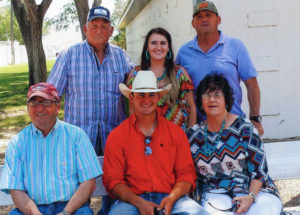
Family picture at the Colorado State High School Finals in Lamar, CO – Courtesy of the family Larry Trenary was “hungry” to rope, and it showed. The Arthur, Nebraska cowboy spent the best days of his life, roping with his sons, Bret and Troy.
He was born in 1939, the son of Elza and Erma Trenary, both teachers, who lived five and a half miles north of the tiny Nebraska Sandhills town. He grew up in a sod house, and when his parents bought the ranch where he and his wife Sonja live, they moved there.
A ranch kid, when his family moved to Lincoln, he “hated every minute of it.” The Trenarys spent vacations and summers on the ranch, and Larry spent time with his uncle Lawrence Shaw at Sutherland, Nebraska. Uncle Lawrence was a cowboy who knew how to rope. Larry knew how to rope from growing up on the ranch, but Lawrence smoothed out the rough spots on his skills, and provided a horse Larry could ride.
He graduated from Northeast High School in Lincoln in 1957, and that summer, went to the Nebraska State High School Finals Rodeo in the calf roping, steer wrestling, bareback riding and cutting. He won the all-around and represented Nebraska in the calf roping and cutting at the National High School Finals.
Then a move to California would add to his rodeo repertoire. Larry spent a year in college in Visalia, Calif., and met two fellows: Manuel Macedo, and Bob Wiley. Manuel got him started team roping, heeling for him at amateur rodeos (team roping wasn’t new in California but it was not common in Nebraska). Wiley, who was from Porterville, Calif., roped and tied calves with Larry all night long. In the old dairy barn owned by Manuel’s parents, with the lights on, “we’d tie calves till three or four in the morning, till we got tired,” Larry remembered. “We were learning to be faster all the time, and consistent.”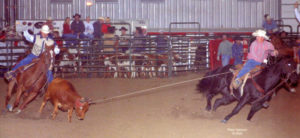
Larry heeling for Marvin Mueller at the 2002 Mid-States Finals – Peter Hammer After a year in California, Larry was back to Arthur, where he had been dating a local girl, Sonja Mickelson. The two tied the knot in 1959, and lived in California for a short time before making their home on his parents’ ranch north of town, where they still live today.
They ranched, but Larry’s parents weren’t rich and didn’t have a lot of land or cattle to give their son. So he supplemented his income with rodeo. He became a member of the Nebraska State Rodeo Association (NSRA) the same year he got married. He also belonged to the Mid-States Rodeo Association (M-SRA).
Larry dominated his events in the NSRA and the Mid-States. He won the NSRA calf-roping title in 1961 and 1963-64, and the heeling title in 1961, 1972, 1978-79, and 1982-83. In 1984, he won the heading title. In 1961 alone, he won the all-around, calf roping and team roping titles and was reserve champion in the steer wrestling. He also won numerous titles in the Mid-States.
Larry competed in the PRCA as well, roping at Denver, Ft. Worth, Cheyenne, Chicago, Pendleton, and other venues, and at USTRC ropings. But he didn’t want to be gone from home that much, so he returned to the NSRA and Mid-States, plus ropings and rodeos in Nebraska and surrounding states. When he turned forty, he joined the Old Timers Rodeo Association (now the National Senior Pro Rodeo) and the Living Legends Rodeo Association. In 1991, he and Tony Tonozzi won the world in the USTRC’s senior division.
His most memorable calf roping horse was possibly the best calf horse ever in the state, he thinks. Old Black “was as ugly as could be,” Larry said. Old Black supposedly came from the wild horse herds in Montana, and was brought to Nebraska by a horse trader. Uncle Lawrence traded two bucket calves for the horse and he and Larry trained him. Old Black was never truly tamed. “He was so wild, he would kick you. You could never trim his tail and hardly trim his feet. He was just an outlaw, but he was a terrific calf horse.”
Larry and Sonja have two sons, Bret, who was born in 1960, and Troy, born three years later. Roping with his boys was his joy. “When my boys got old enough (to rope), that was the finest time in my whole life.” The three were serious students of the sport. They practiced hard, setting up a video camera and watching their runs, to see where they lost time and how to make it up. “We really worked at it, because it was our livelihood.”
The three Trenarys roped everywhere. If there was a good roping, they were there. They competed across Nebraska, Kansas, Colorado, Wyoming, South Dakota, Iowa, anywhere there were steers and a chute. They put on roping schools as well, teaching kids the fundamentals of the sport.
When Troy was seventeen years old, he was hit in the head while playing high school football. The injury put him in a coma for fifteen days. He had been an excellent heeler, Larry said, and three friends came and stayed for days, trying to help Troy rope again, but the use of his right arm was gone. Their son is still alive, and able to lead a normal life, and for that, Sonja and Larry are grateful.
After Troy got hurt, Bret switched from heading to heeling, so Larry, who heeled, lost his partner. He tried five or six different headers, but things weren’t the same. In his last years of roping, he found a good partner: his friend Marvin Mueller.
Bret’s team roping career flourished. He roped professionally for years, qualifying for the National Finals Rodeo in 1987, heading for Allen Bach.
Not growing up with a silver spoon in his mouth was an advantage, Larry feels. “I didn’t have the money to do things, and I had only one really good horse, and gosh, not very good vehicles. I was purt near broke, but kept going because of my roping.” He feels that money isn’t always the answer. To be a good roper, “I think you have to have the ability to stay on track, and the will to win. Money won’t do it. I know so many kids that their folks have a lot of money, and they want to be a great calf roper or team roper. But most of the guys who are really, really good have had to go without things in their life. You can’t give it to them. It just doesn’t work that way. They don’t seem to have enough guts to stay with something that long.
“You gotta be hungry for it, almost like you need the next dollar to eat on. That forces you to try not to make a mistake, because if you make a mistake, you’re not going to win.”
He and his boys were that way, he says. “We were like a basketball team. We trained here at home, and everywhere we went, we watched the good guys. And on the way home, we’d talk about the good guys, and what they’d done that made them so great. We just learned from them.”
The best days of his life were spending time with his boys. “It was everything,” he remembers. “We were learning together. We’d argue and fight, but it would all come out to be the best.”
Larry roped his last calf at the Arthur rodeo in the late 1970s, on Old Black. He quit team roping at the age of seventy, after having been an NSRA member for over fifty years. His roping was as good as ever, but his knees hurt. Two years ago, Larry was inducted into the Nebraska Sandhills Cowboy Hall of Fame.
Larry and Sonja take great pleasure in their grandchildren, Jhett and Mercedes, the son and daughter of Bret and Dede, who live in Salida, Colo. Mercedes, a former college breakaway roper and goat tyer is teaching school in Oklahoma. Jhett, who team ropes with his dad, is a student at South Plains College in Levelland, Texas. “They’re the delight of our life,” Sonja said.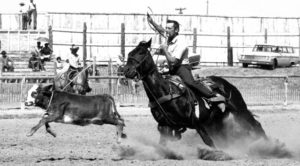
Larry tie-down roping in Gordon, NE on Old Black in the 60’s where he won the rodeo – Courtesy of the family They sold their cow/calf herd a few years ago and now background calves, which Larry enjoys. “It’s not work to him,” Sonja said. “He just loves what he’s doing. We just keep a-going.” Troy lives with his parents and helps out with the cattle work.
The couple enjoyed their rodeo years, and life now, too. “It’s a wonderful life, what we’ve done,” she said. “It’s been a great life. We’ve been up and down the road. I wouldn’t change it for anything, and I know Larry and the boys wouldn’t, either. “We love what we do.” -
Shorty Gorham
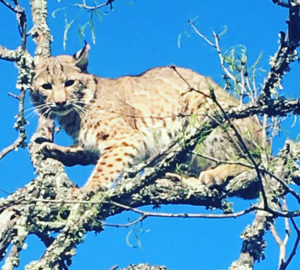
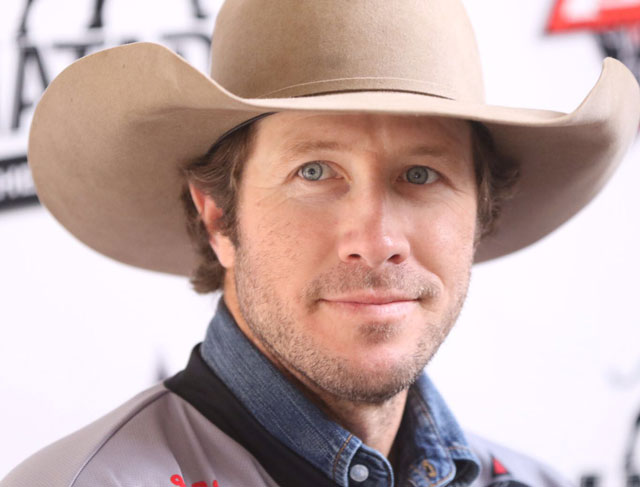
Bobcat- Courtesy of Shorty By day, Shorty Gorham is a bullfighter, now in his 12th season working PBR events across the country. By night – and even into the wee hours of the morning – he’s a hunter, either hunting deer or tracking bobcats with as many as 14 hunting dogs leading the way.
Originally from Orange County, California, Shorty moved to Cotulla, Texas, after marrying his wife, Amanda. “There are a few things I miss about California, but not very many,” says Shorty. “One of the cool things about south Texas is it’s really easy to transplant any game that’s non-native, like elk and a lot of different African game.” Cotulla is on the edge of what hunters call the Golden Triangle, a region that produces some of the country’s best whitetail deer through rigorous deer management, feed, and genetically improved breeding stock. Shorty uses Record Rack deer feed, while his hunting dogs are on Nutrena food, the parent company of Record Rack. “The deer are healthy as can be, and I’ve noticed with both my dogs and the deer that their coats are shinier and they’re fleshier,” Shorty explains. “I’ve been hunting my dogs hard enough to know that their food is doing them justice.”
Shorty did his share of coon hunting in California, but had to transition from coon hounds to fox hounds when he started hunting bobcats in Texas. “These dogs are Running Walkers, and they have more endurance and speed. Coon hounds are bred for their treeing ability, but these dogs are bred for running game. About half of them I’ve purchased already trained, but the other half I’ve trained myself.” The bobcat population is so dense that they are considered varmints, and Shorty does predator control for several ranches in the area, which also benefits the turkey and quail population. “I have GPS trackers on all my dogs so I know where everyone is at all times. You turn the dogs loose and follow them; I try to drive through areas that are bobcat habitats. You wait for the dogs to pick up a scent, which they’ll hopefully follow, and then you listen to some good old-fashioned hound music.
“The down-side to these dogs is that you have to hunt them really hard to keep them tuned in,” Shorty adds. “There are days I’m tired, but the dogs don’t care – they still need to hunt. When I’m beat up and sore, it can feel like a job, but this is my enjoyment and my therapy. I hunt alone a lot, and it’s peaceful. It lets my mind rest and just enjoy good dog work. And hopefully we catch some cats!
During the first few months of the year, Shorty’s PBR schedule keeps him on the road five or six days a week, flying from San Antonio to any of the major cities hosting the PBR. “This season has been going really good. We’re on track to break records again as far as attendance, and we have a young bunch of bull riders coming on the scene with that old school mentality of coming to win a world championship, not just be there their first year. If it keeps on course, this will be one of the more exciting years of my career,” he says. “When I was working rodeos, there were three or four month stretches where I never saw home, but now it’s just three to four days a week. I’m gone just enough that my family doesn’t get tired of me, but the dogs don’t bark at me.” Shorty and Amanda have a son, Tanner, and a daughter, London, who both compete in rodeo.
Shorty has also entered the stock contracting world, recently partnering with his wife’s cousin to put together a string of Spanish fighting bulls. “The freestyle bullfighting industry has taken off,” says Shorty. “It’s been on hiatus for twenty years, and it’s making a resurgence. I’m getting a little long in the tooth to be fighting bulls, so hopefully we’ll have everything together with our bulls so when I’m ready to hang up bullfighting, I can step into the stock contracting. I’m also working with Nutrena on building a feed for our fighting bulls, so we’re experimenting with different energy sources to enhance their performance. It’s been fun to have that relationship with Nutrena and Record Rack.” -
On The Trail with Faith Hoffman
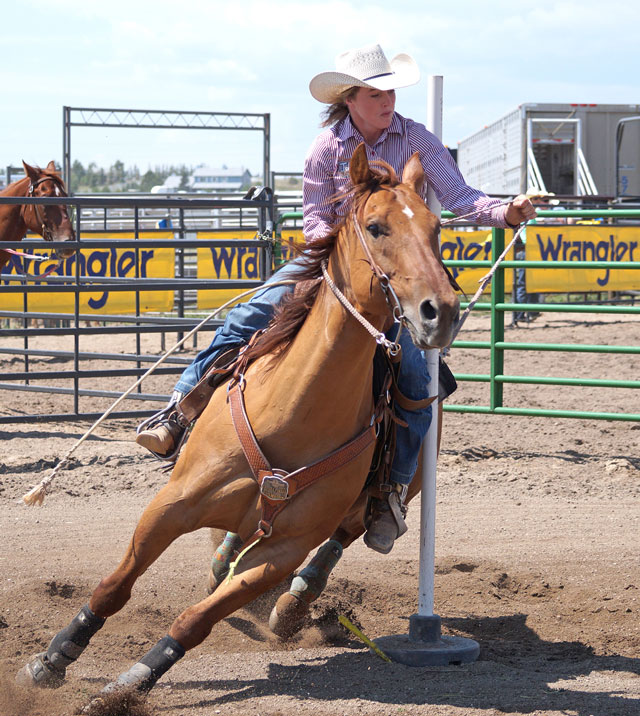
Faith Hoffman of Kiowa, Colorado, is the reigning CSHSRA goat tying champion. The 18-year-old plans to defend her title at state finals at the end of May, earning her third trip to the NHSFR. Yet as quick as her hands and feet are in her favorite event, Faith is even quicker to encourage her fellow competitors, friends, and family.
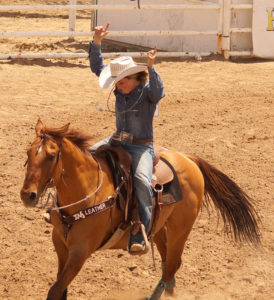
Faith celebrating at 2016 CSHSRA Finals – Chelsea Hoffman Whether it’s giving someone a pep talk at a rodeo or sharing Bible verses, Faith is passionate about helping others. “Our family anthem is Ephesians 4:29, ‘Do not let any unwholesome talk come out of your mouths, but only what is helpful for building others up according to their needs, that it may benefit those who listen.’,” says Dave Hoffman, Faith’s dad. “She’s really an encourager of others, and I think because of her, other kids are encouraging as well.”
Faith’s introduction to the rodeo world came through her dad, a first generation rodeo cowboy and bareback rider turned farrier. Dave competed in the CPRA and PRCA Mountain States Circuit, and later coached the Air Force Academy college rodeo team. Faith started traveling with him when she was five or six, making fast friends with his traveling partners and their children. She was competing in peewee barrels by the time she was eight, and two years later, Faith was a member of the NLBRA and had discovered her passion for goat tying. “It’s such an aggressive and quick sport,” says Faith, who also competes in barrel racing, pole bending, and breakaway roping. She even team ropes on occasion when someone needs a header. “I play basketball too, and I think that sport and goat tying cross over.
When I’m teaching girls to tie, I compare it to basketball moves and how you have to be quick and aggressive in both. I also like how you don’t need an expensive horse to compete in goats – it’s about the work you put into it. I feel like everywhere I turn, there’s someone who has my back or will pick me up, and that’s really shown me that rodeo’s not all about what you put into the arena, but also who you are outside.”
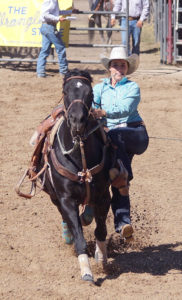
Faith goat tying at CSHSRA Elizabeth 2015 – Chelsea Hoffman Last summer, Faith had the opportunity to teach goat tying at High Plains Rodeo Bible Camp in Hugo, Colorado. She also teaches goat tying lessons from home and at clinics. “It was super fun in Hugo. There were about sixteen kids in the goat tying, and it was a lot of fun to teach them and be in a spiritual environment. I was also a group leader there, so I lead devotions and prayer with five or six girls. It was pretty cool seeing them learning and realizing what Jesus is all about.” Faith also spoke during Cowboy Church at a CJRA rodeo in Yuma, Colorado, last summer when Dave wasn’t able to be there. He’s been involved in the rodeo ministry since he was 19, and has lead Cowboy Church in the CSHSRA the last year and a half. Last summer, he performed a number of water trough baptisms in arenas.
For Faith, rodeo especially complements her relationship with the Lord. “My favorite verse is Jeremiah 29:11, ‘”For I know the plans I have for you,” declares the Lord, “plans to prosper you and not to harm you, plans to give you hope and a future.”’ I have that written down all over, and I can really see that in the rodeo world, because things can change so quickly. You can get hurt and be out a rodeo or a whole season, or other things can happen, and I think that it really puts an emphasis on faith. My mom tells me all the time if I have a bad rodeo or don’t win that God had the win planned for someone else that day.”
Faith received her own encouragement two autumns ago when her barrel horse, Cracker, fell during practice and broke his leg. “This was after Faith won state finals in the average on him. He was an amazing horse,” says Chelsea Hoffman, Faith’s mom. She works in marketing in Denver and does some of the photography for the CSHSRA. “We had ten people offering horses to her, which is huge in barrels. Rodeo has been really amazing for Faith and opened up opportunities like scholarships and being part of an amazing rodeo family. In junior high, she had sessions with college barrel racers, and she’s worked with Kaylee Moyer and Jill Francis, who are great goat tyers. She’d tie until midnight with them if she could. Logan Kenline and his family are very close and have helped her with her roping, and she’ll also rope with the Meeske family.”
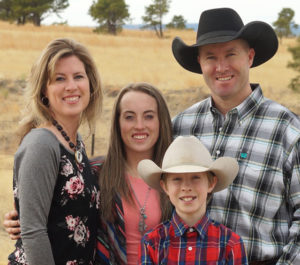
Chelsea, Faith, Cade and Dave Hoffman – Courtesy of the family 
Faith at age 10 and her little brother, Cade at age 3 in Buena Vista – Courtesy of the family At home, Dave helps Faith exercise horses, and Chelsea holds goats and videos runs. Faith competes on Johnny in pole bending, goat tying, and barrel racing. Johnny was voted CJRA Senior Girl Horse of the Year in 2016. Faith has also run barrels on Drifter, and recently brought home a mare, Barbie. “She’s a diva,” Faith says with a laugh. “She’s started in the breakaway, and I’m so excited to see her finish up. I’ll probably start her in barrels, too, since she’s super quick.” Family time is spent in the practice pen and at rodeos, and Faith’s itinerary this summer includes The Best of the Best Timed Event Rodeo in Gallup, New Mexico, the IFYR in Shawnee, Oklahoma, and the NHSFR in Gillette, Wyoming. Her 11-year-old brother, Cade, travels to many of the rodeos and is an avid hiker. Over spring break, he and Dave went on a hiking trip in the Grand Canyon, and they have several other national parks on the list to visit.
This school year, Faith has started her mornings at Abbott Ranch in Kiowa before finishing her afternoon classes at Kiowa High School, where she’s a senior. “One day I might be pulling manure, the next we’re moving cows or hauling hay,” says Faith. “I didn’t grow up on a ranch, so it’s nice that I get to learn these things.” She’s also helping plan the class of 2017 graduation, and finished a banner year playing basketball with the Kiowa Indians.
This fall, she plans on attending Sheridan College in Wyoming on a rodeo scholarship. Faith’s focus is on goat tying and breakaway, as well as majoring in athletic training. “My dad was a coach in the Central Rocky Mountain Region, and I still know a lot of the coaches there. I’d eventually like to transfer to a university so I can get my masters and rodeo a fifth year in college,” says Faith. “I want to win the state championship in goats again, and we have some tough competitors this year. I’d like to go on to Nationals and win there, but I’m not going to stress over anything, because God has a plan.”