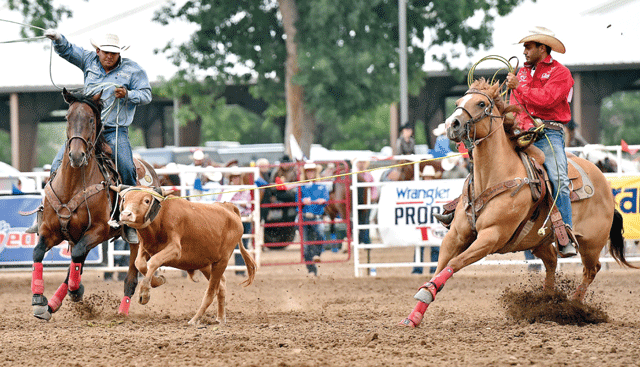
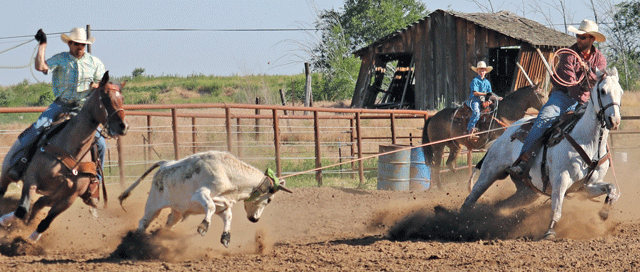
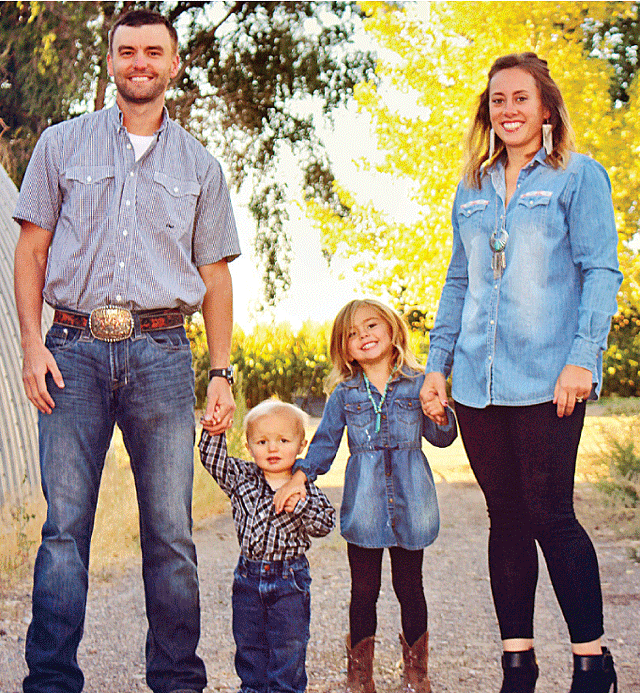
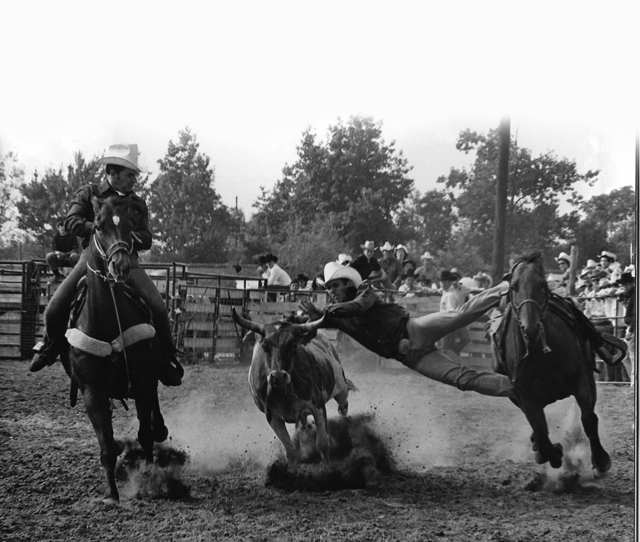
[ Josh & Jonathan Torres both sit at 17th in the PRCA Standings and share the common goal of qualifying for the WNFR this year. ]
Josh and Jonathan Torres, lately of Stephenville, Texas, share the bond of brothers, team roping partners, and business partners, along with their common goal of qualifying for the WNFR this year. Josh, 29, is the header, and Jonathan, 26, is the heeler, both sitting 17th in the PRCA standings. The brothers spent their early years near Miami, Florida, following after their dad, who rode horses and kept a small herd of cattle. They high school rodeoed for Florida and later moved to Lake Charles, Louisiana, to attend McNeese State University. Despite their three-year age gap, they were able to rope together for two years and qualified for the CNFR in 2012 and 2013, where they won several rounds.
“I just like roping, period. But I like that you have to have somebody that also has the same plan and goal as you,” says Jonathan. “You pretty much have to be a team player for everything, and you both meet other people who help you out. Then you have two people with ideas and strategies, not just one.” Josh feels the same about teamwork, both with his brother and his horses. “It takes such special horses, and when a team is working on getting those horses together, you realize how many you have to go through to get a couple of good ones. I think trying to get on a lot of good horses or make them or find them is the best part about team roping. If I didn’t have a fun head horse to ride, I wouldn’t be doing it. I like to show them off and have fun doing it—that’s what keeps a guy motivated to do what we do.”
Josh’s main rope horse, Junior, is an 8-year-old gelding he purchased from his friend Willie Brooks in Baton Rouge, Louisiana, who asked Josh to season Junior. “He’s extremely smart. I asked my friend if he wanted to sell Junior just because he was so athletic. He’s kind of hard to ride—his feet move so fast, so your mind has to move just as fast. He’s been fun, and I wouldn’t be entering any rodeos if I didn’t have that horse.” Jonathan has ridden his 12-year-old gelding, Biggie, for the last two years, whom he purchased from Brock Hansen. “He’d been rodeoed on before by Cesar de la Cruz, and Brock had him and didn’t need a heel horse. He wants to win, and he’s a powerful, big horse. Biggie is out of a Playboy Boonsmal stud horse, and he’s kind of gritty and cocky.” Jonathan and Josh also took two other younger horses on the road with them this year as backup horses that they’re seasoning.
Whether on the road or at home, they’ve fed their horses Nutrena’s SafeChoice Original for the last five years. “You have to take care of your horse, because that’s what makes your money, whether it’s worming, hay, feed, or clean water—all those things make a difference,” says Josh, who has a degree in animal science. He and Jonathan have even conducted several feed experiments with their horses, and found they had the calmest energy on Nutrena. “It keeps our horses energized, and we might feed three or four times a day. I had a horse that wouldn’t eat very well on the road, but he went to eating that Nutrena and we’ve had really good luck with it on the road. Nutrena is sold all over, so it’s pretty easy to find. We like to have a good-looking herd.”
Along with keeping several young horses at home to work on when they’re not traveling, Jonathan and Josh run Young Guns Productions, LLC, a timed event stock contracting business. “We have Corriente cattle and we lease cattle to cutters. When they get big enough to break in, we use them for jackpots and then lease them to people for practice or ropings,” says Jonathan. “When we’re gone, a couple of our buddies like Cory Clark and Dillon Wingeried help out, or we’ve hired contract help. It’s a team effort!”
Of the many rodeos on their 2018 run, a favorite of Jonathan’s is the Salinas Rodeo, while Josh enjoys San Antonio. “I like Salinas because we’re there for a few days, and they have fresh steers that have never been roped—it’s kind of ranchy and fun,” says Jonathan. Josh adds, “The hospitality is great over at San Antonio, and it’s the loudest rodeo that I’ve ever been to. Your adrenaline is going and it’s a pretty fun and exciting rodeo.” Their goal is to experience the energy and excitement of the WNFR next. “It’s the best chance we’ve ever had this year. I definitely want to thank our parents, Jose and Teresa Torres, and my wife, She’Rae Torres, for helping all of us,” Josh finishes. “And I’m thankful for the relationship we’ve had with Nutrena. Rodeo is a hard deal, and it takes a lot of effort from so many people. The Lord has put certain people in our lives and got us through so many situations good and bad. Because the Lord is so good to us we keep our heads up and remind ourselves to take advantage of every situation as best as possible. We believe in His plan. We just try to do our jobs, believe, and work!”
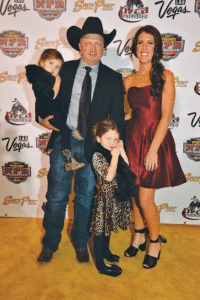
Annelle (Nellie) Miller gets home as often as she can. “This year I didn’t have to travel near as much,” said the mother of two. “We had a pretty good start in the winter so we could pick and choose where we wanted to go.” Nellie has fit motherhood into her NFR run perfectly. “They travel with me most of the time.” That family includes James Miller, General Manager of Red Bluff Roundup, and their two daughters; Payton is 6 and Hadley is 3. “Since they aren’t in school yet, they can go with me. My parents are a huge factor in this too – her dad, Sam Williams, trains her horses, and her mom, Roxy often goes down the road to help with the girls. She has two brothers, Clint and Wyatt.
Accepting her buckle at the 2017 WNFR – Hubbell
At the CNFR, 2007, riding Blue Duck, the first of two years winning the region with her UNLV team, where she was regional champion as well as Rookie of the Year – Hubbell
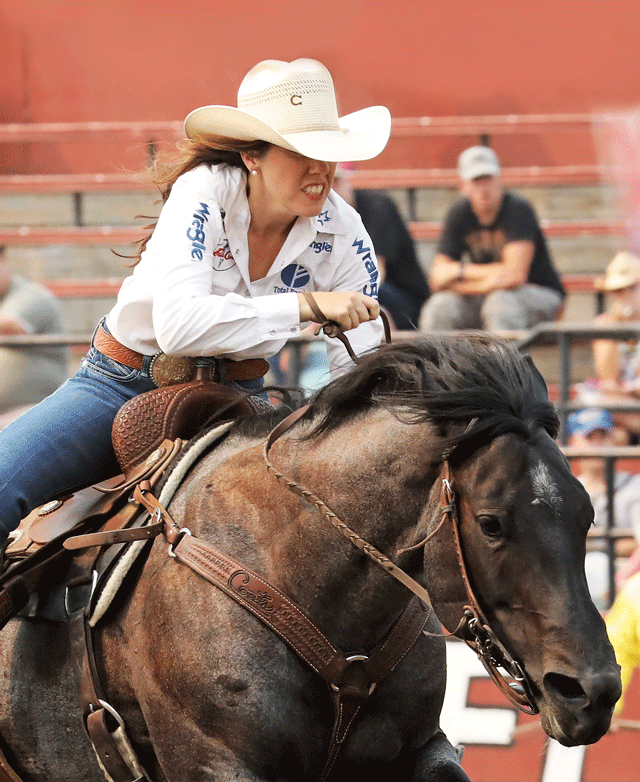
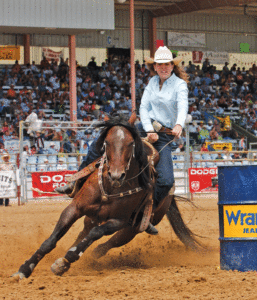
She competes on her horse, Sister, a 10-year-old blue roan mare, Sire: KS Cash N Fame/Dam: Espuela Roan. “I have so much confidence in her,” said the 30-year-old who is making her third appearance to the Thomas and Mack arena this December, with career earnings of $533,276. The duo won Cheyenne Frontier Days in spite of a run around the barrels in the hail. “I knew she was going to work no matter what. My main plan was to push her through that hail – my cowboy hat helped block it a little bit and luckily it wasn’t too big. We definitely felt it – honestly I don’t remember much about it, I was just trying to get through it.” Back home in California now, Nellie is doing mom stuff. “I’m riding a few horses and I’ll go to the Circuit Finals, but until December, I’m home. “ The road to her third WNFR qualification started when she was a little girl.
Nellie started riding about the age of ten. Roxy took it upon herself to take her daughter to some gymkhanas and once she started, the whole family pitched in. Sam is a self-taught horse trainer. “I’ve had a few mentors along the way; Tom Johnson, Bob Nelson and his wife, and I picked up a little bit from everybody, learning where I could from anybody.” Sam breaks all the horses they use on the ranch and roping trail. “I rope and my boy ropes too. Nellie started out roping and the barrels just happened,” he said. “You have great hopes for all of the horses you ride, but until you put them on the clock, you never know. Sister was a real good mare to break and ride – real confident. I was tying cattle out in the field when she was four – very willing and not afraid. To run at the PRCA level, you have to have a horse that can do anything. She tries hard every time. So does Nellie – she doesn’t weaken an ounce.”
Nellie rodeoed through high school, competing in team roping, barrel racing, breakaway roping, pole bending and goat tying, although goat tying was her least favorite event. She made the high school finals in barrel racing all four years, but only traveled to it three times. “My last year it was in Springfield, way far away, and the horse I was on was a real good horse at state level, but not at a national level, so we decided not to go. Her parents, Parents are Sam and Roxy Williams and brothers are Clint and Wyatt…Father Sam trained her horse Blue Duck which was a homegrown horse and started out as Sam’s roping horse.”
Nellie went on to college rodeo at UNLV in Las Vegas, winning the region and second at the CNFR. “I never made it in the roping, just barrels.” She had a great horse in Blue Duck AKA Rebas Smokey Joe (Registered name), half brother to Sister, and made the decision to start rodeing professionally on him. She filled her permit on 2008, but Blue Duck got hurt midyear and they went home. “He came back the following year and did OK and in 2010 we made the NFR.” Nellie has no words to describe her first trip to Vegas. “You never know until you experience it for yourself. It was a real learning experience. We struggled that week. We didn’t know what to expect.” The duo won second in the first round, and after that they were one out of the money every night for five or six nights, and then it went downhill.
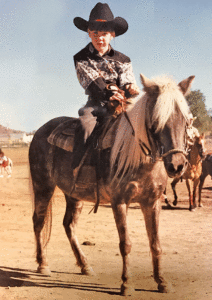
Nellie at age 5 on her pony Snowball
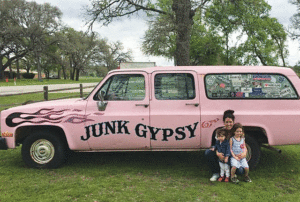
Nellie, Payton and Hadley with their Junk Gypsy
Nellie competing at the High School Finals 2004, riding Reba, the mother to Sister and Blue Duck – JenningsRodeoPhotography.com
The bright spot in that year is she met James Miller, who worked for one of her sponsors. They got married one year later in Las Vegas. Payton was born in 2012 and they moved to California in 2013 for the position that James accepted as GM for Red Bluff RoundUp. Hadley was born and Blue Duck was getting older and Nellie was starting to work with Sister, but she wasn’t quite ready for life on the road. “She had a lot of potential and had what it took to be a rodeo horse, so when she came on, we hit the trail.”
The family lives in Cottonwood, California, two hours from the Oregon border. The small town has a lot of team ropers and barrel racers, but it’s not the California that people generally think of. “It’s rural and ranching.” Nellie was raised there, but James made the trip across the country from his home state of Florida. “I kind of joke about James – he hit California and had more friends than I did – and I lived here my whole life. He’s got a lot to do with the community and the town and it’s fun to be a part of all that.”
Both girls have ponies and they are already talking about barrel racing. For now, Nellie and Sister are at home making sure they are legged up for Vegas. “We raised Sister and have a whole family of horses related to her – I’ve been running her since she was six, and she’s consistent and always fires. She’s special!” Nellie’s secret to being on the road is simple. “I just try to do my own thing and if it works out that I win great and if not, that’s the way it goes. I don’t get wrapped up in beating anyone.”
Rounding the barrel at the 2017 WNFR – Steven Gray
Lacee Curnutt from Talihina, Oklahoma, grew up riding on a ranch. Her grandfather, Don Huddleston (Back When They Bucked, page 18)raised her riding with him on the southeast Oklahoma ranch. “My grandpa went to the NFR 8 times and even though he had retired by the time I started hazing, I used to haze for everyone he helped,” said the oldest of five sisters. “On Sundays, Grandmomma took me to church and we always practiced after the meal.” Lacee competed in barrel racing and hazed with her two bulldogging teams through college. “Those two teams helped me stay on the rodeo team,” she said. Lacee went to college for elementary education, but left to go pro rodeo before completing the student teaching.
She hazed for her ex-husband and several bulldoggers and came home when she became pregnant. “Then along came Walker Don Woodall,” she said. “I couldn’t be luckier –he’s friendly, loving and kind. And a good boy.” She came home and waitressed and eventually worked in the oil fields. “I was still hazing at the amateur rodeos and raising Walker; trying to be a good mom.” Although Walker rides horses, his first priority is playing football. He also likes fishing and playing baseball.
Lacee with her fiance Tom and son Walker – photo by Jana Hardin
Lacee her senior year of high school, 2001 – Courtesy of the family
Lacee met steer wrestler Tom Lewis through a mutual friend and they literally met on the road – at a Wendy’s at Hayes, Kansas. He went his way and she went hers. “I told him if he made the short round at Dodge City, Kansas, I’d come watch him.” He did and she went and he won the rodeo. “It was a good first date.” That was more than a year ago and the couple will be married November 10.
She has been able to stay home, quitting her job of hauling horse trailers, to take care of the horses at home and keep up with 10-year-old Walker and Tom. Whenever she can, she hazes for Tom as well as several others. “I can remember the first time in 2003 when I bought my card. I hazed in Ft. Worth and they were fresh cattle; that will always weed out who deserves to be there. It was a man’s sport, and I had to prove myself before they were ever really nice. Once I did, they were good.”
She says that one of the secrets to being a good hazer is having a good horse. “That hazing horse has to help everyone,” explained the 35 year old. “When I was young, I had a horse that we got off the track. He bucked everyone off and finally I got him and he took care of me until the day he died. He was 22 – it’s been hard to find another one. I’ve trained a bunch, and Chad Richard out of Utah had one that has been super awesome – Superman.”
“Throwing your leg across enough of them you know the difference. When to say enough is enough and when to keep messing with them. With age, you recognize what a good horse has to have. You’ve got to have some heart in them – I like finding that peace in a horse.” They have the perfect team now between Superman and Maverick. It’s the same way they feel about working as a team with each other.
Barrel racing at the Betty Roper Ultimate Barrels and Team Race – Courtesy of the family
Lacee hazing for Curtis Cassidy at Cheyenne – photo by Hubbell
“I never thought I would ever have a lady haze for me,” said Tom, who made the NFR in 2012. “She’s not just a cowgirl; she’s special. She’s the love of my life, we’re good friends and we can talk. It’s been good. At the end of the day, it’s just a rodeo.” He has been dogging steers since he was a junior in high school, joining the PRCA in 2001. In 2012, after winning the circuit 4 times, he made a run at the NFR. His good horse got hurt after he made the NFR in 2012 and it’s taken him four years to find Maverick. Four guys rode him at the Finals last year and the duo, along with the hazing horse, Superman, have had a great year.
Lacee’s goal in life is to be happy and have a peaceful life. “I want to give back, I love helping young ones! Always give God the Glory; we would be nothing without Him! Her other goal is to be the first female hazer at the NFR, a goal she has held dear for many years. “I’d love to make history. To me it would be a payoff of years and years of hard work.”
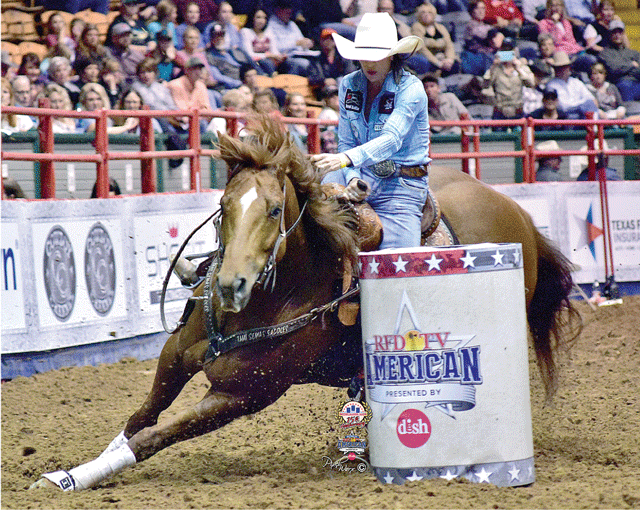
Tami Semas—professional barrel racer, saddle designer, and wife and mother of two—found her niche in the horse industry in high school, and dug deep into her passion after college. The first of her family to rodeo growing up, the 41-year-old from Brock, Texas, learned by trial and error, and her persistence earned her two qualifications to the PRCA Columbia River Circuit Finals, and a place at The American’s inaugural rodeo in 2014. In 2015, she was Equi-Stat’s highest-earning rider of futurity horses, and has trained multiple futurity and derby winners. “Where a lot of people who’ve had parents in that event have the process narrowed down a little bit, I had my biggest successes from my biggest failures,” says Tami. “I’ve spent a lot of time learning from horsemen how to get a horse really broke. I understand the game of barrel racing, and to combine that with horsemanship is kind of my approach. I wanted a very smooth motion in my horses around the turn, and I have learned to get a horse to be soft. I’m a small person—I can’t hold the horse around a barrel—and I’ve learned through various horsemen how to get a horse to respond through weight, leverage, and positioning to keep them light.”
Searching for a saddle that was balanced for Tami’s smaller stature led her to becoming a saddle dealer for seven years, and ultimately, launching her very own line of Tami Semas Barrel Saddles. “A lot of saddles on the market didn’t feel like they balanced my weight great, and either pushed me forward or back. I ride everything centered, and I bought a saddle from one company that worked pretty good,” explains Tami, who at that time was Double J Saddlery’s highest-selling dealer without a store. “I learned a lot about what many riders were wanting and needing. I came up with some ideas on how I would tweak things if I would ever be able to build my own saddle from scratch.”
Tami quit her dealer job in 2014, and she approached a manufacturing company about building her own saddle that same year. “A lot of things are the same with saddle parts, but they can be put together to have a uniquely different feel,” Tami explains. Her saddle came out in the 2015, her best futurity year to date, and the Tami Semas Barrel Saddle was a success. They now sponsor several athletes, including Hallie Hanssen, a futurity horse trainer from South Dakota. After two-and-a-half years, Tami decided to go out on her own for manufacturing, and with the aid of her custom tree maker and a new manufacturer, the latest line of Tami Semas Barrel Saddles will launch this fall.
Of equal importance to a balanced saddle is the saddle pad underneath, and 5 Star Equine became one of Tami’s sponsors the year her first saddle came out. “I’m a firm believer in their product. I’d used their pads over the last 10 years, and they’ve been a sponsor over the last 3 years, and we also promote them with our saddles,” says Tami, who is also using 5 Star’s new line of leg gear. “The things I use for my barrel racing and riding I call timeless tools. I’m not someone to use the latest and greatest thing that’s come out on the market; I’m going to use the tools that have stood the test of time, and I believe 5 Star is a product that has stood the test of time. That 100 percent natural wool has always allowed my horses’ backs to breathe well, especially down in Texas. I want a pad that absorbs shock, breathes well, fits comfortably on my horse, and can withstand weather conditions, and 5 Star has been that product for us.”
Tami, who trains all of her horses, sold her futurity horses this year, thinking 2018 was her year to rodeo. But when her horse Smooth N Famous, who won nearly $200,000 during his futurity career, had an injury this year, she had to turn him out to pasture and make a new plan. That became running and seasoning a 6-year-old, Colour Me Gone, she trained and sold but bought back recently. “I’ve pretty much seasoned him at the pro rodeos, and I’ve gone to Northside, which is an open rodeo every weekend. I always like the Diamonds and Dirt Derby, and we just keep training horses this year and selling them. Next year we’re hoping to have our horse better seasoned for the rodeos,” says Tami.
Her 15-year-old daughter, Madison, traveled with her most of the summer, and enjoys riding and other sports, while Tami’s 16-year-old son, Myles, plays football. Aaron, Tami’s husband, rode bulls for 18 years and qualified for the WNFR 7 times, while he’s also one of the founders of the PBR. “He’s doing some fixer-upper homes down here and ropes, and when you have a family and kids at this age, it’s definitely a busy time. What we’re doing is just trying to train good horses, build a good saddle, and let the horses tell us where we’ll be going.”
The wife of one of the biggest rodeo stars of his time led an interesting life of her own.
Even though Jane Douthitt often lived in the shadow of her husband, Buff Douthitt, she managed to be involved in a variety of activities.
Her life started on June 21, 1936, the daughter of R.C. and Ola Francis Kirkland, near Knox City, Texas. Her father was a rancher, and she and her brother were always on horseback. Living fifty miles from the nearest grocery store, horses and riding were their entertainment.
She graduated from Guthrie High School in 1952 and went to college at Texas Tech in Lubbock, majoring in business. She did not compete in collegiate rodeo; she had other plans. “I had my mind made up,” Jane said. “I didn’t have time to do anything but get my education. I had my life to get on with, in my mind.”
After college, she moved to Wichita Falls, where her dad’s kinfolk lived. She competed in barrel racing at amateur rodeos, riding borrowed horses. At the time, local ranchers would sponsor barrel racers, furnishing the horse and paying the cowgirl’s entry fees, and that’s how Jane rodeoed.
She competed in several pageants, finishing as runner-up for Miss Wichita Falls Queen and winning the Miss Rodeo Archer City title in the mid-1950s.
Her brother was in college in Wichita Falls when she met the man who would become her husband.
Jane had admired the looks of Buff Douthitt, a tie-down roper, steer wrestler, and roper in the wild cow milking (at that time the wild cow milking was often included in pro rodeos) when a picture of him with a group of other cowboys at Madison Square Gardens in 1946 hung in the ranch office where her dad was general manager. At the age of ten, she had pointed to his face and declared to her mother, “here’s the man I’m going to marry.”
She convinced her brother to take her to Vernon for a pro rodeo, and at the dance after the rodeo, Buff asked her to dance. She didn’t recognize him; he wasn’t dressed western but had on dress clothes and dress pants. “Gee, I thought he was cute, but I was determined that I was going to find me a pro cowboy,” she said. “So I turned him down. What a mistake that was.”
Jane and husband Buff in 2005 – courtesy of the family
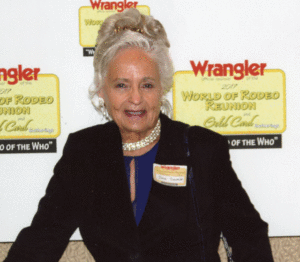
Jane at the December 2017 Ladies of Pro Rodeo Banquet in Las Vegas.
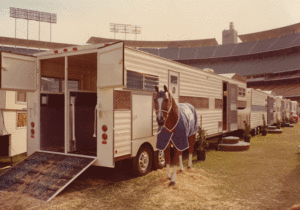
The first horse house trailers on display at the Quarter Horse Congress in Columbus, OH in 1972.
The next day, on a date with another cowboy, she was introduced to Buff and she realized who he was. “I knew I had made a big mistake,” she said.
She dated a couple of cowboys, seeing Buff occasionally, but he never paid any attention to her. In January of 1956, she was about to get his attention. She was at the Ft. Worth Rodeo, sitting with the contestants’ wives and girlfriends, looking down the stairs where the contestants were. “I was conniving,” she laughed. “I saw him start up the stairs, and I just happened to be going down the stairs.” This time, he stopped; they shook hands and talked a bit, and he asked her to the dance that night.
By the time the dance was over, they knew they would marry. “I say it was God,” Jane said. “It was His design, from start to finish. It was wonderful. We were still just as in love to the day he passed away.”
They married in September of 1957 and rented a house, no bigger than a studio, in Wichita Falls. He rodeoed and Jane traveled with him, as her job with the oil company allowed. Their first child, April, was born in 1959.
In 1958, Jane quit work to travel with Buff. At that time, they lived in Throckmorton, where her parents had moved. Three years later, Buff helped train race horses at Hialeah Race Track in Miami, Florida, and Jane and April spent the time with him. Buff and Jane bought a used Air Stream Trailer to live in while in Florida.
In 1962, the family moved to Ardmore, Okla., where they had some horses and cattle on fifteen acres. Buff continued to rodeo and that year, their son Jason was born.
It was in the 1960s that Jane took another role with rodeo. She had timed rodeos for Beutler Bros. but decided if she was on the road with Buff, she could be earning some money, too. She learned to secretary rodeos and worked for Hoss Inman, Mel Potter of Rodeos, Inc., and others. This was before computers, when a secretary had to do all the work by hand, including typing day sheets. Often, Buff would drive while she balanced a typewriter on her knees and put together judges’ sheets. “I have always said that if you can (secretary rodeos) and not make a mistake, you can do anything in the world. Boy, what a responsibility,” Jane said. “I loved it.”
While Buff rodeoed and his family and children traveled with him, they traveled in a car with a horse trailer, staying at hotels. But that year, the price of a room at the Holiday Inn went up $10 a night, “and that was bad news for every cowboy,” Jane remembered. That fall, Buff started planning and designed “horse house trailer”. He, along with a carpenter, in the Douthitt garage, started building a trailer that included a compartment to house horses. When spring came, the Douthitts left for the rodeo trail in their own custom designed horse house trailer, and everybody who saw it wanted one, Jane said. For several years, Buff tried to build one or two in the slow season to sell in the spring.
In 1969, Buff quit rodeo competition and the family moved to the Ft. Worth area, where they bought a small manufacturing plant to make the horse house trailers. Two years later, they couldn’t keep up with the demand, expanding their manufacturing area and making not only horse house trailers but travel trailers, motor homes and hippie vans.
Jane goat tying in 1979 – Cimarron
ne at age 4 riding ‘Ole Danger.’ “He was my first gown up horse and dad would saddle him at 4 am and I rode him until dark everyday.” – courtesy of the family
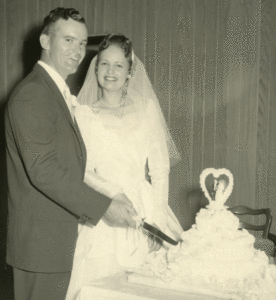
Jane & Buff at their wedding in 1957
Then the oil embargo hit in 1974 and fuel was in short supply. The general public cut back on driving and “cowboys quit pulling trailers,” Jane said. The heyday of their business was over.
But they adapted to the times, and instead of building trailers, switched to contracts with the U.S. government. They built latrines for the troops in South Korea, relocatable housing, “skid towns” – portable housing for pipeline workers, and residential housing that ended up in Houston. Their products went to a variety of foreign countries, including Syria, Saudi Arabia and Iran, countries in Africa, and to Hawaii. Their business, called MBM International Inc., was headquartered in Ft. Worth. At its height, it employed over 3,500 people in the Dallas-Ft. Worth area.
In 1981, they decided to retire and sold the business to a foreign company. Jane stayed on with the company for another year, helping them get on their feet. The couple decided to move to Hawaii, but it wasn’t as much fun to be residents there as it was to be tourists.
So they flipped a coin to determine where their retirement home would be. Buff had grown up in New Mexico, Jane in Texas, and the flip decided the state. New Mexico won out, and the couple moved to Santa Fe. They became involved in the state’s movie industry, providing livestock for movies. Buff served as a movie consultant and played some cameo roles.
Jane took a position with the Edgar Foster Daniels private foundation in Santa Fe, a foundation that funds operas around the world. It was a job she loved. Buff team roped locally, and Jane usually went with him. She loved team roping and she loved watching him compete. Together, they competed in the ribbon roping at senior pro rodeos. Jane ran for other ropers, too. “I could really run at that stage of my life,” she said.
In 2006, tragedy struck. At the age of 43, their son Jason died in a gun accident. It hurt Buff and Jane terribly. “That about killed us both,” Jane said. She retired from the foundation.
In 2014, a horse was tangled in an arena panel when Buff went to release him. No one was around when the accident happened, but it appeared that the horse drug Buff before kicking him, breaking vertebrae C1 through C5, his shoulder and four fingers. Doctors put four metal rods and 22 screws in his neck, and he was hospitalized for several months. He died in September of 2016. Jane had lost her business partner and husband. It took over a year for her to move through her grief.
Now she stays busy, with an office complex she purchased in downtown Santa Fe. She loves to read, travel, and spend time with April’s sons, who are 23 and 18 years old.
She looks back on her beginning, a modest start on a ranch in Texas, and is sometimes amazed at what she and Buff did. “I still wonder how two kids raised on ranches could accomplish what we did.”
It was a good life, she said, and rodeo was a big part of it. “I loved rodeo. I loved watching Buff” compete.
Buff was inducted into the National Cowboy Hall of Fame in 2001 and Jane was honored at the Ladies of Pro Rodeo Banquet in Las Vegas last December.
[ Eight-time WNFR qualifier Scott Kormos currently sits at 15th in the PRCA world standings. ]
“The first time I watched the NFR, I was 8 or 9 years old, and at that moment, I thought ‘I want to be there and compete.’ So I think it was a goal of mine from the very start,” says Scott Kormos. The 38-year-old tie-down roper from Teague, Texas, has eight WNFR qualifications to his name, last competing on the arena floor of the Thomas and Mack Center in 2013. Currently, he’s sitting 15th in the PRCA world standings, traveling with fellow tie-down roper Caleb Smidt.
With his gold buckle dreams hinging on horsepower, Scott started feeding his horses Nutrena five years ago and calls it the best decision he ever made. “I got a call from them asking if I wanted to be on their team, and it’s been a blessing from the start. The way my horses look, feel, and perform—there’s nothing better. I’ve seen a really big upside. I have a couple practice horses I ride when I’m home, and one is 18 and the other is 20, but they look 12. They’re strong and they stay healthy. I feed the SafeChoice Senior to all my horses, young and old. It’s really good for the stomach—a lot of performance horses are having stomach problems, especially traveling, so this is easier to digest. I got on it and I haven’t looked back since.”
Scott also attributes his horse Aggie’s endurance through the summer run to his feed. “You’re out here a long time going up and down the road, and you have to take care of the horses. If they’re not sound and feeling good, then we’re not going to win.” Scott purchased Aggie, now a 13-year-old, four years ago during the San Antonio Rodeo at the ranch horse sale. “The people who’d owned him had never roped on him, so we trained him and started hauling him a little bit last year. I’ve been riding him all year this year, and he seems today as good as he did at the start of the year. He’s just a little young to a lot of this, but he’s feeling his way through it.”
Scott and Aggie often return to enter at their meeting place at the San Antonio Rodeo, and the Houston Livestock Show and Rodeo is another one of Scott’s favorites, from the added money to the hospitality. “There’s not another rodeo we go to like it all year long. They feed you three times a day, have plug-ins and stalls—it’s just unreal,” says Scott. “Through the summer, I just try to tell myself it’s not going to last too long, and just try to drive through two to three months on the road. At my age, it’s about getting enough rest and eating good. I try to look past the travel and focus on the goal I’m trying to get to.”
At the end of the rodeo trail, Scott’s family waits for him. His wife, Laine, is a full-time nurse, and they have three children, Kade, Lawson, and Letty. “Last year, Kade came out with me a couple months to rodeo, but the boys are all about sports and football. Letty will be 3 in October and she shows a lot of interest in the horses, so she may be a little cowgirl.” When he’s home, Scott shoes horses, a skill he picked up as a 16-year-old working with Ricky Luke, who also coached him in roping. Scott’s dad, Michael Kormos, is an electrician, as well as a team roper, and Scott works with him on occasion. In November, Scott is also hosting his third tie-down and breakaway roping school in Buffalo, Texas.
“My dad roped steers and I got started roping steers a little bit at a young age, but I started roping calves and I loved it as soon as I started doing it. I love everything about it—the horses, the competition—there are so many things you have to do besides ride and rope. You have to be a good horseman, and you have to score good, rope, flank, and tie. There are so many more things about it that intrigue me,” Scott explains. “My ultimate goal this year is to make the NFR. I think that’s everybody’s goal out here, so I’m trying to get the finals made and have a chance to compete out there.”
Buddy Cockrell got to do a wide variety of things throughout his life. The Texas-born cowboy competed in high school and college rodeo, played college and professional football, owned ranches in Australia and Brazil and a gold mine in Costa Rica. He was born in 1934 and raised by his mother, Alice Gray Cockrell, and maternal grandparents, O.H. and May Etta Ingrum east of Pampa, Texas, on a farm and ranch.
His granddad started him cowboying and working when he was six years old, and Buddy learned to rope from Perry Franks, a hired hand on the OK Ranch where they lived, a well-known Texas roper and Turtles Cowboy Association member.
Buddy learned to steer wrestle in an unusual way. His uncle had horned purebred Hereford cows, and there was a cattle trail on the place, not far from the house. On horseback, Buddy would run a Hereford down the fence line, diving off his horse and onto the cow. He wasn’t usually able to throw the cow, but it gave him the chance to learn how to plant his feet, slide and get an arm hold. One day, one of the cows’ horns broke, and his granddad asked how it happened. Buddy never said a word, and no one found out. And when he began steer wrestling the real way, with a hazer, “he said he never knew how easy it was,” his wife Geneva said.
Each morning, he and his older brother Lee would milk before school, get on the bus and ride twelve miles. They attended a one room school till they got to junior high, where Buddy’s height and size gave him an advantage in sports. He was a natural athlete, lettering in the shot put, basketball, and football, and playing defensive end and offensive tackle in football.
In 1953, the year he graduated, he played on the Pampa High School basketball team, which was state champs. He was the regional heavy weight Golden Glove boxing winner and was chosen to be on the National High School All American Football team. He was also competing in rodeos by then, match roping other cowboys and winning. Buddy sharpened his roping and steer tripping skills by gathering and branding calves and doctoring for screw worms.
The summer after high school graduation, he competed in the Texas High School Finals Rodeo and won the boys’ all-around saddle by placing in the calf roping and winning the steer wrestling. He competed in pro rodeos that summer, winning some and losing some. “I won more than I lost, or I couldn’t have kept going,” he said. “Money was tight at home and I needed all I could bank for college.”
Buddy steer stopping at Windy Ryan Memorial Roping 1998 – Dudley
Lee & Buddy 1940 – Courtesy of the family
Buddy steer wrestling – James Cathey
Buddy was in the field when Pop Ivy, one of the Oklahoma Sooner football coaches, visited. “I was out on the tractor plowing late one evening when a man stopped by. He had come to recruit me and offered me a scholarship,” Cockrell said. “It was better than driving a tractor, so I agreed.”
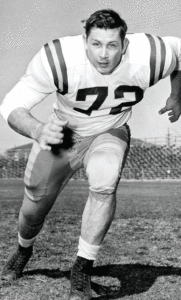
He played two years at Oklahoma University, under the tutelage of Bud Wilkerson and as part of the team’s 47 game winning streak. He didn’t rodeo, as Wilkerson didn’t want him to. Then Hardin Simmons University’s coach Sammy Baugh came calling. He offered Buddy a football and rodeo scholarship, so he transferred, doing both sports at Hardin Simmons and earning a business degree with a minor in economics. He competed once at the College National Finals Rodeo.
After college, Buddy headed back to Pampa to work on the family farm. But football wasn’t over for him. Pop Ivy had moved on to coach with the Saskatchewan Rough Riders, and he called Buddy, asking him to play for them. Buddy drove to Canada and signed a one year contract. When he got home, he found out he had been selected by the Cleveland Browns in the twenty-eighth round of the draft. But he stuck with his word and spent a year playing ball in Canada.
The next year, he went to Cleveland to play for the Browns. But during a scrimmage before the season started, he was blindsided by one of his own players, injuring his right knee. It required surgery, and Buddy never played for the Browns. He worked hard to rehabilitate the knee.
By this time, Sammy Baugh, his college coach, was coaching the New York Titans. He called Buddy and wanted him to come to New York. Buddy spent three years with the Titans (they became the Jets in 1962). The Denver Broncos asked him to play, but by then his knees were bad and he quit football.
Buddy returned home to rodeo and farm. He roped calves and steer wrestled, often traveling with his brother Lee, who was a calf roper. He competed close to home and added steer roping to his repertoire. His best season was in 1977, when he was the PRCA season champion steer roper. There were three years (1976-1978) when two champions were awarded in each event. World championships were determined by the highest amount of money won at the NSFR. Season champs were awarded based on total season earnings. Buddy earned $11,386 that year; Guy Allen, ninth during the regular season, won the world title with earnings of $2,585 from the NFSR.
He and his brother never drank; they had seen the effects of alcohol on their father. But that didn’t stop Buddy from having a good time. Good friend and fellow steer roper Howard Haythorn remembers that Lee and Buddy would get one room with one bed while rodeoing. Lee would take care of horses, eat a good solid meal and go to bed. Buddy would be gone all night, having a good time and coming in when Lee was getting up. “Lee would get more sleep but I had more fun,” Buddy laughed.
Wherever Buddy went, fun and good times followed. He wasn’t scared of anything. His wife Geneva relates a tale of when he, Larry Nolan, Tom Henry, and Tuffy Thompson were headed to a steer roping in Nebraska. Their pickup died and there was no way to start it. Buddy said, “If I can get that big horse out of the trailer, I promise you I can pull this pickup and you can jump it.” Nobody believed him, but Buddy hooked his horse to the pickup, got it to move, and the pickup started.
That same trip, the four of them were at their destination, where they ate supper and checked into a hotel. Two women in the bar decided to follow them to the hotel. Buddy and Tuffy were upstairs in their hotel room, with Larry and Tom on the first floor. All of a sudden, they heard a bang and glass flying. The women had accidentally driven their car into the wall, at Larry and Tom’s room. Buddy said, “what’s going on?” and Tom’s reply was, “girls, if we’d have known you were coming, we’d have opened the door for you.”
After his football career, Buddy had several businesses. In 1971, he built a 25,000 head cattle feed lot east of Pampa, selling it seventeen years later. He and two other men built a 10,000 head hog operation outside Lefors, Texas, selling their hogs to Jimmy Dean’s processing plant in Plainview, Texas.
In 1980, one of Buddy’s biggest adventures began. He flew to Australia to buy carrier airplanes. While he was there, he looked up an old rodeo friend, Carey Crutcher. Crutcher convinced him to buy a ranch (called a station in Australia) and Buddy was in the cattle business Down Under. The Blina Station was 640,000 acres with approximately 12,000 head of cattle. It was 100 miles from the closest town, Derby, and Buddy stayed six months of the year, while his son, Dan worked at the ranch year round.
1972 at Oklahoma State University where he played for two years, under the tutelage of Bud Wilkerson and as part of the team’s 47 game winning streak – Courtesy of the family
Buddy steer roping at the Wyoming State Fair, Douglas, Wyoming 1976 – Jan Spencer
Buddy and his wife Geneva, 2013 – Courtesy of the family
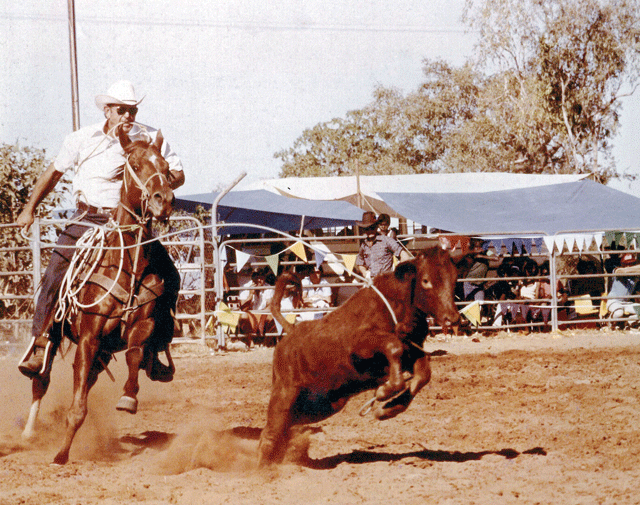
While he was in Australia, he attended and competed in rodeos, introducing team roping to the Australians, supplying timed event cattle for them, and winning an all-around saddle at his last rodeo in the country.
He loved working at the station. The cattle were wild, some of them never having seen humans, and they would catch the bulls by roping them, tying them to the massive trees in the outback, and winching the animal into trailers. Then they were hauled back and put with the herd in the corral. One of Buddy’s worst injuries came when roping a bull. The bulls had been mustered and hauled into the corral. When Buddy roped one, it took off over a feed trough, catching the rope around his leg and breaking it. The bone was sticking through the skin, when Dan, his son, put him in the back of the pickup and drove him to Derby. There, doctors wrapped it, readying it for a flight to Perth for surgery. Buddy insisted that it was wrapped too tightly, but the doctor didn’t listen. When he was in flight, he asked the attendant to loosen it, cutting off over half of it to relieve the pressure. “He’s had some wild wrecks,” his wife Geneva said.
Buddy’s business ventures didn’t end in Australia. He, along with partners, briefly owned a gold mine in Costa Rica and a ranch in Brazil.
He didn’t ever touch alcohol, but he loved his Coca-Cola. He kept a cooler of it in the back of his pickup, and often drank 42 oz. a day.
He was an excellent horseman, Howard said, and his daughter Amy was too. “She was a good hand.” He knew good horseflesh, his wife Geneva said. “He has a super, super eye for a good horse,” although he hasn’t ridden for three years.
Buddy and his first wife, Joyce Moyer, had three children: Mel, Dan and Amy. He met his second wife, Geneva, in 2000, and together they have five children, nine grandchildren and three great-grandchildren. Amy and her husband Kyle Best ranch near Douglas, Ariz. Dan and his wife Drucy ranch at Higgins, Texas, and Mel lives at Amarillo. Geneva has two sons: Ty and his wife Kimberly Harris and Krece Harris, all of Decatur, Texas.
At age 83, Buddy has Myasthenia gravis, a neuromuscular disease that weakens the skeletal muscles, causing difficulty in swallowing, walking and talking, and double vision. He got bucked off a horse three years ago, and since then, his health has declined.
But Buddy has always met life’s challenges with a smile, ready to tackle them. “He lives life to the fullest extent,” Geneva said. “He’s been very blessed, and he’s always thought he was bulletproof.” He doesn’t worry about things. “He’s led a very carefree life. I worry and get grayer and grayer, and he says, why worry about it? Things will work out if they’re supposed to.”
Howard Haythorn loves his old friend. “He’s a giant of a man, and not only in stature but in personality. He’s larger than life but he’s soft-spoken. He’s a lot of fun to be around.”
Buddy is a 2010 inductee into the Texas Panhandle Sports Hall of Fame and a 2014 Texas Cowboy Hall of Fame member.
He’s had a life that he would never have guessed, said his wife Geneva. “I don’t think he could have even dreamt up what would happen. He’s always been the kind, when he saw an opportunity that he was going to rise to the challenge.”
“I’ve been blessed,” Buddy said. Life “has been good to me.”
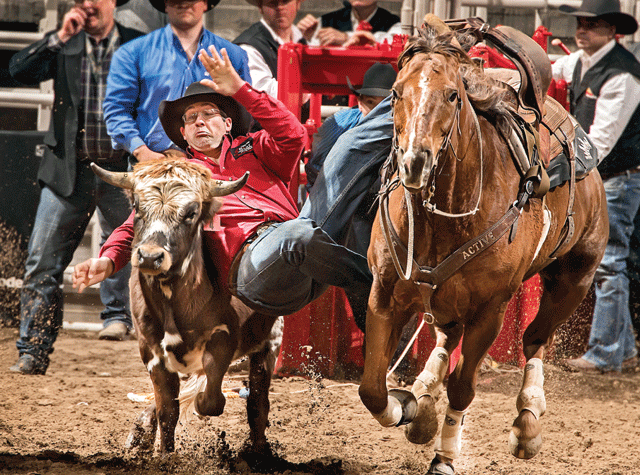
Cole Edge of Durant, Oklahoma, is sitting second in the PRCA standings in steer wrestling, an event he originally took up in high school for the all-around points. The 33-year-old cowboy comes from a family of ropers and focused primarily on team roping and tie-down roping through high school, but he found his niche in steer wrestling. “I’m just steer wrestling now. I can rope when I retire,” he jokes. “I went down to Southeastern Oklahoma State in Durant for school where Sarah Burkes was the coach. Her husband, Jake, talked me into keeping up steer wrestling and it just took off from there. I like the physicality of it, and you have your hazer, but it’s more of an individual sport—everything depends on you. I like the competition and making good runs, and when you get to the big rodeos, I like the pressure in those situations.”
Cole finished third in the CNFR world steer wrestling standings in 2007, and the pressure at Rodeo Austin in March this year spurred him on to a first-place win. He was also invited to the Calgary Stampede for the first time this summer. Cole is traveling with Cameron Morman, Chason Floyd, and Tanner Brunner this season, and the four steer wrestlers are competing on the same three horses this season, all by Pride Farms’ stallion Lions Share of Fame. “We’re all in the top 20 right now, and I think that says a lot for those horses,” says Cole. “We ride all the same saddles and just adjust the stirrups. I’m primarily riding a horse of Sean Mulligan’s, Miss Kitty, and another mare named Holly, and our gelding Slick is our haze horse. Miss Kitty was pretty young when I qualified for The American on her in 2014, but this year and last year I’ve been riding her every day.
“The great thing about steer wrestling is that it’s kind of a big family. Everybody helps each other out,” Cole adds. “Sean Mulligan has helped me my whole career, and Jacob Burkes made sure I kept going with it. I’m pretty fortunate to be around people like that all the time.” Sean also hazes for Cole throughout the season. “You’re pretty much putting your life in your hazer’s hands. It’s a very crucial job. I started rodeoing with Sean and he’s one of the best in the business. Cameron hazes outstanding, and Chason hazed for me at the short round in Reno, and I haze for everybody else. We can’t win what we do without a good hazer.”
Another crucial component in Cole’s steer wrestling career is his tack, including the 5 Star saddle pads and cinches that he uses. He’s been using their products the last 10 years and joined the 5 Star Champion team in 2014, the first year he qualified for the WNFR. “I like things basic, and their pads are 100 percent natural. The wool absorbs the impact just as well, and I like the 100 percent wool cinches they have. They work for me, and they are a great company with great people.” Cole also appreciates the variety of sizes 5 Star pads are offered in, and has a tack room full of them to prove it. “I can have one saddle and switch it to different horses and make it fit that much better. My wife is a barrel racer, and she has a whole bunch of their pads too.”
Cole and his wife, Torrie, met at Southeastern Oklahoma State University where they were both on the rodeo team, and they were married in 2012. Torrie runs barrels on the WPRA Prairie Circuit, though she’s taking the season off since she and Cole are expecting the birth of their twins in November. The husband and wife also enjoy raising and training horses together, and taking them to barrel futurities. “If not barrels, then we try to rope on them and just turn them into good horses,” says Cole, who also likes welding.
“Winning Austin was probably my biggest highlight, and my horses are working good. I get my confidence from what I’m riding—if they keep working good, I’m pretty proud of them. My goal is pretty much to win as much as I can and save up for those babies. I want to keep placing at the rodeos and everything will take care of itself after that.”
Cort Scheer is building his retirement one bronc at a time. The Elsmere, Nebraska, cowboy will top $1 million by the end of this season and he has managed his earnings well, investing in cattle for his family’s ranch in Nebraska and a piece of property in Stephenville, Texas. “I bought a place to fix up since I’m there for the winter and go to rodeos,” said the 32-year-old, who has been running down the rodeo road with the PRCA for eight years. “I’ve built the house and barn and this winter I’ll build the arena. Then I’ll sell it and get a bigger place.” At the end of his rodeo career, Cort plans to return to the family ranch, expand it, and run cattle with his brother, Clete. Right now, Cort doesn’t get home too often – maybe one month total each year. “It’s awesome,” he says of his home in Nebraska. “Cell phone don’t work, no town within 50 miles – it’s perfect –it’s just the ranch.”
Cort grew up there, traveling 40 miles one way to school. “We got on a bus 20 miles from home.” There was no activity bus and since Cort was big into football and wrestling, he and his older brother and sister (Kema) drove themselves. “My brother and sister packed me around until I was old enough to drive.” In Nebraska, that age is 14. He spent the rest of his time working on the ranch. He learned how to ride broncs from his dad, Kevin, who rodeoed until he got married and his uncle.
Scheer family – Dedra Stoner
Cort played running back and corner for his high school team – Courtesy of the family
Cort at Cheyenne Frontier Days; Muttin bustin at age 6, 1992
He started by riding sheep and then started riding in eighth grade, the earliest his dad would let him. He competed in the Nebraska high school rodeo, making Nationals every year. He won the Nebraska High School All around, competing in steer wrestling, calf roping, and saddle bronc riding. He played running back and corner back in football. “I liked it – I wanted to play football more than rodeo but I was too short and slow.
“He’s always been a blessing – I like to say he’s as good a person as he is a bronc rider,” said his mom, Pam, fondly referred to as Grammy Pam. “I’m glad he stands up for what he believes in.” She also adds. “God really blessed him with this talent and I’m thankful that he’s walking with the Lord. He brings a lot of joy and happiness to this family.” Pam also loves ranch life in Nebraska. “I open my window up every morning to the Sandhills,” said the 22-year-veteran teacher that will be going on her second mission trip to Guatemala. She drives 28 miles each way to work each day to teach third grade.
Cort went to college in Garden City and ended up at Panhandle State. “It’s always been the powerhouse in the bronc riding,” said his dad. “He was in the bronc riding region and was there for three years and I think that has a lot to do with his ability. I raised horses for a few years and he got on those colts, but he did most of his practicing down south.” Kevin is proud of all his kids. “I tried to raise my kids so they would go after what they wanted, and Cort has.
When Cort does something, he goes all in – he’s pretty committed to anything he sets his mind to doing.” Kevin quit riding to pursue his first love, the ranch and his family. “I rodeoed at one a year on Labor Day to celebrate the end of haying, so they saw me ride once a year. I like ranching, it’s something I’ve done all my life.”
Tie down roping in 2004 with NHSRA – George Hipple Photography
Cort travels with two other bronc riders, and the three some make the best of the many hours on the road. “It’s been Tyler, Chet, and I for years.” He does a bit of hauling on his own, and spends the windshield time listening to music. “I’m a rocker, a big AC/DC fan and anything old country.” The day to day life on the road is pretty much the same. “We roll in an hour before, ease on up to the bucking chutes, and ride, go back to the van, and hang out. Lots of times we stay at a buddy’s house along the way, that’s a good thing about being older, you know everybody. It’s a big family, the door is always open, the light is always on.”
He doesn’t check the standings very often. “I let the numbers take care of themselves and worry about my riding. If I’m riding good, the numbers will work.” He has stuck to bronc riding since high school. “I blew my knee out one year and riding broncs was paying me pretty good so I didn’t want to jeopardize my knee.” As a veteran on the road, he thinks it’s easier than it was at the beginning of his career. “When I was younger I didn’t pay attention to my eating and being healthy like I do now,” he said. “I try to stay away from fried foods – now I eat more Cliff bars – low in sugar and high in protein. Even though I don’t work out, wherever I’m at I try to work at something. I figure if you’re working, you’re working out.” Entering is easier too. “After so many years, you hit the same trail – just different days up.” The quality of stock has improved as well. “It’s light years from where I started, with the futurity broncs, they are big and strong. They are so athletic, 1,400 pounds jumping 6 feet in the air.” His advice to stay on is simple. “Lift on your rein and a good spur out and hustle; you’re coming down if you don’t.”
“I like riding broncs, but I’d like to be home. My body is doing good, saddle doing good – I’ll keep doing it until they quit paying me. Then I’ll go home.” Until then, he is enjoying his rodeo days. “You dang sure have some stories when you sit in your rocking chairs.”
Cort Scheer summary of accomplishments include:
4x National High School Finals Qualifier 2002 National High School Rookie Bronc Rider 2004 Nebraska High School Steer Wrestling Champion 2005 Nebraska High School Champion Saddle Bronc, Calf Roping, Steer Wrestler, & All Around 4x College National Finals Qualifier 2006 Central Plains Region Saddle Bronc Champion 2008 Big Sky Region Champion Bronc Rider, Steer Wrestler, & All Around 2011 Rodeo Houston Champion Bronc Rider & Shootout Champ 2013 Calgary Saddle Bronc Champ 5x Wrangler National Finals Rodeo Qualifier 2016 Champion ERA Bronc Rider 4x Canadian Finals Qualifier 2018 The American Champion Bronc Rider Pendleton & Denver Champ
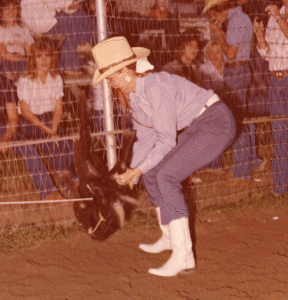
Joleen Hurst Steiner is a petite ‘tells it like she see’s it’ cowgirl who was born in Woodward, Oklahoma in 1952. She grew up in Fort Supply, Oklahoma, which she said was “in the middle of nowhere”. She had two sisters and a brother. Joleen was the third child. Her biggest desire as a youngster was to have a horse. Her sister felt the same way. Joleen remembered getting a pony when she was nine. Then her folks bought her and her sister full-sized horses. The girls both trained their own horses.
At first Joleen competed in Little Britches rodeos and Junior Rodeos. She entered the pole bending, breakaway calf roping, goat tying, and barrel racing events. She broke a breakaway calf roping record at the age of 13 at the Little Britches Finals Rodeo in Littleton, Colorado.
Joleen admits her horse was a good horse for barrel racing, but not National Finals quality. When her sister married she gave her horse, Hot Shot, to Joleen. In 1970, she joined the Girl’s Rodeo Association (GRA) and with her mother at her side she made all the Oklahoma rodeos, and ventured even farther to Colorado, Kansas, all the Texas rodeos, New Mexico, Arizona and even the West Coast. She loved the California rodeos because the weather was always so good.
Joleen admits when asked ‘what was the hardest part of barrel racing’ she thought nothing was hard. She was young, life was good and she had a good horse. She would read the GRA News to decide which rodeos to go to. She picked the rodeos that added the most money and that is the direction she and her mother headed.
When asked how much she practiced her answer was, “Never!” She laughingly admitted, “I just hung on to Hot Shot, and we were in the money a good deal of the time.” We know she worked harder at it than she admits, but she truly enjoyed every minute of it. She felt the rules in barrel racing were fair for everyone when she was competing.
As we discussed, the changes that have occurred since her era she immediately mentioned “No one complained about the ground in my era. Whether it was sandy, too hard, or whatever, we just dealt with it.” Joleen also said there are a lot more quality horses bred to barrel race today than she saw in her days in the arena.
Joleen competing at the 1971 NFR – Al Long
Bobby and Joleen – Courtesy of the family
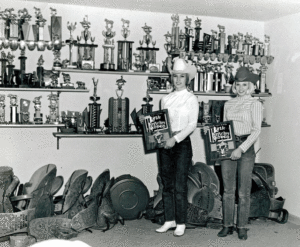
Joleen (14) and her sister LaVonna (15) with their awards – Courtesy of the family
Concerning the barrel racing horses, she feels that often trainers expect the horses they train to turn a barrel a certain way. “I feel they should allow the horses to decide how they choose to make the turn. The horse knows best what fits them.” She also said you can tell which horses love it as much as their rider – it shows.
In 1970, Joleen was having a good year and her dad told her if she won the barrel racing at the Cow Palace he would buy her a trailer with living quarters. That win qualified her for the National Finals Rodeo, in Oklahoma City, as one of the top fifteen barrel racers in the world. There were nine rounds of barrel racing and she won three second places and two first places. “If I didn’t knock over a barrel I placed,” she admitted and laughed. That first year she finished 7th for the year.
“When I hit the road in 1971, I was in heaven. My mom cooked wonderful meals, and we stayed on the rodeo grounds in my new gooseneck trailer. It wasn’t as common to stay on the rodeo grounds as it is today, but it was much easier, Hot Shot was with us, and it was fun.”
The following year, 1971, she qualified for the National Finals Rodeo again, finishing in third place in the world, and third in the Average. There were ten rounds of barrel racing and Joleen had three second places, and three third place wins, but this year something happened that changed her life forever. She met Bobby Steiner, a bull rider.
Her mother didn’t think much of bull riders. Mrs. Hurst was much more interested in Joleen finding a nice calf roper to marry. “Mom thought bull riders were lazy. All they had to do is bring their bull riding equipment in a bag to a rodeo. Mrs. Hurst felt a roper that had the responsibility of hauling his horse and keeping him sound would make a better husband for her.” Joleen was determined. She saw something in Bobby she hadn’t found before. He was very confident. They had their first date at Belton, Texas on the 4th of July. He picked her up in his big Oldsmobile 98 and she was impressed. She asked him if it was his dad’s car. She thought the car was way to fancy for a bull rider. After all, she was driving a little Ford pickup. Bobby informed her it was his car. Their first date was a drive-in movie in Temple where they saw “Bandolero” and “Butch Cassidy and the Sundance Kid”.
After that they ran into each other at various rodeos and continued to date. The following year after the Houston rodeo Bobby asked Joleen to marry him. They married in June, 1972. Their family eventually expanded to three with the birth of Shane. Sid was born fourteen months later. Joleen had her hands full with two little boys, and a husband, so the barrel racing stopped.
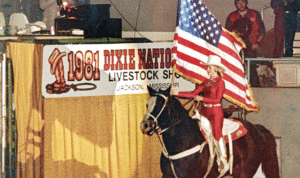
Joleen at the 1981 Dixie National Livestock Show in Jackson, MS – Courtesy of the family
1961, Joleen at age 9 with her pony, alongside her neighbors – Courtesy of the family
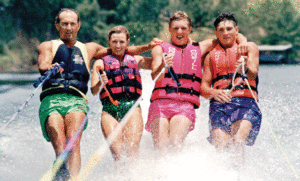
Bobby, Joleen, Shane, & Sid at Lake Austin – Courtesy of the family
The following year Joleen began to help Bobby with his bull riding career. She entered him in all the rodeos and helped him plan to get to all of them. She said, “You might call me Bobby’s navigator. I made sure his entry fees and turn out fines were paid and took care of the business end of the sport.” (This was all before PROCOM).” She traveled with him until the doctor told her, when she was 7 months pregnant, that she needed to stay at home. Bobby won the World Championship in Bull Riding in 1973, and was 2nd in the Average. He retired from bull riding shortly after that.
Bobby began helping his dad, Tommy, with the Steiner Rodeo Company at that time. The legacy of Steiner Rodeo Company began with Buck Steiner, Tommy’s dad running it with Tommy. Then Tommy and Bobby ran it together. Joleen carried the American flag and helped in many other ways. She helped Mildred Farris, the secretary for Steiner Rodeo Company, keep time. “When we had rodeos overlap, liked Belton and Pecos, I would secretary the smaller one,” explained Joleen. When they sold the rodeo company in 1982, Bobby and Joleen spent their time raising their sons and ranching.
The Steiner family has always been tremendously benevolent to many groups and totally supportive of rodeo and the rodeo family. Some of the innovative things started in rodeo was done by Steiner Rodeo Company, including the electric eye for timing the barrel races, and instead of having the barrel racing event next to last they had it as their third event in each performance.
Son Sid became a steer wrestler and went to the National Finals in 2000. In 2001, he was absent from those top fifteen in steer wrestling. But in 2002 he came back with a vengeance and won the Steer Wresting Championship and the Average. He followed in his dad’s footsteps and retired from steer wrestling shortly after winning the World title. This family is totally family-first and admit they don’t like being away from home. Son, Shane, is a musician and although he has played in numerous venues he enjoys his life performing at Steiner Ranch Steakhouse down the road from his home. Now the grandchildren are making their marks in bareback riding, barrel racing and wake-boarding sports.
When doing this interview with Joleen, Bobby stuck his head in, and made this statement, “I may not have been the best bull rider, but I sure got the best looking barrel racer!”
By the way, Joleen’s mom became a major fan of Professional Bullriders and knew all the cowboys competing as well as the bulls. I guess she decided bull riders weren’t so bad, after all.
Chance Schuknecht was raised and graduated high school in Iowa Falls, Iowa. His love for horses and a rodeo scholarship took him to Rapid City, South Dakota where he earned a Bachelor of Science in Equine Management from National American University.
Chance, 33, now oversees Sales and Marketing at Silver Lining Herbs, a world leader in natural herbal support for horses and dogs.
“My brother got me started roping in the 8th grade and I rodeoed through high school and college. I’ve always loved horses and in college thought I wanted to be a trainer,” explains Schuknecht. “I worked for a reining cowhorse trainer and worked for Lisa and Grady Lockhart one summer. I got burned out and realized I would rather ride for pleasure than as a job.”
A college friend, Dustin Luper, introduced Chance to the owners of Silver Lining Herbs, Mickey and Lori Young. Chance was offered a chance to do his college internship at Silver Lining and has been there since.
“Going into that experience, I wasn’t a supplement or herbal person, but this was a chance to stay in the industry and not have to ride every day. My internship was a life changing experience. It inspired me to take care of my horses.
It made me think back to a mare I owned and all the problems she had like pulling back, and how she would dunk her hay in the water. We thought she was half crazy at the time, but after what I learned from Silver Lining, I realized she probably had some physical things going that needed addressing.”
If we pay close attention, our horses will let us know when something is hurting or bothering them. Recently my head horse was swishing his tail through the corner. Obviously something is bothering him. We can ignore it, or try and figure out what’s wrong. I found my horse had sore kidneys,” explains Chance. “The kidneys are not protected by the structural system and the bars of our saddles sit over the kidneys. Then we’re asking our head horses to put that bend in his back going across the arena while pulling a 400 lb. steer. It’s no wonder they may not finish well, or might leave harder or not pull. A typical reaction for most people is to get after their horse. But we really need to take a minute and ask ourselves why it’s happening. The fact is horses by nature are willing and try to please us.”
Some horses are more vocal than others. Those horses that hump up or flag their tail are horses that are trying to communicate with us, to let us know something is up. We should always be listening to our horse’s needs, but, now that we are able to rope for the large amount money available, and considering what our horses are worth, I think it’s very important to listen to what your horse is trying to tell you.”
If we throw a saddle up on a horse and he pins his ears, he’s trying to communicate and we need to listen. I can sit at a team roping and see a 400 lb. guy on a little 14.2-hand horse or see a guy lose his temper and whip his horse these are some of the things that amaze me about horses. These horses show up every day and perform regardless of what they’re having to overcome. I’ve become very sympathetic to horses and realize that they are the coolest animals God has created.”
Schuknecht’s once college internship has turned into a ten-year career at Silver Lining Herbs. Chance finds the company mantra of ‘do what’s right to help dogs and horses’ rewarding. He also enjoys some of the perks such as going to Speed Williams’ place and roping for the day.
“Without working for Silver Lining, that probably wouldn’t happen. It’s been a great experience.”
Chance, a #5+ roper enjoys competing at World Series of Team Roping events. He’s grateful to work in the industry he loves and be surrounded with quality and talented people.
He and his wife Kyla, have been married nine years and have two children, a daughter, Austyn, 6, and a son, Wade, 3.
Chance Schuknecht with wife Kyla, daughter Austyn, & son Wade – Jessica Montgomery
COWBOY Q&A How much do you practice? Three or four days a week. Do you make your own horses? Yes. Who were your roping heroes? Speed Williams. I also high school rodeoed with Kollin Von Ahn and admire his ability. Who do you respect most in the world? My wife. Who has been the biggest influence in your life? My parents. If you had a day off what would you like to do? Hang out with my family. Favorite movie? Braveheart What’s the last thing you read? The Continual Conversation. How would you describe yourself in three words? Patient, persistent, hard working.
What makes you happy? My family. What makes you angry? Laziness.
If you were given 1 million dollars, how would you spend it? I would want to be very generous and help people that need it. And pay off my student loans. What is your best quality – your worst? My best quality is I am very soft-hearted and have compassion for others. That can also be a hard quality to have.
Where do you see yourself in ten years? I see myself being the best dad and husband I can be, and someone who is still giving horses a voice to help them out. It seems like sometimes you get to help a lot of horses at once, sometimes it’s just one. No matter where I am, I want to help horses.
Deep in Scott Tucker’s soul there were seeds of rodeo that drove the Jacksonville, Florida boy towards his destiny, and roots were developed that have entwined family, rodeo, and future generations of cowboys and cowgirls forever. Scott was born in 1946, an only child to his parents, Lucille and Holmes Tucker, but being a cowboy was more in his DNA than it was in his family upbringing. His dad graduated in 1939, from Yale University where he attended on a full-ride boxing and football scholarship; and he went on to work for General Foods, before settling in the automobile business. Although his parents were far more interested in life in the city, Scott was drawn to the Pecan Park horse racing track, where he started jockeying horses when he was just 12-years old. Only destiny knew then, that he was starting down a path that would lead him to become an integral part of one of the most notable rodeo families in North Carolina.
Scott rode racehorses with Sonny Burris on the brush tracks, helping to start colts and train them to use the starting gates until his weight exceeded the 135-pound maximum allowed. Scott jockeyed the legendary Quarter Horse, Go Dick Go, in brush track races before the horse went on to make history as the winner of the first All American Futurity in 1966. Sonny was a boxer and jockey, that also rode bareback and saddlebronc horses; and he helped 12-year old Scott, step onto his first bareback horse at a Callahan, Florida rodeo. Scott did try following his dad’s path in life, and played football his freshman year of high school, but frustrated that the football schedule conflicted too much with his rodeos, he gave it up.
Once Scott had his driver’s license, it was only the rodeo road on Scott’s mind. Scott started out entering bareback riding at open rodeos, before getting on bulls, which quickly became his favorite event. In 1962, Scott attended a Jim Shoulders bull riding school and the memory of staying atop the legendary bull “Tornado,” is forever etched in his memory. In 1963, he got his first membership card for the IRA, known as the Interstate Rodeo Association at that time. Scott started working as a rodeo clown, “Scooter,” when he was 15-years old, and quickly became enthralled with the new job he often performed between riding in his events. The challenge of outmaneuvering the bulls, was as exciting as staying on top of them.
: Scott bareback riding in West Virginia in 1976 – Courtesy of the Family
Scott & Vicki with their grandkids – Courtesy of the Family
Scott & Vicki in 1967 – Courtesy of the Family
Although Scott’s parents were very proud of Scott’s success, they were far too nervous to come watch their fearless cowboy at the rodeos, so Scott often traveled solo or with rodeo friends that became his rodeo family. At 16-years old, Scott was cruising the interstates between rodeos, in a 1958 four-door Oldsmobile, decked with its giant tailfins, pulling a 13-foot travel trailer to sleep in. Scott thinks that rig is what got 14-year old Vicki Kidd’s attention when they met at the Silver Springs rodeo in Maryland. Meeting Vicki would prove to further cement the path of Scott’s life. Vicki Kidd was a barrel racer, and daughter of C.W. and Helen Kidd of Charlotte, North Carolina. The Kidd family was instrumental in bringing rodeo to North Carolina in the mid-50’s, after C.W. had fallen in love with the sport while he was stationed in Florida, in the Air Force. The Kidd’s started the Rockin’ K Ranch, which was a family commune of sorts, raising future cowboys and cowgirls around a central rodeo arena, and has hosted rodeos for over 60 years now. Not only did Vicki fall for the handsome, blue-eyed cowboy, but her parents did as well, taking the 16-year old in and treating him as their own.
Scott would travel to rodeos, staying on the road most of the summer, returning to Florida to complete the school year. In 1963, the summer before his senior year, he and Lyle Wiggins made it up to Frontier Town in upstate New York, in the heart of the Adirondacks. “Frontier Town was an old western town theme park that put on three rodeos per day. I got a job there as a stagecoach driver, and later became the arena director for the rodeos.” The rodeos would highlight one or two competitors in each event, plus feature a trick rider, and there are many PRCA cowboys that got their start there. “It was the best place a young person could rodeo, besides the rodeo shows each day, there were a lot of jackpots within about 30-miles of Frontier Town. I was loving it up there, and making about $500 to $600 per week, which was a lot of money back then.”
Scott graduated from high school in 1964, the year that he earned his first SRA All-Around Champion Cowboy title. He went on to win the title again in 1965, 1968, 1970, 1971 and 1973. When he left home for the summer in 1964, the plan was for him to PRCA, and SRA rodeo through the summer, before heading west to Las Cruces, New Mexico, where he had a full-ride scholarship to New Mexico State University; but seeing Vicki Kidd again that summer, changed his college plans completely. “I didn’t want to go to New Mexico as planned, I called my dad and told him I wasn’t going. He wasn’t very happy about me giving up the scholarship, but I told him if he’d pay my tuition at North Carolina State University in Raleigh, that I’d cover everything else.” Scott graduated from NCSU in 1966, with a degree in agriculture and livestock management, rooming with Vicki’s brother, Buddy, while they attended school there. “Buddy was such a fine person, always willing to help anyone. He always had good horses, and he would always let anyone that needed a better horse at a rodeo, ride them.”
In 1966, after Scott left NCSU, and just three days after Vicki graduated from high school, the two soulmates were married, starting a union that would last for over 50 years, before Vicki’s passing on October 12, 2016. Scott also joined the Air National Guard, in 1966, serving for 6 years in the engine shop, as an airplane mechanic.
Scott bullfighting as rodeo clown “Scooter” in Georgia in 1963- Courtesy of the Family
Scott & Grandson Cole Futrell – Courtesy of the Family
Scott & Vicki in Galax, VA, 1968 – Courtesy of the family
The eastern cowboy couple traveled the roads of the rodeo circuit, chasing dreams while being blessed with new friends across the country. Vicki had a passion for horses, barrel racing, and supporting her roughstock riding husband. Vicki was the 1968 SRA Champion Barrel Racer and was crowned as the very 1st SRA All-Around Champion cowgirl in 1971, winning it again in 1974. Scott was doing quite well as a bull rider in the PRCA, ranking #7 in the world standings in June of 1970, but responsibility was beginning to tug on the roaming cowboy, so the couple continued to rodeo but made more of a permanent camp in Charlotte as they laid a foundation for their family. Scott had traded a good horse for some asphalt equipment, the beginnings of his paving business, Scott Tucker Paving and Grading, which he still operates. Scott and Vicki had their first child, daughter Keri, in 1967, and their son Jason was born in 1971. Also, in 1971, Scott dominated in the Coastal Rodeo Association, winning the All-Around Champion Cowboy title. Although Scott continued to find many successes in rodeo arenas across the east, looking back he wishes he would have continued his PRCA run to finish the 1970 season, thinking about the chance he may have had at that world champion gold buckle.
Scott and Vicki continued to rodeo as they raised a new generation on the Rockin’ K, alongside Vicki’s brothers, Buddy and Jerry, and their budding families. The arena was often filled with champions and celebrities passing through while on their own rodeo circuit travels, and the art of rodeo was being practiced there on a daily basis. Cowboys like Red Duffin, who traveled with groups of cowboys and good horses, often practiced when he came through, and helped anyone interested in improving their steer wrestling skills. Scott served as the president of the SRA in 1979 and 1980 and was the vice-president for six years. Scott was also on the board of directors of the North American Rodeo Commission. Scott was responsible for producing hundreds of rodeos at arenas all over the east, and was the captain of the Southern Rebels, a rodeo team that competed at rodeos such as the Calgary Stampede. In 1983, Scott decided to focus more on the next generation of rodeo stars and he and Vicki stepped into the supportive role for their kids’ and grandkids’ rodeo dreams. Scott was the president of the NCHSRA in 1987 and 1988. Scott has been a pillar in the rodeo community, often stepping up to judge rodeos when needed, turned to when questions arise, and encouraging young rodeo athletes wherever he goes.
The legacy that has continued from Scott and Vicki Tucker has went on to include their children, grandchildren, as well as many uncles, aunts and cousins that all participate in rodeo competition or production. Inevitably, the passion that Scott felt in his heart for rodeo so many years ago, will burn inside the many that will follow in his footsteps for years to come.