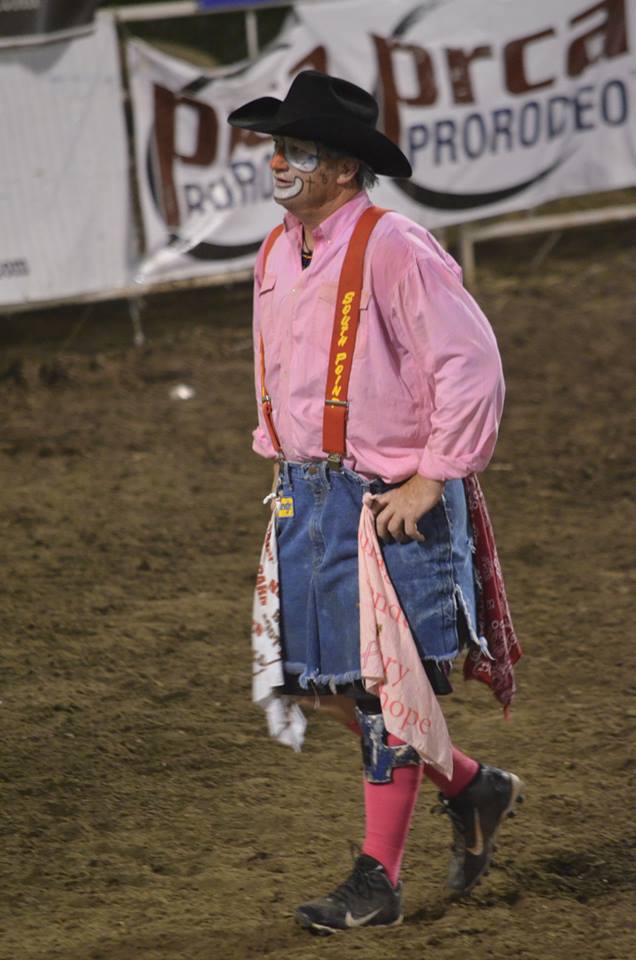
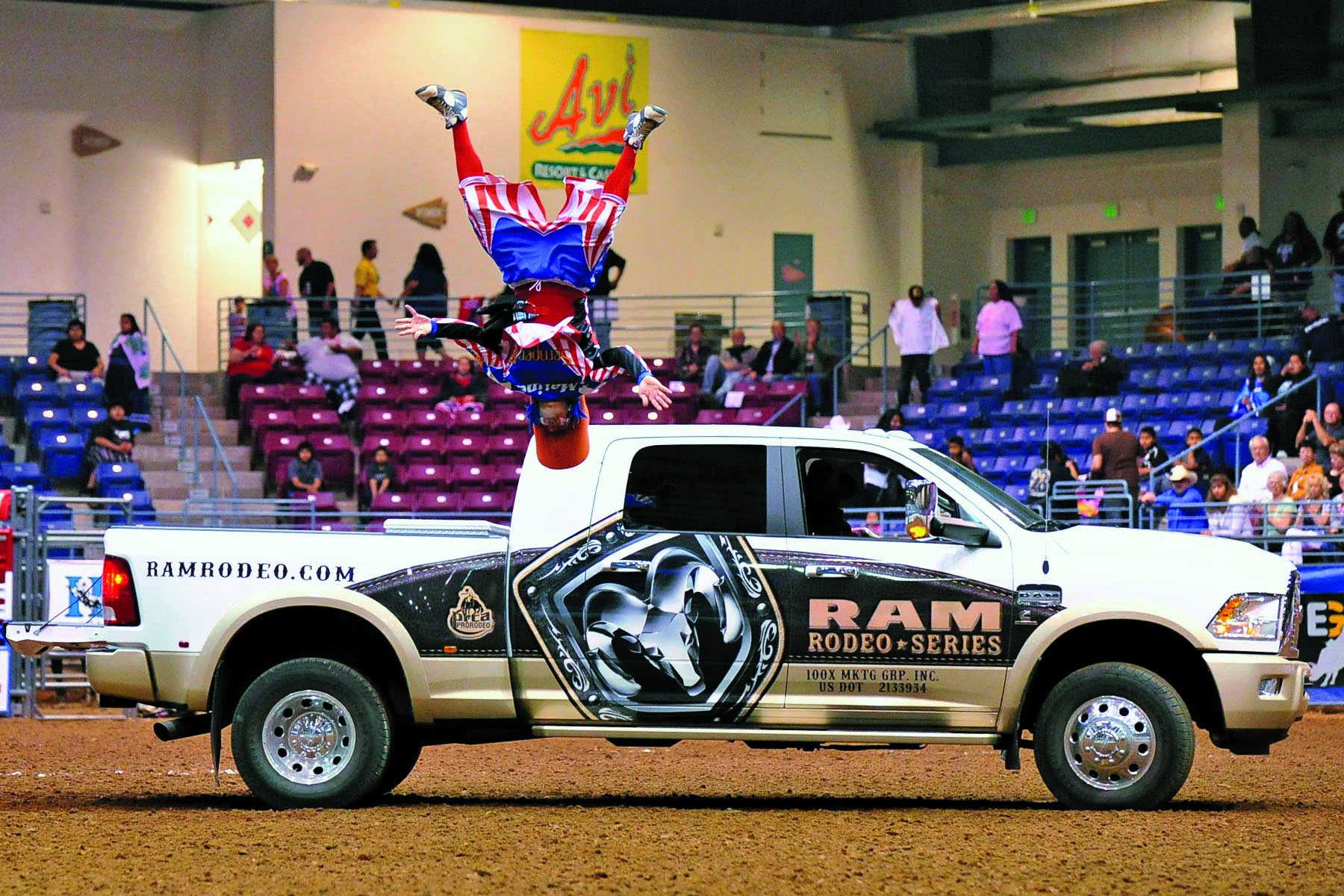
Dustin Brewer put on his baggies and cleats for the last time Labor Day weekend at his hometown rodeo in Elk City, Okla.
The 46-year-old cowboy has been involved in rodeo for most of his life, as a bullfighter, and now as a clown.
Brewer, born to Lee and Donna in Elk City, Okla., in 1969, tagged along as his older sisters competed at Little Britches Rodeos. He began riding bareback horses and bulls in high school, and it was in the practice pen where his talent became evident.
A bull rider got hung up, Brewer recalls, “and I stepped in, got him out, never got touched, and thought that was pretty cool.” That was the beginning of a 27-year career.
He worked as a bullfighter at high school and amateur rodeos, and he struck up a friendship with the late Rex Dunn, a bullfighting and bull raising legend. In 1996, Dunn told Brewer he needed to apply for his Pro Rodeo Cowboys Association membership. At that time, the PRCA gave membership to bullfighters after they had worked the Binion Bull Sale, held in Las Vegas during the National Finals Rodeo. A panel of bullfighters and experts judged the rookies, and out of a class of 18, only two were awarded cards: Brewer and Dusty Essick.
From then on, Brewer’s resume grew. He’s worked major rodeos across the country, including Tucson, Ariz., Greeley, Colo., Oakley, Utah, Salt Lake City, and lots of the smaller rodeos: Elk City, Okla., Abilene and Manhattan, Kan., Burwell, Neb., and more.
He competed in the freestyle bullfighting the Wrangler Bullfights held, and was ranked fourth in the Bullfights standing when he broke a leg. That was in 2000, his only chance to go to the National Finals Rodeo, and it turned out to be the last year for the Bullfights.
Bullfighters are prone to injury, and Brewer has had his share, although nothing that took him out of the game for long. In 1991, he broke his jaw in three places when a horn caught him in the neck. In 1996, he ruptured his spleen. In 2000, the broken leg kept him from going to the Bullfights in Las Vegas, and in 2002, he tore an ACL in his knee.
He’s had a wonderful career, and the people he’s worked with and for hold a high regard for him.
He has worked his hometown rodeo in Elk City, Okla. for sixteen years, and he’s been a real asset to the rodeo, said chairman Larry McConnell. “Dustin’s one of those guys that, whatever you ask him to do, he does it. He’s easy to work with, and he’s an icon around this rodeo.”
Former bullfighter and five-time Wrangler Bullfights champion Rob Smets helped Dustin get started in his early years and considers him like a brother. “I mentored him through some of his career,” Smets said. “Dustin’s done a bang-up job. The guy has integrity and has had it his whole career.”
Brewer has grown close to many of the rodeo committees for whom he has worked. He worked the Abilene, Kan. rodeo for fifteen years, and became like family to the committee men and women, so much that Brewer and his wife Tarra decided to marry in Abilene in 2004. “He was a professional,” said Jerry Marsteller, chairman of the Abilene committee. “He did whatever was asked of him.”
Brewer worked closely with barrelman Mark Swingler, and Swingler believes Brewer’s rodeo career was marked with consistency. “He was always there for the cowboy,” Swingler said. “If he had to take a shot, he’d take a shot.” Brewer was able to handle the mental stress of being injured as well. “Some (bullfighters) get injured and get gun shy, but I’ve never seen that in his work.”
Even though he’s retiring, Brewer isn’t leaving rodeo, he’s just switching roles. He has plans to work as a barrelman and rodeo clown, and has already been hired for some rodeos in 2016. He loves rodeo. “I just love the sport,” he said, “the camaraderie between everybody, the atmosphere.”
His baggies and cleats may go in the closet, but he’ll be back on the road next summer, to another rodeo, just in a different role.
Through it all, Dustin has loved – and still loves – -rodeo.
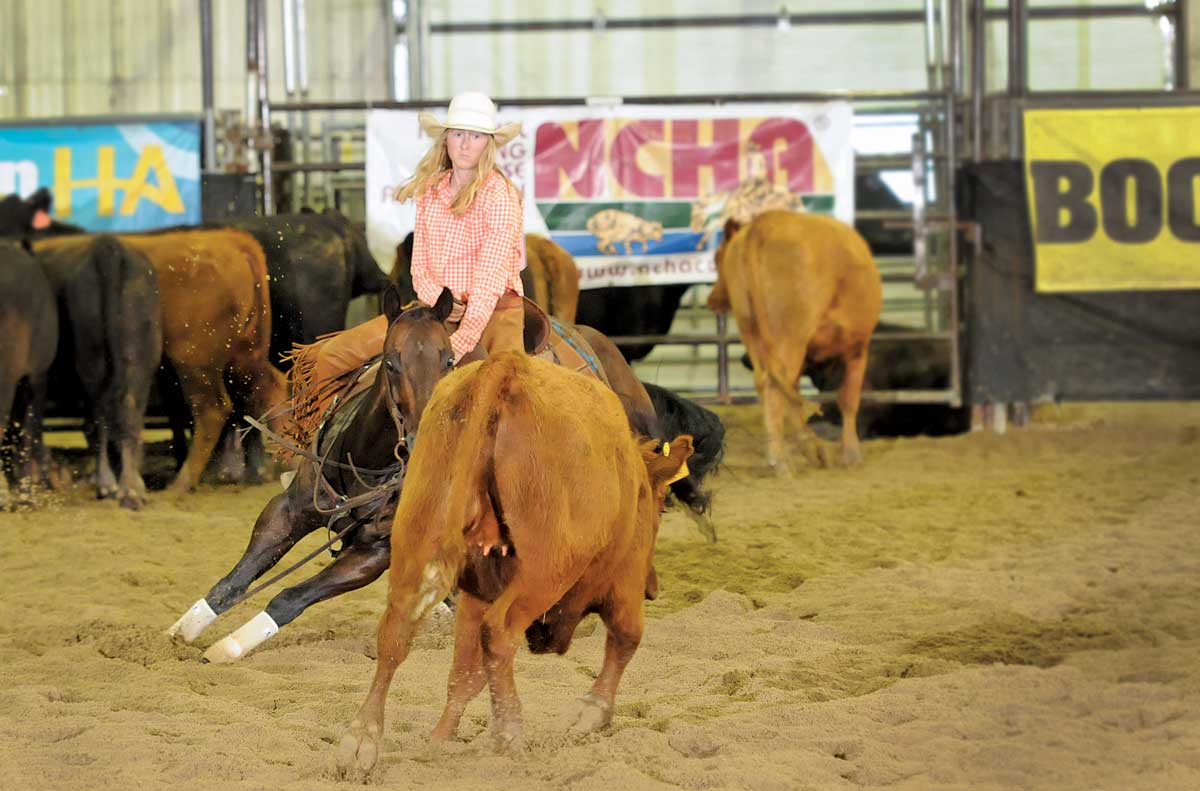
Sidney Amos from Loma, Colo., is the 2015 NHSFR Girls Cutting Champion, rodeoing for Utah High School Rodeo Association. “We live 14 miles from the Utah border.” Her dad, Scott, is a cutting horse trainer, so Sidney has been riding cutting horses her entire life. “I started showing three years ago,” said the 16-year-old. “It’s my drug. It’s the only sport I compete in – I just love it.” Her sister, Sommer, in 8th grade, wants to start team roping and wants her to start. “I like my fingers,” she said about team roping. “I think I’m going to start with breakaway.” Sidney has an older brother, Suade, who is 19. He graduated two years ago and team ropes and breaks colts and competes in the cutting as well. Sidney’s mom, Rebecca, is a stay at home mom. She’s not really a horse person, “but she cheers from the stands a lot.”
Scott started breaking colts in Oklahoma and later met Tim Denton, who helped him get started in cutting. He moved his family to Loma 20 years ago and began training cutting horses. Loma is a very small close-knit farming town. “We are the only horse trainer in the Grand Valley that I know of. We have around 37 horses on the place right now,” she said. “I help in the barn after school, on the weekends, and all summer long. I saddle, unsaddle and wash horses. We have a full time stall person, but I do that sometimes too.” Sidney loves having that many horses around. “Their personalities are all different and it’s great having that many horses to ride. When my dad’s gone I lope all the horses and help him at shows too.” Sidney shows in the NCHA shows as well as the high school.
Sidney admits she was really nervous the first round of the NHSFR. “I had such a good horse, I just had to concentrate on myself.” She did that by keeping to herself on the outside of the arena, loping. “Once I start loping, I can relax.” Clint Allen trained her horse, Dual Pep and sr Getting Busy, and the owners had turned him out to pasture and not ridden him a whole lot. “I had a horse that I was riding that turned out lame, and we called a bunch of our friends that knew about this horse. We went to work on him bringing him back to performance level. It’s taken about a year to figure him out. He’s really high strung, but he’s the kindest horse I’ve ever owned.” The pair clicked at the high school finals. Out of a possible 160, she got a 150 the first round and second round and a 152 the short go.
Sidney is hoping to win state this year, missing it by four points. She also wants to go to more NCHA shows and get her earnings up. When she graduates from high school in two years, she plans to go to CSU and be an Equine Reproduction Vet. “I’ve been there to part of the campus, just the vet part, to drop a horse off. I’ve always had a love of the vet industry and our vet has taught me a lot and I want to be in that field. I love seeing the new stock in the industry and especially the babies.”
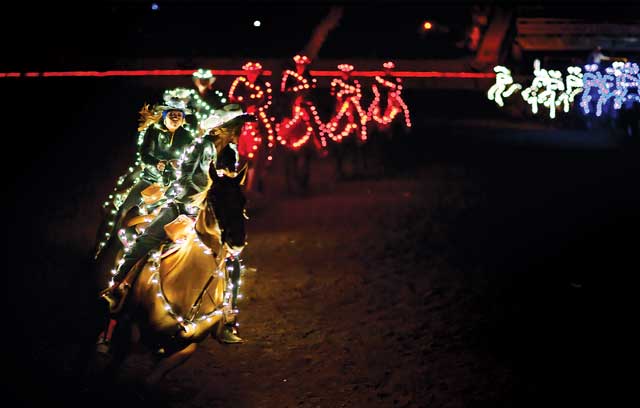
The velvet darkness of the Thomas & Mack arena in Las Vegas, Nev., has been lit up five times by the Snake River Stampeders, a precision drill team of 16 riders galloping in the cover of darkness, each one glowing in the outline of nearly 200 lights. The only drill team invited to perform at the WNFR, the Snake River Stampeders also performed at the 2002 Winter Olympics in Salt Lake City, Utah, and the 2002 Copenhagen Cup Finale held in Texas, and were even approached by America’s Got Talent, who is considering adding outdoor related talent to the show. But the Stampeders’ trademark is their hometown rodeo in Nampa, Idaho.
The Snake River Stampede moved from its well loved outdoor rodeo grounds to the indoor arena of the Ford Idaho Center in 1997, but Stampede fans were loathe to give up the old arena. “I wanted to think of something we could do to dress up the rodeo in the new place – something we couldn’t have done in the outdoor arena,” says Jimmie Hurley, the Stampede’s executive secretary. Brainstorming with her longtime friend Shawn Davis, the general manager of the WNFR, Jimmie’s solution didn’t come until Shawn’s wife recalled the opening of a rodeo she had seen with pretty girls on fast horses. It seemed the perfect complement to the Stampede’s claim as the wildest, fastest show on earth, but Jimmie wanted to add one more element – the pretty girls and their fast horses would perform in the dark.
Jimmie set to work appointing a drill instructor and holding tryouts, which were well attended by horsewomen curious to ride in a drill team unlike any other. The riders wore all black clothing and hats, with yellow Christmas lights safety-pinned on to their clothes and tack. It was wryly observed by one of the volunteers that even D-Day hadn’t required so much planning. The hours of practice and planning were an instantaneous hit, however, and the cheers of the 1997 rodeo audience confirmed what Jimmie hoped was true – the Snake River Stampeders were ready for Las Vegas. They performed that very December at the WNFR and returned again in 2001, riding in red, white, and blue lights, to “Proud to Be an American”, sending out a lone Stampeder with a flag made of lights to start the drill, an especially moving performance just months after 9/11.
Horsewomen all, the team is largely made up of wives, mothers, rodeo queens, and drill instructors, all hailing from the Treasure Valley in Idaho. Coached by Paula Vanhoozer, a seasoned drill team judge and rider, the Stampeders practice once a week over the course of three months, members chosen each year after a challenging night of tryouts in the spring. Of the 30 – 40 women who audition, only 19 are chosen – 16 regular team members and three alternates.
“I enjoy practice!” says Brandi Krajnik, a seven year member of the team. “Paula writes such good drills, and adding that mixed element of danger turning the lights off is a challenge.” Another member, Heather Miner, adds, “You have to have a horse and rider that are willing to push the boundaries of what common sense says is okay, and have a little fun with some adrenaline.” Heather has ridden with the Stampeders the last four years and coaches another drill team, the EhCapa Bareback Riders, with Brandi. “Stampeders is challenging horsemanship wise. It takes a rider who can push through fear, and a horse that has some go but that also stays under control, which is kind of a rare combination.”
Since its creation 18 years ago, the Snake River Stampeders have changed very little beyond team members and drill instructors coming and going. The team switched to L.E.D lights in 2010, which was brought about by Randi Wood, the assistant drill instructor, light coordinator, and rodeo board liaison. The new, brighter lights snake over the riders’ sleeves and up to their glowing hats with the help of extension cords. “Once your lights are fastened on, you’re pretty well staying put in the saddle,” says Randi.
By the time the Snake River Stampede week arrives in July, the Stampeders’ drill – written anew each year by Paula – is second nature. Once the arena is set up, they have just three practices in the dark before launching into their six performances during the Stampede. Though seldom, when the lights do fail, charged by 45 pound battery packs on the saddles, the Stampeders never fail to care for one another, especially during the accidents that inevitably occur. Even performing to music so loud they can feel it in their horses’ hooves, the team manages to communicate with one another during what one Stampeder described as a four minute barrel race in the dark with 16 horses.
“I think proof of how good we are is that we have the fastest riding, in the dark, with some of the best riders practicing in the least amount of time,” Heather Miner describes, “and there’s no way you can do that without amazing horses and riders.”
The Snake River Stampede was inducted in to the ProRodeo Hall of Fame in 2014
– Courtesy of the Hall of Fame
The Snake River Stampeders performing at the 2014 Snake River Stampede
– Shauna Rae’s Photography, Nampa, ID
The Snake River Stampeders performing at the 2014 Snake River Stampede
– Shauna Rae’s Photography, Nampa, ID
Snake river stampede
Celebrates 100 years
Potatoes immediately spring to mind when the state of Idaho is mentioned. But among PRCA cowboys and cowgirls, the pistol shaped state hosts one of the West’s top rodeos to compete in during July. And while Idaho produces more than 13 billion pounds of spuds every year, the Snake River Stampede boasts a $400,000 payout, placing it in the top ten of the PRCA’s regular season rodeos.
The Snake River Stampede, which lands in the middle of Cowboy Christmas, celebrates 100 years this month, a historic milestone coming just after the rodeo was inducted into the ProRodeo Hall of Fame in 2014. The legendary barrel man and rodeo clown, Leon Coffee, is coming out of retirement to be the man in the can during the rodeo, while the rodeo’s trademark drill team, the Snake River Stampeders, are performing their dark defying routine with a surprise twist at the opening. They’ll ride in green and yellow lights – the colors of the original Stampede arena.
Originally an offshoot of the Nampa Harvest Festival, which began in 1911, the Snake River Stampede started as a bucking contest in a roped-off block in town. The event became official in 1915, the first year admission was charged, and soon took place in a ball field. Other events were added, and the buck show, still nameless, grew in popularity.
The year of 1937 proved pivotal when the buck show was christened the Snake River Stampede by rodeo director Ike Corlett, and joined the Rodeo Cowboys Association. The bucking stock, which was originally herded to Nampa from a ranch near Horseshoe Bend, some 50 miles away, was later provided by Leo Cramer, a Montana stock contractor who brought the stock by train. The rodeo was changed to a nighttime show when lights were installed, and President Franklin Roosevelt opened the new rodeo from his home in Hyde Park, New York, where he pressed a golden telegraph key that turned on the lights of the rodeo grounds 2,000 miles away. In 1950, a new arena was built, seating 10,000 in its horseshoe shaped stadium. Gene Autry was the Snake River Stampede’s first star, followed by entertainers including Roy Rogers and Dale Evans, and later, Reba McEntire, and Glen Campbell. The Snake River Stampede moved indoors in 1997 to what is now the Ford Idaho Center, pulling spectators in from the heat and closer to the thrills and spills of the wildest, fastest show on earth.
“I’ve been working here since 1977, and the rodeo is part of my family,” says the Snake River Stampede’s executive secretary, Jimmie Hurley. “I love the rodeo’s heritage, and the fact that the committees have toughed it out through the good and bad years and didn’t let the rodeo go. We strive to have the best announcers, stock, bullfighters, clowns, and specialty acts – and to pay out a lot of money – which of course attracts the best cowboys and barrel racers. It’s an honor for us to be one of the top ten (PRCA) rodeos!”
Each year the association selects honorees who’ve shown dedication and passion for the sport of high school rodeo in South Dakota. Phil and Terri Kissack of Spearfish, South Dakota were recently named the 2015 South Dakota High School Rodeo “Persons of the Year.”
Passion and dedication are two very good words to describe how the Kissack’s feel about rodeo. Phil and Terri grew up in the rodeo community. Both competed when they were in high school. Terri competed for the Faith rodeo team and Phil rode for Spearfish.
In 1974, Terri earned the the National High School Girls Cutting Championship aboard a horse her dad, South Dakota Cutting Horse Hall of Fame trainer Darrel Griffith, had trained and shown. Her senior year, she was the South Dakota breakaway, cutting and all-around champion. Phil stayed busy running his family’s farming operation outside of Spearfish, but he made high school rodeo a priority and competed in team roping and tie-down roping.
Fast forward a number of years to when Phil and Terri’s two oldest children were in high school. Jesse and Billie Jo excelled in sports, but they loved competition outside the rodeo arena. Phil and Terri spent their time traveling to baseball and basketball games, and “loved every minute of it.”
In 2006, their youngest son Dane entered high school and their world shifted back to rodeo. Dane had competed in the Junior and Little Britches ranks, and his involvement in High School Rodeo was an exciting next step. That year Terri became the advisor for the Spearfish/Belle Fourche rodeo club, a position she held for five years.
In 2007 Phil became a Host Site committee member and a state director, roles he served in until 2014. Over the past ten years, the Kissacks have invited countless high school kids to come and practice at their arena, oftentimes helping them with their horses and horsemanship. Terri has found a fun niche judging queen contests, and recently, Terri and Phil joined forces to co-judge the Deadwood “Days of 76” queen competition.
Phil joined the Host Site committee in its second year of hosting the State High School Finals rodeo. He quickly got to work organizing community support to improve the city’s rodeo grounds, and a partnership between the State High School Finals committee and the Black Hills Round-Up committee was born. The group hauled in sand to improve the grounds, installed drain tile under the arenas, and purchased new bucking chutes, roping chutes, and holding pens. They also enlarged both arenas, the cutting pen, and the warm up arena.
“I wanted to try and make the privilege that Belle Fourche had to host the event as an ongoing thing. We wanted to make it better every year,” said Phil.
“I’d describe Phil as the quiet person behind the scenes who’s making sure everything goes smoothly all week long,” commented Terri.
“I remember one year, it rained like crazy during the [state high school] finals, and Phil went and worked the ground all night long,” said Terri. “Then he talked them into starting the rodeo two hours late so the ground could be just right for the kids. He served because he loves the sport of rodeo and he loves seeing kids compete and work so hard at something.”
The work ethic of the contestants is a quality Terri and Phil believe is unique about the sport. They also appreciate the family-centric nature of the competitions.
“Rodeo is a really unique sport because you compete as an individual, yet the whole rodeo community is like a family. When one family sees another family in need of a horse, a place to practice, or advice, it’s freely given,” said Terri. “I like that you’re more in control of the direction of your kids. There’s so much family time to be had driving to and from rodeos, versus them riding to a game in a bus.”
“As we helped with high school rodeo, our mission focused on how rodeo builds character in everyone who participates,” said Terri. “Some will never be involved with horses again, while others will get full ride scholarships to rodeo in college. Yet their experiences in high school rodeo help them be successful in their future lives.”
“I feel very honored by this recognition, but I’m also very humbled knowing how many people are doing exactly what we’ve done to help the sport of rodeo in South Dakota. I’d like to share this honor with those people,” said Terri.
“We do it because somebody else was doing it for us when we were kids,” smiled Phil.
erri and Phil, with their extended family at Dane and Kelli’s wedding, May 24th, 2015
hil in Minot, North Dakota at the 2014 Badlands Circuit Finals with Dane’s good calf horse “Lizzie”
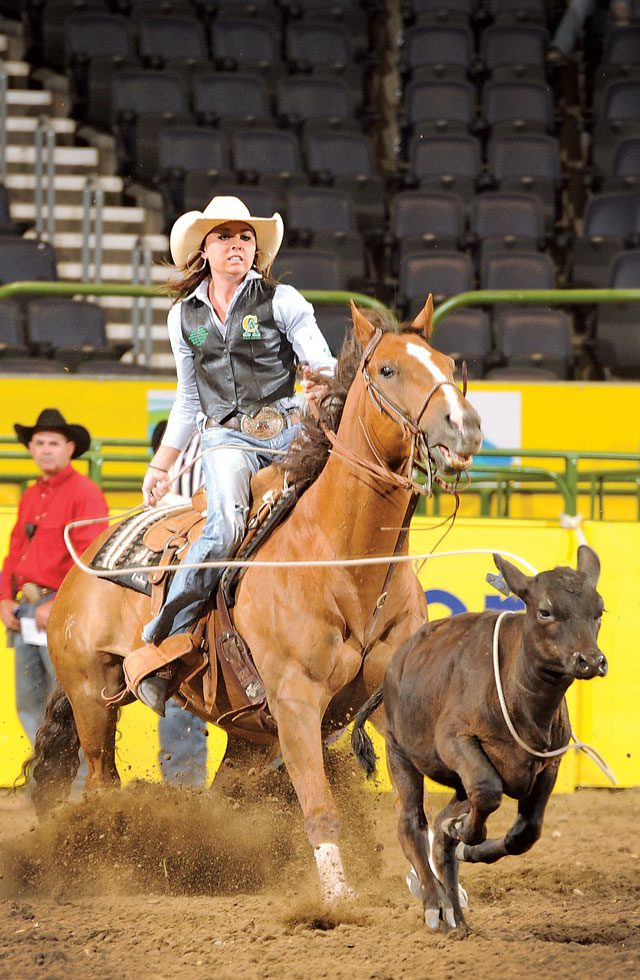
Macy Fuller has spent her time since graduating from Central Arizona Community College searching for a barrel horse for the CNFR. “I’ve tried four so far,” said the defending Women’s All Around Champion, who is entered in three events this year – barrels, breakaway, and goat tying – the same events she has qualified for in the past four years. “My black horse is out until September, so I need to find one for the whole summer. The barn at the college finals is tiny, and indoors, so I am looking for a horse that fits that as well as the big outdoor arenas that I’m used to running in.”
Her favorite event is a toss-up between tying goats and breakaway. “The goat tying I’ve really studied and I can give a lot more back with my style,” said the young lady that spends endless hours coaching students. “People ask me what I’m going to do when my career is over – and it’s not – it’s just beginning. I’ve got an outstanding stud and I want to give him every opportunity that I can.” The stud is Heza Judge of Honor, and she is excited to enter him in futurities. The other thing Macy is excited about is giving back all her goat tying knowledge to her students. “I have a few schools for the summer, but I like to do it over and over with my students and watch them progress slowly. When I’m in Arizona I have a goat practice every Tuesday night and we have fun and hang out. You really get to know them and that’s what I want – a long term relationship with the kids to make sure they are getting the most out of it that they can.”
The style she teaches is one that she picked up through the years with the help of her mom, Karen, who made the college finals and was reserve champion goat tier. “I didn’t ever go to any clinics – it was me figuring new things out. Some kids use the style now – I get off late and flank by the collar and gather in the air. I don’t hang on the side of my horse at all. My horse is truly amazing and is so fast – when he feels me make a slight move, he slows down.” Now that her career chasing a goat tying title is about over, she is excited to have sold this amazing horse. “I’ve had him since he was six and he’s 19. Kaiden Ayers is the new owner – from California. I can’t wait … she has fire in her eye and likes to go fast so it’s a perfect match.”
Macy got her start in rodeo through her dad, Mike, who was rodeoing hard when Macy was young. “When I was three weeks old, I’d been in 17 states while my dad was trying to make the NFR. I actually enjoy being in a truck – I don’t think I’ll ever stop traveling. It’s too much fun and I can’t imagine staying at home. I love to see new people and new rodeos and have fun going.” Mike finished 16th a couple different times, missing the NFR by just a few hundred dollars. He and Karen were college rodeo coaches at LCSC in Washington State, which is where Macy grew up. She continues to hold the record at the National High School Rodeo Association as the only person to win seven consecutive All Around championships at the junior high and high school level. She had plenty of opportunities to practice during those years in Washington and credits her dad with training all the horses she rides today.
“He makes sure that if one’s down, I’ve got another one,” said Macy. “He and my mom always make sure I have the best opportunity I can have. She’s been the one on the phone telling me where to go to try horses.” Macy is an only child, something she has liked. “I am spoiled and I appreciate everything that’s been done for me. I don’t take anything for granted.”
Macy started giving back her knowledge when she was in grade school. “I went to a school of 17 kids and there was a kid at school in the special needs program. I decided to make a change and became his best friend. I still stay in touch with him, but that friendship made a difference in my life. As long as I have something to offer and someone asks me for help, I’m going to give it to them. I’m sure if I’m stuck somewhere, I’m going to ask for help too.” Macy wasn’t involved in any school activities. “I played basketball for a couple years, but it cut into my riding time. My horses are my babies. They have shavings in their stalls and blankets on. They truly are like having kids. I’ve always been like that. Making sure they are comfortable and happy makes me happy.”
Macy Fuller at the CNFR, 2014
– Hubbell Rodeo Photos
Macy Fuller at the CNFR, 2014
– Hubbell Rodeo Photos
Laughter is a precious commodity for “Backflip” Johnny Dudley. The rodeo clown, dubbed for his backward springs, has been splitting sides and spreading smiles at rodeos since 2006, but his dedication to his work is no laughing matter. “It’s my passion!” says the 37 year old from Aubrey, Texas. “I tell people all the time that I’d be a rodeo clown for free, I love it so much. I’m a certified air traffic controller, and I could be making $180,000 a year, but I love being a rodeo clown.”
Though built like a steer wrestler at 6’3”, Johnny’s only ties to rodeo were the local rodeos in Dayton, Texas, that he and his family went to in the summer. The antics of the rodeo clowns were a highlight for Johnny, but by the time he was in third grade, his parents had divorced and he and his mom moved to Groesbeck, Texas. No more rodeos or rodeo clowns until 1999 on the Marine Corps base in Beaufort, S.C.. Johnny was 21 and had joined the Marines immediately after graduating high school. A rodeo was being held on the base and Johnny, who had no intention of going, was volunteered into taking tickets at the gate for the first half of the rodeo. He found a seat in the bleachers for the second half and unknowingly met his future. “I was paying attention to the clowns, and this short, chunky, older guy runs into the stands and sits on a good looking blonde lady’s lap,” Johnny says, recounting one of his favorite stories. “Her husband laughed, and a light bulb went on for me.” Johnny met the clown after the rodeo and was offered a role in his clown act the following night. “I bought some big pants and makeup and showed up as a clown. In my mind, I was thinking I’d be a clown, not a prop,” Johnny recalls humorously. “The fire was lit!”
After getting out of the Marines in 2004, Johnny found the practice bull riding arena in his hometown of Dayton, Texas, and started learning to fight bulls twice a week. “I knew that bull fighting was my gateway to being a clown. I was young and athletic, and the guy who owned the practice pen also produced several local rodeos, so he hired me to clown for him. Cleveland, Texas, was my first rodeo. I made $50.” At the same time, Johnny attended San Jacinto College in Pasadena, Texas, paying for his degree in international business with his rodeo income and Montgomery G.I. Bill. He also continued to attend rodeos and study how other rodeo clowns worked. The experience wasn’t always comfortable. Some people were more welcoming than others, and a few rodeo clowns wanted nothing to do with the competition. “I didn’t have any buckles or boots,” says Johnny. “I was just some guy out of the Marines that wanted to learn! I didn’t know the rodeo terminology – I just wanted to clown.” Yet the people who were willing to help Johnny influenced one of today’s funniest men in ProRodeo. These included Rudy Burns and Lecile Harris, two of Johnny’s rodeo clown idols. “Rudy helped me with anything I wanted and sold me one of his clown cars. I learned from the old guys, so I’m more of a traditional clown. I’m not much for dancing around or clapping – I like to tell jokes and do clown acts.”
Johnny has six different acts and a slew of jokes at the ready for what he calls “situational comedy”. “I don’t go out with a plan,” Johnny explains, “I just go out and wait for something to trigger a joke in my mind. It could be a girlfriend and boyfriend walking down the bleacher, or a guy with long hair. I want to relate to the crowd with a current situation that’s happening, not just tell little Johnny jokes out of nowhere.” None of Johnny’s banter with the rodeo announcer is ever scripted, and his title backflips are also spontaneous. The crowd pleasing maneuver is one of Johnny’s childhood talents that started with showing off for the girls at the swimming pool. Of the thousands of backflips he has made, only two have gone awry – once at a PBR event in Salt Lake City when the fence gave way beneath him, resulting in a broken neck, and one other rodeo where he slipped and barely made his rotation in time.
Johnny is also known for his electric blue wig and large foam cowboy hat, courtesy of any mall in Texas. One of his best known acts is Cow Patty, performed to Jim Stafford’s song of the same title, completed by a mechanical bull mounted on a three wheeler, blowing smoke out the nostrils and shooting water from the rear. Another favorite act involves Johnny’s skunk, Rosie. His first skunk, Flower, was in the act for six years before passing away, and now Rosie performs to the frightened delight of rodeo audiences. “Everyone thinks she’s trained, but I just act off her instincts,” says Johnny. “If I want her to lift her tail, I’ll run at her to startle her a bit, or jump around in front of her. Then I’ll throw a dummy skunk into the audience, and depending on where I throw, they scatter!”
Though the rodeo arena is a second home to Johnny, his home in Aubrey with his wife, Emily, and 18-month-old son, Jase, is still his favorite place to be. They recently purchased a 40 foot motor home so that Emily and Jase can travel with Johnny. The husband and wife first met in 2009 at a rodeo – Johnny clowning and Emily barrel racing. Emily is also the owner of Deuce’s Wild Tack, known by many professional barrel racers for its bright colors and bling. While helping Emily with the business, Johnny spends his time at home going to the gym, duck hunting, watching football and announcing barrel races, many of which Emily competes in. He recently became a certified hypnotist, and plans to do several shows during his off weekends. Johnny is also the cook of the family, having dinner with Emily’s parents several nights a week. “I have a killer lasagna, and I can put anything on a pit and smoke it,” he says.
Taking to the road again, Johnny will be performing west of the Rocky Mountains this summer, with rodeos from Utah up to Montana, and even several in Alaska. He’ll work the All American ProRodeo Series Finals in October for the second year in a row, and is also the PRCA Turquoise Circuit Finals barrelman for the second time. “Everybody wants to do the biggest rodeos for the money and prestige, and I do too, but my favorites are the small hometown rodeos that I grew up working,” says Johnny. “When it comes to prestige in this business, I’d love to work Fort Worth, Pendleton, and of course the WNFR. But the one I thing I want even more is the Coors Man in the Can award, because that’s about who’s best at protecting the bull fighters. I’m just a family guy that likes clean comedy and rodeo.”
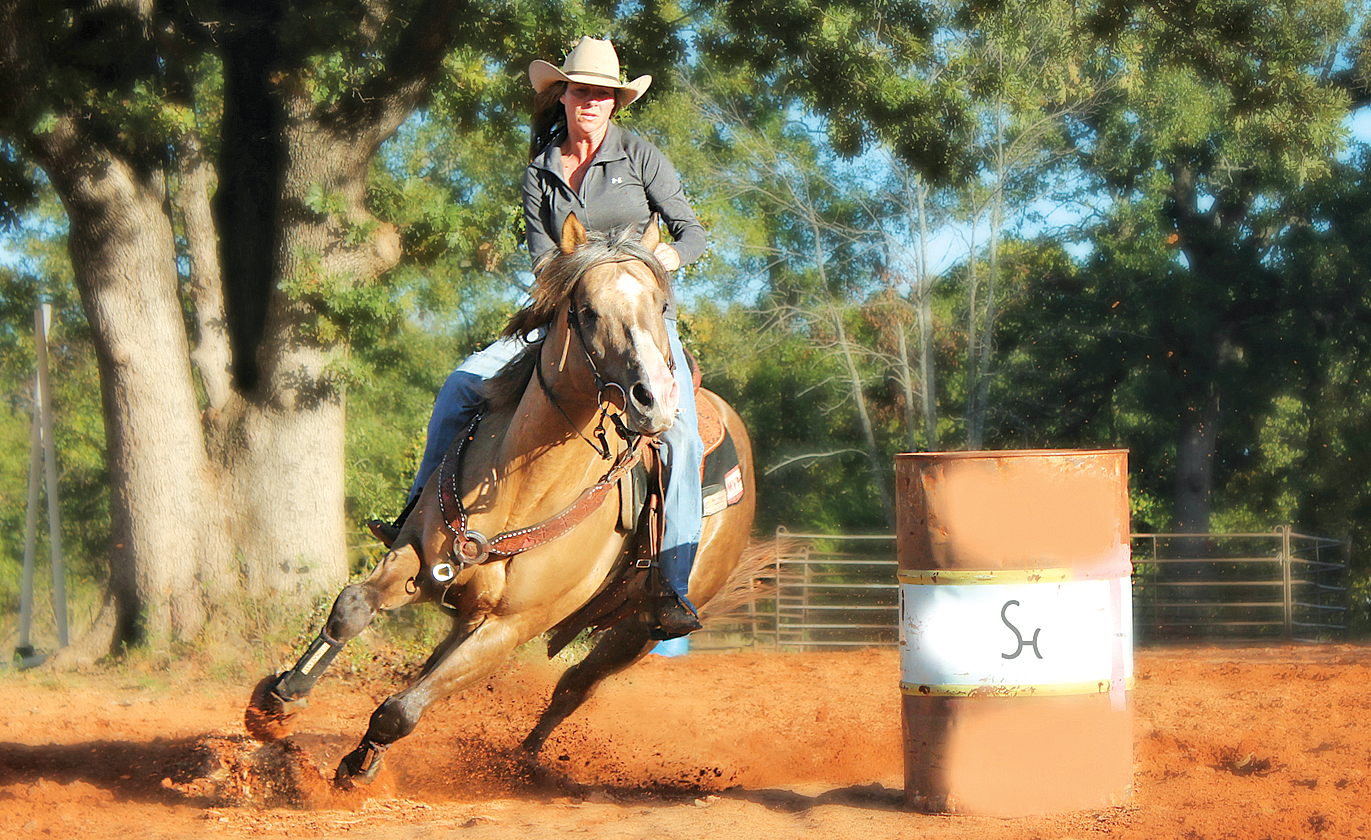
From RFD-TV’s The American, to the Diamonds & Dirt Barrel Horse Classic, barrel racer and trainer, Sharin Hall from Kingston, Okla., has burst into the spotlight, but she’s by no means a stranger to the barrel pen. As a lifelong competitor, Sharin, originally from Sunbury, Ohio, was born to turn three barrels. Her father, Jackson Hall, was a barrel horse trainer. Sharin’s mom was also into horses, so it was only natural their daughter would saddle up as quick as she could.
Every cowgirl has that one horse who really lights the fire, and for Sharin, that horse was T’ Heck, a winning barrel horse of her father’s. She was 8 years old when she started running barrels on the horse. “I won on him until I was 13. I basically learned how to ride and sit right on a horse, and then when I was 16 my mom bought my first horse to train for myself,” Sharin said.
Since that first training project, Sharin has learned how to help shape different horses, while allowing for their individuality, and she’s made a career out of the skill. “I’ve learned that not every horse is the same, and you have to adapt sometimes to their style and their way of doing things, all the while asking for what I want.”
Initially, Sharin’s grandmother stressed a college education, but Sharin quickly realized that a 9-5 desk job wouldn’t be something she could do long term, so she practiced cosmetology at first. “I did that for 10 years and rode my own horses, and then when I was 28 I got a phone call and got a job offer in Oklahoma training horses, so I took the job,” she said, eventually branching out into her own full time training business that’s still thriving today.
It’s a profession where the biggest challenges are, in some ways, also the rewards. “The challenge has been when you pour your heart and soul and everything you have into a horse and develop it into a winner, and it gets sold or it goes back home, you separate from something that you love and created into a winner,” she said but added, “I love it though when they go on to win, that is probably the most satisfying thing that I experience in what I do.”
Over the years, in addition to her training program, Sharin has competed in multiple futurities and pro-rodeos. She has a strong faith in God, and remains close to her family. Sadly, Sharin’s father passed away in December of 2011.
In 2013 she organized an annual memorial barrel race in Ardmore, Okla., in his honor.
To balance the difficulties of saying goodbye to horses she’s trained, Sharin is starting to ride more of her own horses these days, such as the breakout star of the Diamonds and Dirt, a mare named Bulleva Sharin co-owns with attorney Brad Oesch. They bought Bulleva in Oklahoma City. It didn’t hurt that the Bully Bullion breeding in the mare appealed to Sharin. “I picked her and just loved the way she felt, it was a good fit. We’ve just gotten better and she’s gotten better and more confident to the point of winning the slot race. It was my first slot win. It was really special to be on something I part owned, and I just feel very blessed,” Sharin said of her win at Diamonds & Dirt, where she and Bulleva took home over $110,000.
This year also brought success when it came to RFD-TV’s The American. Sharin, riding a client’s horse, Streaking Ta Fame, whom she trained, was the only qualifier to make the final-four in the Shoot Out round, where she ended up third. In the long go, she ran the second fastest time of the entire rodeo against the world’s fiercest competition.
“It’s really a lifetime experience. I think that the American is a golden opportunity for someone who is not able to be on the road and rodeo all year. It’s a great opportunity to be able to run at that money,” she said.
Sharin plans to continue to rodeo on some of her mares and young horses this year, as well as continue down the futurity trail with Bulleva.
It’s that don’t stop attitude that embodies Sharin, explained her apprentice Stevie Ann Tucek, who previously traveled and trained with NFR barrel racer June Holeman and chronicled her tales of inspiration for the rodeo world.
Now, Stevie is finding inspiration in Sharin. “Sharin has amazing will power and drive and gives 110 percent all the time. I believe her having this mindset, faith, and hard non-stop 18-hour days, is what has gotten her to where she is, and where she is going.” Stevie said and added, “She is a great teacher and has passed down some of her techniques that I will cherish and apply in my career for a lifetime. She has a gift, and she knows what she wants from life: to live it to the fullest, and make herself better each day. We could always use more Sharin Halls in this field.”
And if Sharin has anything to do with it, that field is only going to get faster.
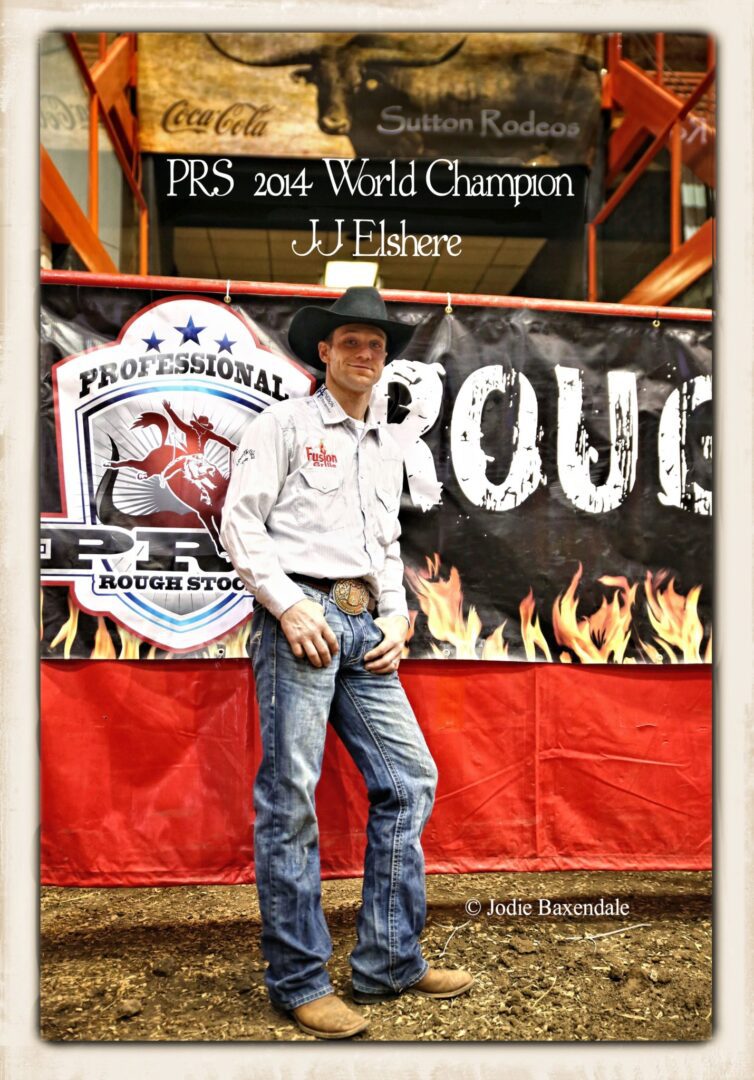
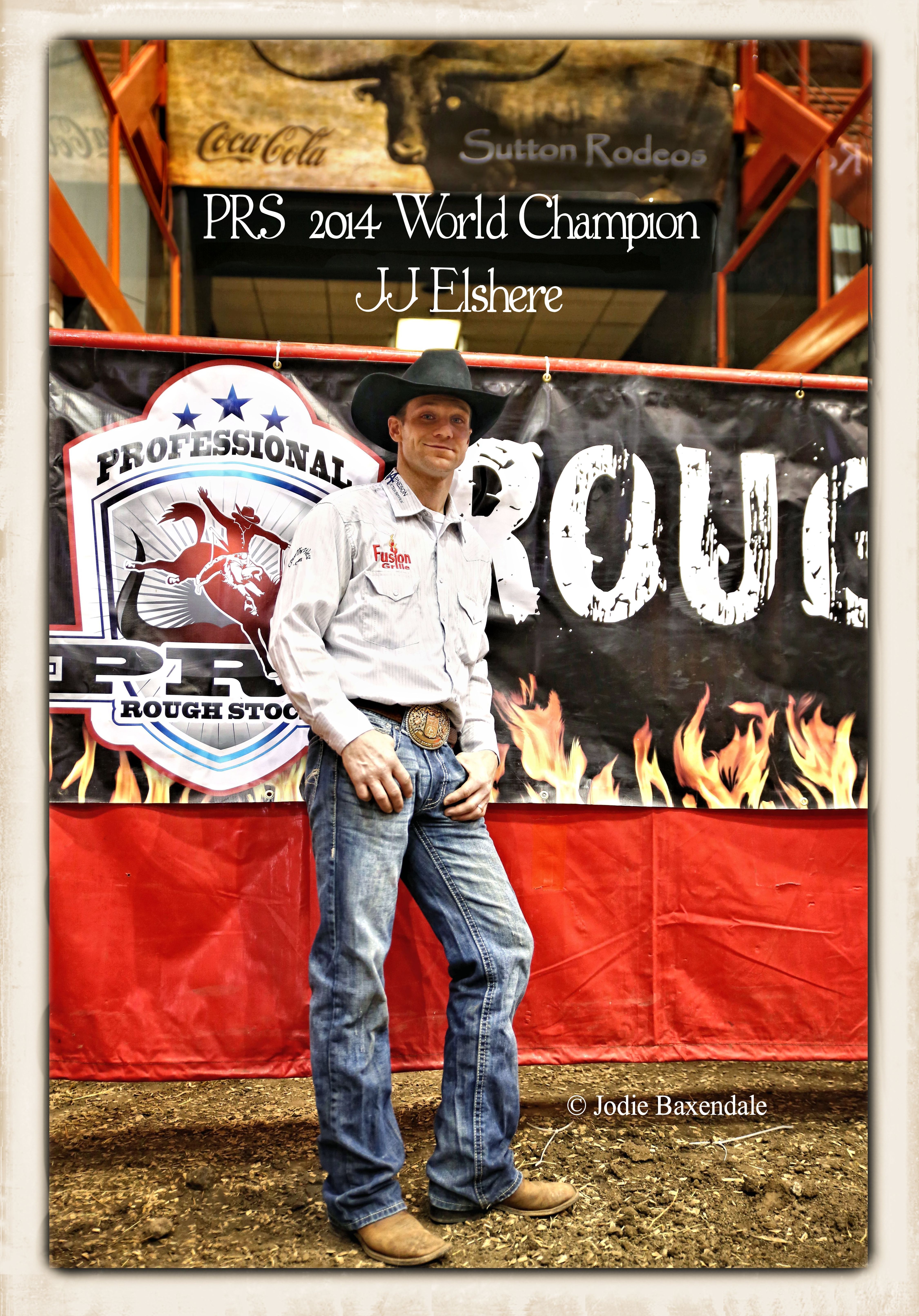
JJ Elshere PRS 2014 Champ – photo by Jodie Baxendale
J.J. Elshere, Professional Rough Stock competitor and 2014 PRS World Saddle Bronc Champion, is carrying his gear bag into the AT&T Stadium for the first time this month. The recipient of one of The American’s coveted exemptions, J.J. has every intention of winning the saddle bronc riding at the world’s richest one-day rodeo. While winning the average in the saddle bronc riding at the 2006 WNFR is one of his career highlights, J.J.’s trip to Arlington, Texas, is equally exciting to him. “I think it’s going to be fun!” says the 34 year old from Hereford, S.D. “I’m just going to treat it like any other rodeo – you want to do your best at every rodeo you go to, and that’s what I’m going to do.”
Following in the bootprints of his older brother, Ryan, J.J. started riding saddle broncs in high school. The boys’ father introduced them to rodeo early on, and both gravitated toward roughstock. “Our whole family went with us to our rodeos, and gave us the opportunity to compete,” J.J. recalls. “Ryan taught me a lot about saddle bronc riding, and that made it a little easier for me to learn.” While J.J. also rode bulls, it was rodeo’s classic event that he pursued after high school. He joined the PRCA in 2000. “Ryan bought my permit for me and got me started in pro rodeo. He entered me in rodeos – even some I didn’t want to go to, but I got money out of it!”
Horses are the tie that binds the Zancanella family, and Kristen Zancanella wouldn’t have it any other way.
Matt and Kristen Zancanella, along with Matt’s sisters, ReAnn Zancanella and Bryel and her husband Sean Mulligan, own and operate Pride Farm, a horse business centered around their stud, King, whose registered name is Lions Share of Fame.
But for Matt and Kristen, their love of horses starts much farther back.
For Matt, life began in Rock Springs, Wyo. the eldest child of three, with two younger sisters. While his dad worked hard to get his veterinary clinic started, his mom groomed dogs. The money she earned from grooming went for entry fees for her kids: Matt and his sisters Bryel and ReAnn. And after she worked all day, she drove all night, hauling her kids to youth rodeos. Matt and his sisters competed in Little Britches, junior and high school rodeos, with his attention being focused mainly on the team roping, and Matt realizes the sacrifices she made for her kids to rodeo.
After graduating from high school in 1994, he spent a semester in college. That winter, he entered Rodeo Houston and never returned to college. “He started rodeoing (fulltime) after that, and never looked back,” Kristen said. “He was addicted to team roping.”
For the next decade and a half, he criss-crossed the country, competing at pro rodeos and making his dream come true three times: qualifying for the Wrangler National Finals Rodeo. In 2002 and 2003, he heeled for Travis Tryan, and in 2004, he roped with Wade Wheatley.
In 2004, he met a tall slender cowgirl named Kristen Storm at the San Juan Capistrano, Calif. rodeo. Kristen was there as a volunteer, and the couple started dating. She moved to South Dakota the next year, and in 2006, they married.
In 2011, the road was wearing on Matt, and he quit rodeo full time, focusing on the Badlands Circuit. He began his own business: Pro Earth Animal Health. The business sells all-natural supplements for cattle and horses, and since he began, it’s taken off. Matt’s genuine personality and friendliness helped him in rodeo and has helped him with his business. “He’s never met an enemy, everyone remembers him and everyone likes him,” Kristen said. “He’s a genuine guy, and he tends to remember everyone. He has a lot of friends.”
Kristen grew up in Orange County, California, in town, with a love of horses but parents who never rode and had no place to keep a horse. So she took riding lessons at the age of seven, when her instructor recognized her as a “horse freak,” as Kristen says. The lady allowed her to spend as much time as she wanted at the stables, where Kristen ended up giving riding lessons and spent summers working for jumping, cutting and reining trainers. Growing up, barrel racing was not her favorite event. “Growing up I thought barrel racing was the stupidest sport ever.” Now that she spends days breaking and training horses for barrels, her opinion has changed. “It’s tougher than anything I’ve ever done.” Full story available in the February 2015 issue.
Kristen Zancanella barrel racing
– Scott Voigt
Keylee Zancanella competing in the Little Wrangler division for Little Britches Rodeo – JenningsRodeoPhotoraphy.com
‘Long live cowboys, may the legacy never fade, ‘cause honor is his code, it’s all he’s ever known and he’d die just to keep it that way. Throwing caution to the wind for the life he defends ‘cause he knows that’s what’s right. So long live cowboys, from now till the end of time!’
The chorus to Austin Wahlert’s song, “Long Live Cowboys”, co-written with Baxter Black, reverberates with the 25-year-old singer songwriter and former bull rider from Gill, Colo. So do the words to Austin’s song “Las Vegas Gold”, which he is singing at the opening of the tenth round of the 2014 WNFR. Austin’s dream from childhood was to rodeo, but at age 23, nearly 25 broken bones from rodeo’s most dangerous sport, made him face the fact that his rodeo career was over. Yet the death of one dream led to the prelude of another. Austin had a talent for songwriting, and a guitar waiting to sing at his fingertips. He had written his first song when he was 16, and several years later put together a demo CD.
Austin grew up on a 3,000 acre cattle ranch in northern Colorado with his brother and sister, learning rodeo from his parents and from being a competitor. His dad, Scot Wahlert, was the president of the Mountain States ProRodeo Circuit, and his mom, Chelle Wahlert, was the director of the WPRA. Austin decided that if he couldn’t compete in the sport, then he was going to sing about it and the western way of life.
He learned to play guitar from his grandpa, Robert Gulvas, spending his afternoons after school soaking in everything he could about music. “Austin has always been very self motivated, and he feels there’s always something he can learn from others,” says his mom, Chelle. Following graduation from Eaton High School, Austin attended Odessa College on a full-ride scholarship, and his guitar took a backseat to his bull rope. However, he would play in the parking lot after rodeos, then began performing in bars and other venues to earn money. During his freshman year of college, Austin broke his back riding a bull and took a year off, which he used to write music while studying for his degree in business and marketing. After returning to rodeo and breaking his back a second time, Austin knew his competition days were at an end.
Yet again, rodeo steered Austin toward music. His travels around the country for bull riding introduced him to gifted songwriters like David Lee and Wynn Varble, who quickly recognized Austin’s talent. Several of Austin’s music friends encouraged him to call Bruce Bouton, a steel guitarist who has played for Ricky Skaggs, Emmylou Harris, Garth Brooks, and Reba McEntire, among other notable artists. Despite the declarations that Austin would likely never reach Bouton on the phone, he called anyway, and caught the musician while he waited for a flight. “It was one of those God things,” says Austin. “Bruce told me to send him some of my songs, called me back after hearing the first two, and said we’d meet when he got back from touring in Europe.” That was the beginning of many trips to Nashville, which opened Austin up to a world of singers, songwriters, musicians, publishers, and record labels. Guitar legends like Bob Seger and Jim “Moose” Brown, who wrote “It’s Five O’clock Somewhere” for Jimmy Buffett, sat in on several of Austin’s recording sessions and even played with him. “I was just like a young cowboy that gets to rodeo with Ty Murray for a week,” Austin describes. “It changed my career.”
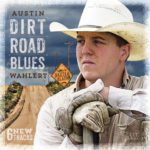
Austin released his first album, Austin Wahlert, in 2011, and a second, Dirt Road Blues, in 2013. He is now working on a third album which should come out in late 2015. “For the songwriting, it takes about a year, while I work on the message of my album. When I’m playing these songs thousands of times for concerts, I want lyrics that help a person get through something in life, or celebrate something. There’s a lot of music out there that you can’t sink your teeth into, and we’ve lost any deeper meaning in our songs.” “The Day She Went to Heaven” is particularly special to Austin, written in honor of his late mother-in-law, and another favorite is “Las Vegas Gold”. The song is inspired by Chris LeDoux’s music, and Austin fantasized about it replacing Elvis’s “Viva Las Vegas” to kick off the tenth round of the WNFR. On December 13, two and a half years to the day he wrote the song, he will be singing it on the arena floor of the WNFR.
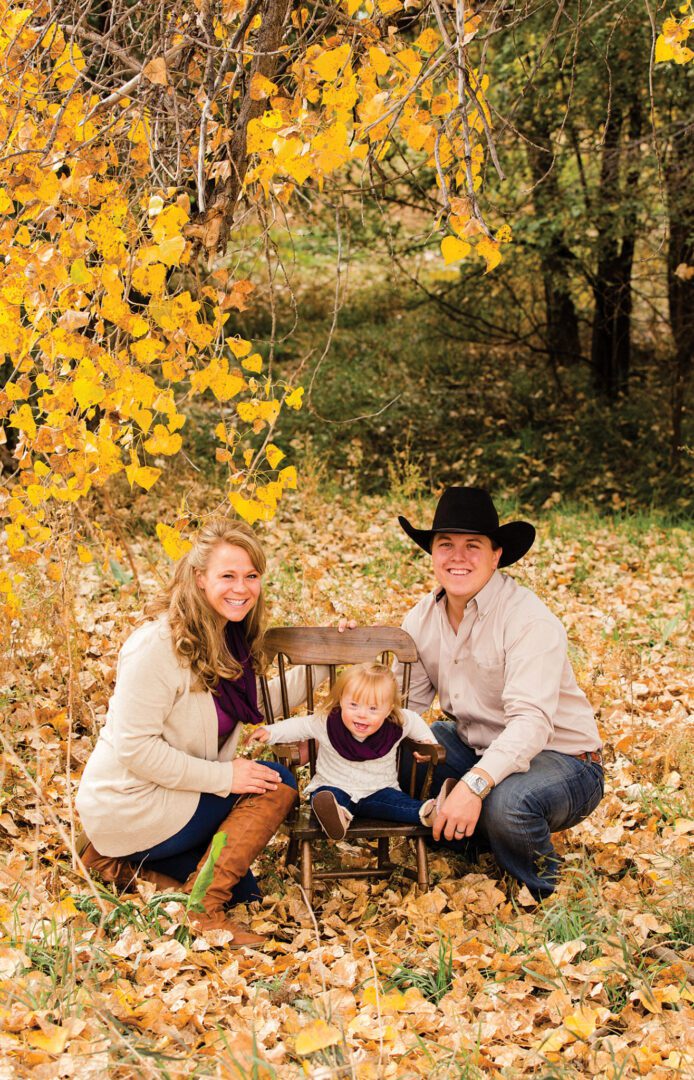
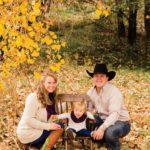
As an independent artist, Austin is his own manager, and business and marketing agent. This has been one of his best years as a professional musician, touring from late April until the third week of August. He flies to Nashville every six weeks to record and write, but spends every other moment with his wife, Justine, and their two-year-old daughter, Reagan. Reagan was born with Down Syndrome and had to have open heart surgery when she was three months old. She pulled through and is an avid fan of her dad’s music. She’ll leave anything she’s doing to listen to Austin play when he brings out his guitar, with ‘music’ being one of the first words she learned in sign language. Justine was a high school and middle school art teacher until Reagan was born, and now continues teaching at home with Reagan, coaching her in sign language and doing three hours of therapy every day. Justine recently took up running and ran the 26.5 mile Denver Marathon in October.
Ever looking to advance his music, Austin is taking a music theory class, previously learning everything by ear. “I never want to be complacent,” he says. “To this day, I can pull into play at a rodeo, close my eyes, and I could be there riding bulls. I still miss it, but music was a dream always burning at the back of my mind too. Singing at the tenth round of the Finals is great, yet I still have so many things to learn. I keep setting new goals, and I’m always working to be better than I was yesterday.”
Austin bull riding at Southeast Allstars, 2006
Austin’s new album, “Dirt Road Blues.”
Austin Wahlert, wife, Justine and daughter, Reagan – Jennifer McDaniel, www.jmphotographycolo.com
Central Plains coaches and Vicki Shireman, Central Plains Secretary for the past 20 years. – Photo by Dale Hirschman
Vickie Shireman has lived around the Elk City (Oklahoma) area all of her life. “My family rodeoed – that’s all we did,” said the daughter of Una and Jiggs Beutler. “My dad was part owner of Beutler and Son, he was the son. And my mother kept the books and timed.” Vickie and her brother, Bennie, and sister, Dollie Riddle, rode to the rodeos in a car when their mom secretaried. “We stayed in motels; we didn’t have a camping trailer. We were raised in a rodeo office. Back then, you opened the books before the rodeo opened so you answered the phone and after you got it set up, they would call back to see what the draw was.” They entertained themselves with fighting with each other and there were always things to do. “A lot of times the rodeo office was in the lobby of the hotel, and sometimes people would take us to the pool. I didn’t know anything else. That’s all we did.”
Vickie learned to trick ride with her sister from JW Stocker, a Hall of Fame trick rider and roper that stayed with the family one winter. “My sister and I went to the West Coast in the early 1970s. She trick rode and I was the ‘extra.’ By the next summer, my dad had us trick riding at the rodeos.” Dollie continued to perform, but after Vickie broke her back, she decided to stick with secretarying. Vickie went to Southwestern Oklahoma State for a year. “I secretaried rodeos and that turned into a full time job.”
She met her husband, Dennis, when he came to work for her dad. “He drove a truck for him and that’s how we met.” The two married a year after that and have two children, a boy and a girl. Vickie kept up with her secretary jobs, raising her two children in the rodeo office. “My daughter, Jennie Murray, has carried on the tradition, and is a rodeo secretary and timer.” Justin works for Hallburton and his rodeo career consisted of helping Bennie with the stock for a few summers.
Vickie took over as the secretary for Central Plains in1994. “My mother was the Southwest Regional secretary for 20 years, so I knew about the work, and I applied for the job and got it.” She has done it ever since. “I still like to go, and I enjoy them.” The region is the largest in the NIRA and she describes each rodeo as a marathon. When she got the job, they didn’t enter with a fax, the entries were mailed in. “I encouraged them to use the fax machine the next year and now most of it is emailed. The region has grown over the years – there were more than 500 this past year. When I started in 1994, Jim Boy Hash was the student director, and now he’s the faculty director. There’s only one coach left that was coaching when I started – Allen Russell from Colby.”
Vickie has been the NIRA Secretary of the Year, the PRCA Secretary of the Year and the WPRA Secretary of the Year. “I couldn’t have a better job – and this will be my 20th year working the NFR, and my tenth year as the office manager.” Her job while at the NFR consists of running the contestant rodeo office with the help of an assistant. She is responsible for the draws, the points, and the money.“I’ve raised my kids and I have five granddaughters.” She and her husband (Dennis) just built a new home out in the country, and that was one of her goals. Now she is working on the landscape. Other than that, “I’ve had a good career. I’ve worked lots of the top rodeos, and I love what I do.”
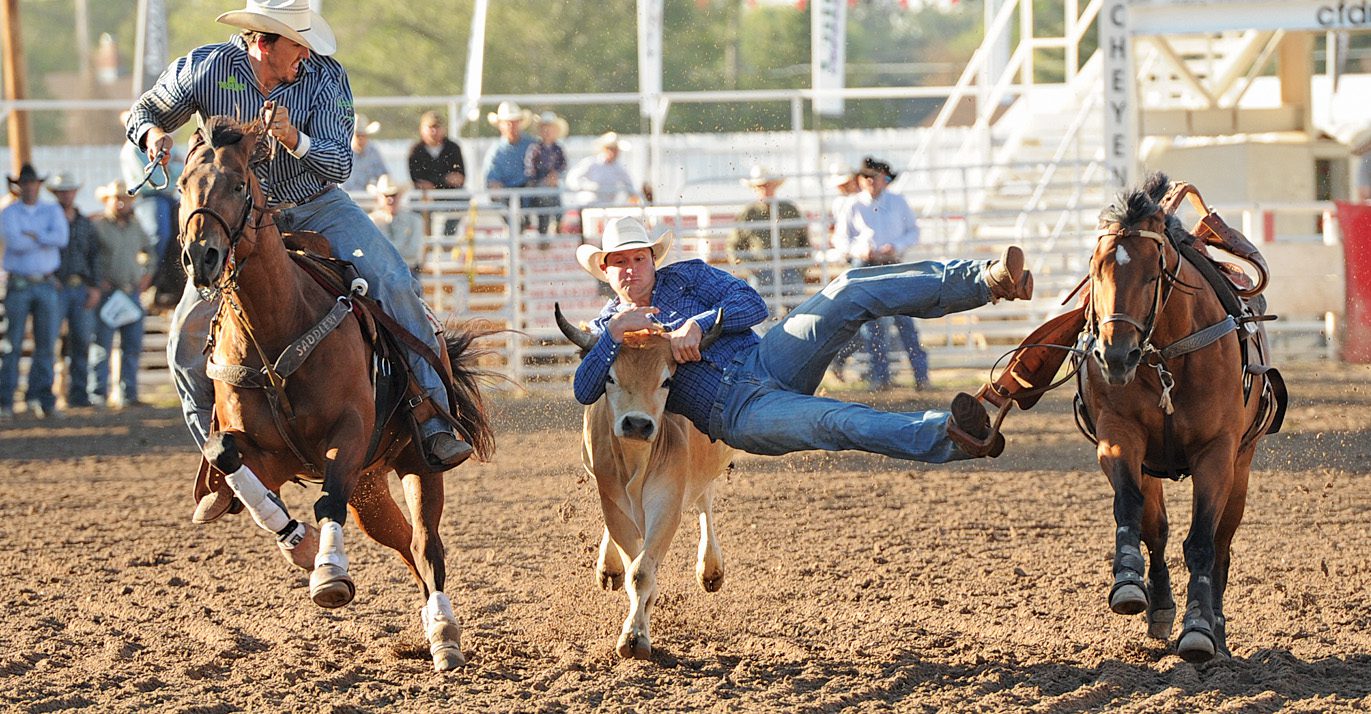
Winning the Ram National Circuit Finals in Guthrie, Okla. earlier this year, the young gun, Kyle Irwin, 24, from Robertsdale, Ala. has big goals for his steer wrestling career. Clocking a record-tying time of 3.3 seconds naming him the 2014 RNCFR Champion, Irwin is confident and motivated with an eye on a gold buckle.
“I’m inspired by the people that succeed when the odds are stacked against them. No one person in particular, just anyone you might read or hear about that started from rock bottom and had nothing, then beat the odds and excelled tremendously. Just to prove that nothing is impossible.”
Growing up around rodeo and cattle, Irwin began junior rodeo at the age of 11 competing in tie-down roping, chute dogging, and team roping. Irwin jumped his first steer at 13 years-of-age at Steve Duhon’s Steer Wrestling School. Graduating from Northwestern Okla. State College, he was fortunate to have a mentor and coach, Stockton Graves. Graves taught Irwin not only about steer wrestling but about life and experiences. Traveling with Kody Woodard and Dru Melvin his senior year in college, he had the opportunity to ride Dru’s horse, Moonshine. By riding Moonshine, Irwin gained a tremendous amount of knowledge and confidence to keep pushing through any doubts about himself. Unbeknownst to Irwin, his adventure into a professional steer wrestler was headed in to a victorious one.
“I remember when I was in high school and signed with Western Okla. State College. The local newspaper wrote an article that read, Robertsdale High Senior Wrestles His Way to Higher Education. I never knew I had a chance to make a career out of the sport of steer wrestling. I had watched guys on TV making a career and I was in awe at how good they were. Now, I am able to pay my bills and enjoy this life that I had dreamed about.” Full story is available in the September 15, 2014 issue.