Rodeo Life

Category: 6 Over 60

  • 6 Over 60: Martha Josey

    6 Over 60: Martha Josey

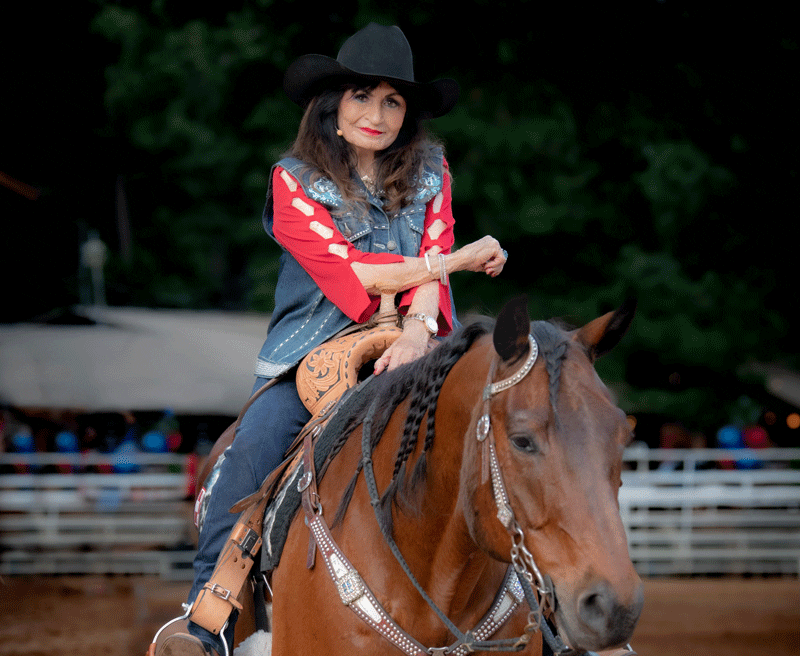
    World champion barrel racer Martha Josey’s small beginnings cultivated a strong work ethic and determination in the Texas cowgirl. So strong, that her trailblazing not only propelled her through four highly successful decades in the arena, but also building a rodeo school, marketing the Josey Ranch brand, and sustaining the business for 56 years and counting. And the ripple effect continues to influence each generation of barrel racers that follow.

    “I started teaching with my husband,” says Martha, who married tie-down roper R.E. Josey in 1966. The couple was invited to teach a barrel racing clinic that same year in Connecticut—one of the first in the area—and three girls that attended later went on to qualify for the NFR, including Lee Natale of New Jersey. Martha and R.E. had moved to West Texas after they married, but after the success of their clinic, a homesick Martha talked R.E. into moving back to her mother’s home in Marshall, Texas, and opening a rodeo school on the property. Thus Josey Ranch was founded in 1967 with 33 students in the first class. Today it is the longest-running rodeo school in the country.

    When she wasn’t teaching, Martha rodeoed hard. The young woman who previously had to rent a horse trailer and tow it with her mother’s worn Buick went on a winning streak. Before joining the WPRA in 1968, she won 52 consecutive barrel races and 7 horse trailers aboard CeBe. She qualified for her first NFR that same year.

    Her success and R.E.’s—who won three AQHA world calf roping titles in the early 1970s—caught the attention of companies such as Purina, Hesston, Wrangler, Priefert, and many more, who approached the couple with sponsorships for Josey Ranch. “When you’re winning, students want to ride what you ride, eat what you eat, and feed what you feed,” Martha explains. “There are many, many banners at our ranch.”
    She invested the money from the first rodeo school into promoting Josey Ranch. “I didn’t go to college since I started rodeoing, but I always had marketing on my mind. Out of sight is out of mind, so you always have to put things before people.” Martha attributes some of her business savvy to her grandmother, Mattie Castleberry, who after working in a cigar store in Tulsa, Oklahoma, decided to start her own business purchasing small buildings and turning them into night clubs. “She didn’t drink or cuss, but she was a businesswoman. She started in Kilgore, Texas and put in Mattie’s Ballroom.  When the Reo Palm Isle was the largest night club in Texas, the owner went off to war and he asked Mattie to run it. When the war was over, she bought it from him. So many country singers started right there at Reo Palm. I live on her property, and the top of the barn she built is my trophy room,” says Martha.

    Another area of her business savvy began in the 1970s with her need for a saddle she could stay in. Her main barrel horse at the time was Cebe Reed. “He was such a turner and could be quick, and I couldn’t find a saddle I could stay on. I kept looking, and every saddle I’d win I couldn’t ride.” Martha, who calls herself a perfectionist when it comes to designing her saddles and bits. She designed a saddle for herself through Circle Y Saddles that not only helped the rider, but also the horse. “One thing that’s really different is that the saddle tree is in close contact with the horse. And the stirrup is on a swivel so you can put your feet in front of you or behind but not get thrown backward. Circle Y has been phenomenal to work with, and we have many champions riding it now.”

    Although her rodeo career was peppered at times with serious riding injuries, Martha qualified for the NFR four consecutive decades—one of the only women to do so—and represented the U.S.A in the 1988 Winter Olympics in Calgary, Canada. In 1980 after winning the AQHA World Championship aboard her horse Sonny Bit O’Both, she won the WPRA world title just ahead of one of her past students, Lynn McKenzie. Sonny still holds the record as the only horse to carry a rider to both titles in the same year. Recently, Martha was the recipient of the prestigious Tad Lucas Award, and at 85, she continues to ride and teach at Josey Ranch, as did R.E. until his passing in February of 2022.

    Josey Ranch has welcomed more than 300,000 students and given out more than $350,000 in college scholarships. “This year is the first time ever we’re holding the Josey Gold Cup Senior Barrel Race, and we just had a meeting about the Junior World Cup and how to be bigger and better,” says Martha. “Gary Arthur, my nephew, is helping me run this place. Without him I’d be in a heap of trouble. Team Josey goes to the out of state clinics—that’s Ty and his wife Lisa—and Mark Burke is our video man at all of the clinics.”

    Martha continues to impart to her students the values that carried her through her titanic career. “They need that passion and they need to stay positive and be motivated, because sometimes you have to be your own best cheerleader. After finishing a rodeo you didn’t do good at, you have to learn how to put that behind you and let it help you be better for the next one. And enjoy the moment. How enjoyable it is to do something we love so much, and have the family involved.”

  • 6 Over 60: Judy Wagner

    6 Over 60: Judy Wagner

    “A woman who knows the ropes isn’t likely to get tied up,” says Mae West. It’s a concept that Judy Wagner takes seriously, whose background in ranching and owning Gator Ropes for ten years gave her an affinity for the lithe and useful tool. Just as she relies on its strength to catch a steer or a loose calf, Judy relies on certain strands of the Western lifestyle to put her best boot forward in her family, in her work as the Chief Marketing Officer for Montana Silversmiths, and in the rodeo community at large.
    Born in 1953 in Avon, Montana, Judy was the oldest of eight children and a handy cowgirl as soon as she could walk. By the time she finished high school, she had 14 years of 4-H under her belt and an entrepreneurial outlook. “The cows don’t know it’s Christmas, and it’s that simple and that complicated. But if you take care of your responsibilities, and work from those values and what you learn as a kid growing up on a ranch—or in sports or other teamwork—that eventually sets the foundation for you as you go into your work life.”
    A marketing degree wasn’t common in college at that time, so Judy studied home economics and child development, then took a job as a county extension agent for Teton County. Her husband, Alvin Wagner, whom she met in college, was a sales representative in the western industry, and he helped Judy as she entered into a partnership with another family to create Gator Ropes in 1988.
    “I went to a business class two years after starting Gator Ropes, and I remember thinking I’d be scared to death now if I had known all of that just starting out. I just jumped in because it was my passion and I didn’t know you couldn’t succeed,” says Judy. “I’m thankful for the people at that time like Jake Barnes, Clay O’Brien Cooper, and Speed Williams who gave endorsements, and the people who helped me with advertising or questions with the business. With the other rope companies back then, we were friends more than competitors, and we sharpened each other like steel on steel. I think I earned the respect of the industry because they saw the blood, sweat, and tears it takes to own a business. Because for me, business is personal and I want to create something of value. I used what I call WIT, whatever it takes, to get the jobs done.
    “I love to speak and tell stories, and one goes back to the creation of the rope and the threads that bind us. And that’s how I look at marketing or the world, because in this industry or this country, we are stronger when we are together.” One of Judy’s strands, which comes from the term she coined, Ranch Grown Logic, is keeping your eyes on the goal. “I was helping my brother at his ranch gather heifers and steers, and I was riding a younger horse. We had to cross a ditch, but it practically turned into a ravine because he just didn’t want to cross it. Thankfully my brother saw I was struggling and came back, and he said, ‘Judy, look up.’ And for me, that was exactly it. You must look where you want to go, and when you do that, you release everything. If I get stuck now, I look up and see where I need to go.”
    Another strand in Judy’s rope of life is what she calls “getting your cowgirl on.” She met a woman near her age one year at the PBR Finals in Las Vegas and was impressed with her spiritedness, especially after learning the woman had recovered from a stroke, coma, and six months recovery on her couch. “In her own way, she was telling me, ‘Get your cowgirl on.’ It gave me so much strength and courage, and for me, wearing a cowboy hat helps me get to peak performance. It brings me pride in and out of the arena and gives me strength.”
    Judy is also passionate about passing that encouragement and strength along to others, inspired by another one of what she calls divine appointments. “I was fortunate enough to be a side walker for a handicapped lady. I was walking beside her and she was riding a big bay horse. She kept talking to it, and when she got done, she reached down and put her arms around his neck and said, ‘Good job, cowboy.’ Her voice rings still in my ears today. I try to pass that on now, like in my social media posts. I want to encourage people to keep going, keep riding, and keep making a difference. We need help and relationships, and in this sport, we know we can ask for help. That gives us the strength to be courageous no matter what lies ahead of us.”
    Judy feels another important strand in life is to continue dreaming, always. “It doesn’t matter how old you are—never stop dreaming. We each have a season, and whatever that is, we can break the trail for our time. For the women in this group of 6 Over 60, this is our time to break ground in our season. We can celebrate each other in and out of the arena and create those strong ties. We are stronger together, and as we tie these strands together, what we give comes back tenfold. We couldn’t do it without each other.”
    In 1998, Judy sold Gator Ropes back to her original partners and tried her hand at freelance marketing, while she also helped establish an all-girl rodeo team in Helena, Montana, and several other rodeo teams in her area. In 1990, she won the John Justin Boots Standard of the West award for the Rocky Mountain All Girl Team, a pre rodeo event for the Last Chance Stampede in Helena. In 2000, she had her second job interview ever and started working for Montana Silversmiths. Judy is now marking 20 years with the company, and was promoted to Chief Marketing Officer in January of 2022.
    She and her husband Alvin continue to make their home in Park City, Montana. Their two children, Tiffany and Ross, both carry on the family love of the West. Tiffany trains horses, and Ross and his wife Casey own Big Time Barrel Racing Championships and Wagner Performance Horses. Judy loves to team rope and won WPRA Heading Rookie of the Year in 2014 at the age of 60. She also competes in the Wrangler Team Roping Championships and National Team Roping. “A year and a half ago, I became a grandmother to Westee Rein, and she and my family are the light of my life,” says Judy. “Life now is about quality time with them, work-life balance, and appreciating the moments with faith, family, and friends.”

  • 6 Over 60: Vicki Christensen O’Shieles

    6 Over 60: Vicki Christensen O’Shieles

    Since day one, Vicki Christensen O’Shieles’s life has been immersed in rodeo, and she wouldn’t have it any other way. From growing up helping her family’s famous Christensen Brothers Rodeo produce professional rodeos around the West, to trick riding, rodeo queening, hosting radio and television shows, and founding the trophy buckle company Tres Rios Silver, Vicki’s life continues to honor and support the heritage she holds so dear.
    “I had a horse before I ever had a bicycle. Bicycles weren’t very fun to ride on gravel roads,” says Vicki, who was born in 1954 and grew up on the Christensen Brothers Ranch located between Eugene and Roseburg, Oregon. “I can’t imagine my life without rodeo in it. I’ve been very blessed, and every generation will tell you this, but when I grew up in rodeo, we spent more time at the rodeo grounds and got together with the crew and people who came to rodeo. The rodeo family is truly remarkable.”
    Vicki’s earliest memories are of riding her pony on her family’s ranch, home to CB Rodeo, which was founded in 1936 by Bob and Henry Christensen and their sister Babe. Eventually Vicki, her brother Bobby Jr., and Henry’s children became the third generation to work the family business. “My first job in rodeo was riding my pony Lucky and clearing the arena during the calf roping and bulldogging events. Whatever the task at hand was, be it feeding roughstock, running calves through, saddling parade and pickup horses, or carrying flags in the grand entry,” recalls Vicki, who also timed rodeos. “To be ranch raised is very special to me. Ranch life and rodeo life were different, and whether you were fixing fence or helping in the field to put up hay, you just did what you did. Growing up, I used to think every day was ordinary, but looking back on it now, those days were truly extraordinary.”
    She went on to run for Miss Rodeo Oregon in 1973 and won the title. Vicki represented The Beaver State at the Miss Rodeo America pageant and was honored to win the prestigious horsemanship award during the competition. Her close friend Pam Minick won Miss Rodeo America. The following year, Vicki planned to start traveling the skies as a flight attendant for Hughes Air West until a phone call changed everything. California Rodeo Salinas, one of CB Rodeo’s longtime contracts, was short a trick rider for the upcoming rodeo. Vicki, who had watched trick riders at the rodeos for years and tinkered with it herself at home, told her dad she could do it. “I chose one of the pickup horses out of the string because they know how to brace and hold the weight from picking up cowboys after an eight second ride.” Vicki’s successful performance in Salinas opened the next gate in her life, and she and her cousin Sherri Christensen, also a trick rider, formed a trick riding group with Lyndy Erwin. “One trick rider that absolutely inspired me was Nancy Sheppard. She used to work a lot of rodeos in the Northwest and was a good friend of my mom’s. I looked forward to Ellensburg, where Karen and Harry Vold were always at, and Karen helped us girls and gave us pointers. But it was J.W. Stoker who taught me so much about showmanship and how to project from horseback. We were blessed to work many of the bigger rodeos throughout the Northwest, California, and even traveled to Texas for the Fort Worth Stock Show and Rodeo.”
    Vicki put up her trick riding saddle and returned to working on her family’s ranch when her son Brett Tatum was born in 1978. When rodeo crews rolled in to make a stop at the ranch, Vicki cared for the horses and cooked. Unfortunately, her family lost their entire business in 1984 during the farm crisis. “It was a really sad time, but through sad endings come new beginnings.” Her sustaining comfort was that her faith and family endured, even as CB Rodeo came to a close. The opportunity arose for Vicki to move to New Mexico after the family ranches were sold, and she started working with KXTC Radio. “We did one of the very first rodeo radio reports and went live every day covering rodeo events through the Four Corners area and Navajo nation. That kept me tied into the life I loved of rodeo.”
    Inspired by the enchanting geography of the Southwest and craftsmanship of the Navajo people, Vicki entered into the trophy buckle business, learning from Jim Custer in Wickenburg, Arizona, and Ralph Maynard in Thoreau, New Mexico. “I started making trophy buckles in 1994 and sold that business and went on to create Tres Rios Silver in 1997. That’s going on 22 years now, and it’s second-generation owned by my son Brett Tatum and his wife Keylie.” Vicki’s grandson, Pecos Tatum, is a tie-down roper, while Brett is a former PRCA bull rider and Keylie is a WPRA world champion heeler. “I’m married to a wonderful man, Bud O’Shieles, these last eight years, and he’s a lifetime vice president of Rodeo Houston,” says Vicki, who now makes her home in Weatherford, Texas.
    She is as involved as ever in rodeo, both preserving her family’s history with the sport and the history of others. She was inducted into the Idaho Rodeo Hall of Fame in 2019, and works with the World of Rodeo Reunion and Gold Card Gathering in Las Vegas each December during the WNFR. “It’s a chance to connect with people who are the foundation of the sport, and it’s loads of fun,” says Vicki, who worked side by side with her niece Becky Christensen Mapston to produce the show CB Cowgirls live on stage during the WNFR from 2013—2019. Currently, they host the YouTube show Come to the Table, where faith, food, and fellowship are still served up the cowboy way. Vicki is also working with Patricia Dawson from the Pendleton Round-Up Hall of Fame, and renowned sculptor Edd Hayes, on a project highlighting CB Rodeo’s famous bronc War Paint. The current Ms. International Ambassador FoRe the American Cowboy, Vicki is compiling her memories of early trophy buckle business days. “Back when I was in the business, there were very few women heavily involved in it at that time. I had an excellent crew and some of the finest Navajo silversmiths in the world. It’s their story as much as mine—the people, and the girls I worked with in the office.
    “A good friend of mine, Judy Wagner, said it’s called W.I.T. for ‘whatever it takes.’ I’ve pulled on that through whatever comes in my life. Whatever it takes, as a cowgirl, a mother, or a wife, we do what we do. It’s inspiring to see so many young women embracing the western lifestyle. It really makes my heart smile to see their enthusiasm and what they bring to the table. You never want someone to follow in your footsteps, but if you will leave a path and allow them, they will choose their own steps because of yours. I have learned from the remarkable cowgirls that have given so much that I might be blessed by their journey. I hope the tracks I leave behind might welcome another group of young women who love the western lifestyle.”

  • 6 Over 60: Jimmie Munroe

    6 Over 60: Jimmie Munroe

    Rodeo’s opportunities for many athletes, and women in particular, wouldn’t be the same without Jimmie Munroe. Today’s professional barrel racers owe a tip of the hat to the 11-time WNFR qualifier as their horses dig into the well-groomed ground of a rodeo and run for home past precision timers. A trip to the pay window especially has Jimmie’s touch on it, as she advocated alongside her WPRA Board of Directors to increase purse money for barrel racers starting in the 1970s.
    Born in 1952, Jimmie’s love of horses knew no bounds, and she started riding at three and competing in local Central Texas horse shows at four. Her grandfather, Zach Miller, was one of the brothers of the Miller Brothers 101 Ranch and Wild West Show, and both her parents ranched and rode. “My dad taught me to rope and I roped dummies on the ground. Then we got calves and I just loved to rope,” says Jimmie. At 10, she joined the AJRA and competed in all of the girl’s events on a little bay gelding named Bill. Together they won the barrel racing and the tie-down roping in the 12 and Under, with many more titles to follow. Jimmie’s parents, Jim and Blevins Gibbs, were her greatest supporters, and she also looked up to Texas cowgirl Wanda Bush, who was one of the first members of the GRA in 1948 and won more than 30 world titles in 5 events. “I went down and spent a week or two with Wanda when I was ten. She helped me and was such a role model to me, not only in the things she accomplished, but the person that she was. I was very blessed to have her as a mentor, and she was very instrumental in the GRA back then.”
    Jimmie ran barrels on her roping horse, but her senior year of high school, she and her parents went in search of a barrel horse for her to ride when she joined the Sam Houston State University rodeo team on her rodeo scholarship. Several of Jimmie’s friends were running fast times on horses by Flit Bar, and she and her parents went to look at a five-year-old Flit Bar gelding. By the time the deal was closed, the family purchased two Flit Bar geldings for $1,400, including a three-year-old, Robin Flit Bar “Billy”, that caught her mom’s eye and would eventually carry Jimmie to the NFR.
    “Billy is the reason I got into professional rodeo,” says Jimmie, who bought her GRA (now WPRA) card in 1974. “In college, I didn’t plan to rodeo professionally—that wasn’t my goal until I got him. He was talented and such a nice horse.” Her last two years in college, Billy and Jimmie won the NIRA barrel racing title in 1974 and 1975, and she capped off her senior year by winning three world titles in the GRA: barrel racing, tie-down roping, and the all-around. Jimmie also served on the NIRA student board as one of two women’s directors, and there she met her future husband, Dan “Bud” Munroe, a saddle bronc rider who rodeoed for Montana State University.
    In the 1970s, there were roughly 30 all-women’s rodeos around the country that Jimmie competed in, while also entering PRCA rodeos. The barrel racing had just been added to the NFR in 1967. Billy carried Jimmie to the NFR six times, but his career was cut short when he developed a viral infection in early July of 1980 and passed away. At the time, Jimmie was sitting second in the world. “Billy was running at his peak then, and that’s how I’ll always remember him. I wound up 16th that year. I came home and had a couple young horses that I seasoned.” Jimmie took one of those horses on the road in 1981, but when her friend Lynn Flynn broke her leg at Red Lodge, Montana, she insisted Jimmie ride Lynn’s barrel horse Leroy the rest of the season. “He was a great horse, and I went on to make the Finals on him that year. That was also the first time Bud and I made the Finals together,” says Jimmie, who married in 1980. The following season of 1982, another barrel horse, Smooth Cadet “Cat” came to Jimmie through Pauline Haller. Jimmie seasoned Cat in 1982 and made the NFR on him four times, starting in 1983. “In 1984, I won the first five rounds of the Finals on him. No one had ever done that before and it hasn’t been done since. Pauline owned him the whole time, and she gave me quite the opportunity.”
    Alongside her barrel racing achievements, Jimmie and the GRA Board were making advancements for women in rodeo every season. Jimmie, who was first on the board in 1976 as the All-Women’s Rodeo Director, was voted in as president in 1978 at 26 years old. “At the time, I’d said I don’t think I have enough experience, but I was very fortunate with the directors on the board. A lot of people were very helpful to me stepping into that position.” In 1982, Jimmie and the Board started on a three-year plan to bring women’s purse money up to equal that of the men’s PRCA events, including at the NFR. “I don’t believe it would’ve worked if we’d just said we want equal money. These ladies worked with the committees and stayed in such close contact with them in their circuits. When 1985 came, we lost very few rodeos, and the few that we did lose came back within a year or so when they could come up to the equal purse money.”
    Ground conditions also improved when Jimmie and the GRA had the idea to incentivize rodeos to improve their ground. Justin Boots had recently started their Justin Sports Medicine program. “We said the wellbeing of the cowboy tied in with the safety and wellbeing of the equine athletes, and ground is important for all other events and livestock,” says Jimmie. “Justin came in with the Best Footing Award, and it was really a good start to encourage the committees.” The GRA also incentivized the use of electric timers for the barrel racing starting in the late 1970s.
    Jimmie and Bud continued to rodeo together through the 1980s, Jimmie qualifying for the NFR a total of 11 times and Bud 12 times. He won the world in saddle bronc riding in 1986, and retired from competition when their daughter Tassie was born in 1989. He and Jimmie, who finished her WPRA presidency term in 1993, ran a cattle brokerage company with Jimmie’s dad in their hometown of Valley Mills, Texas. But the adventures didn’t stop there. Jimmie began hosting 20 or more barrel racing clinics a year, and was invited to teach in Australia, Canada, and Brazil. She and Bud also adventured into the world of English riding when Tassie began showing hunter jumpers all over the country and competing in Nationals. She later attended Texas Christian University on an NCAA equestrian scholarship. “We thoroughly enjoyed it. I always said whatever she wanted to do we would support it, and that’s the way my parents were.”
    Jimmie and Bud were happily married through April of 2022 when Bud passed away. Both were inducted into numerous rodeo halls of fame, including their induction into the National Cowboy Hall of Fame together in 2016. They were also inducted into the ProRodeo Hall of Fame—Bud in 2007 and Jimmie in 2019—one of few husband-and-wife competitors to have that honor. Jimmie continues to make her home in Valley Mills and ride horses, along with picking up the reins as the WPRA president again in 2021. “There have been a lot of milestones since the WPRA started in 1948. The barrel racing developed into a major event in rodeo, and now the breakaway roping is growing phenomenally and also developing into one of the major events. The sport of professional rodeo was very good to me through the people I’ve met and friends that I made, and places I was able to travel to. I’m very blessed that the things in my life fell into place the way they have, and I wouldn’t go back and change anything.”

  • Karen Vold

    Karen Vold

    Karen Vold calls trick riding the desire of her heart. But the sport of daredevil skills and showmanship on horseback was even more than that to Karen, who held on to it like a lifeline through turbulent times in life. She learned to know and trust God through her experiences on the rodeo trail, and now has the privilege of sharing lessons learned through her trick riding school, Red Top Ranch Trick Riding School. “Because of rodeo, I’ve had a very wonderful life,” says Karen. “I started out with not such a great youth, but as I got older and got into trick riding, it got better. I thank God to not only trick ride, but to be in rodeo, where I met my husband.”
    Before Karen became Karen Vold, wife of the late, legendary stock contractor, Harry Vold, she was already leading a life heavily steeped in rodeo. “Dad (Andy Womack) was the only person at the Phoenix Rodeo who was chairman more than one year during the war, and he hired the announcers and clowns and specialty acts. They would come to our house and have dinner, and I was so enthralled with the trick riders and listening to their stories. So at a very young and tender age, I decided to be a trick rider.” When she was about eight years old, Karen learned to trick ride from Louise Tex Lee, a woman trick rider who worked at the Womack family’s riding stable in Phoenix. Later, Karen’s parents purchased a palomino, Gold Dust, from a trick rider who worked the Phoenix Rodeo, and he became Karen’s bosom friend and trick horse during her parents’ divorce. Louise had taught Karen three tricks that she knew, and when Karen got her PRCA card in 1953 at age 14, the Phoenix Jaycee Rodeo was the first PRCA rodeo she worked. Her dad also worked as the clown that year.
    When Karen was 18 and a senior in high school, her dad paid for her to have lessons with the world champion trick rider Dick Griffith at his ranch in Colorado, provided she learn the full shoulder stand the way Dick performed it. It was a more complicated stand that faced forward and required diving over the saddle horn, rather than the side shoulder stand. “I did learn that for my dad, and always did that particular trick as an honor to him,” says Karen. The following year in 1958, Karen took a hiatus from trick riding when she was crowned the Phoenix Jaycee Rodeo queen. Through them, she represented her home state as the first Miss Rodeo Arizona at the Miss Rodeo America pageant. “It added some very lovely adventures to my life and wonderful memories. There used to be a program called Queen for a Day, and they took me to California and I was on TV. I invited their program to the Phoenix Rodeo. At the Miss Rodeo America pageant, there were a lot of interesting things for a young girl to do and see. Jane Russell, who was a very popular actress in those days, was one of the judges. Arlene Kensinger was the chaperone for Miss Rodeo America for many years, and she taught me a lot of things that were helpful.”
    Karen returned to trick riding in 1959, and in 1962, she formed her own troupe, The Flying Cimarrons, who performed together for a few years before disbanding. Not long after that, Karen and Dick Hammond, a fellow student she met at Dick Griffith’s school, formed The Fireballs trick riding team, together with Dick Hammond’s wife, Bev, and brother-in-law, Butch Morgan. Karen still lived in Phoenix at the time, and the other members of the team, who lived in Colorado, came to practice at her place in the winter. They met Canadian stock contractor Harry Vold at the rodeo convention in Denver, and he asked them to come perform at several of his rodeos in Canada. “The first rodeo, it rained three days and three nights—I’d never seen so much water in my life. The rodeo was canceled, and we were so impressed that Harry paid us, even though he didn’t get paid for the rodeo.”
    The Fireballs were invited back to Canada the following summer, which further developed Karen and Harry’s friendship. They married in 1972, combining their families, including Karen’s daughter from her first marriage, Nancy, and Harry’s four children, Wayne, Dona, Doug, and Darce. Harry and Karen were also blessed with their daughter, Kirsten. Once Karen married Harry, she put trick riding aside to help run Vold Rodeo Company. Her knowledge of rodeo showmanship and attention to detail helped continue Vold Rodeo’s reputation, which earned Harry Vold the PRCA Stock Contractor of the Year award 11 times. One of many highlights for Karen was Vold Rodeo Company working in Helsinki, Finland, at the invitation of bull rider turned rodeo producer, Jerome Robinson. “I’ve had lots of favorite rodeos for different reasons. Naturally in trick riding, you love the big arenas. For Santa Fe and Colorado Springs, this is our 55th consecutive year putting those rodeos on, and Prescott is 50 years and we’re still putting it on. My daughter Kirsten is still in charge. First I was the stock contractor’s wife, and now I’m the stock contractor’s mother. Those places are special because you see the same people once a year like a family reunion, and the people make the difference.”
    Karen makes her home in Avondale, Colorado, and travels with Kirsten in the summers to the rodeos they’re producing. She also continues to run Red Top Ranch Trick Riding School, one of the few trick riding schools in the country, which she started in 1988. At 83, she teaches alongside Linda Scholtz, a former student of hers who was a professional trick rider for 20 years before coming to teach at the school. Karen also handles much of the cooking for the three-day schools and the rodeo crews coming through for Vold Rodeo Company.
    One very special person to Karen was her trick riding hero, Tad Lucas, whom she met when the women were both inducted into the Cowgirl Hall of Fame in 1978. Karen made another friend in author Tracie Peterson, who came to the trick riding school to research the sport for one of her historical fiction novels. “She’s a very famous author and has written over 100 books. I wrote two cookbooks and took a year for writing each,” Karen says with a laugh. “Those are the types of experiences I wouldn’t have had without trick riding or rodeo. When I was in high school, I went to a church camp in Prescott and I thought if I wanted to serve the Lord, I had to go to South Africa. Little did I realize that I could still serve the Lord in my backyard by teaching and having those schools. I can share what the Lord has done in my life with students and their parents. I enjoyed 53 years shared with my husband, providing wholesome family entertainment in rodeo business, and got to perform in trick riding. When you’re teaching, you feel the same thing you experienced when you were riding, and when a student is working hard on something and accomplishes it, you feel same excitement.”

  • 6 Over 60: Brenda Allen

    6 Over 60: Brenda Allen

    Brenda Allen was the first woman chosen as the official photographer of the NFR in 1981. She went on to photograph the Finals four more times, both in Oklahoma City and Las Vegas when it moved to Nevada in 1985. Among numerous other accomplishments, she went on to become the official photographer of the USTRC for more than twenty years, and only just retired from professional photography in 2016 at the age of 74.
    As a wife, mother to two, and a schoolteacher, Brenda didn’t set out to make history in the arena. But her camera savvy, attention to detail, and love of the excitement of sports made her the woman for the job. Brenda’s husband, Carl Allen, built a dark room in their home and enjoyed photography himself, but passed the camera along to Brenda so he could coach Little League football. She photographed the games and took team photos, and her familiarity with photography landed her a job with a photographer in New Jersey, where she and Carl lived at the time. She worked as a darkroom technician until Carl, who worked for Trans World Airlines, was transferred to California. “That’s where Carl met up with Jack Roddy and a few others he knew from way back in high school, and he started roping again,” says Brenda. “I was in my forties. I was teaching school, and I went along and sat on the fence and watched him rope. I started taking pictures, and I’d go home and develop them. The next week I’d take them back to the guys and started selling them. But then I was falling asleep in the classroom. I decided to take a sabbatical and the school said to come back when it [photography] didn’t work out, but it did. I got my PRCA card in 1978.”
    Although it had taken her 4 colleges and 16 years to finish her teaching degree due to moving for work, Brenda only taught for 5 years before discovering her passion for action photography. She traveled with Carl to his rodeos and honed her photography skills through trial and error, one of few women working a rodeo from behind a camera. She had been photographing rodeos for about a year when she received her PRCA card in 1978 at the recommendation of Jack Roddy, Dale Smith, and Dick Yates. Just two years later in 1980, she was the first woman to win ProRodeo Sports News’ Best Action Photos award and a silver buckle sponsored by Frontier Airlines. She shot the NFR from the sidelines, and in 1981, she was chosen as the official NFR photographer. “I just treated it like another rodeo. It was exciting to be a part of it—really exciting,” Brenda recalls. “My husband went with me and sold pictures at the NFR.” Like any other rodeo, Brenda asked for a hotel room with no windows in the bathroom so she could set up her darkroom there. Otherwise, she came prepared with tin foil to cover the windows. She kept meticulous records of all her NFR photos. “I had a piece of paper and a pen in my pocket, and I’d pull it out and make a note every time I shot.” This, added to the tasks of changing and rewinding her film every 36 shots—sometimes while climbing a fence to get out of the way of a human or animal athlete barreling towards her—made for plenty excitement of her own to manage. If it was an indoor rodeo, Brenda also had heavy batteries strapped to her belt to run her flash.
    While Brenda was run over by a barrel racer, her person and equipment mostly unharmed, she jokes that most of her close calls came from the fence rather than an animal. “In Sonora, California, I climbed a fence that made an alleyway where the bulls came through, and they were knocking the fence. It knocked me headfirst into the alley and I was hanging from the fence by my knees. Every time I tried to get up, the bulls would hit the fence and I couldn’t get up. John Growney the stock contractor was just laughing. It was totally quiet in the stands and everybody was watching. John Growney wanted to know if I’d do that act the next day.”
    Someone else’s mishap, that of world champion bull rider Charlie Sampson, landed one of Brenda’s photos in a national magazine. Brenda was photographing the 1983 Presidential Command Performance Rodeo in Landover, Maryland, with President Ronald Reagan in attendance, when Charlie Sampson suffered a severe head injury from his bull. Brenda happened to capture the historic accident on film. And while the photographers were instructed not to photograph the president directly, Brenda managed to position herself so that he was in the background of some of her photos.
    Along with rodeo, Brenda photographed other professional sports events including football, baseball, hockey, and the Indie 500, as well as photographing the start of the of CART Long Beach California Grand Prix from the pace car in 1989. She loved being a part of and capturing the excitement that came with each sport, but especially loved the thrills of rodeo and the lasting opportunities it brought. In 1988, she was hired as the official photographer of the USTRC, which she worked until 2016 when she couldn’t climb the fence anymore. Her sports photography has also been used by television networks ABC, CBS, and NBC, and even BBC, ESPN, and CBC.
    “I had a great career and really enjoyed it,” says Brenda. She particularly loves that rodeo introduced her daughter, Veronica, to her husband, world champion bareback rider Lewis Feild, because Veronica helped her mother sell rodeo photographs. “My grandson is Kaycee Feild, and I tell him that the only reason he’s here is because his mom worked for me selling pictures,” Brenda says with a laugh. She occasionally gets calls from people who have found proofs of their photos that they want developed—one as far back as 1993—which Brenda can still develop with the right information. She and Carl have made their home near Denton, Texas, since 1984, and when she’s not hunting for a long-lost photo, she can be found working in her large garden.

  • 6 Over 60 with Pam Minick presented by Montana Silversmiths

    6 Over 60 with Pam Minick presented by Montana Silversmiths

    Editors Note:
    6 over 60 will feature women in the rodeo industry that paved the way for the next generation to step into the sport and contribute to it’s growth. Each of the six will receive a concho scarf slide created exclusively for this project by Montana Silversmiths. This is the first annual recognition of 6 over 60. If you have any suggestions for nominees, please send them to info@i4d.c86.myftpupload.com

    Pam Minick is a pioneer for women reporting in rodeo—and sports as a whole. The now 68-year-old’s classic girlish love for horses set her boots down a trail to covering the largest rodeos in the country. She developed award-winning marketing skills, made history herself winning WPRA world championships, and even acted on the silver screen. And the rodeo arena was her classroom.
    “I don’t know what this girl would look like without the world of rodeo,” says Pam. “Rodeo, especially being Miss Rodeo America, shaped my entire life.” Prior to winning Miss Rodeo America in 1973—one of the youngest to do so at age 19—Pam competed in 4-H, Little Britches, and high school rodeos in her home state of Nevada. She and her younger sister, Lynn, pioneered the love of horses in their family, and their parents, Ralph and Edith Martin, purchased a pair of palominos for the girls when Pam was 9. “We joined 4-H because we knew nothing about horses other than we loved them. That began my foundation for riding and horsemanship,” says Pam, who is an active 4-H volunteer to this day.
    On a dare, Pam entered a rodeo queen competition in high school. She won Miss Rodeo Nevada in 1972, and just months later, she was crowned Miss Rodeo America 1973. “You’re really a marketing person for the sport of rodeo. It taught me that in any given town on any given day, if you pitch a story, there’s a chance it will be told by the media. That helped me in marketing later on—I spent over 30 years as vice president of marketing at Billy Bob’s Texas. Then there’s the foundation of independence to be able to figure things out. It’s not uncommon to find yourself with a canceled flight, or trying to get to a location that’s very obscure. During one stretch, I wasn’t home for 30 days in a row. I had to make sure my outfits were well planned, and I had to find a way to get them laundered.”
    By the end of her Miss Rodeo America reign, Pam had been interviewed hundreds of times, ridden a mechanical bull on The Tonight Show starring Johnny Carson, and even undertook a two-week tour for her sponsor Parkay, cooking with their squeeze liquid margarine. She got her timer’s card and timed rodeos, helped the stock contractors with their opening ceremonies, and was active in any area of the event that needed an extra hand. She made scores of friends, and when the PRCA began televising their rodeos in earnest in 1976, Pam was an obvious choice for handling the commentary and reporting. Her first television broadcast as a commentator was the Wrigley’s Big Red Rodeo with Donny Gay and Jim Shoulders in 1976. “My mother was a very positive person, and she wouldn’t let us say the word ‘can’t’,” Pam recalls. “If you can dream it, you can do it. So when the PRCA called and said would you do the commentary on this rodeo, I said yes and didn’t even think about the millions of people who would be watching.” There were only four television networks at the time, and the PRCA televised eight rodeos a year in 1978 and 1979, which Pam covered, followed by a dozen rodeos a year with ESPN starting in 1980.
    She commentated on the live broadcast of the National Finals Rodeo from 1978 on, and conducted numerous interviews. Pam also co-announced the Houston Livestock Show and Rodeo in 1994, the first woman to do so. Her firsthand knowledge of many of the events helped her with both commentating and interviewing. “I found that people like to talk about their performance, and if you pick a certain part of a ride and have a competitor expand on it for you, they’ll be ready to tell you. The challenge back then was the athletes hadn’t seen anybody be interviewed and cowboys at that time were shy by nature. But most competitors knew me after my year of travel as Miss Rodeo America, so being a familiar face was a leg up, and asking the right questions. You have to ask a question that’s thought provoking.”
    One interview in particular stands out to Pam from the 1995 PBR World Finals when bull Bodacious broke Tuff Hedeman’s face in the short round. Pam was a sideline reporter at the event and her director sent her to the locker room to report on Tuff’s condition. “I went in there, and his face was completely rearranged. He looked at me and said, ‘Tell my wife I’m okay.’ I still remember that because he was more concerned about his wife, who was sitting in the stands watching. The fact that he trusted me to deliver that message was pretty cool too.”
    Pam’s broadcasting and marketing skills, and their impact on the world of rodeo, have earned her inductions into numerous halls of fame, including The National Cowgirl Museum and Hall of Fame, as well as the Tad Lucas Memorial Award. She currently hosts two shows on RFD-TV and covers the Fort Worth Stock Show for The Cowboy Channel. The American Rancher was one of the first series on RFD-TV in 2004, while Gentle Giants, which Pam produces and hosts, became the top equine show on RFD-TV when it started in 2012.
    Pam continued to rope and run barrels following her reign as Miss Rodeo America, and recently found another passion in showing. She competes in the ranch riding and versatility ranch horse events, and won Reserve World Champion at the AQHA World Show in 2020 on her horse “Smart Smartie”. She and her husband of nearly 40 years, Billy Minick, now make their home in Argyle, Texas. “I’ve had a glorious life. I just never said no to an opportunity,” Pam concludes. “If somebody said can you do it, I said yes and figured out a way to do it. And I still say yes!”