Earning $2 million as a professional cowboy is a milestone that PRCA team roper, Luke Brown, recently surpassed. Coming from east of the Mississippi, Luke still hasn’t fully accepted that he is in such an elite group, with only 30 cowboys to achieve those career earnings, out of thousands competing in the history of the sport. “Realizing I had passed the $2-million mark was pretty unbelievable but recognizing that I was one of such a small group of cowboys that had done it was mind-blowing; some of the greatest cowboys that have ever lived have had careers in the PRCA.”
The Rock Hill, South Carolina native remembers well the day he passed the $1 million threshold in earnings, “My wife Lacy made a cake that said ‘Millionaire’ on it, and even though I had spent most of what I had earned, it was cool knowing I’d accomplished that.” Luke feels that this second million was slightly easier to achieve because of the increase in great paying rodeos. He earned $71,134 during the 2018 WNFR alone, and with more rodeos offering great payouts, it’s propelling cowboys to increased earnings at a faster rate.
Growing up, Luke Swann Brown III was the oldest of the three Brown brothers born to Luke Jr. and Debbie Brown. His parents owned a construction company, and Luke, Jay and Cody spent their childhood roping and competing in junior and high school rodeos. While competing in the South Carolina High School Rodeo Association, Luke won 6 state titles, claiming 2 titles in the all-around, team roping and tie-down roping before graduating from Northwestern High School in 1992. Luke went on to Howard College in Big Springs, Texas to college rodeo for two seasons while studying for an agriculture degree. He returned to Rock Hill and went to work, while rodeoing in the SRA, IPRA, and attending many PRCA rodeos.
A pivotal year for Luke was 2007, as he made the decision to move to Stephenville, Texas, live in his horse trailer, and make roping a full-time career. “I knew I was either going to have to go all in or get a better job and just make roping a hobby.” Luke credits much of the change in his path to professional ropers Allen Bach and Chad Masters. “Spending time with Allen, roping with him, and getting to be around some professionals that roped for a living, opened my eyes a lot. I watched their game plan as they practiced, noticed their priorities, and copied some of that to make a plan for my own roping. I lived with Chad Masters and he helped to change my roping style. I started catching better, riding better, and worked hard at the fundamentals; I had more of a blueprint for how I wanted to rope. Then, I got lucky and got a great horse, started getting better partners, and I never looked back.”
Kevin Daniels loaned Luke a blaze-faced sorrel gelding named Slim Shady to practice on and help sell. Luke had recently lost two of his good horses, so riding Slim Shady was a blessing that he needed. “He was goofy about certain things, but he could run, and I roped so good on him. We started clicking, then went to winning, and I rode him until two years ago when I retired him; he’s 25 now.” Luke roped on Slim Shady that first season, competing on him at his first WNFR in 2008, while Kevin still owned him. “After the USTRC finals that year, I placed third with Jade Corkill and had enough money to buy Slim, so I paid Kevin for him as soon as I came home. Kevin had never said a word about it, he just told me to pay for him when I could, and I did.” Since retiring Slim Shady, the past two seasons Luke has ridden a palomino gelding that Brandon Webb gave to him and his daughter, Libby, 5. “He’s done great for me, but 2018 was his last WNFR, and now he’s my daughter’s to ride. She’s starting to enjoy riding, and it’s fun to see her on him.” Luke and his wife Lacy were married in 2011; she grew up in Texas in a family of cutting horse trainers. “Lacy and I enjoy roping together, and she takes care of all the hard stuff for our family so I can just focus on roping.” Luke is now mainly riding another palomino gelding he calls Fast Time, and still thinking about what horse he will ride for the 2019 WNFR.
For 11 years, there has not been a December that Luke hasn’t rolled in to Las Vegas to compete at the WNFR. He has qualified as one of the top 15 headers in the world every season since making that decision to go all-in. “Every single finals is exciting, but I’ll never forget the first time, it was an unforgettable moment. I’d never been there or watched it live or anything, so it was pretty unbelievable when I first drove in. I still half-way don’t believe that this guy from South Carolina is where he is now.” For the last three years, Luke’s heeler has been Jake Long, and they’ve been a dominant pairing in the PRCA. This season, Luke will be roping with Paul Eaves, and he’s looking forward to a successful partnership with him. “At the end of the day, it all comes down to me doing the best I can do. I feel lucky to be a header because I have a lot of control over the money I make. These heelers are phenomenal, they have to deal with whatever you give them, but if you give them something to look at, they’re going to catch.”
Most of Luke’s days include practicing and riding horses. “I don’t go to bed at night without a practice plan for the next day. I try to keep a consistent schedule so that my horses are ridden how they need, and so I work on areas I need for myself each day. I’m pretty hard-headed about staying disciplined and have found that if I stay to the basics and don’t get over or under-confident things go better. Some of the best advice I’ve heard is from Trevor Brazile; he said, ‘the shorter memory span you have the better off you’ll be. Do the best you can on that steer, then go to the next one and do the best you can.’ You keep doing the best you can on the steer you’re roping at the time, and at the end of the year the results will be there.”
Luke appreciates his sponsors: Classic Ropes, Martin Saddles, 3S Services, All Nations Oilfield, Purina, Priefert, Wrangler, Smarty, Rodeo Rigs, Roberson Hill Ranch Cattle, Durango Boots, and Bill Fick Ford.
Author: Michele Toberer
-
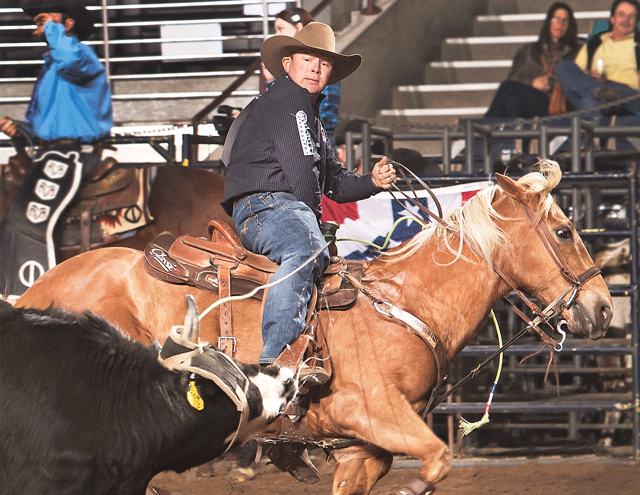
Roper Review: Luke Brown
-
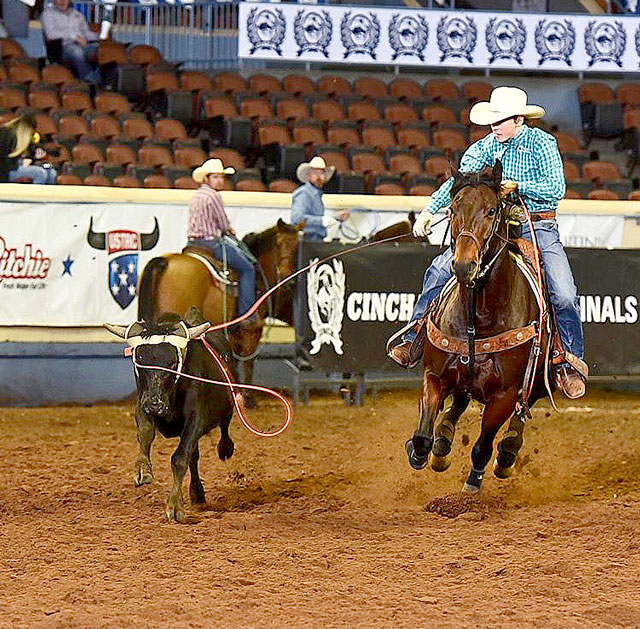
Smarty Young Pro Jaxson Tucker
Ulla, North Carolina is home to 17-year-old, Smarty Young Pro, Jaxson Tucker, but more often than not you’ll find him on the professional rodeo trail. Jaxson has been fortunate to have connections in the rodeo world that have developed into relationships allowing him to live his dream; traveling and roping with some of the top ropers in the world. Jaxson’s father, Jason Tucker, is the general manager for Smarty, and competed for several years as a professional team roper. Jason taught Jaxson how to rope and brought him along as he competed. “I’ve roped for as long as I can remember, always roping the dummy or the sled, and we roped a lot in Texas. I was fortunate to have my dad teaching me, and to be around great ropers like Luke Brown, Brad Culpepper, Caleb Anderson, and Cory Kidd when I started roping steers.”
At 10, Jaxson began entering Junior Southern Rodeo Association rodeos, and competed in the North Carolina and Georgia Junior High School Rodeo Associations in middle school. He was the 2014 NCHSRA All-Around Champion Cowboy, winning team roping, breakaway roping and goat tying. “In seventh-grade I went to Georgia so that I could head for Braxton Culpepper but came back to North Carolina to heel for my cousin, Cole Futrell, in eighth-grade.” While heading for Braxton at the 2015 NJHSFR, the team finished in the top 10 after winning the second round as well as the short round.
Jaxson has competed at multiple USTRC and open ropings across the country and traveled with several professional ropers following PRCA circuits. “I was traveling back and forth to Texas, so it really was impossible to keep up with a rodeo schedule myself. The past two years I traveled with Kaleb Driggers, Brandon Webb, and Kolin Von Ahn; and before that I traveled with Luke Brown.” Jaxson has acquired a multitude of titles as a header, including winning the #15 at the USTRC South Georgia Championships two consecutive years, also winning the Open roping with Ty Etheridge there last year. He has won the Biggest East of the Mississippi roping the past two years, and won at the Perry Bigbee Memorial Roping recently. “Traveling with the pros has pieced me together more as a person than anything. I learn so much just listening to them talk and enter rodeos while they’re driving, because entering right is the key to rodeoing now. Seeing how they handle winning and losing really humbles you as a person because you want to be like that. I could’ve been rodeoing more myself, but it’s been more beneficial to me having the opportunity to travel with these guys. Relationships are key, and I’ve been fortunate to meet and become friends with so many great ropers.”
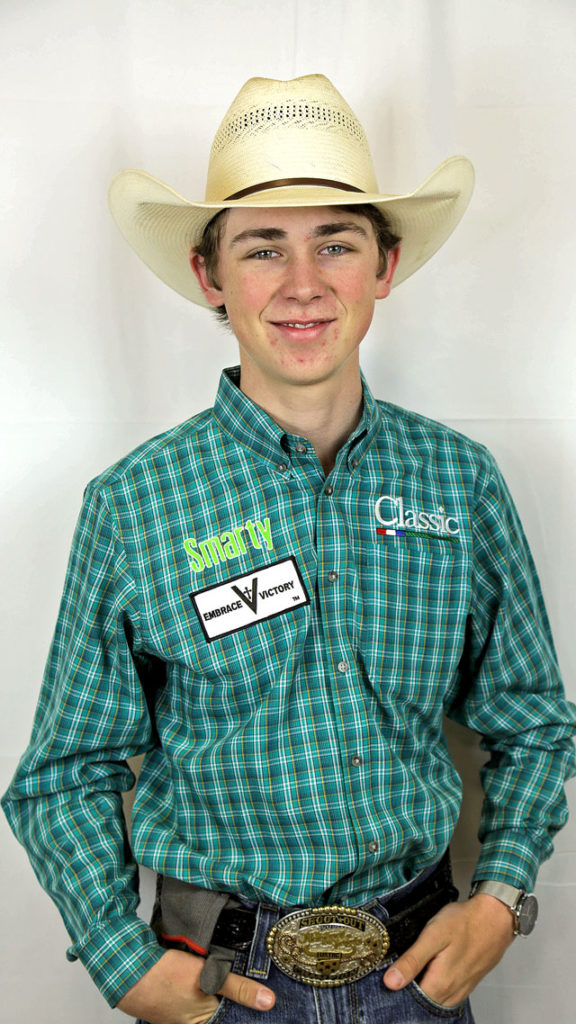
Jaxson Tucker – Smarty Jaxson is an eleventh-grader through the Abeka homeschool program which allows him to be mobile, and when he’s not on the road he values his time in North Carolina with his mom, Robin Tucker, and younger brother, Brody. “It’s hard to be away from my mom so much, I wish I could be with her 24/7, my dad too; but I appreciate them supporting me.” Jaxson also enjoys golfing with friends and loves spending time with his girlfriend, Hallee Webb. “After I graduate, I’d like to go to college and get a business degree while I college rodeo. Of course, everyone says they’d love to pro-rodeo, but it’s expensive and you need to have cash flow from somewhere first. I’ll rope and grind it out, but there’s no way around getting a degree first.”
Jaxson built his heading foundation on a Smarty and is honored to be a Smarty Young Pro. “Roping the Smarty has made me a better roper and changed a lot of things I was doing wrong before.” Besides believing in the training products, being on the team has developed Jaxson as a Christian. “I recommend it to anyone; to learn from Allen Bach, and listen to Trey Johnson, it’s just humbling, and has meant so much more to me than just becoming a better roper.”
Jaxson appreciates the support of his sponsors: Smarty, Classic Ropes, and Embrace Victory
-
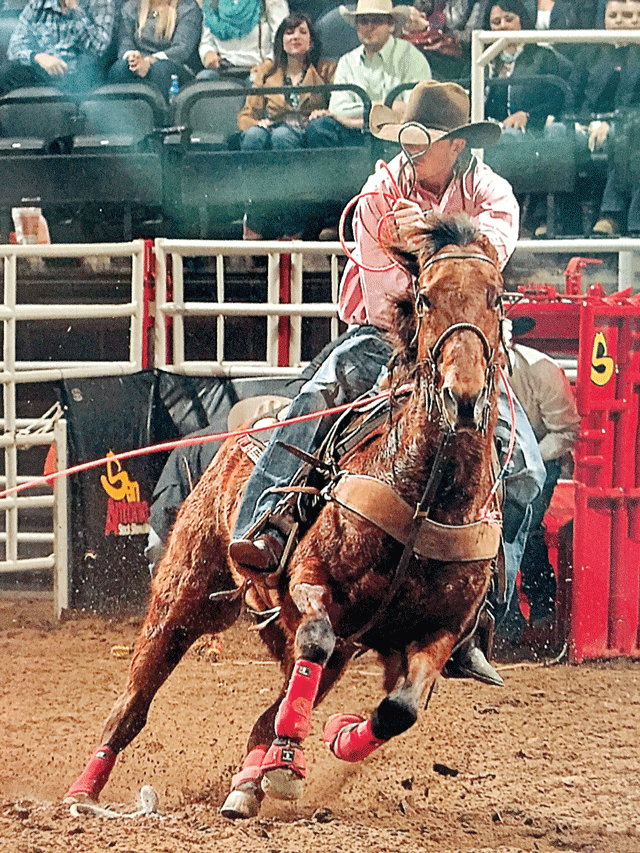
Roper Review: Lane Ivy
Picking up a rope at 4 years old, a seed was planted in Lane Ivy’s heart that grew into a dream. Lane tagged along as his parents, Billy and Joanie Ivy, roped steers; watching, learning, and waiting for his turn. At 5, living on their Canyon, Texas ranch with younger brother Brent, Lane’s parents let him ride an old rope horse to track and rope slow steers as his skills progressed. As he grew, the dream in his heart did also; and like many young cowboys, he imagined himself running those steers under the big lights at the Thomas & Mack. For 26-year-old Lane, that dream has become a reality. “Growing up, roping was a huge part of our lives. I started going to junior rodeos when I was 9 and had some success. The thing about success is it makes you crave it even more, so I continued roping and one thing just led to another.” When Brent was old enough, the Ivy dream team of Lane heading for Brent became a regular entry. “I’m 18-months-older than Brent, so he’s always been a pretty good partner in crime. Although we’ve competed in other events, we were team ropers at heart. We’re blessed because our parents hauled us all over the country, so we could compete.” Lane’s parents did all they could to offer the resources the boys needed to progress in their sport. Lane’s grateful for family friend, Larry Hendrix, who spent many hours opening chutes and supervising the brothers when they were too young to rope on their own while their parents had to work.
Lane competed in the Texas High School Rodeo Association as a freshman, heading for Landon Williams, who’s still one of his best friends today; and for Michael Trujillo his sophomore year. The Ivy brothers partnered to finish Lane’s junior and senior years. “I was fortunate to have an incredible streak-faced sorrel gelding with a 96 on his left hip, named Bandit during high school. Bandit was a true blessing who taught me a lot and made me rope aggressive. My family raised him, and he died last August at 24-years-old. I’d let kids ride him all the time, and one year I got in trouble because I picked up broncs and drug bulls out of the arena on him before team roping; my dad said he was too good of a horse to do all that!” At 15, Lane headed on Bandit at the George Strait roping for Jayten McCright, “It was exciting to hear the announcer mention I was the youngest header to ever make the Top 50 at the George Strait.” Lane also competed in tie-down roping on a sorrel gelding, named Whiskey. “He was absolutely amazing. We sold Whiskey to Trevor Brazile after high school, and Trevor took him to the WNFR. I don’t know that Trevor would name him as one of his top horses, but he was definitely one of the nicest I’ve ever owned.”
When Lane was 15, he started riding horses for Jason Thomas, “I learned tons of lessons from him; every day he was trying to get better and trying to better his horses. It gave me such a great work ethic.” Lane attended Happy High School as a freshman and sophomore but switched to homeschooling his junior year as his dream of being one of the world’s best ropers became a passion and everything Lane did focused on it. “My whole family is completely competitive, we don’t want to just be okay, we want to be the best at something or not do it at all. I loved roping, making good horses, and was having some success; I thought when I turned 18, I’d rodeo for a year and make the WNFR; I didn’t think it would be hard at all.”
After graduating, Lane attended Weatherford College and competed on the rodeo team. “My mom thought it would be good for me to live on my own and asked me to try college for a year.” Just after leaving college, Lane received a call from Jett Hillman, asking him to head for him at some pro rodeos, “I thought ‘here it is, someone is finally calling me,’ this was my whole goal.” The team started having some success, but their season was cut short as Jett had to return home to have neck surgery.
In 2014, Lane roped with Lane Siggins, “We won maybe one check all summer. I was broke, and went back home. It was a hard pill to swallow; I was realizing that I didn’t give enough credit to the guys that made it the national finals. I was seeing that it was one of the hardest things I would ever do.” Lane moved in with Tyler Magnus in 2015 and learned lessons that year that equipped him with more than just the roping skills needed to be successful. “Tyler was such a great influence and teacher, he helped me get better horses, rope better, and I realized how much it was going to take to make the finals.” Lane went to California, and with some success heading for Bucky Campbell, finished in the top 40. “I was pretty excited. I bought my PRCA card, but my season wasn’t really going anywhere, and I went back home again.” In the spring of 2016, Lane moved in with the Coopers, where Jim Ross Cooper, and his brother Jake took him in like family. Lane felt his roping improved and credits the Coopers with helping him in many ways. Lane finished the 2016 season in the top 30. Lane had quite a bit of success roping with Buddy Hawkins in 2017. The dream of qualifying for the WNFR seemed almost in reach, but disappointingly, Buddy finished up in 16th place, with Lane finishing just 5 holes out of qualifying for the national finals.
At 25-years-old, Lane was at a crossroads; feeling that he needed to break into the top 15 or get a job. More determined than ever, he did everything possible to have a chance at the finals. “I roped every day, tried to strengthen my weaknesses, invested in the best horse I could get, and was completely focused on making 2018 the year that I made it.” Buddy and Lane started out earning over $22k in the winter, and although the spring didn’t pan out the same, Lane was counting on the summer rodeos to propel them further in the standings. Lane’s horse Cuervo, a 15-year-old bay gelding he bought from Chad Masters, was working great for him. “Buddy stayed home during the 4th of July run, so there was about a month that I had to rope with other partners. It was difficult, but in the same instance I couldn’t let myself get caught up in that. I just focused on my job and trusted that my partners were going to do theirs.” Lane’s mom often reminded him of the verse Matthew 17:20, encouraging him that with the faith of a mustard seed, all his dreams were possible. Lane had success roping with Blaine Vick and Joe Mattern, and by the time Buddy was roping again, Lane had earned over $45k. Finishing the season together, Lane and Buddy won over $20k more, which qualified them both for the 2018 Wrangler National Finals. “I’m really grateful to be roping with Buddy, I don’t always do a great job of handling the steers for him, but he does an outstanding job of catching what I give him.” A dream come true as the result of the devotion he’s given to the sport, Lane will be competing in the WNFR as the number 14 header in the world, with season earnings of $67,457.62, and Buddy competing as the number 13 heeler with season earnings of $64,451.02.
“I’m living my dream, the last of the season everyone asked if I was nervous about making the finals, but I was just enjoying the fact that I was close enough to have a real chance. It was fun being in the position that if I kept roping good, I could make the finals.” Shortly after the reality of what Lane had just accomplished set in, Walt Woodard asked him how it felt, “He asked me if it felt like everything I imagined all these years. I told him it felt like the biggest weight had been lifted off my shoulders, and someone put an even bigger weight on. I’ve made it to the NFR, but after that last round, it starts over, and I have to work even harder to get back there.”
Lane is preparing with fellow WNFR competitors, Wesley Thorp and Cody Snow, in their replica WNFR arena. They practice on steers like those they’ll be competing on; filming and timing their runs so they can analyze them. “We’re doing as much as possible to be the best we can when we roll into Vegas. We don’t want anyone to be able to say they prepared more than us.” Cuervo will be coming along to Las Vegas, but Lane plans to rope on Tate Kirchenslager’s 18-year-old gelding, Papa. “Papa has been there, done that, and is solid as a rock. He’s bigger than Cuervo so it’ll be easier for him to pull steers up the wall.”
Lane will be savoring every moment of this experience he has worked his whole life for, “I don’t know exactly how I’m going to feel once the competition starts, but the fact that I have the chance to rope a steer for $27k a night, 10 nights in a row is really exciting to me!”
Lane appreciates his sponsors, Wrangler, Classic Ropes, Timber Creek Veterinary Clinic, Resistol and the Mirage Casino. He’s also grateful for his family, and all people that have supported him behind the scenes. -
Back When They Bucked with Arden Clement
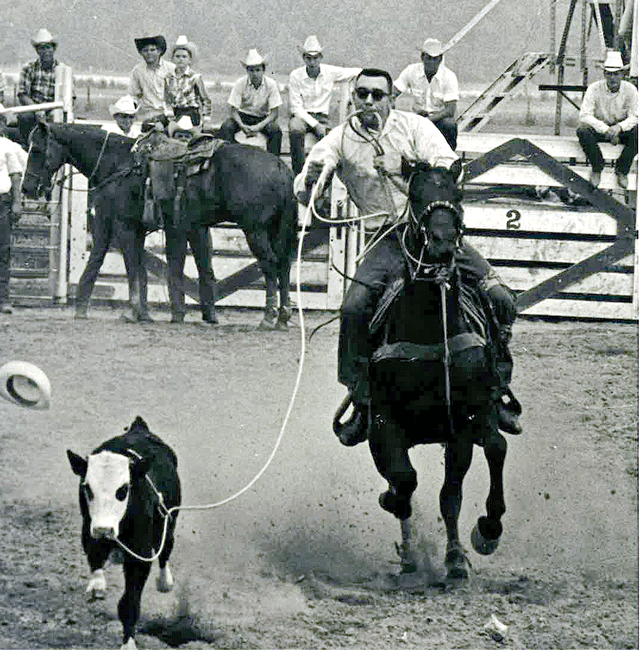
Winston Churchill said, “We make a living by what we get, we make a life by what we give,” and the life of Arden Clement of Kinder, Louisiana, has been all about giving to the future of rodeo. With a Cajun heritage, speaking only French until starting school, Arden began training colts in his youth and quickly became a go-to cow horse trainer for many of the local farmers. In high school, he competed in the inaugural Louisiana High School Rodeo Association rodeo in 1950; and in 1951, riding a sorrel horse Red Man, in cutting, calf roping, and bulldogging, he finished the year as the LHSRA Reserve Champion Calf Roper, Reserve Champion Cutter, and Reserve Champion All-Around Cowboy. Red Man, owned by Sidney Marcantel of Welch, Louisiana, was sold to Wild Bill Elliott, who campaigned the horse in his shows for several years before selling him back to the Marcantel family for his retirement. After high school, Arden dedicated his life to training horses and kids for their own futures in rodeo, retiring from it in 2004, at the age of 72. He stepped back into the training arena in 2011, when his young great-grandson, Cole Ford, came to him with aspirations of becoming a calf-roper like his great-grandfather, and he was happy to get the fourth generation of cowboys started just right.
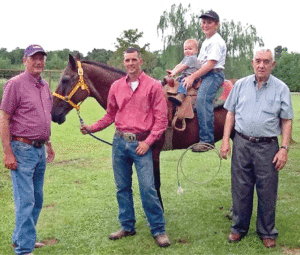
our generations; 2014 (L-R Brent Clement, Cody Clement, on horse Chasen Clement, Cole Ford, Arden Clement) – Courtesy of the family 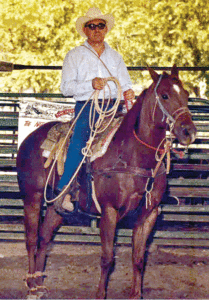
Arden, 1989 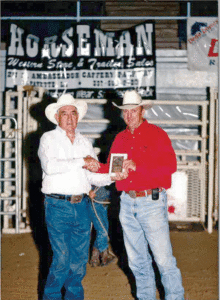
Arden receiving the Student Appreciation Award Born in 1932, just after The Great Depression, Arden began training horses on the rice farm where his family worked, to ride the fields and doctor cattle. His knack for breaking young horses for work led him to training horses for many local farmers, charging them $10 per month to break their 2-year-old colts. Arden’s parents, Elza and Minnie Pearl Clement, counted on Arden to help on the farm, along with his three younger sisters, Rena, Dewanna, and Veronica. “I would break horses to make a little spending and rodeo money while I was in high school. My sisters would help me some, Veronica competed in rodeo through high school and would help work the cattle and the chute as I was training roping and cutting horses. Rena would help unless I raised my voice at her, and she’d head straight back to the house. At the end of the day, when I was done training on the colts, my sisters would ride them in the shade of a pecan tree grove by the house to cool them off, it was a pretty sight.” Arden would load horses up a ramp into the rice truck beds rigged with cattle racks to go to rodeos. “We also used old Chevy one-seater cars with 70-75 horsepower engines that would only pull at about 30-miles-per-hour, to haul trailers with no springs and wood boards on the sides. One time we were going to a rodeo and looked back when we heard something, to see boards falling off the trailer. We just picked them up and tied them back on, so we could make it to the rodeo.”
After high school, Arden worked for a short time managing a hardware store in Elton, before being hired by George Grimshaw of Bunkie, Louisiana to train roping and cutting horses. “Mr. Grimshaw asked me if I needed someone to help me with the horses, and I introduced him to my good friend Billy Duhon. I had taught Billy how to rope and train horses, and he worked there with me until I left that job.” Billy Duhon was a lifelong friend of Arden’s and ended up spending his life training cutting and roping horses as well as competing as a steer wrestler for many years before his retirement. “I made the mistake of teaching Billy all I knew about competing and training, and after that I couldn’t beat him. He was athletic and knowledgeable, he just took to it like a duck takes to water.”
Arden worked for Mr. Grimshaw for a year before leaving, “I went to work for Calcasieu Marine National Bank and started from the bottom up. I worked my way up to assistant vice president and manager of the bank during the 38 years I worked there before retiring.” While working at the bank, Arden continued to rodeo and train cutting and calf roping horses; and found a true enjoyment in helping aspiring rodeo athletes get a start in rodeo. He had a friend build an indoor arena for him at his farm, so he could give lessons year-round. “I could have a bad day at work but get home and ride or train on a horse and it would just relax me.” Arden and Billy remained friends but also worked together to help many get started in rodeo; including Arden’s son from his first marriage, Brent, and Billy’s son Steve Duhon. Steve went on to become a three-time world champion steer wrestler, and Pro Rodeo Hall of Fame Cowboy. Brent competed as a steer wrestler and won the champion title in the Louisiana Rodeo Association in 1981. The two friends were also instrumental in helping world champion steer wrestler, Mike Smith get started. “We both helped them, but Billy was really the champ teaching steer wrestling, I did most of the hazing.”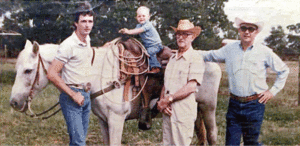
1983 (L-R Brent Clement, Cody Clement on horse, Elza Clement and Arden Clement) 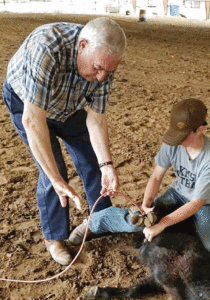
Arden teaching his great grandson, Ross Habert tie down roping – Courtesy of the family Arden helped form the Louisiana Rodeo Association, now known as the Louisiana Rodeo Cowboy Association, remaining a member for many years. He competed in the PRCA for two years as a calf roper before a knee injury kept him home. Arden also competed in the Old Timer’s Rodeo Association, formed in Texas, and although he was one of the oldest in his group, he enjoyed competing in the association for several years before his retirement. Arden remained supportive of the LHSRA from its beginning and was honored at a LHSRA state finals rodeo a few years ago. His son, Brent, explained, “My dad has been active in rodeo his whole life. He’s helped people, trained horses, loaned horses, and let many come rope at his arena. At the LHSRA state finals, at least 50 to 70 people of all ages stood up that he had personally helped, and there have been so many more. He did it because he loved it.”
Arden married his second wife, Betty, in 1970, and helped raise her children, Michael and Bill Creasman, and Sally Daigle. He was glad to share rodeo with them as they were raised, as well as several of their friends. Brent, who after competing in the LHSRA, amateur-rodeoed and college-rodeoed for McNeese State University, had a son, Cody Clement, who also competed in LHSRA as a saddlebronc rider. Cody’s stepson, Cole Ford, currently competes in the LHSRA as a calf roper. “Cole came to me and said he wanted to calf rope, so I started him on the dummy and he just took off, I was really glad to get him going in rodeo. Now Shane Hanchey has taken him under his wing and has really brought him along to where he is now.” Shane found Cole a new strawberry roan calf horse named Thumper, that Cole has had quite a bit of success on. When Arden checked Thumper out, they were surprised to discover that Arden had trained the gelding’s mother over 20-years-prior, as well as the gelding’s sister; and now the offspring of that mare is putting his great-grandson in the winning ranks of rodeo; evidence of the lasting effects of what Arden has given to a sport he loves.
“Rodeo has changed so much over the years, there are better schools, better equipment, and better horses. Kids can go learn more about roping in a 3-day clinic than I learned in 6 years. What hasn’t changed is how good it is for the kids. I hear people say all the time that horses and rodeo fees are so expensive, but I tell them, ‘would you rather pay fines to get your kid out of trouble, or pay rodeo fees to keep them out of trouble?’ When it comes down to it, paying fees is cheap.”
In his retirement, Arden enjoys going to the coffee shop to drink coffee with friends, reading the paper and taking naps after dinner. He still goes to the LHSRA rodeos that are close to home and enjoys seeing many of the results of the help he’s given over the years, especially his great-grandson that is starting down his own rodeo path.
Looking back, Arden appreciates Zack Marcantel for furnishing him good horses and taking care of him throughout his rodeo career; and Doug Habert and family for furnishing his indoor arena for 20 years before he retired.
“I’ve gone to every rodeo I ever wanted to go to in my life, except Calgary. I had a good career, met a lot of people, and saw a lot of things, I can’t complain.” -

Back When They Bucked with Joe McBride
Although Joe McBride spends many hours behind the camera lens now, he started out in front of them as a rodeo clown and bullfighter during a rodeo career that spanned nearly 30 years. Joe has been capturing the essence of rodeo through photography at International Professional Rodeos, not missing a single IFR in Oklahoma City, Oklahoma since he snapped his first shot there in 1992. The Brooklyn born 79-year-old also takes photos at multiple rodeo events as he travels across the northeast on his off-time from his full-time position with the New York State Department of Corrections. Joe just passed his 35-year-mark of service to the job and has no plans to retire anytime soon. He watches inmates from his tower perch 50 feet above them at the Shawangunk Correctional Facility in Wallkill, New York. “When people ask when I’ll retire I tell them on the first…the first chance I get! But really, I have no intentions to retire, I’m like a worker bee, what would I do if I wasn’t working, sit on the couch and watch tv?”
It was a very different line of work that filled Joe’s life before beginning his career with the corrections department. Joe had a fondness for horses, and an intrigue for the cowboy lifestyle. His mom, Eva Catherine McBride, an executive for IBM at their corporate headquarters in New York, fed her son’s passion by taking him on annual trips to the rodeo at Madison Square Garden in New York City, and even gifted him with a white gelding named Silver when he was 15-years-old. When Joe was 16, working at Camp Molloy in Mattituck, Long Island as a horse wrangler and trail guide, he went to the Islip Speedway Rodeo in Islip, Long Island and approached the owner, Gerry Partlow, for a job. Gerry let the teen exhibition ride on a bareback horse that night in 1956, and although he landed upside down into the fence after being bucked off in just a matter of seconds, Joe was drawn in to a life he wanted more of. “As I stepped out of the arena, my buddy asked me ‘How was it?’ and I said I loved it! I want to do it again!” Joe worked at a couple other rodeos for the Black Diamond Wild West Show that season, and at one of them, after sleeping on a bale of hay with a pair of clown baggies as his bedding, he remembers pulling them on just to see what they looked like, not knowing what a big part of his future he had just stepped into.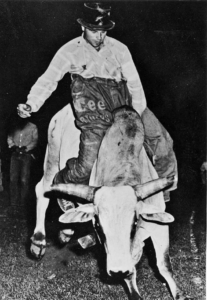
1959, Scranton, PA at the Black Diamond Rodeo 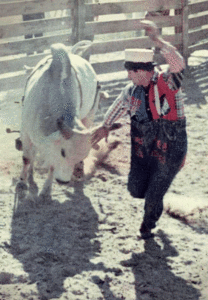
Joe taking the bull away in Pittsfield, MA 1961 Gerry agreed to let the aspiring cowboy have a job the next year if he came to Milan, Illinois the following spring. So, against his mother’s better wishes, in March of 1957, Joe dropped out of his studies at the School of Aviation Trades in Manhattan, and he and his friend Paul Dobin drove out of town in his Neptune green 1952 Ford pickup truck, headed for his future. “I thought spring started in March, and from watching television, I thought we were headed for a life that all cowboys lived, herding cattle on a ranch, sleeping in bunkhouses and then putting on rodeo shows as a sideline.” But, when Joe and Paul arrived in Milan to start their cowboy careers, they were taken aback when they found out the lifestyle of the wild west rodeo shows was not quite what they envisioned. “I was looking for the Black Diamond Ranch, but when we found Gerry Partlow, it ended up that he didn’t have a ranch; he rented a pasture to keep the horses turned out, and sold all the cattle but one bull after the season so he didn’t have to keep them through the winter, and he lived at home with his parents.” Even after attempting to sleep a few nights in Joe’s truck in the cold and snow, the two cowboy hopefuls were determined to make it work and finally decided to get a motel room and call their moms, who began sending them money to get them by. The friends worked several odd jobs and found a more permanent housing solution until May came along and the rodeo shows started up. Joe hauled a trailer that served as a stripping chute at the rodeos and was filled with the stakes and wire used to set up the rodeo arenas, and they left for the first rodeo of the season in Dexter, Missouri. “My job was to help set up and tear down the arena at each rodeo, and ride one bareback horse and one bull every performance.” There was another cowboy that hauled the bucking chutes trailer, and part of setting up the arena entailed taking the tires and wheels off the trailer, setting it on its axles at ground-level for the rodeo, covering the hubs with burlap sacks in case a cowboy was to land on them. They would then put the tires and wheels back on as they tore down the arena, readying it for travel to the next town. Joe spent several years working these traveling rodeo show seasons, riding and entertaining the crowds as a rodeo clown. In 1958, he added bullfighter to his list of job titles and often rode bulls while wearing his rodeo clown costume.
Although rodeo is known to be big in the west, Joe made quite a career working as a rodeo clown and bullfighter in the northeast. Besides working for the Black Diamond, Joe worked for many other rodeo companies, such as Lou LaFalce and The Lazy L Rodeo Company based in Highlands, New York, Dick Quintoni who put on rodeos across Pennsylvania and New Jersey, the Crazy Horse Rodeo Company, Dodge City in Patchogue, Long Island, and for long-time IPRA rodeo contractor, Andy Compantero who owns Double R Rodeo Company. By 1965, Joe had given up bull riding, and was mainly perfecting his rodeo clown act. “In 1965 I bought a 1962 Ford F100 for $15 and turned it into my clown car. I moved the rear axle forward 3-or-4-feet so that it put the truck off balance. In my act, as soon as the other clowns got in the back of the truck it would buck and seesaw as I drove around the arena. The last part of the act a ‘bomb’ would go off, and then I’d pull a pin inside the truck that would flip the bed of the truck up and I’d drive out as the other clowns were dumped out onto the ground. As far as I know, it was one of the first clown trucks like it.”
Joe Jr. was born in Brooklyn, New York in 1939 to his parents, Eva and Joseph F. McBride, who divorced when he was just 3-years old. Joe Sr. was a was a welder in the Brooklyn Navy yard and joined the Navy, becoming a Seabee and working as an underwater welder to repair damaged ships during World War II. He was also a golden gloves middleweight boxer.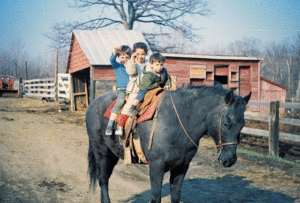
Joe’s children, Lisa, Joey, & Dennis at their Uncle Louie’s on Midnight 
018 Clown Reunion (Joe far right) – Rodeo News In February 1960, Joe met Carolyn Mirsky as he worked at Carroll’s Riding Academy in Brooklyn, by December of 1960 they married, and they ended up settling in the Middletown, New York area. In addition to rodeos, Joe worked many jobs ranging from installing chain link fencing to delivering produce and working as a driver for Sears for nearly 15 years. The couple had three children, Lisa, Joey, and Dennis, before divorcing in 1967.
Photography was once just one of the many acts in Joe’s clown act arsenal, as he made the crowds laugh with delight as he wiggled and joked under a photographer’s cape with an exploding camera; but truly his passion for photography began with his mother. “My mom loved photography and bought me my first camera when I was about 13. Once I was clowning and fighting bulls, she gave me one of her old cameras and encouraged me to take photos at the rodeos; but I was so busy working I didn’t have time to take many. I finally upgraded to a Sears Camera, and then bought a Nikon and over the years I began taking photos at more and more rodeos. I really do it mostly for enjoyment, and now it’s my way of getting in to the rodeos without paying!”
Although Joe didn’t finish his aviation studies in high school, planes were destined to become a big part of his life, and he still owns a 1962 Cessna 172 plane that he flew for many years, logging over 1000 hours of flight time. He is instrument rated and has a commercial rating on his pilot’s license. Joe also enjoyed traveling the roads on his 1993 Harley Davidson up until just 3-years-ago. His daughter Lisa May McBride currently lives in California, but recently passed the test to begin her own career with the same department of corrections as her father, so she will soon be relocating to New York. She has a son, Shawn that is married and living in California. Joe’s son Dennis also resides in California with his wife, Angela, where he manages a water treatment plant, and they have two children; daughter Lauren lives near Redding with her husband, and their son Chandler recently finished four years of service with the Air Force. Joe’s oldest son, Joey, lives on a 182-acre farm in New York, where he farms hay and he also drives double-trailer trucks for UPS, staying in town with Joe 5 nights each week. Joey and his wife Lisa Marie have 2 sons, Hunter and Logan that are 10 and 9-years old respectively, and 2 married daughters, Rachel who lives in Tennessee with her husband, and Heather who lives in upstate New York with her husband and just recently started in the training academy for the New York Department of Corrections.
Joe McBride followed his passions in life and found happiness comes when you work for it, especially when what you do for work is a passion. He has literally spent a good portion of his life ‘clowning around’ and he wouldn’t have done it any other way. -
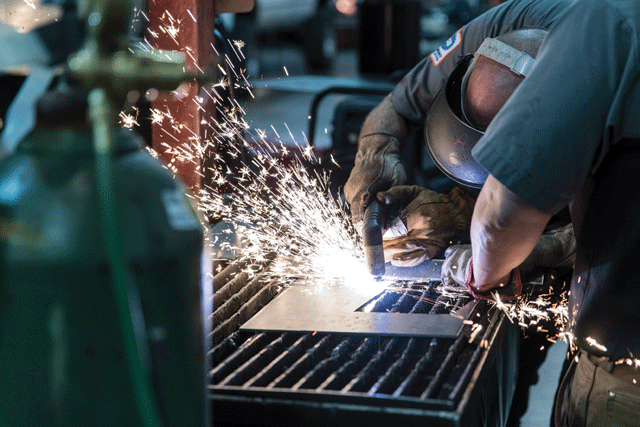
ProFile: WyoTech
Jim Mathis of Wheatland, Wyoming traveled many miles chasing the USTRC jackpot circuit for nearly 17 years. Jim had worked the rope in ranch work for many years, but after watching his younger brother, Scott competing as a team roper, he took some instruction from him and started entering himself. He was at a point in his career with WyoTech that he had the income to support his newfound hobby and spent much of his free time between 1985 and 2002 entering jackpots up and down the roads. In 2002, Jim fulfilled a lifelong dream of becoming a rancher, so his travels slowed down due to focusing his time on his new venture. He still has a rope horse and enjoys occasionally roping with his brother. “Scott has had a big impact on my life, he’s a pastor in North Platte, we’re both Christians and so we compare notes all the time.” Jim and his wife Mary, now own two Wyoming ranches where they operate a cow/calf operation. They live on the lower elevation Wheatland ranch where they keep cattle through the winter after trailing them down on a 3-day cattle drive each fall from their historic Kite Ranch near Rock River, Wyoming. In April they truck the cattle back up to the over-7000’ elevation ranch to calve and enjoy the milder summer and fall. Jim and Mary enjoy spending time with their children; daughter Jodi Hill, and sons JD and Justin Mathis, as well as their 9 grandchildren.
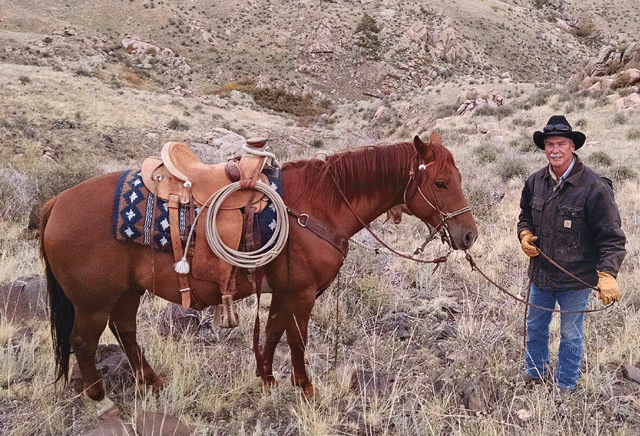
Jim Mathis – Courtesy of the family Jim’s love for agriculture, and being a cowboy started early, and he stepped into the lifestyle as quickly as possible when his father, Pastor Don Mathis relocated his family to take on a new church in La Grange, Wyoming. Jim still appreciates the support and encouragement of his father, who at 91 is still preaching at convalescent homes. When Jim was just 14, he moved in with Gene and Dot Smith, living and working on their farm and ranch for 3 years, and all the while he was learning many farming and ranching skills. “Even today, I think of things Gene taught me, from setting flood irrigation dams to packing wheel bearings, he made such a huge impact on my life.” At 17, Jim was driving combines and semi-trucks, harvesting wheat fields, following the crops from Texas to the north as they were ready for harvest. His life story has been filled with WyoTech from the age of 18, when he first attended the school. Thinking he wanted to own his own fleet of semi-trucks to haul grain and cattle one day, he graduated from a 6-month program at WyoTech so that he could manage and mechanic on his own trucks in his future; however, an inspiring WyoTech instructor, Marlowe Jones, opened a new vision for his life. “Marlowe was so inspirational and funny, and I wanted to be just like him, so at 19, I begged my way into a teaching position at WyoTech.” This move led to not only working with Marlowe for over 25 years, but also to many opportunities for Jim during the 26 years he spent there. WyoTech was founded in 1966, with the goal of providing a concentrated training program to prepare their students to fill the need for technicians in the automotive and diesel industry; however, after several ownership changes over the years, the once thriving school was recently on the verge of being closed. Jim Mathis was the man that many looked to as the answer while employees of the school fought to find a solution to keep the doors open. Jim had the experience and knowledge to take control of the school from the many positions he had held in nearly every capacity and management level that there was before leaving the school in 2002. His newest position, as owner of WyoTech, began on July 2, 2018. This was all made possible because of the support of the community and Wyoming Legislature making a $5-million loan available to Jim and his small investor group, to help complete the purchase.
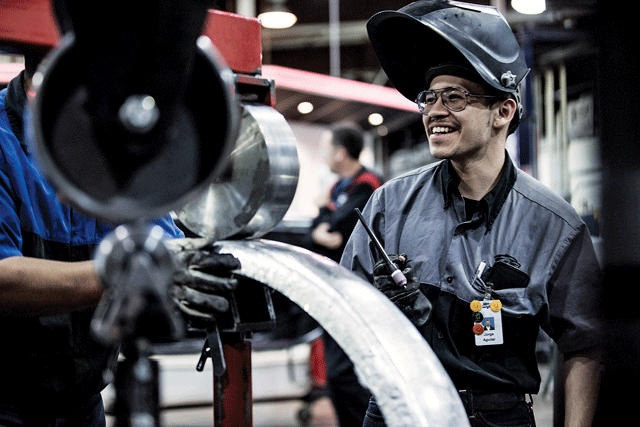 Jim Mathis has a passion for WyoTech and the education it has provided to over 50,000 graduates in the industry over the years. Because of his background in rural farming communities, he wants to share the news about WyoTech with other farming and ranching families. “As I take over at WyoTech, we will start focusing our marketing to reach rural communities rather than large metropolitan areas. WyoTech has changed the lives of many of our former students and we can offer a career path to many young ranch kids in rural America.” WyoTech offers fully accredited programs, that prepare the students for successful careers. “Part of our claim to fame is that we offer a short program, so for those serious about wanting to get into a career quickly, can be in and out in 9 months because they will be immersed in their education, attending classes for 8-hours-and-20-minutes each day. That’s more training, and clock and credit hours than most junior colleges offer.” WyoTech offers diplomas in diesel, automotive, or collision repair technology and associate degrees in business management. WyoTech is approved to offer federal financial aid to those that qualify. The school also has housing for approximately 650 students on campus. Employers appreciate that the students leaving WyoTech are prepared for the real work world, and the graduates are often sought after by companies such as Caterpillar, GM, Ford, and Cummins dealerships. Half of WyoTech’s instructors are alumni and have believed in the program so much that they returned to teach after enjoying successful careers in the industry. For many involved in rodeo, trucks and hauling rigs are a part of everyday life, and even if not looking for a career change, there are many skills to be obtained and much knowledge to be gained from courses at WyoTech. “Part of the reason I love WyoTech is that we truly have a great opportunity to give the students confidence and professionalism, teaching them timeliness, and about having positive attitudes that can help relay into a great professional career. We have really changed lives over the years.” Life often comes full circle, and for Jim Mathis, stepping in to ensure the future success of WyoTech, it certainly has.
 -
Back When They Bucked with Scott Tucker
Deep in Scott Tucker’s soul there were seeds of rodeo that drove the Jacksonville, Florida boy towards his destiny, and roots were developed that have entwined family, rodeo, and future generations of cowboys and cowgirls forever. Scott was born in 1946, an only child to his parents, Lucille and Holmes Tucker, but being a cowboy was more in his DNA than it was in his family upbringing. His dad graduated in 1939, from Yale University where he attended on a full-ride boxing and football scholarship; and he went on to work for General Foods, before settling in the automobile business. Although his parents were far more interested in life in the city, Scott was drawn to the Pecan Park horse racing track, where he started jockeying horses when he was just 12-years old. Only destiny knew then, that he was starting down a path that would lead him to become an integral part of one of the most notable rodeo families in North Carolina.
Scott rode racehorses with Sonny Burris on the brush tracks, helping to start colts and train them to use the starting gates until his weight exceeded the 135-pound maximum allowed. Scott jockeyed the legendary Quarter Horse, Go Dick Go, in brush track races before the horse went on to make history as the winner of the first All American Futurity in 1966. Sonny was a boxer and jockey, that also rode bareback and saddlebronc horses; and he helped 12-year old Scott, step onto his first bareback horse at a Callahan, Florida rodeo. Scott did try following his dad’s path in life, and played football his freshman year of high school, but frustrated that the football schedule conflicted too much with his rodeos, he gave it up.
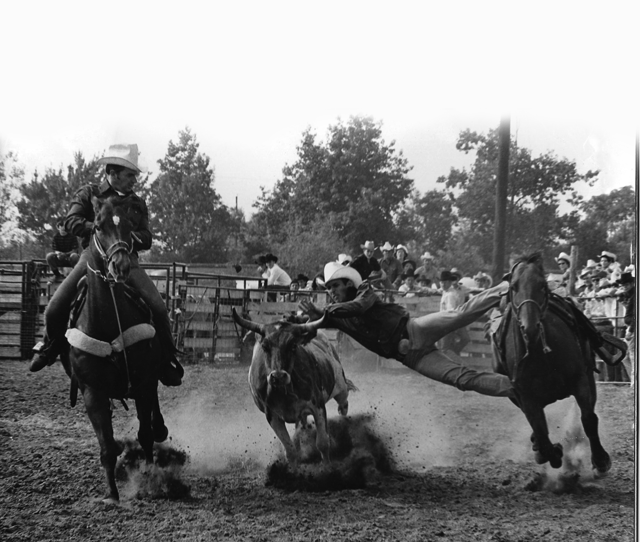
Once Scott had his driver’s license, it was only the rodeo road on Scott’s mind. Scott started out entering bareback riding at open rodeos, before getting on bulls, which quickly became his favorite event. In 1962, Scott attended a Jim Shoulders bull riding school and the memory of staying atop the legendary bull “Tornado,” is forever etched in his memory. In 1963, he got his first membership card for the IRA, known as the Interstate Rodeo Association at that time. Scott started working as a rodeo clown, “Scooter,” when he was 15-years old, and quickly became enthralled with the new job he often performed between riding in his events. The challenge of outmaneuvering the bulls, was as exciting as staying on top of them.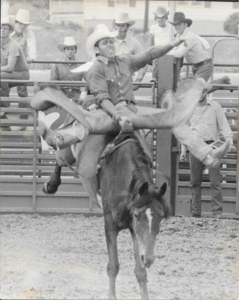
: Scott bareback riding in West Virginia in 1976 – Courtesy of the Family 
Scott & Vicki with their grandkids – Courtesy of the Family 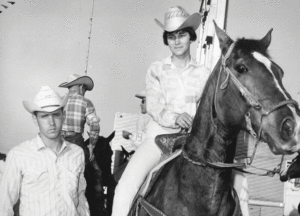
Scott & Vicki in 1967 – Courtesy of the Family Although Scott’s parents were very proud of Scott’s success, they were far too nervous to come watch their fearless cowboy at the rodeos, so Scott often traveled solo or with rodeo friends that became his rodeo family. At 16-years old, Scott was cruising the interstates between rodeos, in a 1958 four-door Oldsmobile, decked with its giant tailfins, pulling a 13-foot travel trailer to sleep in. Scott thinks that rig is what got 14-year old Vicki Kidd’s attention when they met at the Silver Springs rodeo in Maryland. Meeting Vicki would prove to further cement the path of Scott’s life. Vicki Kidd was a barrel racer, and daughter of C.W. and Helen Kidd of Charlotte, North Carolina. The Kidd family was instrumental in bringing rodeo to North Carolina in the mid-50’s, after C.W. had fallen in love with the sport while he was stationed in Florida, in the Air Force. The Kidd’s started the Rockin’ K Ranch, which was a family commune of sorts, raising future cowboys and cowgirls around a central rodeo arena, and has hosted rodeos for over 60 years now. Not only did Vicki fall for the handsome, blue-eyed cowboy, but her parents did as well, taking the 16-year old in and treating him as their own.
Scott would travel to rodeos, staying on the road most of the summer, returning to Florida to complete the school year. In 1963, the summer before his senior year, he and Lyle Wiggins made it up to Frontier Town in upstate New York, in the heart of the Adirondacks. “Frontier Town was an old western town theme park that put on three rodeos per day. I got a job there as a stagecoach driver, and later became the arena director for the rodeos.” The rodeos would highlight one or two competitors in each event, plus feature a trick rider, and there are many PRCA cowboys that got their start there. “It was the best place a young person could rodeo, besides the rodeo shows each day, there were a lot of jackpots within about 30-miles of Frontier Town. I was loving it up there, and making about $500 to $600 per week, which was a lot of money back then.”
Scott graduated from high school in 1964, the year that he earned his first SRA All-Around Champion Cowboy title. He went on to win the title again in 1965, 1968, 1970, 1971 and 1973. When he left home for the summer in 1964, the plan was for him to PRCA, and SRA rodeo through the summer, before heading west to Las Cruces, New Mexico, where he had a full-ride scholarship to New Mexico State University; but seeing Vicki Kidd again that summer, changed his college plans completely. “I didn’t want to go to New Mexico as planned, I called my dad and told him I wasn’t going. He wasn’t very happy about me giving up the scholarship, but I told him if he’d pay my tuition at North Carolina State University in Raleigh, that I’d cover everything else.” Scott graduated from NCSU in 1966, with a degree in agriculture and livestock management, rooming with Vicki’s brother, Buddy, while they attended school there. “Buddy was such a fine person, always willing to help anyone. He always had good horses, and he would always let anyone that needed a better horse at a rodeo, ride them.”
In 1966, after Scott left NCSU, and just three days after Vicki graduated from high school, the two soulmates were married, starting a union that would last for over 50 years, before Vicki’s passing on October 12, 2016. Scott also joined the Air National Guard, in 1966, serving for 6 years in the engine shop, as an airplane mechanic.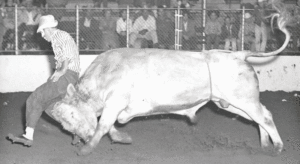
Scott bullfighting as rodeo clown “Scooter” in Georgia in 1963- Courtesy of the Family 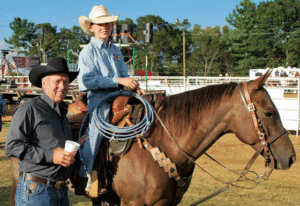
Scott & Grandson Cole Futrell – Courtesy of the Family 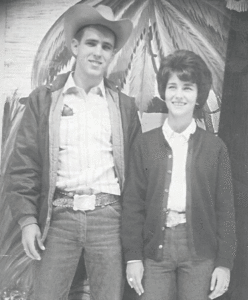
Scott & Vicki in Galax, VA, 1968 – Courtesy of the family The eastern cowboy couple traveled the roads of the rodeo circuit, chasing dreams while being blessed with new friends across the country. Vicki had a passion for horses, barrel racing, and supporting her roughstock riding husband. Vicki was the 1968 SRA Champion Barrel Racer and was crowned as the very 1st SRA All-Around Champion cowgirl in 1971, winning it again in 1974. Scott was doing quite well as a bull rider in the PRCA, ranking #7 in the world standings in June of 1970, but responsibility was beginning to tug on the roaming cowboy, so the couple continued to rodeo but made more of a permanent camp in Charlotte as they laid a foundation for their family. Scott had traded a good horse for some asphalt equipment, the beginnings of his paving business, Scott Tucker Paving and Grading, which he still operates. Scott and Vicki had their first child, daughter Keri, in 1967, and their son Jason was born in 1971. Also, in 1971, Scott dominated in the Coastal Rodeo Association, winning the All-Around Champion Cowboy title. Although Scott continued to find many successes in rodeo arenas across the east, looking back he wishes he would have continued his PRCA run to finish the 1970 season, thinking about the chance he may have had at that world champion gold buckle.
Scott and Vicki continued to rodeo as they raised a new generation on the Rockin’ K, alongside Vicki’s brothers, Buddy and Jerry, and their budding families. The arena was often filled with champions and celebrities passing through while on their own rodeo circuit travels, and the art of rodeo was being practiced there on a daily basis. Cowboys like Red Duffin, who traveled with groups of cowboys and good horses, often practiced when he came through, and helped anyone interested in improving their steer wrestling skills. Scott served as the president of the SRA in 1979 and 1980 and was the vice-president for six years. Scott was also on the board of directors of the North American Rodeo Commission. Scott was responsible for producing hundreds of rodeos at arenas all over the east, and was the captain of the Southern Rebels, a rodeo team that competed at rodeos such as the Calgary Stampede. In 1983, Scott decided to focus more on the next generation of rodeo stars and he and Vicki stepped into the supportive role for their kids’ and grandkids’ rodeo dreams. Scott was the president of the NCHSRA in 1987 and 1988. Scott has been a pillar in the rodeo community, often stepping up to judge rodeos when needed, turned to when questions arise, and encouraging young rodeo athletes wherever he goes.
The legacy that has continued from Scott and Vicki Tucker has went on to include their children, grandchildren, as well as many uncles, aunts and cousins that all participate in rodeo competition or production. Inevitably, the passion that Scott felt in his heart for rodeo so many years ago, will burn inside the many that will follow in his footsteps for years to come. -
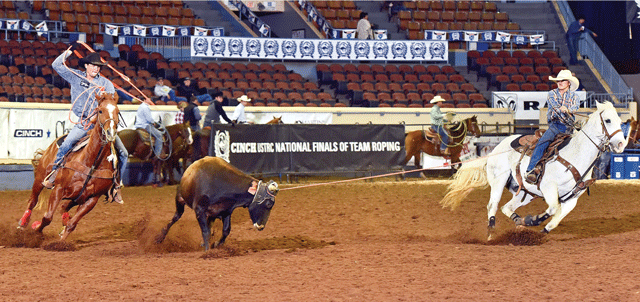
On The Trail with Cole Futrell
Rodeo roots run deep for young North Carolina cowboy, Cole Futrell. The Kidd, Tucker, and Futrell families have had an influence on the sport in the southeast. Cole, a first-year, youth IPRA member, is 16-years-old, and was born in Charlotte, North Carolina where his start in life was on his family’s legendary Rockin’ K Ranch. There aren’t many cowboys or cowgirls of any caliber in North Carolina, that don’t have a story to tell about their rodeo days there at the Rockin’ K, where Cole lived until he moved to their farm in Union Grove when he was in first grade. Cole’s great-grandparents, Helen and C.W. Kidd started the Rockin’ K Arena and were instrumental to the beginnings of the Southern Rodeo Association, and rodeo in North Carolina.
Cole’s Papaw, Scott Tucker (BWTB on page 22)is an SRA All-Around Champion Cowboy, that won the title multiple times in the 1960’s and 1970’s and had a big influence on Cole’s interest in rodeo. “I love listening to all of his old rodeo stories, especially his bull riding stories, and I want to be able to tell those kinds of stories one day too.” Cole’s late-Nana, Vicki Kidd Tucker, was quite the cowgirl, winning many titles during her rodeo days. Scott and Vicki raised their two children on the Rockin’ K; Cole’s mom, Keri Tucker Futrell, and his uncle, Jason Tucker. Jason competed as a team roper on the pro-level for several years and is an IPRA World Champion team roper. “My Uncle Jason has always helped me at rodeos to know what the start is and gives me advice on what I can improve on as a header.”
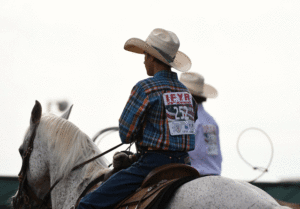
Cole Futrell at the 2017 IFYR – Phifer, RodeoBum.com 
from left: Paige Futrell (Cole’s Sister) Brody Tucker and Jaxson Tucker (cousins) Cole Futrell in center, Jason Tucker (uncle) Keri Futrell (mom) Bart Futrell (dad) – Courtesy of the family Cole is the youngest of Keri and Bart Futrell’s four children; his older siblings are Matt, 29, Paige, 27, and Clay, 19. Keri is a timer at many IPRA and SRA rodeos and has been a supportive rodeo mom to all her children. Cole appreciates that she hauls him anywhere he needs to go, watching most of his runs through the video lens, so that he can watch them later. Bart competed as a bull rider for several years and is a past IFR qualifier. He now owns Bow F Bucking Bulls and is a well-respected IPRA stock contractor and rodeo producer with his partner, Chet Kidd, (Keri’s cousin) as Rafter 3 Rodeo Company. Cole often helps his dad feed and care for bulls, as well as sorting stock and running them through the chutes before events to prepare them for the rodeo. “My dad has always told me to never give up no matter what anyone tells me. He is a hard worker, and I’ve learned from him that if I want something to never give up on it. If my dad puts his mind to something, he’s going to get it done.” Matt has also been an IFR qualifier, and still competes in many IPRA and SRA rodeos, as well as training horses and helping with the family stock contracting business. “When Matt is home, he’s always willing to pull the sled for me and is there to help me anyway he can.” Cole’s sister Paige is a NCHSRA alumni and went on to college rodeo in Texas; she is now a beautician and co-owner of the online boutique, Madeleine Paige. Paige is engaged to PRCA bull rider, Eli Vastbinder, who is currently in the top 15 in the world standings. “I really appreciate all of the help Eli gives me on my mental game; he has always been very motivational and positive.”
Clay, an IPRA heeler and IFR qualifier; and has been instrumental in Cole’s team roping. Cole watched Clay rope for a few years, while he stayed busy competing in steer riding, ribbon roping, and breakaway roping through junior high. Once Cole started heading, he and Clay spent nearly every day in the practice pen, roping the sled and steers together. Cole has been to several IFYR rodeos to watch Clay compete and last year was Cole’s first year to compete in Shawnee. Clay graduated in 2017, and is currently living in Stephenville, Texas. Cole’s favorite roping win was when he and Clay won the 12 Preliminary roping at the 2017 NTRL Finals in Jacksonville, Florida.
Besides the many family members, including cousins Cory and Tyler Kidd, that have been down the IPRA and IFR roads before him, Cole credits team roper, Bronc Fanning for much of his success as a header. Bronc competed at his first IFR in Tulsa, Oklahoma in 1971, and spent many years competing as a team roper. Bronc started working with Cole about five years ago, after Cole had told his dad he wasn’t ever going to rope, because he just wanted to ride bulls. “His dad called me that day, to see if I’d start working with him. I just started spending time teaching him how to do tricks on the dummy that his brother and cousins couldn’t do, and once he started beating them on the dummy, he got interested in roping steers. I don’t think I’ve ever been around such a kind and big-hearted kid, that has been so dedicated or works as hard at his roping.”
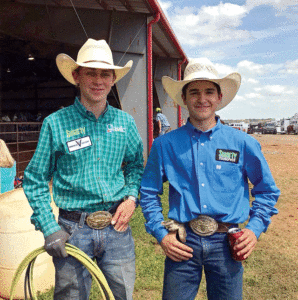
Cole with his cousin Jaxson Tucker – Courtesy of the family 
Cole at age five – Courtesy of the family Cole, a homeschooled sophomore, team ropes at rodeos as well as USTRC jackpots. He just finished his second year competing in the NCHSRA, with roping partner, Blake Walker; finishing the season as the Reserve Champion Header. The two are anxious to compete at the 2018 IFYR and high school national finals. Since 7th grade, Cole has headed on a 15-year-old grey gelding he calls Bam Bam, “I like riding him because he is so honest, he never gets too strong and lets me handle the steers however I want.”
Cole was chosen to be on the Smarty Young Pro Team and has been blessed by the experience. The help he has received from Smarty Pro members, like Kaleb Driggers and family friend, Luke Brown have been invaluable to him. Last March, the Smarty Young Pro Team gathering at Allen Bach’s Smarty training facility in Texas, was a life-changing experience that not only gave him the opportunity to learn from many of the pro team members involved, but also strengthened his walk with the Lord. Trey Johnson leads the ministry and motivational team meetings, and Cole has learned lessons from him about being a winner inside as well as outside the arena. “Trey has really helped to bring me closer to God.”
With such strong family connections to rodeo, it is not much of a surprise that Cole is also traveling down the rodeo road. Like a rite of passage, it’s now his turn to compete at these events he has spent his life watching. His plans, goals and dreams for his future include moving to Stephenville, Texas and competing in college rodeo before starting a career as a roper; with the ultimate dream of one day, heading steers for his brother Clay at the WNFR. “It’s all I want to do – it’s all I think about and what drives me.”
-
On The Trail with Amy Wilson
The western lifestyle is not only her business, but the true roots under her feet, and the passion that fills her heart. Amy Wilson was born and raised in rural Colby, Kansas as the second-oldest of 6 children, with 4 sisters, 1 brother, and her parents, Lonnie and Lori Wilson. Family, horses, and cattle, were all instrumental parts of her childhood as she worked alongside her dad and uncles in their family livestock sale yards. Fond memories of the days riding sale barn horses, as she completed necessary tasks; and working on the family ranch, where they had a start-to-finish cattle operation raising Angus-crosses, built a strong work ethic in Amy, and an intense love for what it meant to be a cowgirl. Her love for cattle was apparent, as any money she made as a child, was generally spent purchasing cattle for her own herd. Amy’s dreams for her future bring her back to her roots, as she hopes to have her own cattle ranch one day, to share with another generation.
Amy jokes that she has a serious horse addiction, and loves talking about horses she owns, as well as unforgettable horses of her past. Flo-yo was a special horse from Amy’s childhood, that she rode in 4-H, used to move cattle, and taught her so much about riding and communicating with horses. When Amy was a junior in high school, she bought her first rodeo horse at a performance horse sale. Missile was an extraordinary 17-year-old gelding that propelled Amy into the rodeo world, as she competed on him in barrel racing and pole bending in the Kansas High School Rodeo Association. “He was such a great horse, they called him Missile because that’s what it felt like you were on, when he took off!” Missile continued to take care of Amy as she left high school and went on to Colby Community College on a rodeo scholarship. Grateful for the years and experience he gave her, Amy gifted Missile back to his previous owner to enjoy his well-deserved retirement. One of Amy’s mentors, Kelly Conrado, found her a phenomenal mare, Miss Piggy, that went all over the country with her, from college in New Mexico, to living in Colorado and Oklahoma for short times, to her move in Tennessee, and she was always competitive.
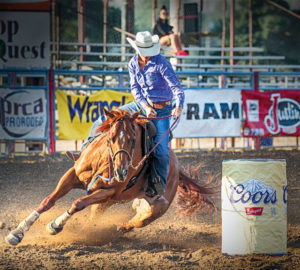
Amy at Dodge City Roundup 2017 – fotocowboy 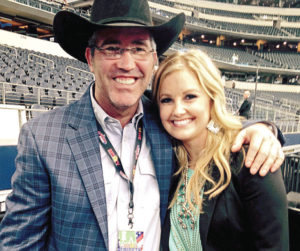
Amy With Randy Bernard at The American – Courtesy of Amy 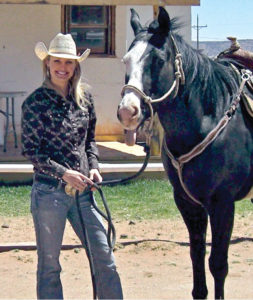
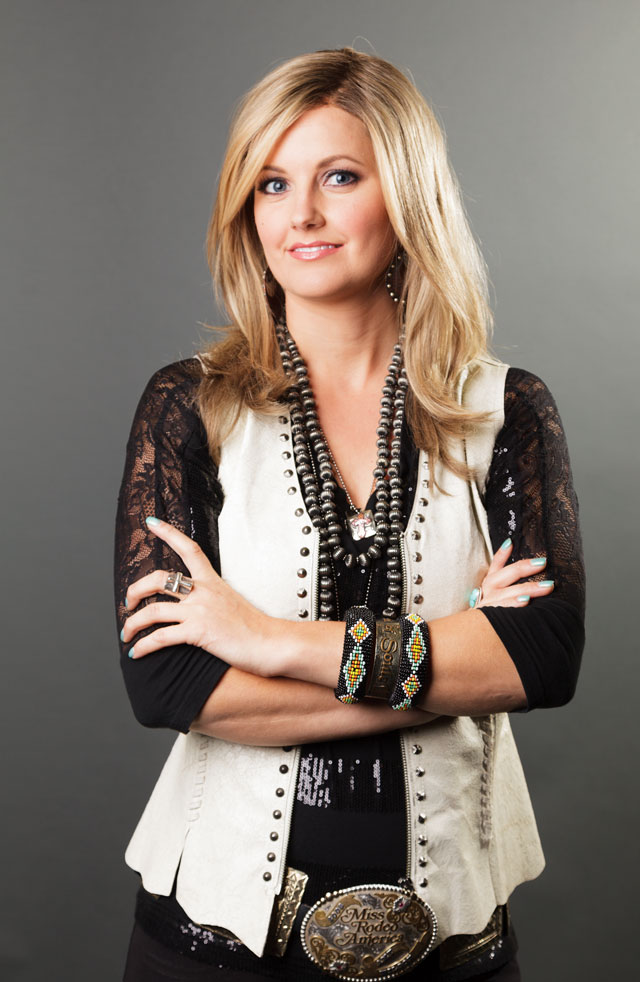
Miss Piggy in college in New Mexico – Courtesy of Amy Amy had a background in princess pageants, as she had started competing in them from the time she was 11-years-old, and she combined that experience with her love of all things western, to become Miss Rodeo Kansas in 2007. The next year she set her sights even higher, and took over the most coveted crown of all, as she became Miss Rodeo America, 2008. Her reign as Miss Rodeo America presented Amy with many amazing opportunities, placing remarkable people and incredible experiences in her path. In 2011, Amy finished her degree at New Mexico Highlands University in Las Vegas, New Mexico, earning a bachelor’s degree in Media Arts; specializing in digital and graphic design, film and photography. While Amy was Miss Rodeo Kansas, she had many occasions to work with a Pam Minick, who became a special friend and mentor, and that relationship became instrumental in her path to RFD-TV, as Pam encouraged her to contact Rural Media Group’s CEO, Randy Bernard. After meeting with him, Amy was given a chance to show her abilities, covering the Miss Rodeo America contest at the NFR, for RFD-TV in 2012. Amy headed east in 2013, relocating for her new position, and has now worked for RFD-TV, based out of Nashville, Tennessee, for the past 5 years. Amy currently hosts RFD’s Western Sports Roundup, as well as Rural Radio on Sirius XM, Cowboy Minute on the Cowboy Channel, and the Road to the American. Amy travels to many major western and rodeo events across the country to interview rodeo athletes and feature important western icons. What she loves most about the job isn’t the spotlight that is on her during her hosting engagements; but is about being able to put that spotlight on others. “I’m passionate about western sports and the western way of life, and I am so grateful to have the opportunity to meet and share stories about people that possibly wouldn’t be shared otherwise.”
Eager to continue her rodeo endeavors while in Nashville, Amy was excited to find many options in the east for competing, and has competed in Southeastern Pro Rodeo Association rodeos, as well as other amateur and pro rodeos, and jackpots across the southeast. She competes in breakaway roping and barrel racing, and is blessed to have some special horses to enter on. It was love at first sight, when she first laid eyes on KN No Moe Siss, affectionately called Flapper, at a barrel race a few years ago; and although she didn’t purchase him then, he was a horse that didn’t leave her mind. Destined to be hers, she was able to track down the owners of the 9-year-old, sorrel gelding and purchase him in December, 2016. Since riding him, he has been everything her heart knew he would be, and she has gained so many experiences, to include winning 4th place in Garden City, Kansas, and winning 1st place at an American barrel racing qualifier this past summer. It was a similar gut-instinct that led her to purchasing a 5-year-old roan mare named Bailey, after seeing her Facebook sales ad, and they recently had the 6th fastest time out of 1200 runs at the No Bull barrel race in Florida this past January. Brandi, is Amy’s 14-year-old breakaway horse that she has competed on since college, and she is so appreciative that she can pull her out at any time, and the mare gives her a great run, whether there’s been much time for practice or not. Amy credits Total Equine Feed for keeping her special horses, at their best.
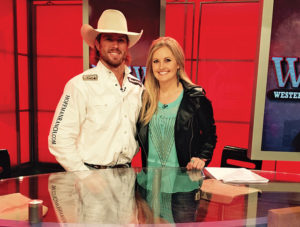
Amy on set at RFD-TV studio with Cort Scheer – Courtesy of Amy 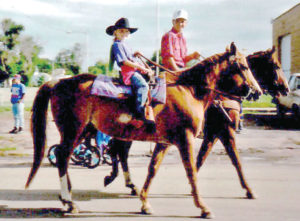
Riding in the county fair parade on Flo-yo with her dad. – Courtesy of Amy Not only did Amy find competition in the East, but this journey she has been on has also connected her with great people. Pro rodeo athletes that she’s interviewed or spent time with that have made lasting impressions on her, as she has gleaned from their attitudes or experiences, have left her with quotes that drive her forward in life. She writes some of the statements down in a journal to reflect on later, “There are so many that have influenced me and my mindset, it’s hard to mention them all. Trevor Brazille, the King of the Cowboys, he is drenched in winning, everything he says is important. Casey Tibbs, saying ‘Never leave home for Second,’ that works to remind me that once you’ve worked as hard as you have and invested all that you have, when you go to a rodeo your whole focus should be on winning.” Amy also has respect for cowgirls like Jackie Crawford, who has such a great mentality for making rodeo, and winning at them, fun. Sherri Cervi, who has the ability to stay so level, has helped Amy realize how important it is through the highs and lows of life or rodeo, to stay emotionally balanced. In addition to pros, there have been some great traveling partners Amy has been blessed to find, like Misty Orr, that traveled with her, always cheering her on and giving her advice on her riding; and Callie Correll has been a great friend, roping motivator, and become such a big part of the journey Amy has been on. The pair have traveled many roads together to rodeos and jackpots, and both qualified for the SPRA 2017 finals in February, where Amy and Flapper placed 2nd in barrel racing in both rounds and 2nd in the average, missing 1st place by only .002 of a second; and Callie won the average in breakaway roping. Amy was grateful to go and enjoy the finals with Callie as their journey took them separate directions when they were over. After the finals, Amy moved to Texas, and Callie headed further west to start her future with her fiancé.
The East has been good to Amy, and she treasures her time there, but Amy is excited about her new ventures in Texas, where she will be pursuing new opportunities with RFD-TV. RFD will be opening a new recording studio in Texas, and being in the heart of it all puts her in close proximity to cover many more live events for RFD; plus…being closer to family in Kansas is a huge bonus. Amy is already making plans for pro rodeos to be a big part of her future, as she plans to take a more substantial step into the big leagues this year, and she’s looking forward to balancing work and rodeo as she travels down the road. She believes that God has put significant people and animals in her life so far, at the right times and the right places. Amy lives with the faith that despite the harsh realities life may bring, she just needs to stay grounded in her faith and constantly follow the paths, and pursue the passions that God has given her.
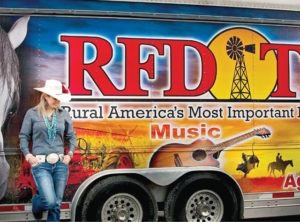
Amy has worked for RFD-TV for five years, currently hosting RFD’s Western Sports Roundup – Courtesy of RFD-TV