Rodeo Life

Author: C.J. Aragon

  • A Little Encouragement

    Continued from the August 1 issue on the five things rodeo contestants want their parents to know…

    3. Slumps happen! Slumps are the worst! When nothing will fall your way, it seems like the world is ending. The best thing about slumps is that they only last forever if you quit. Parents, keep entering them. Keep going to the practice pen. Keep letting them know this is a temporary thing and try to take off all the pressure on these kids that you possibly can because they are putting more than enough pressure on themselves. Step back and support them through it.
    4. Rodeo is HARD! When you mix kids that aren’t even old enough to drive with thousand pound animals moving fast enough to get you a speeding ticket in a school zone, things can get hairy. Once you enter the arena or nod your head, things happen quick! If you are a parent that has never entered a rodeo event, it’s difficult to describe what your kid is experiencing. Horses and stock don’t always cooperate. Plus there are other kids there that work just as hard on just as nice of horses trying to achieve the same thing. Competition in rodeo is TOUGH these days. Be reasonable with your expectations of how your kid should perform each rodeo. They have off days just like we do, especially around those teenage (aka hormones stole my kid) years.

    5. They wish you wouldn’t compare them to other kids. Every kid’s journey is different and each kid will face different obstacles along the way. You might not see some of these obstacles because many times these obstacles are mental. Mind Gym is a fantastic book that can really help your kids with the mental aspect of all sports. I highly recommend all kids read this book or listen to it on those long road trips! Some kids are not natural athletes and they will have to work 10x harder than other kids. In these kids, acknowledging their hard work and encouraging them for one more tenth of a second faster time will get more out of them than expecting them to perform out of their level of ability. You can’t expect Michael Phelps to compete with Usain Bolt and vise versa. We all have our own talents and abilities. Making comparisons between your kid and others makes them feel like you wish the other kid was your kid or you are more proud of one kid than the other and it can be very damaging to your relationship.
    This is just my take on things from the points of view I have been lucky enough to see. Many hours in a trailer and late night drives have been a great way to connect with these kids and hear about what they experience and need from us. We are all going to fail at this from time to time but I’m going to attempt to be a good rodeo parent for my little cowboy and enjoy this ride for the short time it’s going to last.

    C.J. Aragon was named the 2008-2011 Grand Canyon Region Coach-of-the-Year. 2014-2015 WJCAC Coach-of-the-Year, 2016 Southwest Region Coach-of-the-Year, and 2010 National Intercollegiate Rodeo Association Coach-of-the-Year.



  • A Little Encouragement

    This was taken from a friend of mine who is a great coach, Stacey Elias Martin. She has coached from the pee wee level to the college level and here are a few observations that we share.
    After being around some of the best (and worst) parents and kids in the rodeo world, there are a few things I want parents to know about their little cowboys and cowgirls. This is about those kids that are internally driven to strive for success and are out there working all week for those weekend rodeos. Here are 5 things they want their parents to know…

    1. Their fear of disappointing the people who support them and love them can be overwhelming and can cripple them in a competition. These kids WANT to win. They know YOU really want them to win and so they enter the arena with the weight of all of that pressure on their shoulders. The kids I have seen be amazing in the arena, never had to walk out and worry about parents that were mad/yelling/upset with them. These kids were free to lay it all on the line every time they rode in the alley so they won a lot more than the kid that was scared to make a mistake. We ALL want to win but is it worth losing the respect of our kids when we act like jerks by being loud, embarrassing, and insulting if they don’t win? I want to win as much or more than anyone but I try really hard to let my son know that as long as he gives it his best effort, win or lose, I love him and this is something we do for fun. Wins and losses will never be allowed to define who we are or change our love for him.
    2. These days are numbered and when these kids are gone, you will beg for one more rodeo road trip, win or lose. I hear it from so many parents… “We can’t wait for high school rodeo to be over.” Then two years later they are wishing for one more trip to nationals with their kids because they finally realize how amazingly blessed we are, that we get to haul our kids all over the country every summer and make some amazing memories. The memories we make and time with our kids is much more valuable than any saddle or buckle you could ever bring home.

    TO BE CONTINUED in August 15, 2017 issue…

  • COMING TOGETHER

    Just a few short weeks ago the rodeo world was abuzz for a speech Joe Beaver made at the Texas High School Finals Rodeo. I will admit it I was caught up in watching the video and reading the comments from parents and contestants across the country.
    I have an unusual perspective on his speech, you see I am an Idaho native that has moved to Texas to coach college rodeo. From my view on it there is rodeo talent from across the country and around the world. It is not simply localized in one area. What was disturbing was how easily the rodeo world took offense to Beavers speech and how easily it separated the rodeo world based on state lines.
    The speech did start to drive a divide between the rodeo families across the country. But then at the CNFR a young bull rider from Australia was severely injured in the third round.
    Bradie Gray faced life threating injuries after a bull stepped on his chest. He was rushed to the hospital where they did an emergency surgery in the ER to save his life. As I write he is still in the ICU in the Wyoming Regional Medical Center in Casper, Wyoming.
    As the word of Bradie’s accident quickly spread the rodeo world quickly and quietly threw away their differences and came together in support of the young cowboy that few of them knew. The rodeo family was quickly united, in a time of need for one of their fellow members.
    Bradie and his family received help in many ways from across the country and around the world. Donations flew in to help with medical expenses from Texas, to Canada and from New York to Australia. Unfortunately in most cases it takes a tragedy to unite all of us involved in rodeo.
    The hosting city of the CNFR, Casper, has treated the Gray’s as if they were a member of their community. The out pouring of support has been overwhelming at times.
    We can all be thankful that we are involved in a sport like rodeo, and that although we may have our differences of opinion on certain things that we can all still come together and support one of our own in a time of need.

  • What is Good Practice?

    What is Good Practice?

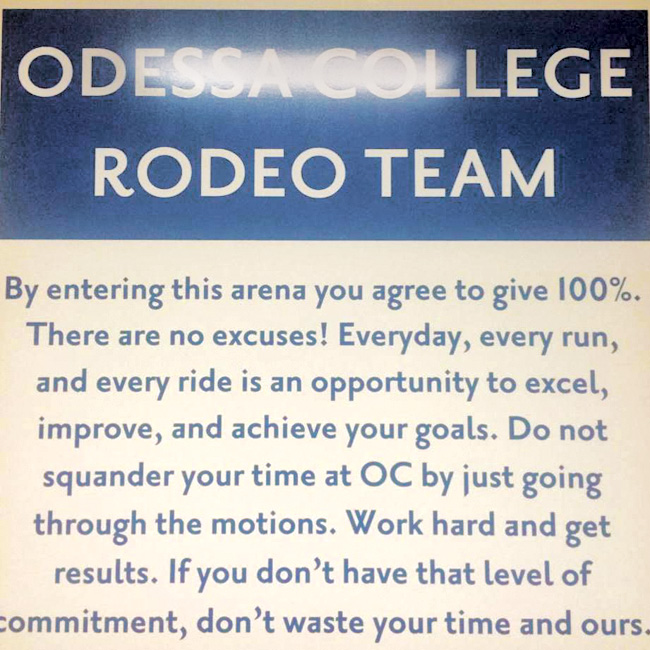
    We are talking about practice. We have a sign at the gate of all three of our practice arenas, but there is much more than just the sign.
    I recently had the chance to sit in on a conversation with other sports coaches about practice. From experience and the conversation it seems that there is a lot most of us can do to improve practice. Signs and motivational sayings are great, but there is much more we can all do to get more out of practice.
    For most rodeo athletes practice time is limited and it is not as structured as most other sports. However the general consensus was that a lot of practice time is wasted because of a lack of focus. Coaches and students alike can have a lack of focus that can waste valuable practice time. Runs and rides in the practice pen should be approached with a high level of focus to get results. If possible find a way, a routine, to focus for your practice. Make your time in the practice pen count.
    Student and coaches need to find a way to set expectations in the practice pen. Coaches need to be able to set the expectation of how they want their students to be coachable and students need to understand the importance of being coachable. All members of the team need to understand the expectation of being a good teammate. The final expectation needs to be for effort and energy in the practice pen. There is no substitute to effort and energy in the practice pen, bring it every day.
    Finally what is a definition of a good practice? If you have a team with 25 students you will probably get 25 different answers on what a good practice is?
    So what is a good practice for you?
    Does one good run or ride define a good practice for you?
    Does improvement or progress define a good practice for you?
    You and your coach should both know your definition of a good practice. Have that conversation with them, whether it is your parents, a paid coach, your high school coach or your college coach. The students who have the most improvement usually have strong communication with their coach.
    For most everyone practice time is limited. Make sure you make the most of it. Show up focused and know what you are working on in that practice session. Set expectations that will lead to improvement. Bring energy and effort to the practice pen. And finally know your definition of a good practice.

  • Teamwork

    College Rodeo is a unique sport because it blends an individual sport into a team sport. There are only a few other sports that have a similar format, golf and track and field being the most comparable. Individuals compete for individual titles, but they are still competing as a team.
    Many students struggle to make the transition from practicing as an individual to becoming part of a team practice. As freshmen this is where I see one of the biggest struggles for students who go to a program that has practices that are run as a team. I have visited with several other coaches and they see the same difficulties in the program each year.
    I have had the opportunity to coach a lot of really good individuals and a few great teams. From experience it is exciting and rewarding to have individual success. However the bond you will share with your teammates and coaches from team success is even more rewarding. With team championships the reward is much stronger because of the commitment and work that it took as a group to get there. Many of the following qualities can build the championship team that we all seek to be part of.
    Your attitude will affect you in your daily routine. Not only will your attitude affect you but it may affect those around you. Your teammates and your coaches. Be coachable, and be the type of teammate you would like to have. IF you have a good attitude others will want to practice with you and help you.
    You are now on a team. As a member of a team practice will not always be centered on you. You will not always get to run as many as you would like. You will not always get on the best practice horse or bull. However you are a member of the team and need to do what you can to make your team better. Run chutes, bring up the practice cattle. Be there to support your teammates as much as possible.
    On every team that I have ever been on, or coached there have been strong personalities. Most good competitors have strong personalities, and strong personalities are not always the easiest to get along with. As a coach I have never expected everyone on the team to be best friends. I do expect everyone on the team respect each other in and out of the arena. You are members representing a school, working towards a goal and you are now going to be treated as an adult. One of the best and most important lessons you can learn on a team is how to be respectful to the different personalities on the team. This is a lesson that will serve you well the rest of your life.
    A college rodeo team has a lot of different groups. I usually break it down into three groups, rough stock riders, men’s timed events and women’s timed events. Then in each group you have your individual events. Practice time and the coach’s time will be split up among the groups and events. Make sure you can learn to work on improving in practice without the coach babysitting you. Don’t expect a compliment or criticism on every run or ride. Coaches see more, observe more and hear more than you give them credit for. Coaches and team mates will recognize and respect great daily effort in the practice pen.
    Be the teammate you would want to practice with every day.

  • Social Media Presence

    Social media has become huge.  Facebook, Twitter, Instagram, YouTube, Snapchat and many more are out there for everyone to use.  Social media accounts are used by young and old, alike and viewed worldwide. How important is your social media presence? That is probably a loaded question, depending on what you expect to gain from your social media account. I know people that keep their social media circle very small with just friends and family. Others choose to max out their friends or have thousands of followers. Make sure your social media is an accurate reflection of you.
    Some use their social media account to become popular or even famous.  Videos, pictures and whatever else they can post to become popular. I will admit I follow two totally different social media accounts. Dale Brisby and Eric Thomas.  Those two are on opposite sides of the social media spectrum. One I follow for the entertainment value, one I follow for education and inspiration. That is the benefit of social media, it is a venue that can be used in many different ways.
    As a coach I will use social media accounts to see if a student is someone we want to bring into our program. With a quick peak at your social media accounts we can watch videos of you compete.  Learn about how you treat others. The type of decisions you make on your social media accounts can and will affect the scholarships you may receive. Once you are on scholarship for an athletic team, your social media account will in some ways begin to represent not only you but your team as well. Social media has become so prominent that many schools now have policies and programs about how to use social media in a positive way.
    Many sponsors now look at your social media accounts as well.  I know first-hand of very talented rodeo athletes that have lost sponsors because of their social media presence.  I also know of other athletes that have had doors opened for them because of how they represent themselves on social media. Simple choices of what to post or send can lead you in different directions in a hurry.
    Now even most employers will check your social media account.  That post that was inappropriate that you posted seven years ago may now come back to haunt you.  What you put on social media is out there, once you post, you have little control.  It can be shared, copied, saved, made into a meme, the possibilities are endless.
    With social media we all become our own promoter? How will you be represented on social media, everyone is watching…

  • Positive Attitudes

    What separates those who are successful in the rodeo business? Over my years as a coach I have watched many students go on to be very successful in the arena and they all share a few key characteristics that seem to separate them from everyone else.
    The best student athletes on my team each year are not the most talented on the team. In almost every case the students who win the most have a few characteristics that separate them from everyone else.
    Winners are driven to reach their goals. They know what their goals are and so do those around them. Over the years I had a few students on my team that have been extremely successful. They were not shy about telling you what their goals were. They weren’t afraid of working hard to reach their goals. They weren’t afraid of competition. They also took their failures as a learning experience.
    Along with treating failures as learning experiences, they were incredibly positive. Not just about what they were doing but to those around them. Their positive energy was contagious, it made them better and it made those around them better as well.
    Because of their attitudes they were very coachable. They showed up to practice with energy. They listened to feedback from the coaches. I know there were times when they were coached, and told things that they did not want to hear. They listened anyway. That is one of the keys to any successful athlete, they have the ability to be coached. Not everything is going to go their way, they will not be told what they want to hear, and they learn from all experiences because of their attitude.
    Dedication to their craft is a must as well. They study and learn all they can about their sport. They take care of their business. For a college rodeo student, that means getting good grades, becoming a leader, and being the best competitor they can be. These guys spent time in the gym and they really put in the work in the practice pen. Because of their dedication they find ways to win.
    Finally they competed fearlessly. This group approached every competition with one goal in mind, winning. They didn’t worry about their competition, they didn’t make excuses. Because of their approach to competition they were able to eliminate distractions and focus on what they were working to accomplish.
    I have been blessed to coach several WNFR, and PRR World Finals Qualifiers over the last few years. Every one of them had these traits, and I believe I learned a lot from these students as well. Now it is exciting for me to see these traits in students currently in our program or coming into our program. I truly believe that if you want to be at the top of any sport you need to embrace these traits.

  • Judgement Call

    At the last college rodeo I watched some college students question rodeo officials on their calls. Rodeo is officiated by the judges, they are human and they make mistakes. Like many other officiated sports it is very fast paced and the calls are made in the blink of an eye. Under this system the calls will never be perfect and there are always going to be those who question the calls made in the arena.
    Every event has an element that is judged or open to a judgement call. Mark outs, the flagger, timers, they all make mistakes, but I rarely if ever felt that someone intentionally made a bad call. I haven’t agreed with all of the calls I have witnessed, but I think they were made to the best of the rodeo officials’ ability.
    Here are a few of my takeaways from this weekend and college students protesting calls.
    If you don’t agree will the call, don’t make a fool of yourself in and out of the arena after the call. No matter how much you disagree with the call, acting like a spoiled brat is not going to change the call. No one will remember the run in a few weeks, but they will remember how you acted. In many cases your behavior will warrant a conduct fine, you may get by once or twice acting like this but conduct fines are not cheap, and if you make a habit of acting like this you will get one. You may find some people in your corner that will tell you it was a terrible call and that the judge cost you lost of money, but in the end the one person in the arena that agreed with the call was holding the flag. End of story.
    Don’t post the video on Facebook, naming the judge and ask all your friends what they think. Just don’t do it. I saw someone from another region do this and tag the judge in the video, I watched the video with the judges at a different rodeo. First the angle you filmed from was not good to make a case either way. Two, the judges watch your video and next time they are flagging at a rodeo you are at they will know to watch you for crossfire. Three you will likely not get the benefit of the doubt on any crossfire calls from that judge in the future, or any of the other judges that watched the video. Finally it was the right call, know the rules of the association you are competing in before you question the call on social media.
    Finally the one good example was in the bareback riding where a rider missed his horse out. After the event the rider went to the judge and asked him what he saw, and what he could do better. The judge took the time to explain the rule and how he interpreted the rule in this case. Then he went on to explain how the rule book told them to judge the mark out. Both sides left the discussion feeling better about their conversation about the call.
    In all of my year’s rodeoing and coaching, I have never witnessed anyone throwing a fit about a call or posting it on social media, get the call changed. If you plan on rodeoing for a living there are only so many rodeo judges, don’t find ways to make them all dislike you when you are still in college.

  • Freshman

    I was asked today what was important for freshmen athletes in college to learn. It got me thinking what were the qualities of successful freshmen athletes? After some thought, here is my list, most of these skills they need to come to college with. Some of the skills can be developed at college, but if you wait too long you may learn a hard lesson.

    1. You have to learn to do things on your own. Independence is a key for success of any college athlete. College forces you to be responsible and independent. Going to class, getting your homework done on time, doing your laundry; all of a sudden your parents are no longer there to do it for you. The quicker you learn to be independent in college the more successful you will be.

    2. You have to be able to work with others. If you are an athlete you are now on a team, you will be working with others and many times the groups success or failure depends on how well you can work together. All of a sudden this is real life stuff, just like a job, you may not like all of the people you work with but you must respect and work with them to get your job done. Not only on your team but in class group project you will have the one group member who lets the rest of the group carry them. This will be a skill that you will likely use the rest of your life so make sure you develop it well.

    3. Time management will be key. You only have so many hours every day. Class, practice and sleep will take up a big portion of that time every day. How you manage the rest of your time will likely determine how successful you are as a student and as an athlete. In no other time in your life will you have the opportunity to improve your athletic skills like you will in college, take advantage of it.

    4. Most college students have to learn to live on a budget. Success in college is about learning to make good decisions and one of the first places you can see students go down the wrong path is how they handle their budget. Athletes may have it tougher than many students because of their schedules it may be tough for them to have a job. It is important to learn to manage your money so it does not become an excuse for you to leave college.

    5. How to deal with difficult circumstances. Most college athletes were the star in high school, college presents a whole new problem for them, and all of a sudden you are surrounded by many talented athletes. You may not win as much as you did in high school right off of the bat, but how you respond to the difficult times will tell how good you will be in the future. If you start making excuses, and believe that your talent alone will carry you through college, you are sadly mistaken. In college the talent level starts to equalize, the hardest workers will start to rise to the top. Those who can handle failure and learn from it and work through it will be the toughest competitors.
    Just my observations…

  • Recruiting Season

    It is recruiting season in many sports including college rodeo. This is a very busy time of year for coaches, practices, spring rodeos, fundraising and recruiting. It is an exciting time of year as well, building for the future.
    From previous experience recruiting is not an exact science. In fact recruiting difficulties carry over to all sports. Five star recruits, walk-ons and everyone in between start with a clean slate as soon as they walk on campus. But they do not all come equipped with the tools to be successful at the next level. Some come with tons of talent, some come with character, a few come with both. Send me the ones with lots of character who just need the opportunity to be successful.
    Recently I came across an interesting statistic, 37 of the 44 NFL Pro-bowl selections this year were three-star or lower recruits out of high school. Like I said recruiting is not an exact science, even for football programs that have huge budgets and hired professionals just to scout talent and recruit. The 37 recruits worked their way to success on the highest level and rest assured that it was not an easy journey. Through their character and development of their talent they were able to face many difficult times to find their way to the elite level they compete on now.
    What talent scouts and recruiting experts struggle with on every level struggle with is sorting through the high school success and finding the true character of their recruits. How determined are they to be successful? How hard are they willing to work to be successful? How goal orientated are they? How good of a student are they? How fierce of a competitor are they? Can they motivate themselves on a daily basis? Can they avoid social distractions? Are they satisfied with their previous successes?
    These are all good recruiting questions that are not easy for the coach to find answers to. From the high school level to the pro draft these questions may go farther in determining future success than the measurable numbers.
    In the past I have had walk-ons with very little experience, and scholarship athletes with a great high school resume. The walk-on had the key character tools that we all look for, the talented kid had just relied on talent. Over the course of the first year the gap in performance was closed between the two based on the character of the athletes. By the second year the walk-on was out performing the high school star and had been selected a team captain by his peers. By the third year the walk-on was competing at the CNFR and the high school star had progressed very little from when he first arrived. (By the way the walk on did earn his scholarship after his first semester of school).
    I have watched this unfold in the past, I see it currently, and I know I will see it in the future. This proves that no matter how much success you had in high school or early in your career you have to keep working. The hardest workers will find a way to be great no matter what sport or profession they choose. Character and hard work are the best equalizers, don’t let others beat you in these areas…

  • Participation Parents

    I don’t think that participation trophies are as prevalent in rodeo as other sports, but I do think the participation trophy problems carry over into rodeo as well. I have a different take on the problem than a lot of people. The kids and participants are not the problem, the problem is the parents.
    Not many want to hear that, but the problem is the parents. I have never heard of the junior rodeo contestants budgeting for the rodeo they are putting on and making sure that they order awards for all of the other participants. At a young age prize money and prizes are not the main priority, just ask any nine year old entered in a rodeo. Most young participants in any sport are more interested in the having fun and the social aspect.
    Kids are at competitive events for one of two reasons. One reason is they like to compete and have fun competing with their friends. Two, their parents want them entered.
    Here is where the participation trophies come in. The parents want to justify the time and money they spend on and with their children, so the parents are the ones that need and want the trophies for their kids. The parents are the ones responsible for the “Participation Trophy Generation” not the kids, the problems that are developing in the students come directly from the parents’ actions. Everyone learns to win, but no one learns how to handle the disappointments, especially the parents. These parents are too protective of their kids, they don’t teach them basic life lessons of dealing with success and more importantly dealing with failure. Of work and accountability for your actions.
    Put the blame where it belongs, on the parents. So how do we fix the problem?
    At an early age students should be competing for the love of the sport, to develop their fundamental skills and improving. For this process to be complete there has to be a balance, there have to be up and downs. At an early age students need to learn how to win, but they also need to learn how to handle defeat and disappointments as well. Many times the lessons learned from losing are much better than any they learn from winning.
    As a parent and a coach this can be tough to watch. It is hard to see your kid crying in disappointment. But a disappointment can go different ways as a learning tool, use it wisely. Don’t make excuses for your kid, don’t try to make it easy for them, and don’t give them a trophy for trying. Let them learn from their experience to be better in the future; if it is something they truly want, they will work at learning from their experience. They will become stronger and achieve more in the future as long as you don’t reward them for just participating.
    Make sure you raise kids that understand that nothing is owed to them, and that nothing will be given to them for just participating.
    Our main jobs as parents and coaches are to use our sport to develop the character of our kids as much as their skills inside the arena.

  • Ace High Roughstock Academy

    We recently concluded the Ace High Roughstock Academy at Odessa College. We had forty students from across the country come to learn from some of the top athletes in our sport. Over the time spent with the instructors and students I was able to pick a lot up. I learned from watching students make mistakes, from the instructors, and from the students.

    A few things that I learned from the instructors at the Roughstock School:
    •    They pay attention to details. They know their sport inside and out. They pay attention to the horses. They watch the gate men, the flank man and the pick-men. They really know the judges and their tendencies, who watches the mark outs like a hawk, which ones like certain riding styles or certain horse types.
    Little Details. Big Details.
    Rodeo is their livelihood and they learn and pay as much attention to all of their surroundings as possible. They know their equipment, they know how to fix it, and they know when not to fix it. Most everything they do in and around the arena is done on purpose. Everything in their world is detail oriented to give them the best shot to be competitive.
    •    If you want to win a gold buckle or make the WNFR you had better be dedicated to the sport. The Top ranked bareback rider (Tim O’Connell) and the top ranked saddle bronc rider (Jacobs Crawley) were both at the school as instructors. They had early morning workouts before the school started. They were on the spur board with the students. Even though they were instructors at the school they each got on practice horses with the students. So did most of the other instructors. They are extremely dedicated to their craft; to be in their spot in the future or take their spot at the WNFR you are going to dedicate yourself to the sport. You will have to earn your right to compete with these guys and they aren’t just resting waiting for you to come get them.
    •    If you want to be great you must have an inner competitive drive. Your mom and dad can’t make you want to be great; your friends can’t make you want to be great. It has to come from you and it has to be your passion. On the way to lunch we had five 2016 WNFR qualifiers in the truck. Everything they do inside the arena is competitive and everything they do outside of the arena becomes a competition as well. The top guys thrivwe on competition, they enjoy it, and they become great because of it. If rodeo is your passion make sure you have the competitive fire.

    You can learn a lot at any rodeo school. To get the most out of it make sure you watch and learn as much as you can from everyone around you.
    A special thanks to Cervi Rodeo, Jabob and Sterling Crawley, Richie Champion, Winn Ratliff, Binion and Chase Cervi, Tim O’Connell, Clint Johnson, Chuck Kite, Randy Britton, Vicki Pack and Hanna Wiebelhaus. Also a big thanks to the sponsors, Justin Boots, the PRCA, Rodeo Houston, and Cinch for helping put on the third annual Odessa College Ace High Roughstock Academy.


    C.J. Aragon was named the 2008-2011 Grand Canyon Region Coach-of-the-Year. 2014-2015 WJCAC Coach-of-the-Year, 2016 Southwest Region Coach-of-the-Year, and 2010 National Intercollegiate Rodeo Association Coach-of-the-Year.