Rodeo Life

Blog

  • Best in the Badlands

    Best in the Badlands

    Pro Rodeo circuit rodeo determines champions in North, South Dakota

    MINOT, N.D. (October 9, 2016) – The best of the best cowboys and cowgirls converged on Minot this weekend to duke it out, determing the Badlands Circuit champions.

    The Pro Rodeo Cowboys Association designates the pro rodeos in North Dakota and South Dakota as the Badlands Circuit, and rodeo contestants who had won the most money after the season came to the RAM Badlands Circuit Finals Rodeo, hosted by the Minot Y’s Men’s Rodeo for four performances October 5-8. The top two champs in each event, the year-end and average champions, qualify to compete at the RAM National Circuit Finals Rodeo, held in Kissimmee, Fla. April 5-8, 2018, where $1 million is up for grabs.

    It came down to the last rides and runs in most events, with just a few points or seconds making the difference between champ and second place.

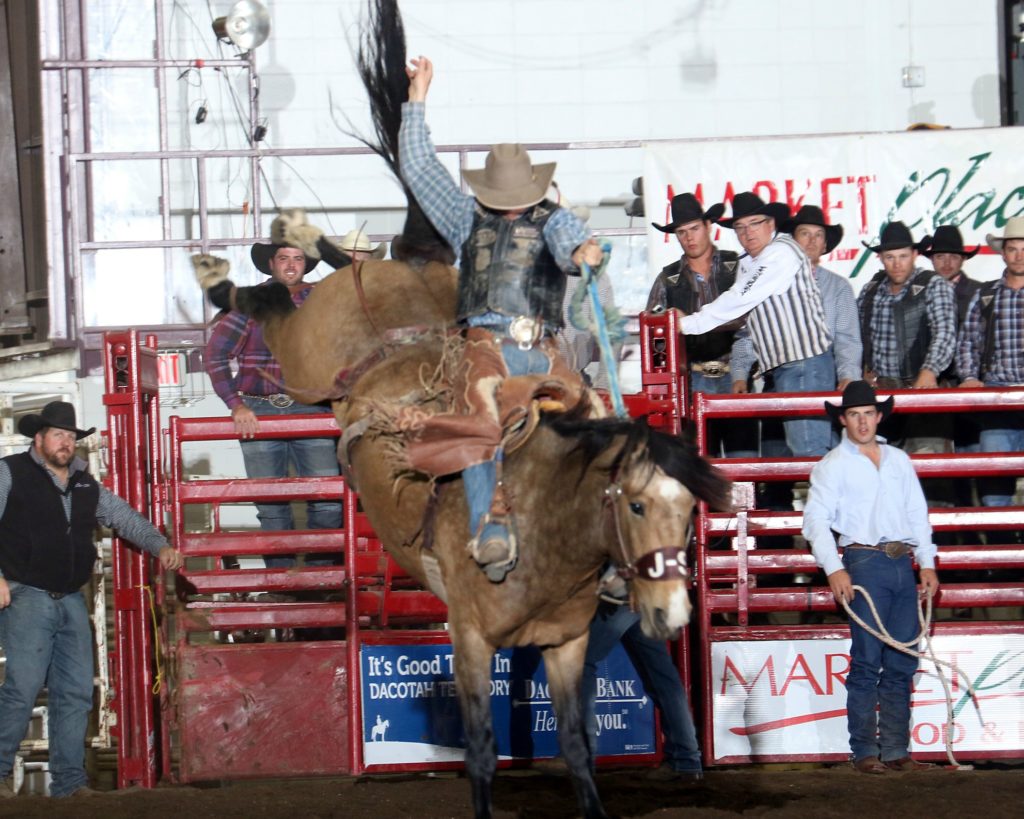
    It was the last two rides in the bareback riding that determined the year end and average (the most points on four rides combined) champions, and Ty Breuer squeaked past Shane O’Connell by $810 and two points in the average. It was a close race from the start. “Before the last couple of rodeos,” Breuer said, “I was looking at the standings and Shane had quite a bit of a jump on me.” Breuer, of Mandan, N.D., estimates that if a cowboy is within $1,000 of the next cowboy before circuit finals, he has a chance of catching up and overtaking him at circuit finals.

    “I got lucky and got within $900 before circuit finals,” he said. With each round paying $4,193, split between first through fourth places, and the average paying $8,386, split between first and fourth, there’s plenty of money up for grabs at the rodeo.

    Only two points separated the two bareback riders for the average win. Breuer had 324 points on two head and O’Connell of Wall, S.D. had 322. Breuer appreciated O’Connell’s talent. “Shane rides great,” Breuer said. “It was hard to get the win against him. He’s a good rider and a good guy.” O’Connell appreciated that the victory came down to the last ride. “That’s the way it should be,” he said.

    Breuer also won both the year-end and average titles at last year’s circuit finals.

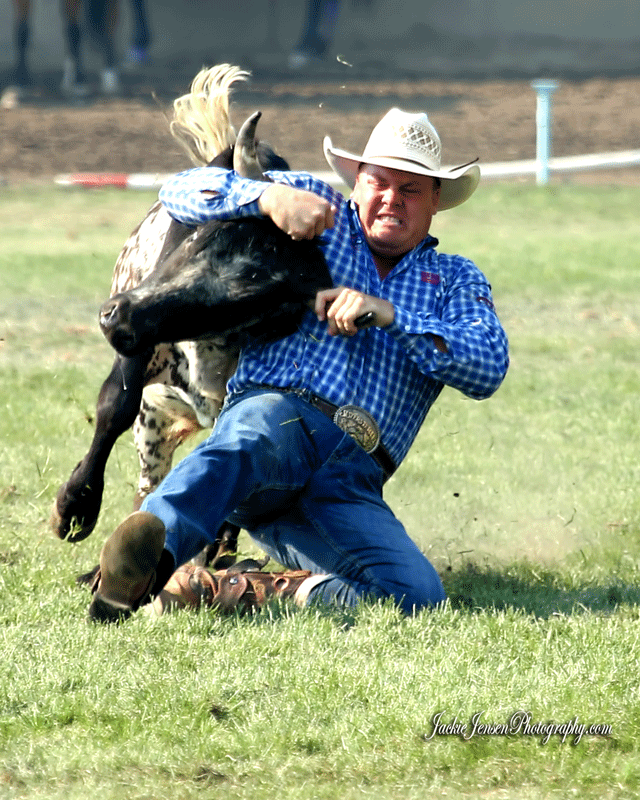
    The steer wrestling average title went to Cameron Morman of Glen Ullin, N.D.

    The race was between Morman, Chason Floyd and Beau Franzen, but Franzen had a 5.1 second time during Sunday’s rodeo, and Floyd missed his steer, leaving the door open for Morman to walk through. He scored a time of 4.9 seconds to take the average title (18.3 seconds on four head).

    “I needed to get out of the barrier and catch four steers,” he said. “That’s what I kept thinking the whole time. That’s always been the key” at circuit finals. He finished first place in the first round (4.2 seconds) and fourth place in the second round (4.4 seconds). Morman, Floyd, of Buffalo, S.D., and Jake Rinehart, Highmore, S.D., rode Rinehart’s horse Rio, who also won the Badlands Circuit Steer Wrestling Horse of the Year. “I was very fortunate Jake brought his horse and let me ride. Rio is an outstanding horse.”

    This will be Morman’s second trip to the RAM National Circuit Finals Rodeo; he qualified in 2015. The steer wrestling year-end title went to Floyd.

    In the saddle bronc riding, veteran bronc rider JJ Elshere had the year-end award sewn up from the beginning.

    The Hereford, S.D. man won big over July fourth rodeos and came into the circuit finals with a comfortable lead of over $8,000 over the number two cowboy, Shorty Garrett.

    Elshere placed in every round, winning first in rounds one and two and fourth in rounds three and four to also win the average with a score of 321.5 points on four head.

    The Badlands Circuit Finals might be considered “JJ’s house.”  “I’ve done well here,” Elshere said. “Every now and then you have a good year, and fortunately, I’ve had a couple.”

    The rodeo fits him well, he said. “It’s just a great atmosphere here. It’s always fun when you get to come and hang out with everybody. It’s a pretty relaxed situation. I like that.”

    The thirty-seven year old cowboy has made every circuit finals since 2003 except for two, and won the year-end title in 2006, 2007 and 2015. He has more good years in him, he hopes. He and his wife Lindsay have five sons, ages 15, twelve, eight, seven, and five, and he’d like to compete for another fifteen years, so he can ride against the youngest one. Age is just a number, Elshere said. “It feels old only if you’re counting the years. I feel like I’m still kicking.”

    The team roping titles went to the duo of Logan Olson, Flandreau, S.D., and Matt Kasner, Cody, Neb. Olson, the header and Kasner, the heeler, won money in every round to win the year-end and the average title (22.4 seconds on four head).

    The Badlands Circuit year end barrel racing winner was Jessica Routier, Buffalo, S.D. She led the pack coming into the circuit finals aboard her six-year-old palomino, Missy. Routier never planned on trying to make the circuit finals but Missy did better than expected, handling new situations and arena conditions like a veteran horse. “She’s very smart,” Routier said. “The crowd, the noise, the commotion, nothing bothers her one bit.” Missy, whose registered name is Fiery Miss West, is owned by Gary Westergren and won the Badlands Circuit Barrel Horse of the Year.

    Nikki Hansen, Dickinson, N.D. won the average title with a time of 55.09 seconds. Less than a second separated the top four cowgirls’ average times: Hansen’s 55.09, Kristi Steffes’ time of 55.41, Routier’s time of 55.55, and Erin Williams’ 55.96. Barrel racing competition in the Badlands Circuit is tough, Routier said. “The group of horses that are here this year, I think they could win anywhere across the country, every one of them. They’re really tough horses and really tough riders.”

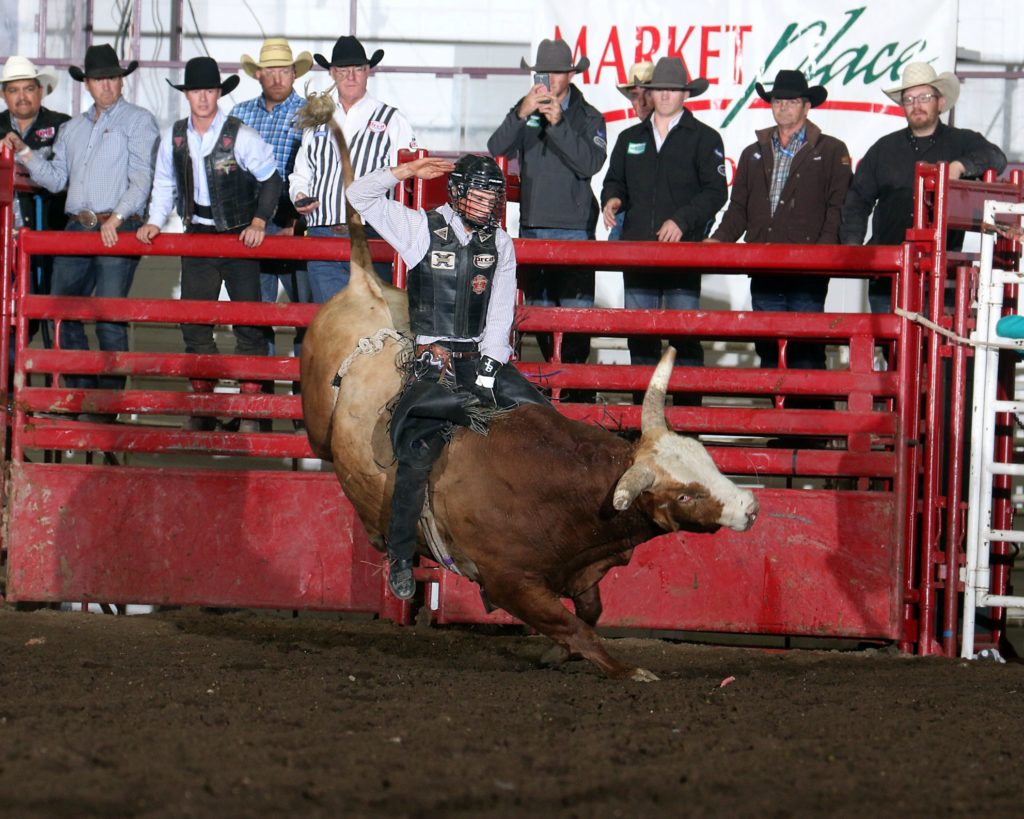
    In the bull riding, no cowboy rode all four bulls, and only one rode three. Jeff Bertus, Avon, S.D., won the average title with a score of 207 points on three. He also won the year-end title. In 2014, Bertus won both titles, and in 2012-2013, he won the average.

    Tie-down roping titles went to Trey Young, Dupree, S.D. for the year-end and Paul David Tierney, Oral, S.D. for the average.

    The Rookie of the Year was awarded to Tucker White, Hershey, Neb., and the all-around went to Paul David Tierney, Oral, S.D.

    Awards were also given to the Badlands bareback horse, saddle bronc, and bull of the finals and the year. Chuckulator won Bareback Horse of the Finals, West Coast Kitty won Saddle Bronc of the Finals, and the bull High Roller won Bull of the Finals. All three are owned by Sutton Rodeo, Onida, S.D.

    For the year-end awards, the Bareback Horse of the Year went to Hard Hat, Sutton Rodeo. The Saddle Bronc Horse of the Year was won by Spider, Bailey Rodeo, and the Bull of the Year was tied between Candy Crush and Judas, both owned by Sutton Rodeo.

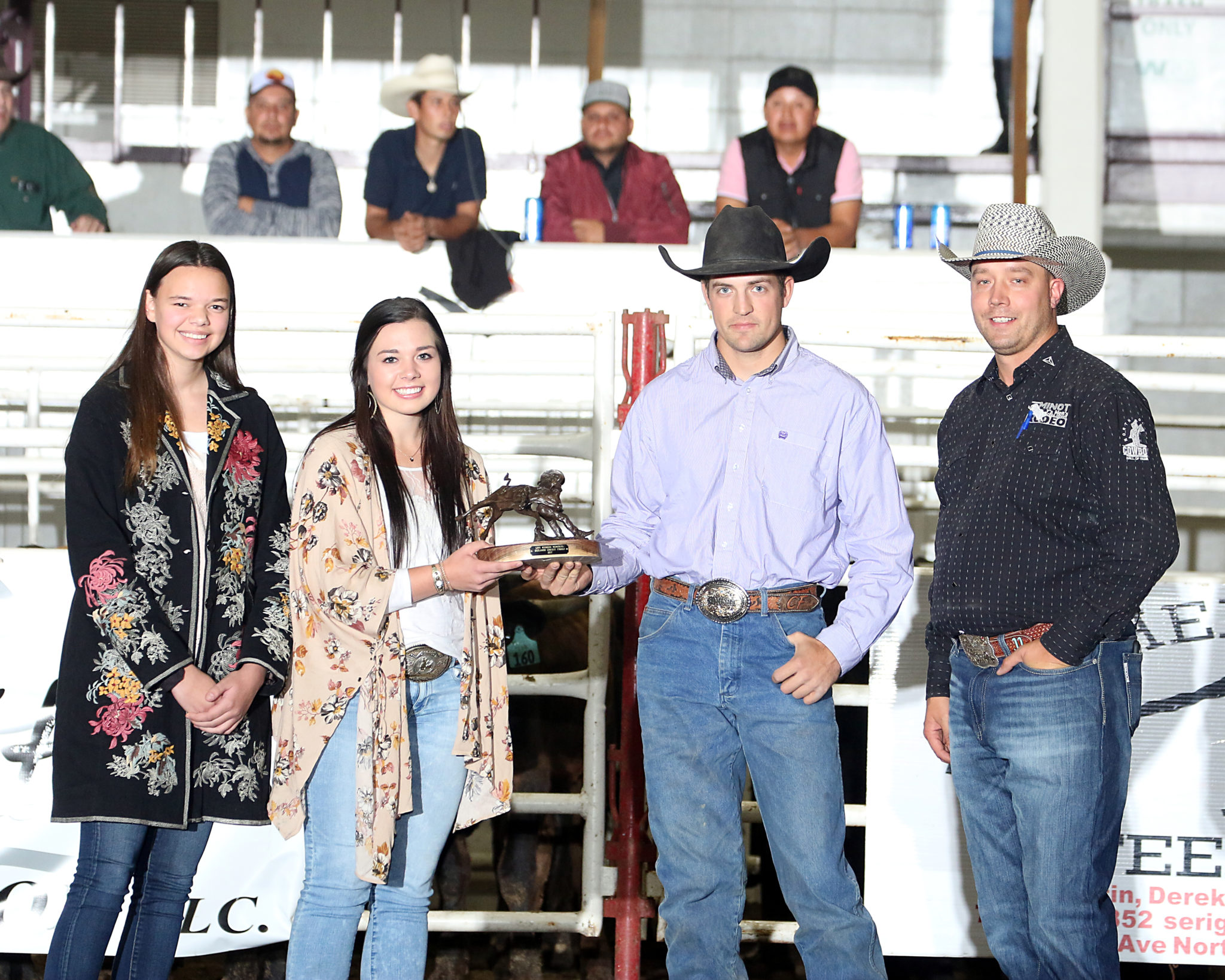
    The 2018 Miss Rodeo North Dakota was crowned. Hope Ebel, the former Minot Y’s Men’s Rodeo queen, won the title. The nineteen year old, a resident of Zeeland, N.D., is a student at North Dakota State University, majoring in animal science. She hopes to study to be a veterinarian after she serves as Miss Rodeo North Dakota.

    The Minot Y’s Men’s Rodeo is a not-for-profit venture by the YMCA Men of Minot, N.D. Proceeds from each year’s rodeo benefit the Triangle Y Camp at Lake Sakakawea, near Garrison, N.D. Next year’s Badlands Circuit Finals Rodeo will be October 4-7, 2018. Hess and 4- Bears Casino & Lodge are proud sponsors of the Badlands Circuit Finals Rodeo. National sponsors include Wrangler, Justin Boots, Las Vegas, Experience Kissimmee, Ram, and Montana Silversmiths.


    – ### –
     

    Ram Badlands Circuit Finals Rodeo, Minot, ND

    4th performance October 8, 2017

    Year end and average winners for the Badlands Circuit


    All-around Champion:  Paul David Tierney, Oral, S.D.

    All-around champion for the Finals: Paul David Tierney, Oral, S.D.


    Bareback riding

    Bareback Riding Year End Champion: Ty Breuer, Mandan, N.D.

    Bareback Riding Average Champion: Ty Breuer, Mandan, N.D.


    4th go round results:

    1. Shane O’Connell, Rapid City, S.D. 80.5 points on Korkow’s Gun It; 2. Ty Breuer, Mandan, N.D., 78.5; 3. Joe Gunderson, Gettysburg, S.D., 75; 4. Steven DeWolfe-Shadeed, Buffalo Gap, S.D., 71.


    Average results:

    1. Ty Breuer, Mandan, ND. 324 points on 4 head; 2. Shane O’Connell, Rapid City, S.D. 322; 3. Joe Gunderson, Gettysburg, S.D. 298.5; 4. Nick Schwedhelm, Sioux Falls, S.D. 286


    Steer Wrestling

    Steer Wrestling Year End Champion:  Chason Floyd, Buffalo, S.D.

    Steer Wrestling Average Champion: Cameron Morman, Glen Ullin, N.D.


    4th go round results:

    1. (tie) Jake Kraupie, Bridgeport, Neb., and Eli Lord, Sturgis, S.D. 3.7 seconds each; 3. Jake Rinehart, Highmore, S.D., 3.8; 4. Taz Olson, Prairie City, S.D., 4.1.


    Average results:

    1. Cameron Morman, Glen Ullin, N.D. 18.3 seconds on 4 head; 2. Beau Franzen, Sidney, Mont. 20.3; 3. Eli Lord, Sturgis, S.D. 22.3; 4. Forest Sainsbury, Camp Crook, S.D. 24.3.


    Team Roping

    Team Roping Year End Champion Header:   Logan Olson, Flandreau, S.D.

    Heeler:  Matt Kasner, Cody, Neb.

    Team Roping Average Champion Header: Logan Olson, Flandreau, S.D.

    Heeler:   Matt Kasner, Cody, Neb.


    4th go round results:

    1. Paul David Tierney, Oral, S.D./ Jade Nelson, Midland, S.D., 4.9 seconds; 2. (tie) Tyrell Moody, Edgemont, S.D./ Elliott Gourneau, Kennebec, S.D., and Cooper White, Hershey, Neb./ Tucker White, Hershey, Neb. 5.7 each; 4. Logan Olson, Flandreau, S.D./ Matt Kasner, Cody, Neb. 6.8.


    Average results:

    1. Logan Olson, Flandreau, S.D./Matt Kasner, Cody, Neb. 22.4 on 4 head; 2. Jason Thorstenson, Rapid City, S.D./J.D. Gerard, Kennebec, S.D. 35.5; 3. Paul David Tierney, Oral, S.D./Jade Nelson, Midland, S.D. 21.3; 4. Wyatt Bice, Killdeer, N.D./Derick Fleming, Killdeer, N.D. 28.0.


    Saddle Bronc Riding

    Saddle Bronc Year End Champion: JJ Elshere, Hereford, S.D.

    Saddle Bronc Average Champion:  JJ Elshere, Hereford, S.D.


    4th go round results:

    1. Ty Manke, Hermosa, S.D. 84.5 on Korkow’s Duck Butter; 2. Troy Crowser, Whitewood, S.D., 82; 3. (tie) JJ Elshere, Hereford, S.D., and Jade Blackwell, Rapid City, S.D., 79 each.


    Average results:

    1. JJ Elshere, Hereford, S.D. 321.5 on 4 head; 2. Troy Crowser, Whitewood, S.D. 316.5; 3. Ty Manke, Hermosa, S.D. 311.5; 4. Shorty Garrett, Eagle Butte, S.D. 302.5.


    Barrel Racing

    Barrel Racing Year End Champion: Jessica Routier, Buffalo, S.D.

    Barrel Racing Average Champion:  Nikki Hansen, Dickinson, N.D.


    4th go round results:

    1. Nikki Hansen, Dickinson, N.D. 13.70 seconds; 2. Kristi Steffes, Vale, S.D. 13.77; 3. Jackie Schau, Almont, N.D. 13.84; 4. Lisa Lockhart, Oelrichs, S.D. 13.86.


    Average results:

    1. Nikki Hansen, Dickinson, N.D. 55.09 seconds on 4 runs; 2. Kristi Steffes, Vale, S.D. 55.41; 3. Jessica Routier, Buffalo, S.D. 55.55; 4. Erin Williams, Dickinson, N.D. 55.96.


    Tie-down Roping

    Tie Down Roping Year End Champion: Trey Young, Dupree, S.D.

    Tie Down Roping Average Champion: Paul David Tierney, Oral, S.D.


    4th go round results:

    1. Cole W Hatzenbuehler, Solen, N.D. 8.5 seconds; 2. Jess Woodward, Dupree, S.D. 8.7; 3. Riley Wakefield, O’Neill, Neb. 8.9; 4. Justin Scofield, Wessington Springs, S.D. 9.0.


    Average results:

    1. Paul David Tierney, Oral, S.D. 36.9 seconds on 4 runs; 2. Jess Woodward, Dupree, S.D. 40.4; 3. Trey Young, Dupree, S.D. 43.2; 4. Cole Hatzenbuehler, Solen, N.D. 66.4.


    Bull Riding

    Bull Riding Year End Champion: Jeff Bertus, Avon, S.D.

    Bull Riding Average Champion:  Jeff Bertus, Avon, S.D.


    4th go round results:

    1. Riley Blankenship, Killdeer, N.D. 77.5 points on Bailey Pro Rodeo’s Say When; 2. Jeff Bertus, Avon, S.D., 46; no other qualified rides.


    Average results:

    1. Jeff Bertus, Avon, S.D 207 points on 3 head; 2. Tate Smith, Litchville, N.D. 170 on 2 head; 3. Taylor Miller, Faith, S.D. 145.5; 4. Tyler Viers, Comstock, Neb. 82.5 on 1 head.


    ** All results are unofficial.  For more information, visit www.MinotYsMensRodeo.com and www.ProRodeo.com.
  • Kyle Whitaker captures ninth Linderman award

    Kyle Whitaker captures ninth Linderman award

    COLORADO SPRINGS, Colo. – Twenty years ago, Kyle Whitaker won his first Linderman Award, a decoration bestowed upon select cowboys that win at least $1,000 in a minimum of three events, where two of three must include one roughstock and timed event.

    Following in the footsteps of his father, Chip, a four-time recipient of the Linderman Award, Whitaker understands the magnitude of its legacy, as he now accepts his ninth career victory of the multi-event achievement.

    “It’s something I’ve wanted to win ever since I was a little kid going to rodeos with my dad,” Whitaker said. “I always grew up knowing about it. That probably makes it more special to me than most of the guys that go. A lot of people don’t really know about it. I know the history of the award and respect it a lot.”

    The Linderman Award, named after ProRodeo Hall of Fame cowboy Bill Linderman, is intended to recognize cowboys capable and willing to perform at both ends of the arena. In total, Linderman’s career ended with six world championships to his name, including two in the all-around (1950, 1953) and saddle bronc riding (1945, 1950) as well as claiming world titles in bareback riding (1943) and steer wrestling (1950).

    Given the rigors of rodeo, even the spryest of cowboys are challenged to work multiple events. At the age of 41, Whitaker says it’s a matter of simply giving what he has.

    He earned the majority of his money – $51,233 – in steer wrestling, while also collecting $9,666 in tie-down roping and $3,740 in saddle bronc riding.

    “A lot of it is I just keep doing it,” Whitaker said. “I don’t get rusty. I just keep going. I haven’t taken a lot of time off to where I may lose some of my edge. Just stay in shape, and you have to keep the will to win at both ends.”

    Despite his veteran age and the try on his body, Whitaker still has plans to rodeo this winter. Whenever the end to his career arises, and however it may finish, Whitaker will have no qualms with the time he’s spent in the sport he’s known for all his years.

    “It’s something I’ve always dreamed of,” Whitaker said. “I remember when I won it the first time, nobody else had qualified and nobody had won it the year before. I thought well, I’d win it 10 times easy. And then here, to win it the ninth time 20 years later, it’s like man, that’s a lot of hard work and it takes a lot of perseverance to stick with it that long.

    “It means a heck of a lot more now than it did when I was a 21-year-old kid.”


  • Chason Floyd heads to his first WNFR; the standings heading to the WNFR

    Chason Floyd heads to his first WNFR; the standings heading to the WNFR

    $87 was the difference between riding into the Thomas & Mack in December and not. Chason Floyd kept his hold on the 15th spot for a couple weeks. He had to keep going to keep ahead of Josh Peek, who was trying up until the last minute to get that spot. Neither pulled a check the last week. Chason got a couple checks the week before, and he entered three rodeos the last week. “Josh wished me luck at a rodeo we were at that last week – hoping I would make it.”

    Chason has been trying to punch his ticket to Vegas since 2012. “I had a very good rookie year, and tried again for the next few years,” said the 28-year-old from Buffalo, South Dakota. “In 2015, I got hurt and had to sit out a year.”  He went from 41st last year to 15th this year, entering more than 90 rodeos. “I try to learn something new every year, and this year I’m more mature and I know a little more. I also switched horses after Labor Day, jumping off Sean Mulligan’s horse. She fit me really good.”

    Chason got married May of 2014 to Jesika Garrett Floyd and the couple is expecting a new bulldogger into the family February 14. “I mentally told myself after we found out we were having a baby that I better get to winning if I was going to make this happen.” The couple owns an assisted living facility in Buffalo South Dakota, and Jesika has a home health business as well. They are opening another one in Faith, South Dakota, within a year. “I also ranch with my family.”

    He is still adjusting to his first WNFR qualification. “We woke up and went over to the building and started working on it – you go back to normal. But I’m still getting the calls, and it will sink in that I did accomplish my dreams. It’s pretty neat.” Chason will stay in shape by jackpotting and going to his circuit finals in Minot. He plans to enter a few others and continue jogging and staying in shape. “I’ll head to Oklahoma the middle of November to practice with Sean.”  He has never been to the WNFR – this will be his first trip. “I didn’t want to go until I made it. We’re super excited.”

    Standings courtesy PRCA, unofficial, subject to audit and may change


    All-around

    1                            Tuf Cooper, Weatherford, Texas $214,131

    2                            Trevor Brazile, Decatur, Texas     180,487

    3                            Caleb Smidt, Bellville, Texas          151,990

    4                            Ryle Smith, Oakdale, Calif.            140,876

    5                            Junior Nogueira, Presidente Prudente, Brazil          136,430

    6                            Erich Rogers, Round Rock, Ariz.   128,764

    7                            Russell Cardoza, Terrebonne, Ore.             112,795

    8                            Josh Peek, Pueblo, Colo. 105,470

    9                            Dakota Eldridge, Elko, Nev.          104,200

    10                          Clayton Hass, Weatherford, Texas             97,022

    11                          Marty Yates, Stephenville, Texas 89,284

    12                          Marcus Theriot, Poplarville, Miss.              89,029

    13                          Rhen Richard, Roosevelt, Utah    78,241

    14                          Trell Etbauer, Goodwell, Okla.     75,671

    15                          Cody Doescher, Oklahoma City, Okla.       74,931

    16                          Seth Hall, Albuquerque, N.M.       58,000

    17                          Kyle Whitaker, Chambers, Neb.   56,733

    18                          Jordan Ketscher, Squaw Valley, Calif.        56,048

    19                          Josh Frost, Randlett, Utah             55,618

    20                          Curtis Cassidy, Donalda, Alberta  54,641


    Bareback Riding

    1                            Tim O’Connell, Zwingle, Iowa       $201,916

    2                            Tanner Aus, Granite Falls, Minn.  136,657

    3                            Clayton Biglow, Clements, Calif.  128,153

    4                            J.R. Vezain, Cowley, Wyo.             113,312

    5                            Wyatt Denny, Minden, Nev.          109,353

    6                            Caleb Bennett, Tremonton, Utah               106,677

    7                            Jake Brown, Cleveland, Texas      103,212

    8                            Jake Vold, Ponoka, Alberta           102,161

    9                            Richmond Champion, The Woodlands, Texas         101,197

    10                          Orin Larsen, Inglis, Manitoba        99,240

    11                          Bill Tutor, Huntsville, Texas           96,039

    12                          Steven Dent, Mullen, Neb.            93,652

    13                          R.C. Landingham, Hat Creek, Calif.            89,261

    14                          Ty Breuer, Mandan, N.D.               89,106

    15                          Mason Clements, Santaquin, Utah             86,114

    16                          Justin Miller, Billings, Mont.          83,495

    17                          Evan Jayne, Marseille, France       80,762

    18                          Jessy Davis, Power, Mont.             66,029

    19                          Shane O’Connell, Rapid City, S.D.               64,757

    20                          Steven Peebles, Redmond, Ore.   62,612


    Steer Wrestling

    1                            Ty Erickson, Helena, Mont.           $163,152

    2                            Olin Hannum, Malad, Idaho          110,951

    3                            Tyler Pearson, Louisville, Miss.     109,919

    4                            Tyler Waguespack, Gonzales, La.               103,944

    5                            Scott Guenthner, Provost, Alberta              99,501

    6                            Baylor Roche, Tremonton, Utah  99,340

    7                            Ryle Smith, Oakdale, Calif.            93,463

    8                            Tanner Milan, Cochrane, Alberta 84,073

    9                            Nick Guy, Sparta, Wis.     82,968

    10                          Dakota Eldridge, Elko, Nev.          80,981

    11                          Kyle Irwin, Robertsdale, Ala.         79,684

    12                          Jon Ragatz, Beetown, Wis.           77,340

    13                          J.D. Struxness, Appleton, Minn.    76,442

    14                          Rowdy Parrott, Mamou, La.         73,558

    15                          Chason Floyd, Buffalo, S.D.           71,192

    16                          Josh Peek, Pueblo, Colo.                71,105

    17                          Clayton Hass, Weatherford, Texas             70,545

    18                          Jacob Talley, Keatchie, La.            68,915

    19                          Jason Thomas, Benton, Ark.         67,294

    20                          Will Lummus, West Point, Miss.   66,520


    Team Roping (header)

    1                            Kaleb Driggers, Albany, Ga.           $133,977

    2                            Erich Rogers, Round Rock, Ariz.   133,633

    3                            Clay Smith, Broken Bow, Okla.     113,094

    4                            Luke Brown, Stephenville, Texas  111,551

    5                            Coleman Proctor, Pryor, Okla.     98,033

    6                            Riley Minor, Ellensburg, Wash.     96,587

    7                            Chad Masters, Cedar Hill, Tenn.   85,448

    8                            Tom Richards, Humboldt, Ariz.     81,415

    9                            Clay Tryan, Billings, Mont.             81,356

    10                          Cody Snow, Los Olivos, Calif.       79,236

    11                          Jr. Dees, Aurora, S.D.       78,964

    12                          Dustin Bird, Cut Bank, Mont.        78,288

    13                          Dustin Egusquiza, Mariana, Fla.   77,437

    14                          Garrett Rogers, Baker City, Ore.  75,614

    15                          Charly Crawford, Prineville, Ore. 74,146

    16                          Levi Simpson, Ponoka, Alberta     68,006

    17                          Matt Sherwood, Pima, Ariz.          61,983

    18                          Hayes Smith, Central Point, Ore.  61,949

    19                          Marcus Theriot, Poplarville, Miss.              59,915

    20                          Lane Ivy, Adrian, Texas   57,576


    Team Roping (heeler)

    1                            Junior Nogueira, Presidente Prudente, Brazil          $133,779

    2                            Cory Petska, Marana, Ariz.            133,633

    3                            Paul Eaves, Lonedell, Mo.             117,212

    4                            Billie Jack Saebens, Nowata, Okla.             110,930

    5                            Jake Long, Coffeyville, Kan.          103,022

    6                            Russell Cardoza, Terrebonne, Ore.             99,774

    7                            Brady Minor, Ellensburg, Wash.   96,587

    8                            Travis Graves, Jay, Okla. 92,358

    9                            Jade Corkill, Fallon, Nev.               81,356

    10                          Wesley Thorp, Throckmorton, Texas         81,050

    11                          Tyler McKnight, Wells, Texas        79,374

    12                          Joseph Harrison, Overbrook, Okla.             78,387

    13                          Jake Minor, Ellensburg, Wash.     75,614

    14                          Kory Koontz, Stephenville, Texas 74,652

    15                          Jeremy Buhler, Arrowwood, Alberta          68,006

    16                          Buddy Hawkins II, Columbus, Kan.              65,136

    17                          Kyle Lockett, Visalia, Calif.            61,745

    18                          John Robertson, Polson, Mont.    52,238

    19                          Clint Summers, Lake City, Fla.       51,647

    20                          Cody Doescher, Oklahoma City, Okla.       49,836


    Saddle Bronc Riding

    1                            Jacobs Crawley, Boerne, Texas    $184,052

    2                            Zeke Thurston, Big Valley, Alberta              170,456

    3                            CoBurn Bradshaw, Beaver, Utah 124,115

    4                            Cody DeMoss, Heflin, La.              119,657

    5                            Layton Green, Meeting Creek, Alberta      110,613

    6                            Brody Cress, Hillsdale, Wyo.         105,789

    7                            Hardy Braden, Welch, Okla.          102,774

    8                            Ryder Wright, Milford, Utah         99,361

    9                            Sterling Crawley, Stephenville, Texas         92,992

    10                          Jake Wright, Milford, Utah            91,745

    11                          Clay Elliott, Nanton, Alberta         89,332

    12                          Heith DeMoss, Heflin, La.              88,613

    13                          Taos Muncy, Corona, N.M.           88,402

    14                          Jesse Wright, Milford, Utah          76,630

    15                          Audy Reed, Spearman, Texas        75,649

    16                          Cort Scheer, Elsmere, Neb.           71,822

    17                          Cody Wright, Milford, Utah          69,693

    18                          Allen Boore, Axtell, Utah               66,258

    19                          Isaac Diaz, Desdemona, Texas     61,398

    20                          Bradley Harter, Loranger, La.       54,401


    Tie-down Roping

    1                            Tuf Cooper, Weatherford, Texas $190,445

    2                            Caleb Smidt, Bellville, Texas          142,194

    3                            Shane Hanchey, Sulphur, La.         124,498

    4                            Marcos Costa, Childress, Texas    121,902

    5                            Tyson Durfey, Weatherford, Texas            107,423

    6                            Trevor Brazile, Decatur, Texas     101,433

    7                            Marty Yates, Stephenville, Texas 97,173

    8                            Ryan Jarrett, Comanche, Okla.     96,056

    9                            Matt Shiozawa, Chubbuck, Idaho               93,363

    10                          J.C. Malone, Plain City, Utah        86,299

    11                          Timber Moore, Aubrey, Texas      85,962

    12                          Randall Carlisle, Athens, La.          85,566

    13                          Cade Swor, Winnie, Texas             85,460

    14                          Cooper Martin, Alma, Kan.            85,438

    15                          Cory Solomon, Prairie View, Texas             85,210

    16                          Blane Cox, Cameron, Texas          78,317

    17                          Cody Quaney, Cheney, Kan.          77,288

    18                          Ace Slone, Cuero, Texas 76,926

    19                          Cimarron Boardman, Stephenville, Texas 73,367

    20                          Westyn Hughes, Caldwell, Texas 70,016


    Steer Roping

    1                            Jason Evans, Glen Rose, Texas     $84,156

    2                            Vin Fisher Jr., Andrews, Texas       78,934

    3                            Chet Herren, Pawhuska, Okla.      72,976

    4                            Scott Snedecor, Fredericksburg, Texas      68,084

    5                            Trevor Brazile, Decatur, Texas     64,266

    6                            J. Tom Fisher, Andrews, Texas      56,868

    7                            Tony Reina, Wharton, Texas         50,109

    8                            Rocky Patterson, Pratt, Kan.         49,347

    9                            JoJo LeMond, Andrews, Texas     49,309

    10                          John Bland, Turkey, Texas             48,184

    11                          Shay Good, Midland, Texas           47,061

    12                          Cody Lee, Gatesville, Texas           45,082

    13                          Tuf Cooper, Weatherford, Texas 44,217

    14                          Troy Tillard, Douglas, Wyo.           42,848

    15                          Bryce Davis, Ovalo, Texas             41,913

    16                          Chris Glover, Keenesburg, Colo.   40,615

    17                          J.P. Wickett, Sallisaw, Okla.          39,780

    18                          Garrett Hale, Snyder, Texas          32,565

    19                          Brian Garr, Belle Fourche, S.D.     32,545

    20                          Roger Branch, Wellston, Okla.     31,183


    Bull Riding

    1                            Sage Kimzey, Strong City, Okla.    $237,152

    2                            Garrett Smith, Rexburg, Idaho      204,239

    3                            Ty Wallace, Collbran, Colo.           157,077

    4                            Jordan Spears, Redding, Calif.      131,423

    5                            Joe Frost, Randlett, Utah               120,963

    6                            Trey Benton III, Rock Island, Texas            110,471

    7                            Tim Bingham, Honeyville, Utah    106,188

    8                            Cole Melancon, Liberty, Texas     103,619

    9                            Roscoe Jarboe, New Plymouth, Idaho       102,855

    10                          Trevor Reiste, Linden, Iowa          97,121

    11                          Dustin Bowen, Waller, Texas        94,668

    12                          Brennon Eldred, Sulphur, Okla.     92,991

    13                          Jordan Hansen, Okotoks, Alberta               92,660

    14                          Boudreaux Campbell, Crockett, Texas       88,063

    15                          Guthrie Murray, Miami, Okla.       87,288

    16                          Brady Portenier, Caldwell, Idaho 87,014

    17                          Tristan Mize, Bryan, Texas            85,957

    18                          Tyler Bingham, Honeyville, Utah  80,183

    19                          Chase Dougherty, Canby, Ore.     72,754

    20                          Elliot Jacoby, Fredericksburg, Texas           70,593


    *2017 Barrel Racing (Oct. 2, 2017)

    Barrel racing standings, provided by the Women’s Professional Rodeo Association (WPRA), are unofficial, subject to audit and may change. Unofficial WPRA Standings are published by the PRCA as a courtesy. The PRCA is not responsible for the verification or updating of WPRA standings.


    1                            Tiany Schuster, Krum, Texas         $250,378

    2                            Stevi Hillman, Weatherford, Texas             185,952

    3                            Nellie Miller, Cottonwood, Calif. 130,537

    4                            Amberleigh Moore, Salem, Ore.  120,806

    5                            Kassie Mowry, Dublin, Texas        115,163

    6                            Kathy Grimes, Medical Lake, Wash.           111,758

    7                            Hailey Kinsel, Cotulla, Texas         98,707

    8                            Taci Bettis, Round Top, Texas      97,023

    9                            Lisa Lockhart, Oelrichs, S.D.          96,454

    10                          Brittany Pozzi Tonozzi, Victoria, Texas      92,930

    11                          Sydni Blanchard, Albuquerque, N.M.          91,362

    12                          Tilar Murray, Fort Worth, Texas   86,020

    13                          Kellie Collier, Hereford, Texas      83,338

    14                          Ivy Conrado, Hudson, Colo.          78,181

    15                          Kimmie Wall, Roosevelt, Texas    76,294

    16                          Sherry Cervi, Marana, Ariz.            74,363

    17                          Emily Miller, Weatherford, Texas               72,876

    18                          Jana Bean, Ft. Hancock, Texas     72,692

    19                          Jackie Ganter, Abilene, Texas       68,759

    20                          Ari-Anna Flynn, Charleston, Ark.  64,894

  • Roper Review: Makayla Boisjoli

    Roper Review: Makayla Boisjoli

    Almost all parents encourage their children to follow their dreams… but not all parents change their lifestyle or location to help them pursue those dreams. The Boisjoli sisters, (Makayla, 20; Shelby, 19; Marissa, 17) grew up in the small hamlet of Langdon, Alberta.
    “I can remember stories of when my dad cut his thumb off,” recalls Makayla. “I decided then I didn’t want to rope. But when I went to nationals in Pole Bending during junior high, I saw these kids roping the dummy and I was hooked. It took a lot of work because we started later than most kids. Our Dad wouldn’t let us rope horseback until we could catch the dummy 50 times in a row, its harder than you think.”
    Makayla fell in love with roping and focused all of her time towards her goal of making nationals in breakaway. She attributes much of her success to practice drills and late nights at the barn roping the dummy with her dad and sister. The girls started out roping calves and were not allowed to team rope until, four or five months later when Garth felt they handled their rope well enough.
    Frequently on the road with work, Garth didn’t have the time to make a head horse. They refinanced a truck and bought the safest head horse they could find. The girls fell in love with “Handsome,” and couldn’t have asked for a better teacher.
    In January of 2012, Double C and Load ‘Em in the Dark Productions had a truck roping scheduled in Phoenix, Arizona. As true beginners, the Boisjoli sisters were all numbered low because they hadn’t really competed anywhere. After seeing the flyer, Sherry convinced Garth she “felt” they needed to haul the kids from Canada to Arizona for the roping. The “feeling” was right on target as Shelby ended up winning the #3 & Under truck.
    The Boisjolis sold the truck and used the money to buy property in Arizona. This gave the family a winter home enabling the girls to rope more. The girls home schooled leaving friends and other sports for the next two years working on their roping and making horses. With that came another truck and trailer, buckets of buckles, and a tack room full of saddles. The sacrifice was paying off.
    Extremely close, the Boisjoli sisters are tough competitors, both in breakaway and team roping. This summer, while home in Canada, the girls taught over twenty-five eager breakaway students.
    Makayla has chosen to attend college in Texas so she could “compete against the best.” She is currently attending Tarleton University in Stephenville where she is working on her Accounting degree. She plans to pursue a Masters degree and become a C.P.A.

    COWBOY Q&A

    How much do you practice?
    I try to rope calves every day, I make a point of roping the dummy every day, even if it’s just a few times. My dad always preached that to us.
    Do you make your own horses?
    Yes I love when you get a good one that loves what they do.
    Who is your favorite horse?
    Flop is our main man. He has made nine trips to nationals for us girls. He’s come close to a national title and we are hoping he gets one this year before we retire him after Marissa’s senior year. He’s one of the most honest horses I have ever swung a leg over.
    Who were your roping heroes?
    Melissa Reinhart, she was so handy and one of the best girl ropers in Canada. She always took the time to help my sisters and I and I thank her for that. I had always heard of Lari Dee and Jackie Crawford, but never realized how talented they are and hard they work until I got to Texas. I will always look up to my dad. He taught us everything.
    Who do you respect most in the world?
    My mom. She sacrificed everything for us and taught us how important it is to be a good person.
    Who has been the biggest influence in your life?
    My parents, they are giving and hard working; and my sisters because on my best and worst days they are always pushing me to be better. Whatever they are doing, I’m doing, and vice versa we are a pack.


    If you had a day off what would you like to do?
    Anything that involves my family, a game of basketball, go to the lake and ski or just chill on the couch.
    Favorite movie?
    The Notebook.
    What’s the last thing you read?
    Mental Toughness.
    How would you describe yourself in three words?
    Driven, focused, kind.
    What makes you happy?
    Getting to do the things I love: rope and the freedom that goes with it.
    What makes you angry?
    When I see people belittling other people. Rudeness.
    If you were given 1 million dollars, how would you spend it?
    Buy a place in Texas, for my parents and myself and buy my youngest sister a breakaway horse.
    What is your worst quality – your best?
    My best quality is I like to help people; I hate to see people struggle. My worst is I take better care of others than I do myself.

  • Chicken Spaghetti & Pumpkin Cake

    Chicken Spaghetti

    recipe courtesy of Clem and Donna McSpadden

    INGREDIENTS:
    1 (16 oz) pkg spaghetti (wheat, spinach or white)
    1 (10.75 oz) can condensed cream of mushroom soup
    3/4 lb. Velveeta cheese
    1 (10 oz) can tomatoes w/ chile peppers
    1 cup chopped green onion
    4 skinless boneless chicken breasts

    DIRECTIONS:
    Boil chicken breasts, then cut into bite size pieces. Bring a salted water to a boil. Add pasta; cook for 10 minutes; drain. Heat soup in saucepan over low heat; add cheese and melt, stirring constantly. As cheese melts stir in tomatoes w/ green chile peppers and green onion. Simmer 4 minutes over low heat, stirring…Add spaghetti and mix well; stir in cubed chicken. Heat thoroughly and serve. Accompaniment of green salad makes a delicious meal.

    __________________________________________________________

    Pumpkin Cake

    recipe courtesy of Nancy Sheppard, Ridin’, Ropin’ & Recipes

    INGREDIENTS:

    1 cup granulated sugar
    3 eggs, beaten
    One small can of canned pumpkin
    2 tsp ground cinnamon
    1/2 tsp ground ginger
    1/2 tsp salt
    1 can evaporated milk
    1 standard box of yellow cake mix
    1 cup chopped nuts
    1/4 cup melted butter
    Whipped cream topping when done

    DIRECTIONS:
    Mix sugar, eggs, pumpkin, cinnamon, ginger, salt and milk (you don’t need a mixer). Spray Pam in bottom of a 9” x 13” x 2” pan. Pour mixture in pan and sprinkle the dry cake mix on top. Sprinkle the nuts on top. Then pour melted butter over the top. Bake 350 degrees for about an hour. Should be a little brownish on top. Serve warm or cold with whipped topping.

  • Lee Brice

    Lee Brice

    Lee Brice is best known for crafting music born of his Southeastern roots, but loved the country over for its down-home emotions and values. He recently released a new single, “Boy,” and his fourth album comes out in November. Lee has won numerous awards, including Song of the Year at the CMA and ACM awards in 2012 for his single, “I Drive Your Truck,” but like most artists, his inspiration isn’t found in any one area alone. Yet the time he spends outdoors while hunting or fishing often kindles the ideas that eventually make their way to our radios.
    Lee started fishing as soon as he could cast a rod, and was given his first shotgun when he was 10, hunting often with his dad or brother near their home in Sumter, South Carolina. “My daddy took us, and every chance we had, we were dove hunting or deer hunting, or hunting for rabbits or squirrels—anything we could find,” says Lee. “It’s been a part of my life since I was little. I got into duck hunting in the last ten years, and I just went turkey hunting for the first time last year, which was really cool. It’s a whole different style. Being on the road so much, I meet people from other places, where they have elk and other types of hunting that’s a whole different ball game. I want to get in to that.”
    As a father raising three children with his wife, Sara—including their daughter who was born in June, Trulee—Lee says those new hunting opportunities will have to wait. But last year, he purchased 240 acres of land not far from his home near Nashville, Tennessee, and he’s making improvements to bring in more deer with the help of Record Rack feed. “I just got the farm last September, and it had no food on it whatsoever. I killed a ten (point) last year, and a buddy came over and killed one, but there was no food, so that was my first priority. I have four different food plots and some feeders, and I put some new stands up. We recently saw twelve bucks in the same night, and what a difference from last year when there were just three bucks. I have a farm manager out there who’s helped me. It’s a tough process, but the bucks have grown so much and they have so much mass. I’m not used to that. I’m from South Carolina where the deer are smaller than here in Tennessee.”
    The land, where Lee plans to build a house in the future, is surrounded by the Harpeth River. Lee is in the process of turning a small cow pond into a seven-acre bass pond. “I’ve been getting in to fly fishing the last few years, and the farm is going to be my sanctuary for all of that. The point of it is to try and get out there and relax and decompress. But because it is the one time when I can really breathe and rest my mind, that’s when there’s a freedom of inspiration. Sometimes I think of song titles, and even an emotion’s an inspiration in itself. I go there to get away from work, but it turns back into how work started, and being inspired.”
    Lee also loves sharing his passion of the outdoors with his children, especially his oldest son, Takoda. “He’s been going and sitting with me the last couple of years, and my youngest son (Ryker) can now spot deer, and he’s getting the excitement for it. I’ve learned that hunting is such a great thing, and I think it’s important to have kids around it. There are so many facets to it—not only the hunting itself, but the preparation. It’s the little things they learn growing up that stick with them their whole lives, because it did me.”
    Rodeo has stuck with Lee as well over the years, particularly when he was first starting his music career, and playing in Las Vegas at the South Point Hotel. “I got to meet a lot of guys out there, and through my manager Enzo, I got to be good friends with Tuff Hedeman. I’m a fan,” says Lee. “We play the Houston Rodeo and a lot of the big ones, and I sure do respect it like crazy.
    “Early on, my whole life was music and football and hunting and fishing. I played football for Clemson all the way through college, and once that was over, music was the natural thing for me. Now, even though it’s a job and it’s definitely hard work, it’s a job that I love. I’m so fortunate to do what I love for a living, so that leaves hunting and fishing as something I love to do that I don’t get paid for. I still work for it—I still put up the stands and food plots and clean the deer—but it’s good.”

  • Time Management Skills

    Time Management Skills

    Successful collegiate rodeo contestants must be effective time managers. There is no choice in the matter as they are responsible for themselves and in many cases for their animals. Time management skills are critical for your success.
    When you consider the amount of time in a day that must be allocated to sleep, eating, attending classes, practice, studying, doing laundry, running any necessary errands, and hopefully having some free time for a social life, you will quickly realize that a college rodeo athlete has very little spare time.
    All of this is built on the assumption that they are not traveling to a rodeo.
    The major key for success in the classroom and in the arena is being able to have good time management skills. Some students are able to find the balance. Others are able to master the rodeo side, and struggle with the class side. Some are on the other side of the fence and do well in the classroom and struggle in the arena. Develop the balance.
    As a college rodeo student it is critical that you cultivate your time management skills if you want to be successful. These skills will benefit you now and in the future.
    Here are some suggestions that we give our student athletes:
    Learn to keep a calendar with your dates and deadlines. You can do this on most smart phones now. You don’t want to miss an assignment because you were out of town or traveling or simply forgot.
    Know what you need to accomplish each day. Classes and Practices included.
    Do not let your social life take first priority. Classes first, practice second, social life down the list somewhere.
    Make sure you are prepared for your assignments when you are traveling. Yes you are on the road at a rodeo. You are still responsible for completing your class work on time.
    Have a good practice plan so that you don’t have to spend more time than necessary in the arena practicing.
    Work with your roommates and teammates to split your chores. This will help everyone maximize their time and effort. But also make sure you have good roommates and teammates that will pull their weight as well.
    Wake up early. You can get a lot accomplished while everyone else is sleeping. This also requires you going to bed early.
    Listen to your Coach when they are trying to help you. Most of them have been at this for a long time. They really can help you shorten the learning curve. If you don’t listen you may just learn the hard way.
    Do not procrastinate, you will do better work when you are not rushed. Plus your grades will reflect your effort.
    The sooner you learn these skills, the better chance you have to be successful as a college rodeo athlete.
    Good luck!


  • On the Trail with Carmen Buckingham

    On the Trail with Carmen Buckingham

    Carmen Buckingham, from Bruneau, Idaho, was on the winning team at the first Women’s Ranch Rodeo team at the Western States Ranch Rodeo in 2013. That team, representing Outback Stallion Station, included Katie McFarlane, Kim Grubbs, Carmen Buckingham, and Marcia Eiguren. Her team won again in 2016 representing Miller Livestock from Nevada and included Carmen Buckingham, Katie McFarlane, Kayla Tiegs and Bailey Bachman. In between, she rode the 2014 and 2015 WSRRA National Finals Women’s All-Around Horse and was named the 2016 WSRRA National Finals Women’s Top Hand and was on the 2016 WSRRA Women’s National finals champion team. “I am very proud to win this year because this event is usually for men and there are a lot of really handy women and it really shows that. It is very tough competition and I am very lucky to have such a great team,” she said.
     

    Carmen grew up on a ranch in Mountain Home, Idaho. That’s where she learned her grit and the ways of ranch life. “My parents, Felipe and Mary Fran Aguirre, taught myself, my brothers- Richard and Felipe and my sister-Jeannie to do well, work hard and achieve our goals. I was on the swim team in high school, where my mom was the swim coach but I really like 4-H, riding horses and roping better than I did swimming. I decided to work at a feedlot in Grand View, Idaho during my high school days. This is where I really caught the “cowgirl bug,” Carmen states. “I loved working at the feedlot in high school. I learned how to look for sick cattle and how to treat them; I just loved every bit of the feedlot job. This is where I also started riding colts.”

    In 1992, when she was 18 years old, Carmen got a job offer in Sacramento, California where she worked on a ranch owned by Dwayne Martin. “I worked for Dwayne for year,” she states. The she moved to Eagleville, California, worked for a ranch owned by Simplot and there her daughters Bailey and Sami where born. After her daughters were born, Carmen moved back to Bruneau, Idaho, where she met Tom Buckingham. They will be celebrating 17 years of marriage this year.

    Bailey manages a ranch in Bruneau, Idaho and was also on the 2016 WSRRA National Finals Women’s Champion team. Sami lives in Lucas, Kansas where she keeps busy ranch/farm wife and a new baby boy. “Both of the girls are good hands. They helped us on the ranch,” Carmen says about her two daughters.

    Today Carmen and Tom, own a ranch in Bruneau, where they run mother cows and buy/sell horses. “We look for all-around Quarter Horses that are gentle,” she says. Carmen and Tom keep all their horses for a year just to see what they are like. “We like to know them before we sell them. We might event compete on them before we sell them.” A typical day for Tom and Carmen include riding horses, irrigating, hauling hay, branding calves, checking cows and roping. Achieving the balance of ranch life and ranch rodeo life is something that Carmen does very well. “Competing in ranch rodeos on sale horses is really good advertising for us and having a good horse to compete on is the key to success at the ranch rodeos.”

    Carmen and her ranch rodeo team have qualified for the 2017 WSRRA National Finals in Winnemucca, Nevada, November 2-5. “We don’t practice together; we just have the same style. You can say we just fit,” Carmen states about her 2017 WSRRA National finals qualified Women’s ranch rodeo team. Carmen also believe that it takes a mental and physical stagey to win such a big event. “We get together before each event and make a plan.”


    Author’s Note: I have learned a couple of really important lessons from Carmen. Cowgirls have a different touch of nature, you see, it’s a fact that cowgirls aren’t as strong as men but their finesse and teamwork is really inspiring to me. Watching Carmen and her team compete at a national level is a real example of team work; they know what to do and where to be. They finesse their horses and roping abilities to get the job done in fast times. Another thing that I have discovered is that these cowgirls are a true testament to sportsmanship. They are humble and efficient. They encourage each other. They all have class.

    __________________________________________________________________________

    WSRRA Women’s Ranch Rodeo Team

    Katie McFarlane, Kim Grubbs, Carmen Buckingham, and Marcia Eiguren

    There is a special group of cowgirls that aim to empower women who believe in showcasing their skills and determination in the arena and out.
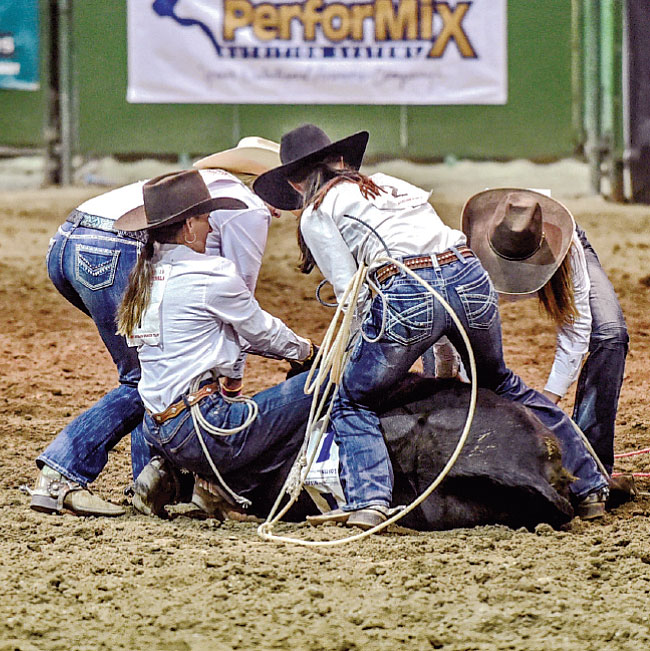
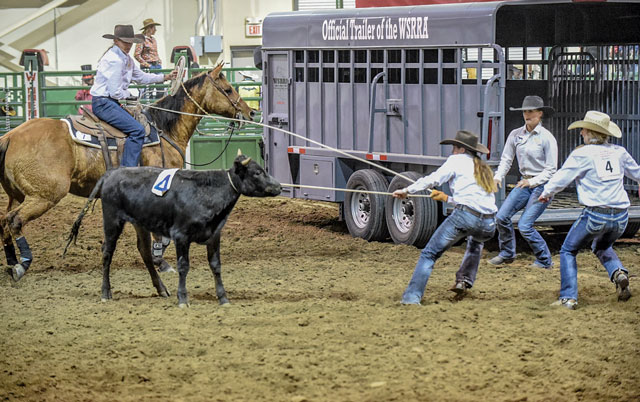
    The world doesn’t seem to know these cowgirls but the ladies that compete in ranch rodeos are changing all of that. You see, these cowgirls have grit and know how to get a job done. They have no problem sorting and roping cattle, they can doctor sick animals, they can load and tie a calf, they can rope and brand calves and can put a handle on a ranch horse. They also have no problem pulling a rig down the highway, pulling a calf, and working right along with cowboys, they include mothers, daughters, sisters, grandmas, and wives who raise families, hold day jobs and help run ranches. They will do whatever it takes to get the ranch work done. The start of their day usually starts at the break of dawn. Whether it’s branding in the spring or fall roundup, these ladies know cattle. On the weekends, your will find them, competing in ranch rodeos-a true western sport that starting in 1900’s, and one that is preserving the heritage of the West.
    Women that compete in ranch rodeos have to have strength, good roping and riding skills, and raw courage. The secret of success is the bond that these ladies develop working together. Many of these cowgirls, either come from the same ranch, or neighboring ranches, have known each other for years, through marriage and friends. They trust each. They believe in each other. Take their cowgirl attitude and put it to work on top of a good, athletic horse in an action-packed timed event and you have an event that is worth watching.

    “Ranch rodeo really promotes team spirt because if you don’t work together you probably won’t do good.” Carmen, her team and all of the contestants will get to showcase their talents and abilities in authentic ranch events replicated in a competition setting.
    Ranch rodeos are team affairs for working cowboys and/or cowgirls, who compete in events that mirror the daily activities of ranch life. These outstanding women are a shining example of the fact that the women’s division of the WSRRA can compete in and expand the sport of ranch rodeo.
    The WSRRA National Finals in Winnemucca, Nevada is an entertaining demonstration of traditional cowgirl skills. The contestants showcase their talents and abilities and those of their horses in authentic ranch events replicated in a competition setting. “Ranch rodeo really promotes team spirt because if you don’t work together you probably won’t do good,” stated Carmen.
    Fifteen outstanding ladies will be competing in the women’s division of the WSRRA National Finals in Winnemucca, Nevada, November 2 -5. These 4 days will showcase cowboys and cowgirls from across the western states and Canada.

  • Back When They Bucked with Bob Ragsdale

    Back When They Bucked with Bob Ragsdale

    story by Steve Alexander, Blaine County Journal; PRCA, and Siri Stevens

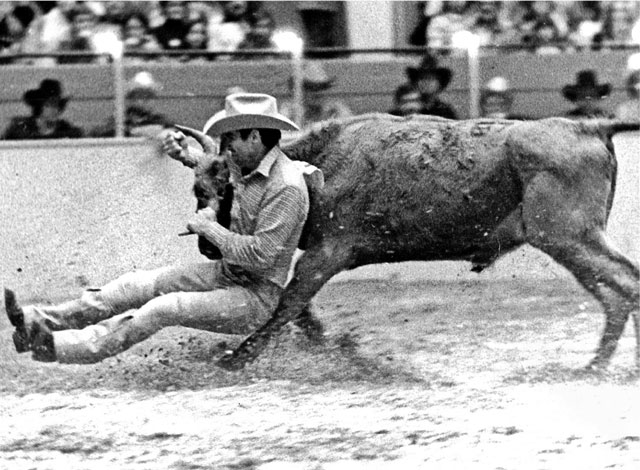
    Bob Ragsdale was an all-around Montana cowboy, competing in steer wrestling, as well as calf roping and team roping. He qualified for the National Finals Rodeo on 22 separate occasions. Bob never won a world title, but his impact on rodeo has been profound.
    He was the Montana High School All-Around Champion in 1956, and became an official member of the PRCA in 1961. He was one of only six left-handed tie-down ropers to qualify for the NFR, and he did so for 15 consecutive years from 1961-75. In that 15-year span, he finished as high as fourth in the world, and never lower than ninth. He competed at the NFR in steer wrestling five times, with two qualifications in team roping as well. Bob earned nine Top 10 finishes at the NFR in the all-around, including a second-place standing in 1972. He continued his support of rodeo by serving as the Vice President (1971-72) and President (1973-75) of the Rodeo Cowboys Association, and is credited as the one to propose the association include “Professional” to the organization’s formal title in 1975. – courtesy of PRCA
    Bob was born October 23, 1936 in Harlem, Montana. His father, Slim, always had horses and the family split their time between farming and living in town. “Wherever we were living dad would have horses and they would wander from north of Harlem to the Canadian border.” Bob’s mom told a story about a man coming to the house to see if Bob would round up some horses for him. When the man was introduced to Bob, and saw that he was just a little kid, the man said, “those horses are big,” to which Bob replied, “I’ll take a big rope.”
    Bob competed in the Montana High School rodeo. “Back then there was no divisional or regional rodeos, you went to state for a tournament that anyone could enter so long as you preregistered. I won Montana All Around and went on to the high school Nationals in Reno. I placed in a couple of events, but no wins.”
    In October, right out of high school, Bob went to the Toots Mansfield Roping School in Texas. “He was a great guy; he showed me how to ‘flank’ a calf. At the time most professional ropers were legging calves. That immediately took a couple of seconds off my time.” To cover the expenses of getting to Texas and paying for the roping school Bob and his dad went to the bank in Harlem and borrowed $300 for the month-long school.
    Bob met his wife, Ree, through high school. “We both went to the high school rodeos.” Ree and Bob married in December 29, 1956, after he completed the roping school and returned to Montana. “It was a pretty busy year.” He worked in the oil fields in the winter and that next summer, in 1957, went back into rodeo, working in Yellowstone Park and the following summer at the Cody Night Rodeo. “It was a rodeo,” Bob said, “but it was really a tourist show. We would work maintenance on the grounds for half the day, then do the rodeo show. They were looking for a calf roper, bulldogger and bareback bronc rider. That was 1957 and it was the last time I ever got on rough stock in the rodeo.”

    In 1958 the couple welcomed twin girls, Cathy and Cindy; then another girl, Jamie, in 1961.
    “With plans to ‘fill my permit’ with the RCA (becoming a member of the Rodeo Cowboys Association, later the PRCA) at the end of the rodeo season in 1961,” Bob said, “I won big at a rodeo in Caldwell, Idaho. The RCA representative for that region was waiting for me and said, “You had better have your permit before you show up at the next RCA rodeo.” Members of the RCA resented non-members winning and reducing members’ chances to go to the year-end national rodeo.”
    He moved his family to Chowchilla, California, in 1961 at the invitation of a farmer/rancher who also was a roper. “Dan Branco had a place where we could keep horses and practice roping.” They saved enough money rodeoing to buy a place there and that was home until just a few years ago when they retired. They now spend winters in Bakersfield, California and summers at their place in Landusky, Montana.
    Beginning in 1961, for the next fifteen years, Bob made his living roping calves, steer wrestling and team roping. “I followed the money to choose rodeos. In the 1960-70’s I’d go to 90-100 rodeos a year. If I got into a slump I’d do a small rodeo to earn some money and get back on the RCA (PRCA) tour for the bigger rodeos.” He drove a station wagon and it was equipped with a grub box. “We’d camp out – the twins were small enough they could sleep in the front seat and Ree and I slept in the back.”
    Because Bob roped left handed, he had to have horses that were comfortable seeing the rope on their left side. “A horse could be startled if it wasn’t used to a left-handed roper, which meant I had to have my own horse, sometimes more than one horse to keep up with the rodeo schedule.” He said often Ree and the kids would be driving one rig, pulling a horse trailer toward an upcoming rodeo, and he would be pulling a different horse to another rodeo on his schedule.
    He not only competed, he gave back to the industry through his service as an office holder and active volunteer in a number of rodeo associated groups and as a spokesperson for rodeo. After that, he continued competing in the National Senior Pro Rodeo Association, winning three All Around titles, four calf roping titles and one ribbon roping title.


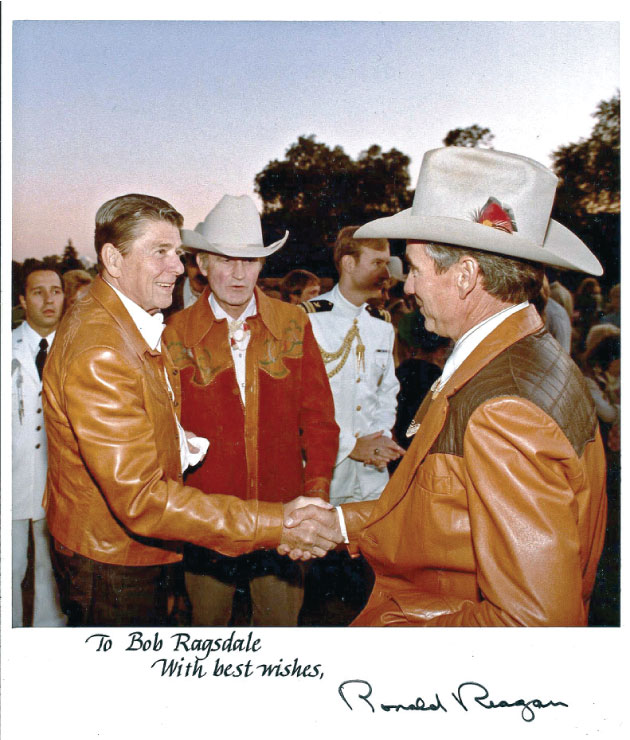
    In 1983 Mac Baldrige, the U.S. Secretary of Commerce under President Ronald Reagan, organized an ‘exhibition’ rodeo for the President and selected guests. He asked Bob to rope in the exhibition which was staged in an arena just outside Washington, DC. Bob also helped create Friends of Rodeo (FoR), a non-partisan group that responded to animal rights issues. “Through FoR we did a better job of telling our side to the media and even instituted ‘chute tours’ so critics and media personnel could see reality about animal treatment.” Bob served as President of FoR and was on governing boards of several other rodeo related organizations, including the Senior Pro Rodeo executive board, during the 1990’s.
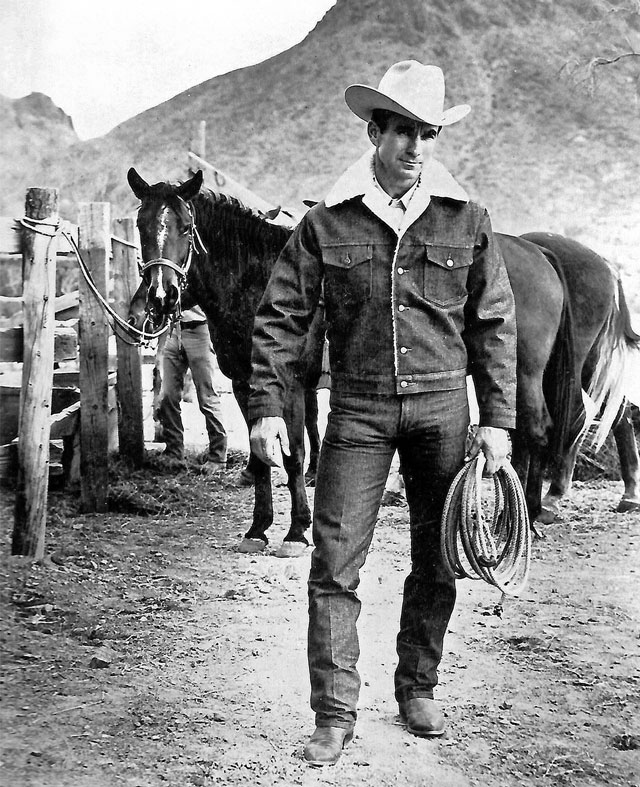
    From 1973 to 1981 Bob worked for Sears as a consultant for the company’s western wear brand of clothing. “There were several professional cowboys interviewed and I was chosen to help Sears with their western wear line of clothing.” He described his role as “helping Sears clothing buyers and designers meet with rodeo fans and cowboys to see what kinds of clothing they were wearing or would like to see available. I even went to some of the markets with the Sears buyers to help choose the clothing for the next year’s catalog.” Bob often was photographed in Sears western wear for their catalogs and in 1973 was on the cover of the annual western wear catalog.
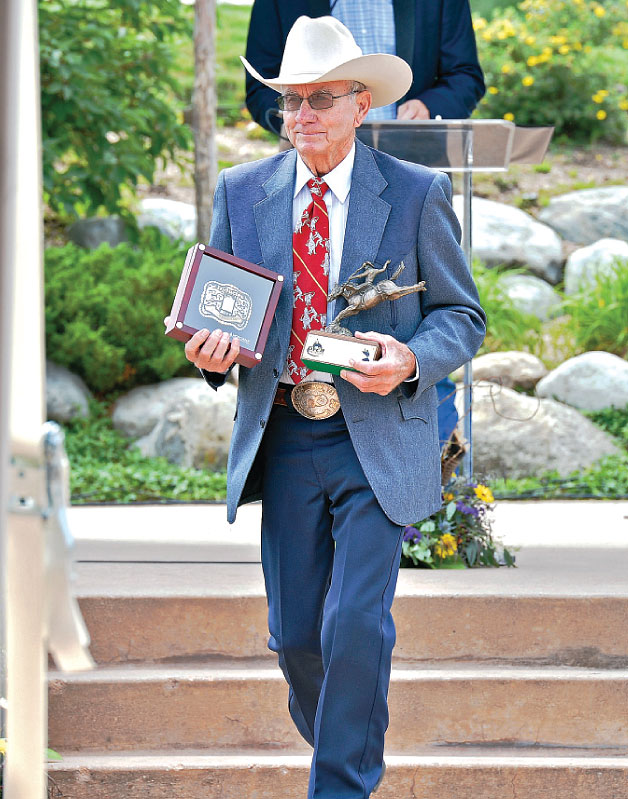
    In the last two decades he’s been recognized with a number of inductions into rodeo related organizations: the St. Paul Rodeo Hall of Fame, St. Paul, Oregon (2001); the Senior Pro Rodeo Hall of Fame (2001); the National Cowboy and Western Heritage Museum in Oklahoma City (2003) and The Montana Pro Rodeo Hall and Wall of Fame in Billings. His latest accomplishment happened a few weeks ago in Colorado Springs, where he was inducted into the PRCA ProRodeo Hall of Fame. “It was a great event. I had no idea what to expect – I’ve never been to one before. This was the best one – it was developed by the professional cowboy.”
    Bob and Ree saw the world through his rodeo career. Cathy Watkins, one of their twin daughters remembers going to Hawaii with her parents as a result of Bob’s rodeo career. “After Denny (Cathy’s husband and a professional team roper) and I were married we were visiting mom and dad and a guy drove up into the yard. He was from Hawaii and wanted dad to come to Hawaii and teach a roping school. We all went to Hawaii and while dad taught ropers the rest of us were treated to the sites of the islands. I think it was at that point I realized just how special my dad’s role was in rodeo-he was known all over the world. My sisters and I got to see a lot of things and meet a lot of interesting people because of his career choice.” As to interesting people, Cathy told about meeting a fellow teenager she and her sister met while traveling with their dad. The teenager played the guitar and the girls all sang together. The guitar player was Reba McEntire, whose dad and older brother were both accomplished ropers. “Of course none of us kids, at that time, had any idea of how Reba would develop into a famous singer and actress.”
    For Bob, the biggest change in rodeo is in the rodeo competitors and the amount of money they make. “When I first got into professional rodeo, most of us were cowboys. The competitors now are truly athletes, devoting their lives to the sport and continually doing things to improve their ability to compete.” In the old days, “We often had to work other jobs between rodeos to keep our families going.”
    And the winnings have increased. “When I was RCA All Around runner up at the NFR in 1972, I think first place for All Around paid about $40,000. That number now is in the neighborhood of $300,000-400,000.
    “Whatever I’ve been able to accomplish has been through rodeo. I tore my knee up in 1976, and started looking for other things to do. But I had put enough away and then I got into the construction business. Everything I was able to do was because of rodeo.”

  • Back When They Bucked with Ken Adams

    Back When They Bucked with Ken Adams

    In 1957, Ken Adams was the year-end NIRA Bull Riding Champion. The Arizona cowboy qualified four times for the CNFR and competed there twice when it was held in Colorado Springs, Colorado. As a college student on a shoestring budget, he used his winnings to buy books while attending Arizona State University, and his experiences inspired him to start a scholarship for the NIRA Bull Riding Rookie of the Year four years ago. Since then, the NIRA Alumni have created a scholarship for the rookie of the year in each event, and in 2017 alone, they contributed $10,500 in scholarships to the CNFR.
    Born in 1933 to Kenneth and Gladys Adams, Ken was the second of three boys. His parents had moved from Missouri during the Great Depression, and while en route to California, Ken’s dad was offered a job driving delivery trucks in Arizona. The family stayed and made their home near Phoenix, and Ken got his first job riding horses with a girl his age at a livestock auction nearby when he was 11 or 12. “I hadn’t ridden at all to speak of – we just started riding whatever horse we could a hold of,” Ken recalls. “We got a dollar apiece riding horses for them back in the ‘40s. I guess people thought it was a pretty good horse if a couple of kids could ride it, but anyone could ride in that ring.”

    Not long after that, Ken started riding calves and cows in junior rodeos around the area, catching a ride with anyone who had a car. “I think the first time I ever won money, I was riding cows. The horses didn’t show up to the rodeo, so I got into cow riding. Someone would give you tips, but mostly they just let you get on and learn. There were no schools, and I didn’t have anybody I traveled with that was older, so all of us were pretty much in the same boat. I think the opportunities to learn are much improved now, and the biggest thing to me is videotaping performances to watch them and learn.”
    Ken continued riding roughstock in the bareback and bull riding, though he won the most riding bulls. “I think at the time I had really good balance, and it was easier to find bull ridings than anything else.” Ken also worked on two or three ranches during high school, including the Boquillas Ranch, which now belongs to the Navajo Nation and is in the top 25 of the largest working cattle ranches in the United States. “I gathered horses for them, and then I’d enter rodeos and hope I learned something every time. The Palace Bar in Prescott was like an employment agency. Ranchers who needed a cowboy would go in there, or if you needed a job you went in there,” says Ken. He also worked at the copper mine in Baghdad, Arizona, for several months, living on site and hauling debris from the mill, but he hadn’t been there long when he was drafted into the Army during the Korean War. Although the cease-fire was signed by the time Ken finished basic training, he still shipped to South Korea where he drove supply trucks. “There was not much glamour in our jobs, unless you wanted to eat! Seoul was pretty much a mess – it had changed hands four times, but those trucks we had could go pretty much anywhere. All the roads were narrow and dirt, and in the summer they were very dusty. They had huge trucks, but the ones I was driving were three axles.”
    Ken was discharged from the Army in 1955, and he enrolled at Arizona State University in 1956, majoring in animal science. Though he had dropped out of high school, he finished his GED in the Army, and he joined the rodeo team and competed in the West Coast Region. He even tried his hand at steer wrestling. “I wasn’t too good in timed events. I told everybody I had a record in the bulldogging – I was in the bulldogging seven or eight times and never got a flag,” Ken says with a laugh. He was helped along the way by college teammates John Fincher and Jon Nickerson. Ken enjoyed rodeoing in California and as far north as Klamath, Oregon. He was also a member of the RCA when a membership cost $10, and on summer breaks, he competed in Colorado, Utah, Texas, Arkansas, and Missouri, though many of his favorites were in Arizona, such as Phoenix, Prescott, and Tucson. “Some of the little towns didn’t have anything (like motels) to sleep in, so we’d sleep in the back of a car. You stayed in rooms when you were prosperous, and we’d split rooms with three or four people usually.”

    Ken met his wife, Sharon, at school, and they were married after he graduated and she finished her teaching certificate. “We got married in July of 1960. I’d been teaching school for a year, and Ken won second in the bull riding at Prescott, so we had enough money to get married,” says Sharon. After he finished college, Ken was a brand inspector for several sale barns, then went into the crop spraying business with his brother-in-law before finding his niche in the animal health business selling medicine. Though Ken quit rodeoing not long after they were married, he stayed involved with rodeo by judging several of the law enforcement rodeos a college friend of his organized, along with jackpot bull ridings. In the late 1970s, one of Ken’s friends Stan Harter, a college champion tie-down roper, asked Ken to be the manager of the PRCA Turquoise Circuit when the circuit system was just getting started. Ken served on the board for three or four years and helped put on the finals, along with soliciting saddle donations. “The Turquoise Circuit Finals Rodeo was in Phoenix at the fairgrounds, and for some reason, there was a mix-up one year and all of the trophy saddles got shipped to our house!” says Sharon. “Each saddle came in a big box, and we had them everywhere in the house because we couldn’t leave them outdoors.”
    Ken became involved in the NIRA Alumni when he attended the NIRA reunion in Rapid City, South Dakota, in 1997, the 40th anniversary of his NIRA bull riding championship. The following year, his friend Stan Harter was waiting for a kidney transplant, and he asked Ken to represent him on the NIRA Alumni board during the annual meeting. Together, Ken and NIRA founder, Evelyn Bruce Kingsbery, put together the 50th Anniversary Reunion of the NIRA in 1999, and Ken was president of the NIRA Alumni from 1999-2001. Sharon served as the NIRA Alumni secretary for 12 years, and Ken continues to serve on the board of directors. He hasn’t missed a performance of the CNFR since he started attending 20 years ago. When he started raising money for his bull riding rookie of the year scholarship, his plan was to ask former champions to donate $100 each, and by the next year, donations were coming in to provide scholarships for all nine college rodeo events, including team roping header and heeler. “I never had a scholarship, and even the year I won, I was never offered a scholarship,” Ken explains. “They’re giving quite a few scholarships now, but I just thought the rookie scholarship was something somebody wasn’t already covering.”
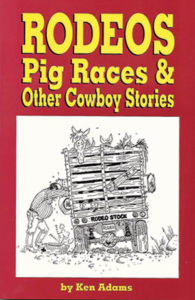
    When they’re not off to the next CNFR, Ken and Sharon make their home in Phoenix, not far from where Ken grew up. They have a son, Ira Adams, and daughter, Adrienne Schiele, and her husband, Mark Schiele, while Ken and Sharon’s two grandsons, Mike and Matt Schiele, live in California. Ken stays current with rodeo via television and never misses a rodeo or bull riding, while he wrote and published a book of short stories about rodeo called “Rodeos, Pig Races & Other Cowboy Stories.” He and Sharon continue their passion of supporting the NIRA and alumni, and they are searching for all NIRA champions, top finishers, faculty, and board members from years ending in eight to join them for the 2018 Annual Reunion.

  • On The Trail with Cooper Nastri

    On The Trail with Cooper Nastri

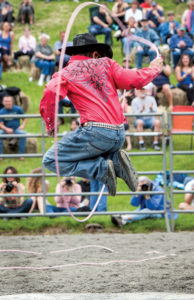
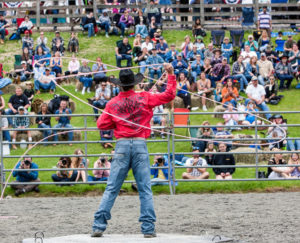
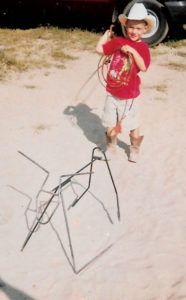
    With the flick of a wrist and the twirl of an arm, Cooper Nastri has entertained scores of rodeo audiences up and down the East Coast in the last six years. The 17-year-old trick roper, who alternately makes his home in Ballston Spa, New York, and Screven, Georgia, became one of rodeo’s youngest trick ropers in the country when he started performing at 11. Yet he was no stranger to the roping world before that. Cooper had already been competing in rodeos for several years, and is even named after the Super Looper himself, Roy Cooper, but his decision to become an entertainer was a surprise to his parents, Carmine and Sheri Nastri. “Cooper was real shy when he was little, and when he said he wanted to trick rope, I was impressed that he wanted to get in front of an audience and do something like that,” says Carmine. “His work ethic has always been really good, and when he decided he wanted to trick rope, he practiced seven days a week for hours. It turned him right out of his shell, and he’s not very shy anymore.”


    Cooper originally wanted to be a rodeo clown and worked with Dusty Barrett as a rodeo clown and helped Hollywood Harris a couple times but he first saw trick roping when Mark Madden came to the Natri’s home and showed him several tricks. He’s also met professional trick ropers including Anthony Lucia, who performed on America’s Got Talent, and Austin Stewart, who also performed on America’s Got Talent, and at Dolly Parton’s Dixie Stampede. “Mark Madden helped me a lot with my trick roping. A lot of people don’t understand that it’s very easy once you figure it out, but it takes a lot of time to learn,” explains Cooper. “I was really impressed by it, and you get paid every rodeo. I try to get one of my family members to video me every time I perform so I can watch and see if there’s anything I need to improve. I watch a lot of horse training videos, too.”

    Cooper started by performing at open rodeos, then worked his way up to events like the Painted Pony Rodeo in Lake Luzerne, New York, and Cowtown Rodeo in Pilesgrove, New Jersey, which his grandfather, Dusty Cleveland, has announced for many years. He also performs in Georgia, and was honored to trick rope at AFR 35 and AFR 39. The materials are simple enough – Cooper buys 100 feet of cotton spot cord and cuts it into the four different lengths he performs with. The shortest is 15 feet, and the longest is 50 feet, which he uses to perform a trick called the wedding ring. “The first trick I do is the butterfly, and some high spirals. The big trick I really like is the Texas Skip, which is the hardest trick in the book to do. That’s where the rope is on one side of you, and you jump back and forth through it. I feed off the crowd, so if I can tell the crowd doesn’t like something, I might stick something new in there. Keeping the tricks tuned up is probably the most challenging. I’m pretty busy riding horses every day, so I don’t get to practice as much as I’d like to. Once I get to a rodeo I might practice before the performance. I try to keep the tricks pretty snappy and tuned up.”

    This year alone, Cooper will perform in 45 rodeos, many of which are APRA rodeos that he enters in the team roping with his dad or Robbie Erck. Cooper is also practicing his tie-down roping, but prefers to team rope in the USTRC and APRA. He changes footwear – going from sneakers to boots since sneakers allow him to jump higher during his performances – and often heels for his dad. Carmine is a 24-time PRCA First Frontier Circuit Finals Champion, and he’s won the APRA six times between team roping, tie-down roping, and the all-around. He’s competed in the APRA on and off since the 1980s, and his wife, Sheri, is also a First Frontier Circuit Champion in the barrel racing. She team ropes every October at the USTRC Cruel Girl Championships with her partner, Kim Breyo, and has competed in the APRA in the past. “She backs us 100%,” says Carmine. “She drives, rides horses, and helps keep this whole thing afloat. Whether it’s the four of us here or we have ten cowboys staying with us, she keeps everything going.”


    Sheri’s grandfather, Harry Cleveland, was the Painted Pony Champion Calf Roper in 1953 when it was part of the Cowboys’ Turtle Association, and he taught many of his generation in the Northeast how to rope. Her dad, Dusty Cleveland, taught her how to rope, and he comes to several Painted Pony Rodeos a year to watch Cooper and his sister, Shelby, compete. Shelby is also an APRA member, competing in breakaway roping and barrel racing, and her senior year of high school, she was the NYSHSRA barrel racing and all-around cowgirl champion. She holds her WPRA card, but primarily competes in the APRA, and her goal is to qualify for the association’s finals in the next few years.

    The Nastris put on several roping schools each year with ropers including Speed Williams, Roy Cooper, and Rich Skelton, all friends of Carmine. They also hold weekly roping lessons, and Carmine takes in outside horses to train, along with buying young horses he turns into rope horses. “One of the head horses I made and sold was voted Head Horse of the Bob Feist Invitational this year,” says Carmine. Cooper, who is homeschooled, helps with all of the training and riding, and has become especially passionate about the horsemanship side of roping. “When people come for lessons and have horsemanship questions, Cooper’s a fanatic about it – he’ll spend 15 minutes answering the question.”

    Cooper helped finish his own roping horse, Shorty, a bay gelding that stands 14.1 hands high. “He’s a pretty cool little dude. He’s really stout, so I can head on him, heel on him, and rope calves on him,” says Cooper. “He’s got a lot of grit.” Every year since 1987, the Nastris load all of their animals and spend their winters in the southeast corner of Georgia. “We’ve got a pretty good routine, and we know how to get things packed in a hurry and get the trailers organized,” says Carmine. “My mom, Patricia, spends the winter months with us. She’s been a big supporter all my life and pushed us to do whatever our dreams are.

    “The nice thing about the summer rodeos up here is that they’re all really close,” Carmine adds. “Painted Pony Ranch does two rodeos a week, and they’re only 27 miles away. My daughter, Shelby, works at a western store in town, and she can come home, practice a little, and go to the rodeo. We live right next to Saratoga, where the big thoroughbred race track is. For Shelby’s birthday, we went to the Saratoga Race Track and took the day off riding and roping.” Sheri adds, “We’re usually all in the arena, but every now and then we take a day off to go to the movies. Our vacation every year is to go to the US Finals, and go to Rich Skelton’s and see Speed Williams.” Cooper plans to continue trick roping, but he has a growing passion for horse training. “One of the biggest things I want to do is go work for a top horse trainer like Bob Avila, Jay Holmes, or other AQHA people,” he finishes. “I’ll still trick rope now and again, but that’s the biggest thing I’m working on.”


  • Salmon Patties & Apple Snack Cake

    Salmon Patties
    in memory of Mrs. Paul (Velda Barnhart) Morehouse
    from The Pioneer Journey Cookbook

    Ingredients:
    1 can (15 ½ oz.) salmon
    1 cup fine dry bread crumbs
    ½ cup chopped onion
    ¼ cup chopped parsley
    2 eggs, beaten
    2 Tbsp. lemon juice
    ¼ tsp. pepper
    2 Tbsp oil
    Lemon wedges


    Directions:
    Drain salmon, reserving 1/3 cup liquid; flake. Combine salmon with bread crumbs, onion and parsley. Add reserved salmon liquid, eggs, lemon juice and pepper and mix well. Shape into patties. Fry salmon parties in oil over medium heat until lightly browned on both sides. Serve hot; garnish with lemon wedges. Makes 6 servings.


    Apple Snack Cake
    recipe courtesy of Nicki Ulberry

    Ingredients:
    1 ¾ cups sugar
    2 cups flour
    1 tsp. baking soda
    ½ tsp. salt
    3 eggs
    1 cup oil
    1 tsp. cinnamon
    ¼ cup milk
    1 cup chopped nuts
    3 cups apples

    Directions:
    Mix eggs, oil, cinnamon, salt, soda, flour, sugar and milk; mix well. Add in nuts and apples. Stir until well blended. Bake are 375 degrees for 45 minutes in an ungreased 9×13 inch pan. Can use 2 round cake pans. Can frost or eat as is, warm.