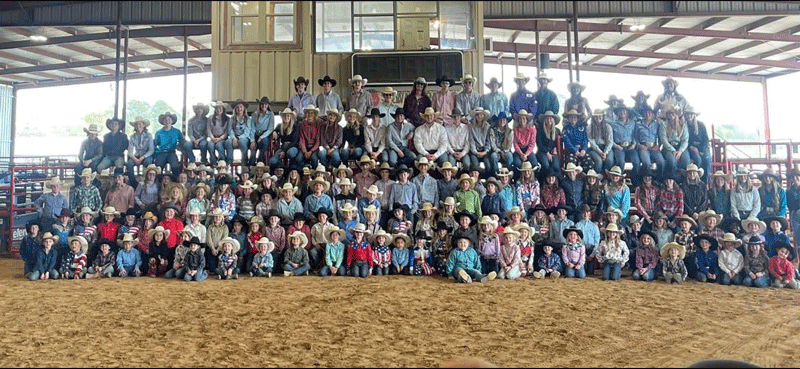
This was the biggest year we’ve had,” said Sam Dixon, past president of the SJRA, Southern Junior Rodeo Association. “It’s given the girls a great start on life in general, and not just rodeo. They learn responsibility by taking care of animals and the life lessons are the best in rodeo.” Hadlie Dixon and Reiny were two and three when they started.
Sam and Heath and two of the other board members, were contestants in the first SJRA finals in 2001. Miss Robin Blankenship had the idea and put a notice in the local paper and a few people showed up and it started. It got big enough to make it a nonprofit. “This year we gave a little over $225,000 worth of prizes – it’s growing,” said Sam.
One thing that sets the association apart from others is all the rodeos are held in the same place – Saline County Fairgrounds in Benton, Arkansas. “We gave them their first buckle this year and it said, ‘home of the SJRA’. We run 7,924 entries in ten weekends,” said Sam. The partnership with 5 Star has lasted for since the beginning. “He was open minded with it and believed in what we were doing. We try to do as much local as we can.” The 5 Star shop is located about an hour from the arena.
Heath Harrison, past board member, serves as the AM arena director. “I work with the 10 and under kids, keeping the arena going.” Heath has two boys, Hudson (11), and Han (9), that are current members, as well as a newborn coming up that will be in the association. “Four-month-old, Hattie, is going to be the next All Around. She was 10 days old when she went to her first SJRA. We wrapped her up and took her with us.” Heath’s oldest boy, Hudson, won the reserve all around. “We all use 5 Star products, from the pads to the boots to the breast collar. We won the All Around because of 5 Star.” Heath was a bull rider and didn’t do a lot of roping, but he knew with all the aches and pains of riding bulls he didn’t want his boys doing that. “When we joined, my oldest boy was five, and had never been on a horse. In this association, they see other kids their age doing things on horses – it gives them the courage to try. It taught them how to ride and rope, and the friends they made helped them chase their goals. It gives them a broader base of friends than our little town.” Both his wife (Summer) and Sam’s wife (Allison) work in the office. “We volunteer and give everything we can to the association to give those kids the same opportunity our kids had.”
Blog
-
5 Star Featured Partner Southern Junior Rodeo Association
-
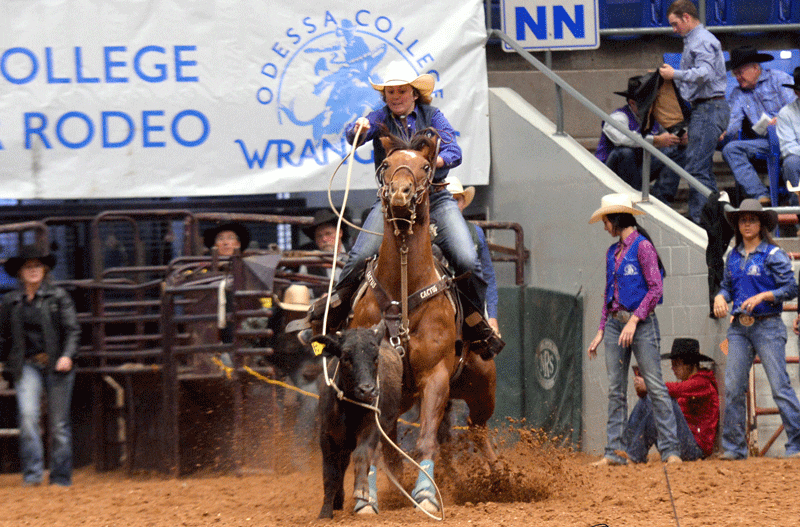
American Hat Presents Baylee Paul
Baylee will be responsible for overseeing the company’s social media strategy, developing engaging content, and managing American Hat Company’s social media presence.
Baylee joins American Hat Company from Outlaw Equine, where she worked for several years in all facets of the clinic including social media and marketing. “I did lots of things at Outlaw and the knowledge I gained is immeasurable. I started teching for Dr. Josh Harvey, owner and founder of Outlaw Equine; in high school when he came to Florida for tours. During college breaks and after college, I worked in Rehab as well as teching. Eventually I moved into the office where I handled all the pro rodeo athletes, clinic scheduling and tours for the vets – it was a full-time job that’s for sure. It was while I was in the office, I began to manage the Social Media accounts and create marketing videos. I will forever be grateful to Josh and Ashley for the opportunities given to me.” said the 24-year-old, who went to school for Ag Communications and Dental Hygiene. “I worked in the dental industry for two years and realized I missed the Agricultural and Western Industries. I’m the kind of person that is social and likes to be out and about, not in the same place doing the same thing every day.” She did her college work at Frank Phillips College and North Texas Dental Academy.
Baylee grew up in the agriculture industry and has a history of rodeo all the way up to the collegiate level. Her deep understanding and passion for the western lifestyle make her an excellent fit for American Hat Company. She started competing in rodeo at the age of 6 in goat tying and barrels. In middle school, she added breakaway and team roping to the events she competed in. “I also showed pigs and steers in 4-H and FFA.” She admits the heat and humidity in Florida can be hard to handle, but she adapted. “We’d get up before the sun and get everything done and if you don’t get it done, you get used to sweating.” When she moved to Borger in 2016 for college, she has never looked back and eventually ended up in Decatur where her two brothers, Tyler and Wyatt, lived. Her parents, Bert and Tom, joined the rest of the family in Wise County in 2019.
“Growing up in and my love of this lifestyle make me a perfect fit for this job,” she said, of her position with American Hat. “I am working with all the pro athletes and the 250 youth ambassadors as well. I get to watch the kids grow up and see who they become as young adults.” She sees Instagram and TikTok as the most popular platforms on social media, with the focus on video, movement, and interaction. She has moved closer to Bowie and is planning to be around for a while. “I like the message the company stands for – it’s a way of life.”
“We are thrilled to have Baylee on board as our new Social Media Manager,” said Keith Mundee, President of American Hat Company. “Her experience and knowledge of the western lifestyle and rodeo industry, coupled with her expertise in social media marketing, make her an invaluable asset to our team.”
In her new role, Baylee will be responsible for creating and implementing social media campaigns that showcase American Hat Company’s brand and products. She will also be working closely with the sales and marketing teams to develop marketing strategies that drive engagement and increase brand awareness. -
SUNSHINE AND RODEO
First night of Red Bluff Round-Up sets the bar for cowboys, cowgirls
Red Bluff, Calif. (April 21, 2023) – Tanner Aus traded the cold winter of Minnesota for California sunshine, and he’s loving it.
The bareback rider came to the Red Bluff Round-Up and put on a show, tying for the lead in the bareback riding after the first performance of the Round-Up on April 21.
He scored 86.5 points on the horse called Little Red Hawk, cared for by the Flying U Rodeo Co. Jacek Frost, Browns Valley, Calif., also scored 86.5 points, aboard the Rosser Rodeo horse Yeti Rambler.
For Aus, it was a horse he was anxious to partner with. “That horse is a very good bucking horse,” he said, “one of the best, the funnest horses to get on. She’s fun for me, anyway. She bucks, and she’s very consistent, and she’s been around a long time.” The mare is 17 years old.
The Round-Up is what is informally called part of the California run, rodeos in the state that draw cowboys and cowgirls, because of spring weather and outdoor arenas.
“We got two inches of snow this morning,” he said. “Being from Minnesota, you can expect that, but to be able to come out here for a few days and rodeo in the sunshine, it’s awesome.”
Aus is a seven-time qualifier to the Wrangler National Finals Rodeo, the PRCA’s world championship, and is currently ranked nineteenth in the world standings.
He’s quick to give credit to his wife, Lonissa, who holds down the fort, with their three children, ages 5, 3 and 9 months, in Granite Falls, Minn. “My wife is my rock. She makes it all work. If I didn’t have her support, I definitely couldn’t do this. She believes in the dream that I have and lets me chase it. She’s a blessing.”
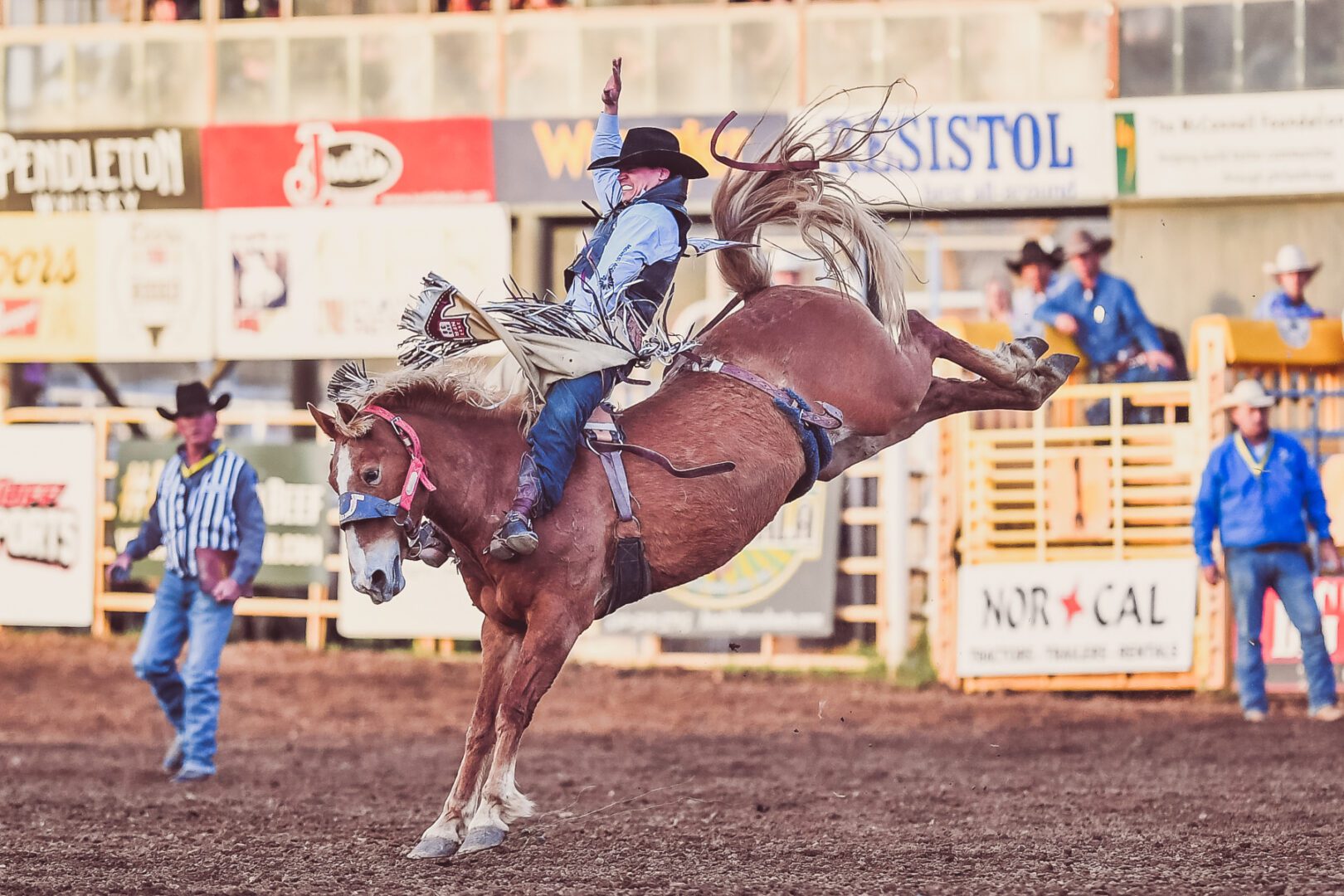
For saddle bronc rider Allen Boore, he got a birthday gift on April 21, with a lead in his event at the Round-Up.
The Axtell, Utah cowboy turned 32 years old on Friday and scored 86 points to take the lead after the first performance of the Round-Up.
He was complimentary of the bucking horse he rode, a horse named Houchie Mama and owned by C5 Rodeo.
“She’s a dream horse,” he said, “a horse you want, that feels good, that you have time to spur.”
He noted that the seven-year-old mare jumps higher than the average bucking horse, giving him time to make a better spur stroke. “That horse jumps up in the air high enough that you have time to set your feet, before the horse’s front feet hit the ground. The higher they jump, the longer you have to make that spur stroke.”
Like Aus, Boore was glad to experience springtime in California. His part of Utah has been colder and snowier than normal.
“I came over the (Sierra) Mountains, and dropped into the valley with the green grass, knee high, and it’s 70-some degrees.”
And rodeoing outside is good, too. “After being in the building (rodeos) all winter, it’s nice to get out.”
Boore has qualified for the Wrangler National Finals twice (2016, 2020).
Other leaders after tonight’s performance include steer wrestlers Jake Nelson, Whitehall, Mont. and Brandon Harrison, Cheek, Texas (5.0 seconds each); tie-down roper Tyler Forsberg, Fillmore, Calif. (9.0 seconds); breakaway roper Samantha Fulton, Miller, S.D. (2.8 seconds); team ropers (and brothers) Kellan Johnson and Carson Johnson, both of Casper, Wyo. (6.6 seconds); and barrel racer Timber Allenbrand, Paola, Kan. (17.39 seconds).
In the bull riding, Tristen Hutchings, Monteview, Idaho, scored 90 points to take the lead. Hutchings is a college student at Sul Ross University in Alpine, Texas.
The second of three performances of the Red Bluff Round-Up takes place Saturday, April 22. Other activities taking place on Saturday include the rodeo parade at 10 am, Jackson Dean in concert at 6 pm, and more.
Round-Up tickets range in price from $20 to $40 and are available at the gate and online.
Results from the first performance, Red Bluff Round-Up, April 21, 2023
Bareback riding
- (tie) Tanner Aus, Granite Falls, Minn. 86.5 points on Flying U Rodeo’s Little Red Hawk and Jacek Frost, Browns Valley, Calif. 86.5 points on Rosser Rodeo’s Yeti Rambler; 3. Jacob Lees, Caldwell, Idaho 85; 4. Dean Thompson, Altamont, Utah 83.5.
Steer wrestling
- (tie) Jake Nelson, Whitehall, Mont. and Brandon Harrison, Cheek, Texas 5.0 seconds each; 3. Kalane Anders, Bayard, Neb. 5.2; 4. Darcy Kersh, Charters Towers, Australia 7.2.
Tie-down roping
- Tyler Forsberg, Fillmore, Calif. 9.0 seconds; 2. Shane Hanchey, Sulphur, La. 9.1; 3. Kass Kayser, Ellensburg, Wash. 11.0; 4. Bo Pickett, Caldwell, Idaho 11.6.
Saddle bronc riding
- Allen Boore, Axtell, Utah 86 points on C5 Rodeo’s Houchie Mama; 2. Damian Brennan, Injune, Australia 84.5; 3. Kade Bruno, Challis, Idaho 84; 4. Cole Elshere, Faith, S.D. 83.5.
Breakaway Roping
- Samantha Fulton, Miller, S.D. 2.8 seconds; 2. Josie Conner, Iowa, La. 3.2; 3. Kelsie Domer, Dublin, Texas 4.1; 4. Erika Frost, Randlett, Utah 4.3.
Team Roping
- Kellan Johnson, Casper, Wyo./Carson Johnson, Casper, Wyo. 6.6 seconds; 2. Cole Thomas, Emelle, Ala./Clay Green, Pine Grove, La. 7.1; 3. Braden Pirrung, Hartford, S.D./Lane Siggins, Coolidge, Ariz. 7.2; 4. J7 Bland, Turkey, Texas/Tyson Thompson, Munday, Texas 10.8.
Barrel racing
- Timber Allenbrand, Paola, Kan. 17.39 seconds; 2. Miley Bunting, Red Bluff, Calif. 17.40; 3. Emily Beisel, Weatherford, Okla. 17.57; 4. Paige Dove, Hico, Texas 17.62.
Bull riding
- Tristen Hutchings, Monteview, Idaho 90 points on Big Stone Rodeo’s Dirty Dave; 2. Braden Richardson, Jasper, Texas 86; 3. Trey Benton III, Richards, Texas 83; 4. Robbie Taylor, Chinle, Ariz. 80.
** All results are unofficial. For more information, visit RedBluffRoundup.com.
– ### –
Cutlines:
Minnesota cowboy Tanner Aus leads the bareback riding after the first night of the Red Bluff Round-Up. Photo by Crystal Amen Photography.
Allen Boore makes an 86 point ride to lead the pack of saddle bronc riders at the Red Bluff Round-Up. Rodeo action continues April 22-23. Photo by Crystal Amen Photography
-

Back When They Bucked with RL Tolbert
RL Tolbert has jumped out of burning buildings, tumbled down cliffs, crashed cars and been shot numerous times.
But he’s walked away from every near-death experience.
That’s because the Vale, Oregon cowboy served as a stuntman in the movie industry as well as being a rodeo contestant.
That’s him getting the girl out of the wagon in “Back to the Future III”, before the wagon goes over the cliff. That’s him driving the six-horse hitch in the same movie, and tumbling down a staircase in “Silverado.”
He’s been a stunt double and worked as a stuntman in such movies as “The Sacketts” (1979), “Shadow Riders” (1982), “Silverado” (1985), “Three Amigos” (1986), “Mask of Zorro” (1998), “Conagher” (1991), “The Quick and the Dead” (1987), “Lonesome Dove” (1982), “Back to the Future II and III” (1989, 90), “The Rookie” (1990), “Far and Away,” (1992), “Tombstone” (1993), and many more.
Born in 1941 in Fountain, Colo., both of his grandfathers worked with horses: AR Ward, as a farmer, and Ed Tolbert, building roads in Kansas with horsepower and later driving a coach at the Royal Gorge’s Buckskin Joe tourist attraction.
By the time he was in his early teens, he was working at local dairies while attending school. He worked at the Littleton race track, then spent a year in Watsonville, Calif., with his mother, after his parents divorced. By age 15, he was back in Colorado, working at the Appelt Ranch.
In his twenties, RL broke horses for ranches all over Colorado. He spent time on the Butler Ranch, the Trinchera Ranch, the McQuaid Ranch, anywhere where they still fed cattle or hayed with horsepower.
Situated in the Rockies, with long, snowy winters, RL had told his fellow ranch cowboys, “when the first snowflake hits me, the second flake will be in my tracks because I’m leaving here.”
So that winter, he went to Colorado Springs, where he found an indoor arena, local cowboys held jackpots, and RL fine-tuned his saddle bronc riding.
“I knew how to ride horses that bucked,” he said, from breaking them. The learning part that took place at the arena was how to use the equipment and working on his technique.
RL also rode bulls as well, anything to make a little money.
While there, in 1964, he met another bull rider from Iowa, who talked him into going back to Iowa. There, he worked for PRCA stock contractor Bob Barnes, as a pickup man, driving truck, feeding and loading cattle, doing whatever was needed, and sometimes working five events: the three roughstock events, plus tie-down roping and steer wrestling, at Barnes rodeos where contestants were lacking. He had gotten his Rodeo Cowboys Association (predecessor to the PRCA) card in 1962.
After a year of that, he went to work for Jake and Lynn Beutler and Beutler Brothers, driving truck and picking up. He rode saddle broncs and bulls at the Beutler rodeos where he worked.
From the late 1960s to 1970, RL worked for Larry Mahan in Phoenix in the trailer business, then moved to California in the early 70s, using the Golden State as his rodeo base.
While he was rodeoing in California, he went to work for Cotton Rosser and the Flying U Rodeo Co., driving the chariots that Cotton used for his specialty act.
Through rodeo friends, RL got hired at Great Adventure, a huge amusement park in New Jersey. The park had a wild west show, with chariot racing, jousting, Roman riding, and a stagecoach hold-up, and RL got hired to help with that. He spent three years, from 1975-1977, working at the park, and on the weekends, he headed to Cowtown, N.J., for the weekly rodeos.
In those days, cowboys would winter in Tucson during the winter rodeo run, while they hit the rodeos in Odessa, Denver, El Paso, Scottsdale, and Phoenix. While RL was there, he made friends with several stuntmen, including Chuck Hayward, who was John Wayne’s main stuntman.
He also became friends with Glenn Randall, Sr., a trainer who had trained Roy Rogers’ and other celebrities’ horses, and Glenn’s son, Glenn, Jr. He learned more about horsemanship and training by working with Glenn, Sr.
Once RL got his Screen Actors Guild card, Hayward helped get him established in the movie industry.
He was a stuntman for dozens of movies, rigging wagon wrecks, car wrecks, falling horses, and more.
He doubled for Sam Elliott, Barry Corbin, Christopher Lloyd, and others. He doubled for Lloyd when Lloyd played “Doc” in the “Back to the Future III” movie and rigged the six horses to the DeLorean car, hooking the car’s steering into the wagon tongue.
He trained horses to fall and had three special ones. El Guapo was his favorite. A bucking horse, he used him for bucking in the movies till he later turned him into a liberty horse. The horse was “a really good raring horse,” he said. “He was excellent.
Juan was one of his falling horses. A thoroughbred, the horse was hard to work with. RL would get mad at him and vow to sell him, “then he’d bail me out.” Roanie was another of his beloved horses; as a four-year-old, Sam Elliott rode him for the movies “Quick and the Dead,” and “Conagher.” Roanie and El Guapo are buried side by side.
For about twenty years, from 1979 to the early 2000s, a lot of the six-horse hitches in the movies were driven by RL.
He became a member of the Screen Actors Guild in 1975, the Stuntman’s Association of Motion Pictures in 1977, and is also a member of the Directors’ Guild of America.
In 2002, he and his wife Kim, who had married in 1986, moved to Oregon. RL had admired the country when he had been there in his rodeo days.
On his farm near Vale, he raised alfalfa, oats and wheat, horses, goats and llamas. In 2015, they sold the farm.
From his first marriage, RL has two daughters, Robin and Stephanie. With Kim, he has a son, Elliott, and a daughter, Tessa. Kim passed away in 2021. The couple has seven grandkids.
RL still craves getting on saddle broncs. “I loved riding broncs,” he said. “I’d still get on one. That’s what I miss most, more than anything. And maybe meeting a lot of girls,” he chuckled.
He’s had a good life. “You really can’t beat it. It was all good times.”
RL was a 2018 Silver Spur recipient for his work in various western movies as a stuntman. Examples of his stunt work can be found at https://www.reelcowboys.org/members/LifetimeMembers/TolbertRL.php -

On The Trail with Flint Rasmussen
“I changed the expectations for the quality and professionalism of the position of rodeo clown or entertainer, as the times changed. All while staying true to the history and integrity of the sport. And that through it all, I hope I treated everyone with kindness and respect.”
Flint Rasmussen was the start of a new era in his job as a rodeo clown. He was the end of the era and an era during which nobody touched him. Now, at 55, he will step out of the dirt and onto the stage or the mic or whatever comes next. The Choteau, Montana, native has spent the past 50 years entertaining audiences. The youngest of four, his mom, Tootie, wasn’t surprised when her son hit the stage. “I always say, he learned how to entertain himself because he was a latch key kid,” she said. “After he went to school, he’d have to come home and be alone.” She and Flint’s dad, Stan, were both working. “He used his imagination to entertain himself.” Stan worked as a rodeo announcer and was the past president for the Northern Rodeo Association (NRA) and Tootie served as a timer. Their four children, Will, Pete, Linda, and Flint were raised on the announcers stand. “My claim to fame is I have four talented kids,” said Tootie. “I remember when Flint was really little, like three or four, and he would do imitations and pretend he was playing football in the middle of the floor in slow motion.”
He got his first taste of clowning when he was a teenager. Lloyd Ketchum asked him to help him with a skit. “Loyd helped me put my make-up on,” Flint said. “It was a two-man act. We blew up an outhouse. It was awesome.” While in college, he became the voice of the Bulldogs, announcing basketball and football. After he completed college, Flint returned to the town where he was born, Havre, and taught math and history at Havre High School. He also coached football and track, continuing his announcing on the side. “I didn’t have any aspirations to do this (rodeo clown) for a living. It was my summer job. I did it for six years for the NRA, perfecting my craft and developing a character. When I jumped in and went to Red Lodge for the first pro rodeo (1994), I was pretty good – I’d been doing this awhile.”
He started down the road, quickly racking up the accolades. He earned the title of PRCA Clown of the Year for eight consecutive years and won the Coors Man in the Can honor seven times. Flint met ex-wife, Katie Grasky, who was a barrel racer, while he was touring. He was working at both PRCA and PBR events when Randy Bernard, CEO of PBR called, offering him an exclusive deal. Flint turned it down because of all the work he had lined up. By the end of that year (2006), he made the decision to go full-time with PBR. With the PBR, he could fly on the weekends, and be home during the week. “We used to load up the motor home with a three-horse trailer behind it. We’d travel from June to September. We went together. When the girls started school, and their activities were on the weekends, it broke the connection we had – I was gone every weekend.”
Paige, his youngest daughter, remembers growing up on the road with her dad. “I remember life in the motorhome,” said 21-year-old Paige. “It was how we lived. It wasn’t this crazy thing to me that my dad was a clown, we had a kiddy pool and other kids our age would come and play. It was normal for us to live on the road.” When the girls started school, he flew out on the weekends and then he would be home. “I remember going to rodeos with my dad and my mom around home.” Along with rodeo, she did track. “My dad was my track coach in high school – he was great. He was a great athlete himself – I did all the same events he did in high school, 100 hurdles, relay, triple jump and long jump.”
Paige is a senior at Montana State University, where her sister, Shelby, graduated and is an assistant coach. Two years ago, as a sophomore, Paige was the 2021 College National All Around Champion. At the Finals in goat tying Paige was leading by a long way. In the short round she was confident she had it with 6.3 seconds. “It was a done deal – at the last second the goat got up,” she said. “I was heartbroken; my goals were relying on winning the goat tying.” Although she was teary-eyed, she went to the awards to support her team and sister, Shelby. Their team had won the National Women’s Title. “But then they announced that I won the All Around. It was surreal.” Paige did split the All Around title with her good friend that did win the Goat Tying.
Paige has her own coaching business, traveling to produce clinics. That, along with rodeo will take a pause as she pursues medical school. “I want to be a psychiatrist in the Air Force and work with veterans with PTSD.” She loves learning about the brain and she has family roots in the military. “It would be great to work with populations that serve our country so I can serve them back. Before applying to med school, Paige is taking a year off to intern at MIT, in Boston, Mass., and prepare for med school. “I’ll be working in the brain institute at MIT – studying MRIs of teenagers and kids and looking for abnormalities.” When she’s done with her internship, Paige will study and prepare her applications for med school.
She has maintained a 3.9 grade point average as well as competing on the rodeo team. It’s taken lots of early morning and late nights and weekends practicing and studying. “All my close friends on the rodeo team are good at time management; every free minute we get stuff done.” The team is under the athletic department, so they have their own strength training coach, twice a week at 6:30 am. The team does condition training the other day, and Paige works out on her own the fifth day of the week.
Shelby has been coaching Paige forever, so having her as the coach for the team was an easy transition. “We get along well – she’s my role model, so now she just tells me what I need to hear when I need to hear it.” They also live together at the family home in Bozeman, Mont. “My mom lives in Arizona in the winter so we stay here.” In the summer, they all split up and rodeo. They also share a love of music and dance – something that runs in the family and was encouraged growing up. Both sisters went to a one-room school, where the teacher emphasized music. “I write songs, and play six different instruments, including drums. I also did musical theater in high school.”
Shelby remembers that tiny county school. “I played trumpet, violin, and piano. We learned all about drums, and ballroom dancing. My dad’s whole family is very musical.” Her earliest memories of her dad revolved around rodeo and the motorhome. “We’d be gone for months at a time going to rodeos.” Even after school started, she remembers going during the summer until she was in second or third grade. “My mom trained barrel horses even on the road with my dad.” Her love was rodeo and competing was not thwarted by the weather of Montana. “It adds a whole level of difficulty – we had an indoor barn in Choteau and that helped – we just got two feet of snow here last week.”
Shelby graduated from Montana State with a degree in marketing and is enjoying her first year as the assistant coach. “I’m using what I learned in marketing to find what styles work best for the students and communicating that.” The 24-year-old wants to be a role model for her team as well as anyone else she meets along the way. “My parents are both role models.” She is looking forward to her dad retiring from the arena. “All we’ve ever known is dad in the arena, so we don’t know. He will still be traveling, but maybe have some time to get to our stuff – he just went to his first rodeo banquet this year. It will be nice to have our dad back.” Both daughters are dedicated to preserving the Western lifestyle that they grew up in.
“People don’t realize how close we are to losing it,” Flint said about the Western lifestyle. Flint travels to large cities like Madison Square Garden in New York City. “The farther we get away from it, the unhealthier our country is.” Flint set out to help bridge that gap and entertain people. He never dreamed of what would happen to his life once he made that decision. He also never realized the sacrifice that his career cost his family. “In my job there is a selfishness to it, a pride in doing it for myself. But I really truly believed through my career I was doing it for them. I consider them to be my biggest fans in the world, alongside their mom, who still is.” Flint is quick to give Katie credit for the girls’ success in the rodeo arena. “We did a lot of neat stuff. My job put us in the rodeo business, but the person that taught them how to ride and take care of horses is their mom – she college rodeoed.”
On March 11, 2009, Flint, at the age of 41, suffered a heart attack. “We were home, and I was working out. I was out of breath and had stations set up – my wife, Katie, was trying to visit with me and I couldn’t talk – I ended up having a heart attack that day. We lived 11 miles out of town and she drove me to the ER in our little town.” Being in shape saved his life, and after a couple of procedures, he was back in the arena. “There’s not a day goes by that I don’t forget about it. I was working out when I had the heart attack. I was angry and confused. If I had a heart attack doing this, when’s the next one.” He had to wear a heart rate monitor and had to take a few breaks when his heart rate exceeded 140 bpm.
His favorite part of his job is also the worst part of it – the travel. “What a wonderful thing – I’ve watched the college basketball tournament and I know where all the locker rooms are. The best thing is I fulfilled something that was always in me – performing in front of crowds. Singing and dancing and being in front of people fills up a place in you that other people don’t understand. I get to be on a starting lineup and bring people joy.” The PBR has had a record setting year. Before each rodeo, Flint has a little huddle with the bullfighters. “Look over your shoulder,” he reminds them. “These people paid to come see us, we are doing something right.”
“There’s no handbook or guidelines about family – I’m a small-town guy that worked my way up. “In middle age, I’m in front of 15,000 fans in Madison Square Garden … no matter how ready for it you are, you aren’t ready.” Being on the road every weekend took it’s toll on family time – he missed a lot of things due to travel. “It’s the part of this job that people don’t think of. At the time, I was making decisions based on what was best for my family. I do believe I was. My girls have had an amazing life. “
Flint has used his platforms to promote the sport of rodeo. From his studio in Montana, he has produced 66 podcasts, According to Flint, featuring guests from all walks of life that Flint has encountered over the years and some who he is meeting for the first time. His years of knowledge in the industry makes interviews easy. Flint has also hosted “Outside the Barrel” for 18 years at the National Finals Rodeo. “I don’t do the show because I’m a rodeo clown, but because it is a separate passion of mine. That’s all I ever wanted to do – I wanted to be a talk show host, to be on stage. If you want to be effective, you have to perfect your craft. That’s what I tried to do.” Flint also hosts the NFR’s Buckle Ceremony following the nightly performances. “That is part of the transitioning.” He wants to be an Ambassador for the lifestyle. “I see how close it is to disappearing – part of my job moving forward is to preserve the Western lifestyle.” -

Recruitment Advice
I get asked every year for advice on the recruitment process. Here is some of the advice I share every year with students:
Finish your senior year strong, keep your grades up. The NIRA has very strict rules when it comes to grades and if you are taking dual credit classes in high school those will count as college classes. This means that if your dual credit GPA doesn’t meet the NIRA standards you will start off ineligible. Your grades matter, take care of them through your entire high school career. Another huge step is making sure you qualify academically. It’s important to know what qualifications your specific school requires so you know if you’re even eligible to apply. If your academics aren’t up to par, you can’t qualify for a scholarship, which is another important reason to do your research early.
Create a highlight video and resume. Show all of the best moments you have had over the past few seasons. However, keep your video short and to the point. Coaches are busy and we want to see your highlights, but we don’t have time to watch a 30-minute video on every student. Also pick appropriate music for your video. I’ve had videos that I couldn’t watch with the volume on in my office because of the language. Your video is a great opportunity to make a first impression, Take advantage of it.
Communicate with coaches. Learn how to contact and communicate with coaches throughout the recruitment process. YOU should communicate directly with the coach. Reach out to coaches early in the process to get on their radar. Recruiting is very competitive so start planning early and reach out to programs that you are interested in. Once you have committed to a school, let the other coaches know, trust me, coaches appreciate it when you tell us that you have committed.
It’s important to know yourself and your strengths and weaknesses and where you will be the most successful. This is true for the classroom and in the arena. Not everyone will do well at a University with 20,000 students and not everyone will do well at a community college with 1500 students. Pick a school where you can be successful in the classroom and in the arena. You have to be honest with yourself and pick programs that suit your talents and abilities. If you’re having trouble assessing your abilities, ask someone that you trust and will be honest with you. You don’t want to waste your time contacting schools that aren’t for you.
Make sure your social media content is professional and appropriate. It may come as a shock, but a lot of coaches will look to social media to see who you are and what you’re about. You want to make the right impression. Make sure things like pictures, voicemail, email, and Twitter handles are appropriate, because at the end of the day, they represent you and your future program.
Never be afraid to ask for help. College recruiting can be a very confusing and tedious process. Use your resources, whether that’s your parents, coaches, guidance counselors or students who have already been through the process. Always ask for help if you don’t know, because there’s no such thing as a dumb question. You don’t want to miss out on an opportunity because you were unsure about something or you were afraid to ask for help. -

Rodeo Dunes – From plains and planes to green golf growth
2,000 acres of the Cervi ranch, near Roggen, a small town in northeastern Colorado, are about to turn green. Two course routings—one by Bill Coore and Ben Crenshaw, the other by veteran Coore & Crenshaw associate Jim Craig—have already been devised for the 2,000-acre, pure sand property acquired by Michael and Chris Keiser, sons of Bandon Dunes developer/owner Mike Keiser and owners of Sand Valley Golf Resort in Wisconsin. And even more golf is expected.
The water will come from ranch shares of the Lost Creek Water Basin- 1,186 acre feet, or the equivalent water usage for 3,500 homes for a year. Water is a private property right, and the water for this project is already in the hands of the developers of the golf courses.
-
ProRodeo Hall of Fame announces 2023 inductees
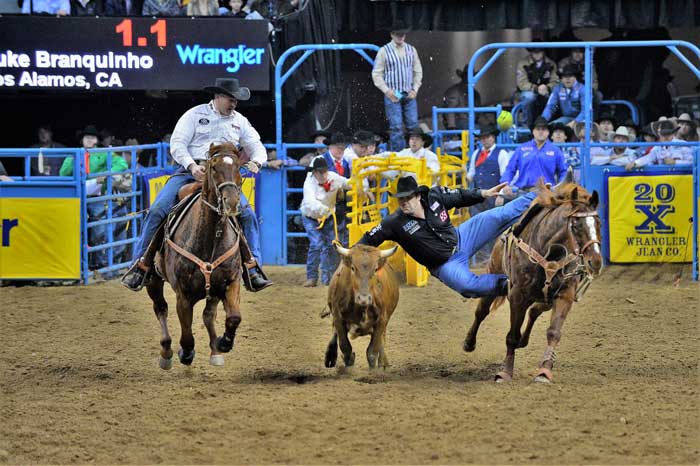
COLORADO SPRINGS, Colo. (March 27) – Steer wrestler Luke Branquinho, a five-time PRCA World Champion, heads up a star-studded 2023 induction class for the ProRodeo Hall of Fame.
Branquinho is joined by two-time PRCA World Champion Saddle Bronc rider Cody Wright (2008 and 2010), World Champion Team Roper Doyle Gellerman (1981), pickup man Kenny Clabaugh, rodeo notables Butch Knowles and Tom Feller and standout bareback horse Night Jacket, rodeo committees from the St. Paul (Ore.) Rodeo and Cowtown Rodeo in Pilesgrove, N.J., and barrel racer Sherry (Combs) Johnson, the 1962 WPRA World Champion and WPRA notable Fay Ann Horton Leach.
The 2023 Ken Stemler Pioneer Award, which recognizes those who have provided groundbreaking, innovative ideas and forward thinking that help the development, advancement, and success of the PRCA and or the Hall of Fame and their missions is being awarded to Bryan McDonald, former bull rider, and National Finals Rodeo judge. His foresight on day money and work with PROCOM have set the industry apart.
“It certainly wasn’t expected that’s for sure,” McDonald said. “It’s a great honor to be in the presence of all those people, knowing what they have contributed and did for the sport throughout the years. It’s pretty heavy company.”
They will be enshrined July 15, during ceremonies at the ProRodeo Hall of Fame in Colorado Springs, Colo.
Branquinho, who won world championships in 2004, 2008, 2011-12 and 2014, is second all-time in ProRodeo Steer Wrestling World Championships behind only Homer Pettigrew, who had six.
“I don’t even know if words can describe it,” Branquinho said when informed of his induction. “A guy starts his rodeo career just wanting to be the best that he can and win a world championship and to win five is pretty special. Then to be able to consider myself as one of the greatest with what you guys are saying being inducted to the Hall, I don’t have words to describe it. Some of my heroes are in there obviously, John W. Jones Jr. and John W. Jones Sr., and a lot of the California cowboys that helped put ProRodeo on the map and to be able to be in that Hall with them is very special.”
Branquinho, who was known for his booty shake, qualified for the Wrangler National Finals Rodeo 14 times – 2001-04, 2006-15 – and won the average three times in 2008, 2011 and 2014. He has the record for most NFR rounds won by a steer wrestler at 25.
Cody Wright comes from the storied Wright family of saddle bronc riders as his brothers Jesse (2012) and Spencer (2014) also won PRCA World Championships as have his sons, Ryder (2017 and 2020) and Stetson (2021). Stetson has won a total of seven world championships – four in all-around (2019-22), two in bull riding (2020 and 2022) and one in saddle bronc riding in 2021.
“Really?” said Cody, when told of his induction. “You didn’t give me much time to come up with any type of emotions, but it is definitely a great honor to be put in there just because of the people who are in there. I really don’t even know what to say. I would definitely say winning my first and second world championships were memorable and winning the second one made the first one that much sweeter to me. Probably more so than me winning world titles was to watch my boys win.”
Cody qualified for the NFR 13 times from 2003-14, and 2016.
In 1981, Gellerman, a header, roping with partner Walt Woodard, won the team roping world championship.
Gellerman qualified for the NFR 25 times, the fifth most by any team roper in PRCA history.
“It means everything to me really, it’s quite an honor,” Gellerman said. “When I started my career, it wasn’t anything I really even thought about. It was one of those things, where if it happened it happened, if it didn’t, I was good with it.
“Winning a world championship was something I wanted since I was a kid. That was one of my goals and I got that accomplished. So, I’d say that was my most memorable moment.”
By nature, Clabaugh wasn’t about the spotlight at all. He didn’t seek attention nor boast about his accomplishments.
However, after being selected as a pickup man for the NFR six times, he didn’t go unnoticed by the ProRodeo Hall of Fame selection committee.
“Oh my gosh, are you serious? This means everything to me, I’m really in shock,” Clabaugh said. “This isn’t even something that I thought would be possible when I was picking up at rodeos. It was quite a life and an enjoyable life that’s for sure. I’m looking forward to getting out to Colorado Springs, but right now I’m still in shock this is happening.”
Knowles made a name for himself as a TV commentator, including countless broadcasts from the NFR. He also qualified for the NFR in saddle bronc riding in 1981, 1983, and 1986-87. He won the NFR average in 1987.
“That’s pretty humbling, holy cow. For a guy that does a lot of talking I don’t have a ton of words to say right now. This is the last thing that I ever thought would happen. It is quite an honor, it’s probably not the place that I feel like I should be. But it’s an honor to be thought of that way, it really is.
“I’ve never ever thought my place would be in the Hall of Fame, I’m just that type of guy. I’ve enjoyed the ride that I’ve had. I look up to all those guys in the Hall of Fame and I think they’ve made incredible marks in the sport of rodeo in their lives.”
Feller is a cowboy through and through. His loyalty to the sport of rodeo and his commitment to ProRodeo programs such as the Justin Sportsmedicine team and the Justin Cowboy Crisis Fund gained him entrance into the Hall.
Feller also was a barrelman at the NFR in 1981 and was an alternate in 1976, 1982, 1985.
“This is mind-boggling,” Feller said. “This is not anything I would have ever thought about. I think the only thing that stands out is the people in the business. They are lifelong friends and people who you can count on.”
Famous “Night Jacket” raised by Jim and Maggie Zinser, who founded J Bar J Rodeo Company, is a horse that will be remembered for decades to come.
Night Jacket competed at every Wrangler National Finals Rodeo as a bareback horse from 2000-2007. During that time, the horse helped six different cowboys reach the pay window in Las Vegas. Even with
Night Jacket’s success inside the arena, the horse may be more known for his star-studded offspring.
Moving from J Bar J to Pickett Pro Rodeo, NFR bucking horses like Fringe Jacket, Straight Jacket, and Night Gazer are direct descendants of Night Jacket. Many more are lighting up the ProRodeo ranks as we speak, carrying on this once in a lifetime horses’ legacy.
“I’m at a loss for words, I really am. I didn’t ever think that would happen in the lifetime that we lived,” Maggie Zinser said.
Jim shared the same sentiments.
“That horse had so many offspring that were buckers throughout their lives. It seemed like every single one of them were 20-to-22-point horses when you would buck them. Over 50 percent of them turned into fantastic horses from Night Jacket.”
Cullen Pickett, who bought Night Jacket in 2009, also praised the horse.
“It means the world to us for sure. Just to be a part of that elite club is truly an hour.”
“The horse was unlike any other as far as that many offspring and colts that have moved on to be great ProRodeo animals. Not to mention he had a great bucking career as well.”
This also was a special honor for the St. Paul Rodeo.
“This is fabulous,” said Kevin Smith, a member of the St. Paul Rodeo committee. “A small town with some serious roots is a good place for rodeo and we have been one of those. Half of our board is grandsons and great grandsons of our rodeo in 1936. This is just a great honor for us to receive.”
Cowtown has had a storied rodeo tradition, but rodeo secretary Betsy Harris, who has been an integral part of the rodeo for decades couldn’t believe the phone call she received on Monday.
“Seriously,” Harris said when told Cowtown Rodeo was Hall of Fame bound. “Oh, my goodness. My husband and I have been doing this for 44 years and we never saw this coming. Our rodeo committee is just four of us, my son-in-law and daughter and my husband Grant and me. We have a huge work force that does work for us and so dedicated and wonderful. I’m really in shock, not the call I was expecting. This is wonderful.”
Johnson will join the Hall of Fame alongside her world champion horse Star Plaudit “Red,” who was inducted in 2017 and her sister Florence Youree, who was inducted as a notable in the 2019 Class.
“I am in shock,” stated Johnson upon learning of her induction into the ProRodeo Hall of Fame. “I knew when Jimmie (Munroe) called me that she wasn’t fibbing, but it is still just so hard to grasp. It is such a blessing to be put in the Hall with my horse Red and my sister. It definitely brings my career around full circle.
Born August 16, 1938, in Duncan, Okla., Johnson has made her home in Addington, Oklahoma. During her career she qualified for 12 National Finals Rodeos, the first coming in 1959 at the first GRA (predecessor to the WPRA) Finals in Clayton, N.M. and the last in 1991 under the bright lights of Las Vegas, a span of four decades (1959-68, 1970, 1991).
She won her first WPRA world title in 1961 in the all-around category, but the highlight of her career would come in 1962 when she won the barrel racing world title aboard Star Plaudit “Red.”
Johnson made her mark in the National High School Association as well, winning the all-around title, barrel racing and breakaway roping titles in 1955.
Johnson gave back to the WPRA, serving on the Board of Directors from 1963-1971, including a stint as the Vice President. She was named Coca-Cola Woman of the Year in 1997 and was inducted into the National Cowboy and Western Heritage Museum in Oklahoma City in 2005.
In July, she will cement her place in ProRodeo history with her induction into the ProRodeo Hall of Fame.
“When I got my card and went to the first NFR in Clayton (N.M.), I would have never dreamt of this day and what the Association has become. It is just truly a great day.”
Horton Leach led the Girls Rodeo Association (GRA-now WPRA) as a founding member, competitor, and board member. One of the 38 women who met in San Angelo, Texas, on February 28, 1948, to form the very first professional sports association created solely for women by women.
“This is quite an honor. I don’t know that I truly deserve it but know it is a big deal,” said Leach, who makes her home in Kilgore, Texas. “We worked very hard in the early years for the Association but never really got to reap the benefits, but they are now. I am so thankful the girls now can expect to make some money as we were lucky to run at $20 day money. I love to see the progress the Association and the sport of rodeo has made.”
Leach never won a world title in the barrel racing, but she qualified for nine consecutive NFRs (1959-1967). She would finish third in the world in 1962 behind Johnson and Bush.
Like many cowgirls during this era, they competed in many different events with calf roping being one of Leach’s favorites. In fact, she broke her mentor’s streak of six consecutive titles in the calf roping when she beat Bush for the world title in 1957. She would add three more of those titles in 1959, 1963 and 1971. She won the all-around in 1960, the flag race world title in 1964 and one that might surprise everyone was her bull riding title in 1966.
In 1967, Fay Ann married Billy Leach, who competed in the RCA roping calves and steer wrestling. Together they founded Billy Leach Ropes.
In 2011, she was inducted into the Texas Rodeo Cowboy Hall of Fame under the category of Trailblazers and now she will be immortalized in the ProRodeo Hall of Fame for her dedication to building a strong foundation for women in rodeo
-
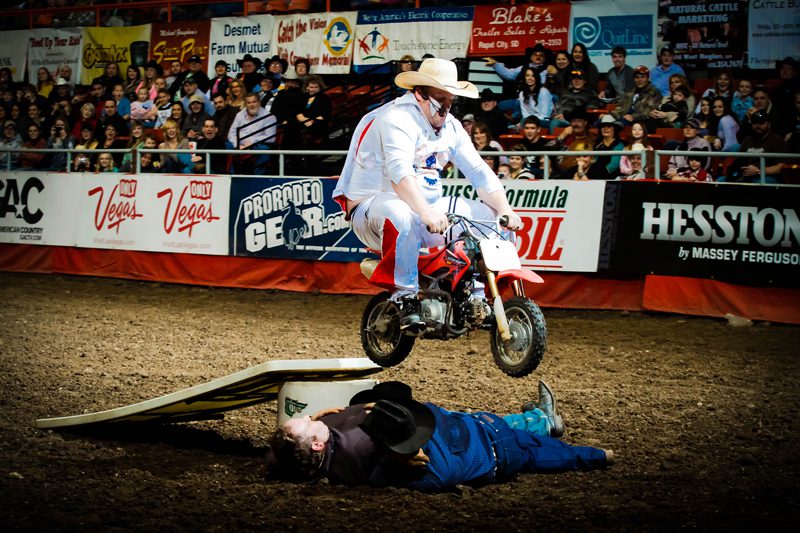
Profile: Justin Rumford
Justin Rumford Discusses The Evolution Of A Rodeo Clown
“Someone told me that rodeo clowns are just cowboys that can’t make it competing. I love being a rodeo clown. It’s my dream job! I win every performance.”
Justin Rumford is a third generation rodeo cowboy. He’s tried many positions in rodeo and finds the one that he enjoys the most – Barrelman & Funnyman.
Justin grew up in Abbyville, Kansas, in a family that put on rodeos – Rumford Rodeo Company. His grandfather started it, and his father followed in it. Today the company is run by his sister, Haley, and her family, under the name Bridwell ProRodeo, out of Red Bluff, California.
Justin rode saddle broncs and steer wrestled and qualified for the High School Finals in both events. He also went to the NIRA Finals, in both events, when he received a rodeo scholarship for Northwestern Oklahoma State University. He graduated with a degree in Agriculture and Business Finance in 2004.
Justin was inspired by Lance Brittain, a PRCA bullfighter, and went to Rex Dunn’s Bullfighting School. He fought bulls, starting in his Senior year of high school, but a bullfighting accident in 2001 at Denver, that punctured his colon made him decide bullfighting was not for him.
He hit the rodeo road hard after college trying to qualify for the PRCA National Finals. He concentrated on his steer wrestling career. He had a friend, Shane Henderson, who bankrolled him for awhile. Justin was riding other people’s horses in steer wrestling, so when he did win money, 25% went to the horse owner. Entry fees were costly. He remembered, “I got to North Platte (NE) and I had $34 in my pocket. I decided I couldn’t go on. I was done!”
Benny Beutler, of Beutler and Son Rodeo, asked Justin why he was so frustrated. When Justin told him about his dilemma Benny offered him a job. “Come work for me and you can still compete.” Justin began driving trucks, hauling horses, for Beutler and Son Rodeo. “I always loved bucking horses and so working for Benny and hauling his horses was a perfect fit for me. I continued to bulldog and I started winning – Phillipsburg (KS), Loveland (CO), and Burwell (NE). In no time I had won $15,000 and I was still working for Benny.”
The Pretty Prairie, (KS) barrelman got word his father had just had a stroke and had to leave the rodeo. Suddenly the rodeo had no barrelman. Someone suggested Justin, to stand in for him, because he was always behind the chutes joking with everyone. Justin agreed and said, “I had fun with the audience – and I got a good check.” Mike Greenleaf, a Kansas amateur stockman, encouraged Justin to become a funnyman. He thought about it and decided to try it. That was 2011.
“ Cervi Rodeo Company offered me 10 rodeos, without even seeing me perform,” Justin said. He also informed other PRCA stock contractors. Justin’s first full year of clowning he had 100 performances and was voted PRCA Clown of the Year.
Lecile Harris, PRCA funnyman, signed Justin’s PRCA card, along with Rob Smets, former bullfighter, and Bob Tallman, rodeo announcer. Justin asked Flint Rasmussen, former rodeo clown, for advice about the profession. Flint’s answer was, “Justin, the best prop you have is the one you put under your hat.” Meaning Justin’s own mind.
His acts were varied. At first he hauled two bucking horses he owned. Justin would harass the bronc riders, until the announcer, would ask him, “Do you think you can do any better?” He was challenged. When Justin rode a bucking horse he always got laughs. When asked if he rode them backwards or did something funny like the clowns did many years ago? Justin said, “No, just a fat dude on a bucking horse was all it took to get laughs.” He also named his Spiderman act, his Gorilla act, and several more acts. He has received the PRCA Clown of the Year honor a total of ten times since becoming a rodeo clown/barrelman.
Justin explained that rodeo has changed so much it’s harder to entertain. He said that former bullfighter/rodeo clown, Ted Kimzey, was his very favorite when he was growing up. When asked why, he said because Ted’s acts were great, and his barrelman toughness. “People don’t realize how hard the knocks are for ‘the man in the can’ when the bull hits the barrel. Ted took some real hard knocks,” explained Justin.
He described the ‘good old days’ the older rodeo fans remember, “A rodeo clown had 10 to 15 minutes to perform an act a couple of times during the rodeo.” And he was right. The rodeo clown also jumped in when a cowboy had to be revived or when something needed to be repaired and entertained the fans. He wandered through the bleachers.
Justin continued to explain, “Today’s rodeo requires an act to be minimized to maybe 3 ½ minutes. I love the older generation, which I respect so much. But in today’s rodeo our responsibilities for entertaining are very different.” He said a daily production meeting before each performance may be pages and pages long, going over the events, and actions by each person that works on the rodeo, whether they are in the arena, in the announcer booth, working the chutes or behind the scenes. Each person’s actions must be accounted for, sometimes down to the minute.”
He explained: “We are paid to do a job. We do what we are asked to do.” He gave an example of what is required. “A PRCA rodeo is required to have one or more ambulance on the grounds with the proper medical team available. If it should happen that the amblance has to leave the grounds, the rodeo is to STOP until the proper medical people can either return or be replaced. I was at a rodeo which had two ambulances, and both had injured guys and had to leave the rodeo grounds. I wear an ear piece that production people can tell me when I need to urgently do something to keep the rodeo going. I jumped into the arena, yelling “Stop the Rodeo” but not to alarm the audience I started joking to keep the audience involved. Once the ambulance returned to the grounds, I got word, through my ear piece, to finish my banter and the rodeo went on.
“A few days later,” said Justin, “ I was told the rodeo company got a scathing letter saying: ‘ The rodeo clown that came in to the arena and stopped the tie down roping, just when Tuf Cooper, a World Champion, was just about to rope his calf. How thoughtless was that rodeo clown to do such a thing. What was the rodeo thinking!!’ I was compelled to contact the person who had sent the letter and explain what the PRCA rules are about the medical team being at the rodeo, and why I did it. Her response was ‘Oh, I didn’t know that.’ ”
Justin went on to explain that because professional rodeo is on television daily, and he worked Denver, Rapid City, San Antonio, and Austin with very few days in between performances he has been on television so much recently. “I have to stay current on what is happening in the world, and what is happening in the community where the rodeo is being held. I do talk a lot about what I learn from current happenings, and I usually throw in fun facts about the city we are in.” You can tell Justin enjoys interacting with the audience, and they it’s obvious the fans have a lot of fun with him.
His rodeo clown heroes from the past, before we had so much television coverage, were only seen when a person went to a rodeo. Today, with the Cowboy Channel playing 750 rodeos a year, he is sometimes on the television screen almost daily. That requires a great deal of variation and patter that the spectators and audience enjoys. It seems to be working very well for Justin. He was quick to say, “We have to adapt or we go away.”
Justin admits most all the rodeo clowns and bullfighters are good friends, and truly band together. They help one another out when ever necessary and enjoy communicating wherever they happen to be. They all have smart phones and it’s easy to keep up with one another, no matter where they are performing.
Justin is a family man. He met Ashley Van Hoesen, at a rodeo. She was Miss Rodeo Oklahoma in 2005. They dated for two years and married in 2007. She graduated with honors in Business from Oklahoma University. She was a registered nurse but put nursing on hold to be able to travel with Justin. She became an integral part of the rodeo business, taking care of all the business end of rodeo. He says Ashley loves rodeo just as much as he does.
In 2013 they were blessed with triplets. Two girls and a boy, named Livi, Lola (after Justin’s grandmother) and Bandy (after Justin’s best friend, Bandy Boswell). The family travels in their RV with Justin, unless school gets in the way. It is evident the family is most important to Justin and often if they aren’t able to travel he’ll slip home, to Ponca City, OK, when he can.
Justin has been picked as the PRCA Clown of the Year ten different years. He has been the Coors Man in the Can three years. He was the PRCA Comedy Act of the Year in 2018. In 2014 he was the barrelman for the PRCA National Finals.
Now during the National Finals he hosts the “Rodeo Vegas” after-rodeo party at the Mirage Hotel & Casino every night. During the day at the Convention Center where the largest Trade Show is held, he has “Rump Chat Live”, on a stage where he and “Hambone” Hilton, rodeo music director, interview cowboys and cowgirls as well as other prominent people. Justin says they have 1.8 million downloads with 138 interviewing episodes. Additionally, Ashley researches and recommends purchasing commercial real estate for a group of six rodeo cowboys as investments – 5 bullfighters/rodeo clowns, and one announcer.
Justin is living his dream job. He enjoys everything he does. His family is totally behind him. The fans are, too. Flint Rasmussen’s advice,”The best prop he has, to be a rodeo clown, is what he puts under his hat – his mind. Justin understands his audience and realizes and accepts the changes that are happening in the world of rodeo. And as Justin says, “If we don’t adapt we go away.” Justin doesn’t plan to go away any time soon. -

5 Star Champion JJ Hampton
A decorated career didn’t make JJ Hampton’s return to the toughest sport on dirt any easier after taking off a year from breakaway roping in the early 2000s. After losing a few good horses, JJ just needed some time at home to regroup. And that she did, because when she started chasing the rodeo trail again, she was as fast as she’d ever been. “Some people don’t understand how important a horse that fits you as a roper is to winning,” said the real estate agent from Stephenville, Texas. “I came back faster than I thought and I started winning in the UPRA and CPRA.” JJ wasn’t competing in the WPRA just yet, but when she came back it would be with a literal and metaphorical fire lit under her rope.
“I had my son [now 13, Kason] in 2009 and I was still winning titles in those associations even while I was pregnant. It took me a few months to get back to feeling good after I had him. Getting back into the groove of going and winning is hard when you’re competing against girls who are going hard every weekend.” While JJ appreciates the increasing interest in her favorite event, it definitely makes her job harder than it’s ever been. “I just had to put in my time knowing I was going to get beat but I had to keep practicing and entering. You have to be willing to grind it out in this sport because it’s hard to beat these girls who are talented and have good horses.”
Along the way, breakaway roping made it’s first appearance at the NFR in 2020. JJ was there alongside 14 other fierce ropers. “Other than barrels, we are the biggest event. We show up and participate. While I appreciate that we can rope at the NFR, I’m not sure how long we can do it for a small fraction of the prize money that the boys go for. We need and deserve to be roping for more.” JJ knows the answer is complex at best, but at the same time she believes that as a group, breakaway ropers have to stick together and stand up for each other in this endeavor. “I think it comes down to needing more sponsors who believe in us, but I don’t have the total answer for that either.” On that same token, it’s the sponsors who have helped keep JJ going when things get tough out on the road. And 5 Star Equine happens to be one of those for her.
“Lari Dee Guy and Hope Thompson both use 5 Star and we rodeo together and so they thought it would be great if I used them too. They both liked how well the pads protected their horses, so I figured why not give them a try.” This was back in 2020 and Lari Dee even called 5 Star on JJ’s behalf about getting her a sponsorship. JJ started out using their fleece pad, but went back to the felt and it’s been a great switch for her horses. “I really love how the pads fit my horse; they do a good job protecting my horses’ back. I use some of their boots too, but they’re pads are my favorite.” Much like her peers, JJ’s never had any issues fitting a saddle to her horses thanks to the 5 Star pads. It doesn’t hurt that they come in favorite color: purple. “It’s the color of royalty and power and it’s been my color for a long time. I really appreciate that this is a family-owned company and they’re great to work with no matter the situation.” -

Back When They Bucked with Bob Wiley
Lots of kids grow up aspiring to be a cowboy or a police officer, but only some accomplish that feat. And even less manage to do both. Bob Wiley is the exception to that rule.
Long before Bob Wiley was able to fulfill his childhood dreams, he was learning fundamental life lessons while running track and playing football for Kingsburg High School in central California. The Fresno County Swedish village is now home to just over 10,000 residents. It was and is a small, quiet town by California standards.
Back in the 1950s, Wiley was a star athlete alongside his classmate Rafer Johnson who would go on to win Olympic gold as a decathlete in 1960. Standing an inch over 6-foot, Wiley was the right hand running back to Johnson’s left when the pair played for the Kingsburg Vikings.
“We won our division in both football and track my senior year,” Wiley said who is now 85 years old and lives just 30 miles down the road from where he was born and raised. “Porterville College had a real strong football program. They recruited me to play for them out of high school. I played football for two years there and that’s where I met my wife, Sonja, because she’s from Porterville.”Cowboy Town
When Porterville College was still trying to entice Wiley to play for them, they had an unknown advantage.
“I went down to Porterville, and discovered it was a Western town,” Wiley said. “People around there had different roping events going on and lots of horse activity. I liked it, so I went to school there.”
The grandson of Swedish immigrants, Wiley grew up on the family farm where he could often be found swamping grapes and peaches. Horses were always part of the landscape, but they certainly weren’t the talented athletes that Wiley would later come to own.
“Some of my earliest memories as a little bitty kid were of my dad and his friends packing into the mountains on horses to go hunting,” he said. “They’d plan for months, and I could hardly wait to go.”
Always interested in horses and roping, Wiley watched people rope any chance he got. At the impressionable age of 15, he was introduced to calf roping for the first time and decided that’s what he wanted to do.
“A friend of mine taught me how to tie and that’s how it really started,” Wiley said. “I bought a horse for $85 and a calf for $15. I didn’t have an arena to rope in, so I just chased that calf around a little pen at home. I essentially taught myself how to rope by doing that.”
High school athletics took a lot of Wiley’s time, but roping was always in the back of his mind. He found his groove in college and rodeo took center stage.A New Cowboy in Town
“When I got out of college I started working right away and I’d practice roping until 9 at night, then go inside to eat, head to bed and do it all over again the next day,” Wiley explained. “Then I’d rope all day on Saturday and Sunday.”
For most of Wiley’s roping career he was working part-time as a deputy in Porterville while traveling the countryside to rodeo.
“I’d practice in the early hours of the morning until about 4 when I’d go home to put on my uniform and go to work,” Wiley said. “I’d come home around 3 and sleep for a few hours before doing it all again. That was usually my schedule Monday through Wednesday and then the rest of the week I was getting ready for a rodeo and traveling.”
“I finally started getting good and winning a little,” Wiley said. “It wasn’t until 1961 that I was good enough to do it full time.”
That same year Wiley qualified for his first National Finals Rodeo in Dallas. They moved to the L.A. Sports Arena the following year before heading to Oklahoma City in 1965. He’d compete in five NFRs in total, all in consecutive years and in all three locations.
In 1963, Wiley was the reserve world champion behind one of the greatest calf ropers of all time, Dean Oliver, who was inducted into the PRCA Hall of Fame in 1979.
There were plenty of times when Wiley was gone for a month or more at a time. Wiley’s wife and kids spent a lot of time on the rodeo trail right alongside him in the first few years.
Their oldest daughter, Andrea, was born in 1959, followed closely by Acia in 1962 and later Robert in 1967. When the kids started school, their time on the road dwindled. Especially in 1963 when Wiley was making his strongest run at the NFR.A Gold Buckle Career
“I got started early that year, probably in March, and I was roping pretty good,” Wiley said. “I had a good horse that year too. It all started in Springville, which was kind of a hometown rodeo for me. I won that and I just kept on winning.”
Wiley headed east for the summer so he could hit some of the biggest venues in pro rodeo: Calgary, Cheyenne, Great Falls, Saint Paul, Burwell, Bozeman, and Billings before heading back west for Salt Lake, Ogden, Eureka and Klamath Falls.
“If you’re going to rodeo and try to win something for the year, you have to go to all the big rodeos,” Wiley said. “When you went like I did in ‘63, it’s hard for little kids to be in the car all the time like I was.”
Even though Wiley loved roping competitively for himself, teaching people the finer details of the event became one of his many passions in life. Throughout the 60s he put on multiple calf roping schools for both tie-down and breakaway roping.
“I had quite a few students over the years, but I never charged more than enough to cover the cost of the calves,” Wiley said. “I was mostly doing it to pass my own time really. I liked teaching them how to do it and it kept me involved in the sport when I wasn’t roping myself.”
In 1965, Wiley made his last run at the finals. He didn’t know it initially, but his life was destined for a career outside the arena.
He started that year out strong and won enough to keep him in the top 15, but he was preoccupied to say the least.A Golden Badge Life
“I got the idea that I wanted to be sheriff and after I announced my candidacy, I campaigned for 22 months,” Wiley said. “I was in full-bore campaign mode, so I wasn’t practicing or competing at all by the fall of ’65.”
Early success in the spring kept Wiley in seventh heading into the finals. He shut the campaign down for a week to compete in Oklahoma City for the first and last time.
“Before the finals my wife and I flew to Amarillo to see my friend Lee Cockrel to ride with him up to the finals,” Wiley said. “Lee took an extra horse for me because I hadn’t ridden my horse in a few months. I won just enough at the finals to pay for the trip there.”
Even though this wouldn’t be Wiley’s last time in the arena, it was his final year as a full-time professional calf roper. As soon as he got back to California, Wiley picked up the campaign trail right where he left it.
In November 1966, Wiley was elected Tulare County Sheriff where he would serve his community for 24 years and win a total of seven elections.
“When I took office in January, I was only 30 years old,” Wiley said. “As a kid, I was always interested in policemen and my family had several law enforcement members that would come and visit us. It was always interesting to me.”
Just like every endeavor before, Wiley put his full weight into being sheriff. He changed the face of the Tulare County Sheriff’s Department, which transcended into revolutionizing jail training programs.A Life of Discipline
When Wiley first decided to throw his hat into the ring for sheriff, the department was doing the bare minimum. Most notably, it wasn’t taking care of its employees the way Wiley thought they should.
“It was one of the lowest paid operations in the state that didn’t offer any overtime pay, no uniform allowances, and no retirement plans,” Wiley said. “It was tough at first, but I had a lot of good ideas. I knew I wanted to work in the schools with the young people to get a handle on the drug problems.”
It all started when Wiley placed deputies in schools and created educational programs to teach kids about the dangers of drug use. They even introduced kids to ammo, grenades and dynamite so they would know what they are and that they shouldn’t mess with them.
It was a novel approach to a rapidly growing problem. First illustrated by his roping schools, Wiley enjoyed teaching people new things and improving efficiency any chance he got.
“Lots of people copied our school educational programs,” Wiley said. “I also developed a jailer training program that was recognized by the Department of Justice. I went to several jail training programs, and their trainers had never worked in jails. I didn’t like that, so my staff and I developed our own program.”
It shouldn’t be surprising that Wiley made his way inside the jail houses and left his mark there as well. He helped remodel some and build a brand new one. In 1987, his work in the county was commemorated in Visalia when the jail was named the Bob Wiley Detention Facility.
Wiley’s time as a sheriff is a testament to his upbringing. The order and efficiency he instilled in his department kept the cogs running smoothly for a long, effective career.
“My mom was real particular about not abusing people; not making fun of anyone for any reason and not making snide remarks,” Wiley said. “There’s a lot of people that make a habit out of pushing people around and whenever I found out about that, I put a stop to it.”
Over his career, Wiley implemented two narcotic units in his department, solved multiple homicide cases, found lost children and was one of the first to have a K-9 unit. By his retirement in 1991, Wiley was the senior officer of the 58 county sheriffs in California.A Cowboy at Heart
Getting back to his cowboy boots and roots, Wiley and his wife traveled the country following the NSPRA schedule for a few years. Even competing in Canada at one point.
“At the time, I didn’t have a great horse to rope on, they had gotten really scarce and thus very expensive,” Wiley said.
Dabbling in roping schools for a few more years helped Wiley pass the time before the turn of the century. By then, roping and riding was becoming increasingly difficult.
“The last time I roped was in 2003 and it hurt to come out of the box and to get off,” Wiley said. “I got crippled in the hips and it made it hard to move the way I needed to for calf roping.”
Even though Wiley officially hung his hat up from roping and teaching almost 20 years ago, rodeo is never far from his mind.
“I was lucky that I won quite a bit of money roping,” Wiley said. “I had a good life, and I was young and sound when I needed to be.” -
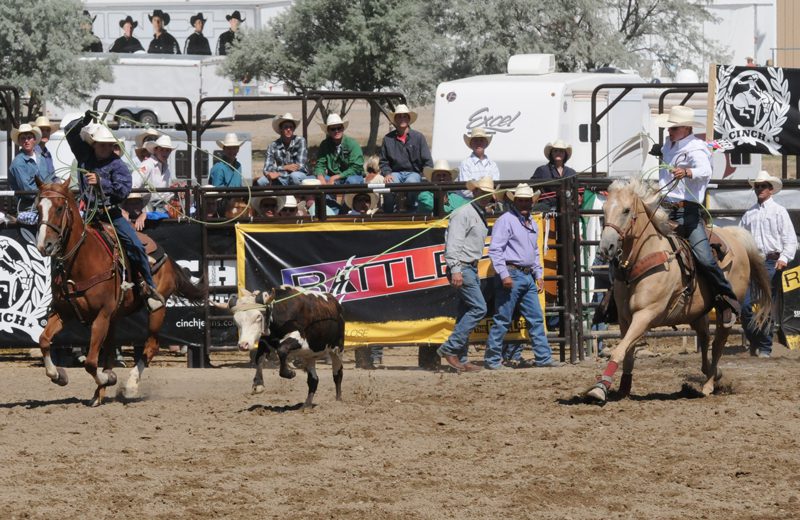
On The Trail with Riley Wakefield
I’ve learned how to win and lose – to deal with adversity – that’s easier said than done. I try to be thankful from the beginning and look failure in the eye.
he first time Riley Wakefield went to the Cinch Timed Event Championships, he and his older brother Brady were star-struck. The next time he attended, 15 years later, he went as a contestant, finishing in fourth place. At the 2023 Cinch TEC, the O’Neill, Neb. cowboy turned in a time of 366 seconds throughout five rounds to finish fourth and win $10,000. After applying for the prestigious event for the past five years, Riley was first on the alternate list this year. He got the call in early February that someone couldn’t make it, and there was a spot for him. He prepared, making four or five runs in each event, every day.
It was in 2008, when Riley was eleven years old, that he and his family, including parents Jim and Susan Wakefield, went to Guthrie’s Lazy E Arena as spectators. “It was a treat,” Riley said. He and Brady saw their heroes among the competitors. “I just remember seeing role models,” he said, “seeing people in places that I wanted to be, people with extreme talent. We had old videotapes of the finals so we knew who guys were, and when they’d walk by us, we’d stare at them. And to see them in person, we were star struck. It was a pretty amazing experience.”
He and Brady, who passed away in a vehicle accident in 2015, got their picture taken with Trevor Brazile.
The CINCH Timed Event Challenge is an invitational event, taking the best twenty cowboys in the world, to compete in five events: steer wrestling, tie-down roping, heading, heeling, and steer roping, in four rounds, with the best fifteen going on to the fifth round. Fastest time in all four events, over five rounds, wins. Riley was leading the average going into the fifth round but a sixty second run in the team roping put him in fourth place for the finish.
A 2020 graduate of Northwestern Oklahoma State in Alva, Riley has been living in Stephenville, Texas. But this winter, he was at home on his parents’ (Jim & Susan) ranch near O’Neill, during what was the worst winter in the last ten years in north-central Nebraska; O’Neill has had 57 inches of snow. The snow and cold weather made everything harder to accomplish. “We had three feet of snow on the ground, and it was an absolute workout to get to the horses. You had to lift each leg through the snow.” All the watering was done by hand, because the tanks would freeze to the bottom by morning. “We hand watered everything,” he said. Riley’s girlfriend Jenna Dallyn helped him, loading cattle, roping with him, until she had to return to High River, Alberta, to work. Then his dad helped. Jim “was out there every day, all day, pushing cattle. When Jenna left, he had to fill in and be the guy to help me. He was a huge part of this.”
Cinch TEC contestants designate “helpers,” who head, heel and haze for them. Cinch TEC contestants cannot head or heel for each other, but they can haze for each other. Riley’s header was CJ DeForest; his heeler was Tanner Braden, and Allen Good was his hazer for three rounds with Mason Couch for the last two rounds. Nerves wore on him for round number one, which showed up in the heading. “That first head loop I threw, it was not a good head loop but a nervous head loop. It was sloppy,” he said. “I was feeling the nerves.” But when the tie-down roping came around, he settled in. “As soon as I tied my first calf, I felt a lot more comfortable. The set-up fit my horse perfectly. He has a lot of run, he’s fairly free, and he doesn’t take my shot away.”
In February, after getting the call that he would be competing at the Cinch TEC, Riley was nervous. The event was so important to him, the concept of being a “true” cowboy and showing skills across four disciplines, had him anxious. So nervous, that he’d never felt this much nerves since he and Brady backed into the box at the 2012 National High School Finals Rodeo, when he was a freshman. The brothers had done some mental training, with one of the pieces of advice being that they should visualize the best thing that could happen and the worst thing that could happen. It worked; he and Brady finished as reserve team roping champions that year.
So Riley applied the same concept to the Cinch TEC. He knew, if he failed, that he’d still have family and friends who still cared about him, and he could still have the chance of being invited to compete at next year’s Cinch TEC. “After I looked failure dead in the eyes,” he said on a Facebook post, “the rest of the Cinch TEC was pretty smooth sailing.”
He grew up on the family ranch south of O’Neill, in the Sandhills of Nebraska, with a dad who was a pro steer wrestler and roper.
When family friends came over to the Wakefields to rope, it was Brady and Riley running the chutes, and looking up with respect to the men who practiced with their dad.
“It was an honor to ride their horses around after practice.”
Like many young cowboys, they fell in love with the sport. Jim and Susan hauled their boys to Little Britches Rodeos and youth events all over the region.
The brothers loved it, Riley said. “We took a liking to it and got small successes along the way, that keep you going, and sooner or later, you get bigger successes, then bigger and bigger, and by that time, we were hooked.”
In junior high, Riley wanted to be a bull rider. He followed the PBR faithfully and got on roping steers at home. But in eighth grade, he realized the timed events were more his thing.
In high school, he qualified for state finals and the National High School Finals all four years, competing at Nationals four times in the team roping and once in the steer wrestling.
In college at Gillette (Wyo.) College, he made it to the College National Finals Rodeo in 2017 in three events, then two years later, won the tie-down in the Central Plains Region while a student at Northwestern Oklahoma State.
Riley rode his horse Gator for the tie-down roping and his horse William for the heeling, borrowing horses for the other three events. Gator has been a long-time project for the cowboy. When Riley’s horse died of colic three years ago, friend Austin Barstow suggested that Riley borrow Gator, who showed potential but was really green. “I knew from the start that Gator had tremendous ability and athleticism,” he said. “But he is extremely playful. He is difficult to catch, he messes around, and he sees how much he can get away with. That’s been the struggle, to get the business attitude out of him.”
At a rodeo in 2021, after Riley roped a calf, Gator misbehaved, stepping away from him as he tried to re-mount. “It took me a full minute to get on him. He was inching away from me in a circle. He wasn’t dragging the calf, but he was moving away.” A few weeks after that, Riley took him to the Badlands Circuit Finals Rodeo, where he worried how the horse would respond to an indoor arena with noise and lots of activity. “I was nervous and had no idea what he would do, but the circuit finals was a turning point. He worked better than he ever had, in a loud and pressure-filled environment.” The twelve-year-old bay has improved. “He’s more business-like now, and I think we’ve both grown up together. I’ve learned how to train one and ride one correctly, and that’s more important than a lot of people understand. A horse is sometimes only as good as his rider.”
For the steer tripping, he rode Todd Eberle’s horse Mississippi, and for the heading, he rode Danielle Wray’s horse, Peanut. Danielle was instrumental in helping him in 2021 when he qualified for the Badlands Circuit Finals Rodeo in three events, and at the Cinch TEC as well. “I couldn’t have done either without her.”
Riley, at age 26, is working at making rodeo his fulltime job. It’s not easy. Last year, he competed across the nation, at times broke and trying to prove himself, not only to the rodeo world, but to himself. “I went through some hard times, really low times,” he said. “I questioned why the heck I was doing this. I have my (college) degree, why am I not at home, working, making for-sure money.” He remembers tough times last summer, traveling in a small trailer with a shower, no bathroom, and two bunk beds, and the time in Caldwell when his traveling partner headed to another rodeo but Riley stayed for the short round. From 6 am, when his buddy got on the road, till 4 pm, when a friend arrived, he sat on the grounds with his lawn chair and phone, while Gator grazed, “taking it all in.”
Rodeoing isn’t cheap, either, with entry fees and fuel bills. “You pull the trigger anyways,” he said. “You can’t be emotional about (spending) the money. You have to trust your talent. If you worry about the money, you’re going to be worried all the time.” During the hard times, he talked to his dad, telling him he was ready to come home. “I remember calling my dad, and he said, ‘you chose to do this, you’re going to stay on the road.”
It can be a game of confidence, Riley said. “When you’re new on the trail, you feel like you have something to prove. You feel like you’re not trying to lose, instead of trying to win, not looking like an idiot, instead of going out there and wining first.
The fourth place finish at the Cinch TEC has boosted his confidence. Now, when backing into the box, “I’m thinking about how fast I can be instead of how not to mess up. I’m thinking of what can go right instead of what can go wrong.”
His parents are behind him one hundred percent. “If I didn’t have my parents helping me out, I would be working a nine-to-five,” he said. “My wins are just as much theirs as they are mine. We’re a team.”
This summer, he will rodeo full time, competing at 80 rodeos, heading to California in April, with a bounce in his step and more confidence under the cowboy hat.
Rodeo hasn’t always come easy to him. “I wasn’t one of those guys that was consistently winning,” he said. “It took some things I needed to work through.”
There were several times he could have quit, but he didn’t. “To me, it’s the fact that I put all the work in and I didn’t want to waste it. I wanted it to pay off somehow.”
“I felt like I could have decided to teach school, forget about rodeo and make some money. I could have, and I’ve had ended up OK. But I had the opportunity (to rodeo) and I have so many people behind me, and it’s what I love to do and what I’ve worked for, so why not let it pay off? And if it doesn’t, that’s fine, but I want to give it the chance.”
His hard work and perseverance is yielding a profit. “I’m so glad it’s paying off now. There’s nothing better than hard work paying off.”
Riley credits his sponsors with helping him stay on the rodeo road. They are Rattler, Wrangler, Wakefield Insurance Agency, Pritchett Twine and Net Wrap, Laursen Chiropractic, Twin Creek Ranches, and Make An Impact.
Cody Doescher won the 2023 Cinch TEC with a time of 312.7 seconds (total on 25 head); Russell Cardoza was second (321.7 seconds); Lane Karney was third (355.3 seconds.)